Liposuction / VASER
Liposuction is one of the most frequently performed cosmetic surgical procedures in the world, used to reshape stubborn fat deposits that resist diet and exercise. It is a body-contouring operation, not a treatment for excess weight. This guide explains how modern techniques such as tumescent liposuction and VASER ultrasound-assisted liposuction work, who is a suitable candidate, what recovery realistically involves, and how to choose a qualified surgeon if you are considering treatment abroad, including in Turkiye.
- Anaesthesia
- Local anaesthesia with sedation, or general anaesthesia, depending on the volume and number of areas treated.
- Duration
- Approximately 1 to 3 hours, depending on the number of areas and the volume of fat removed.
- Recovery
- Light activity within a few days to a week; light exercise around 3 to 4 weeks; strenuous activity around 10 to 12 weeks. Final contour settles over up to 6 months.
- Hospital stay
- A day case or one night: the NHS notes most people stay overnight, and overnight monitoring is recommended for large-volume procedures.
Minimum price, for reference only — the final cost is calculated individually after your records are reviewed. You pay the hospital’s price; our service is free for you.
What liposuction is
Liposuction, also called lipoplasty or simply lipo, is a surgical procedure that removes localised deposits of excess fat from specific areas of the body using a thin hollow tube called a cannula. The American Society of Plastic Surgeons (ASPS) describes it as a way to refine the contour of areas such as the abdomen, hips, thighs and buttocks where diet and exercise alone have not produced the desired shape.
It is important to understand what liposuction is not. Both the ASPS and Cleveland Clinic are explicit that liposuction is not a treatment for obesity and not a substitute for a healthy diet and exercise. It is a body contouring procedure, intended to reshape proportions rather than to reduce overall body weight. The amount of fat removed is modest relative to total body fat, and the procedure does not address loose skin or cellulite on its own.
Liposuction is performed very commonly worldwide. In the ISAPS Global Survey for 2024 it was the second most common surgical cosmetic procedure globally, and it remained the single most common surgical procedure among women.
Who is a candidate
According to the ASPS and Cleveland Clinic, the best candidates are adults who are at or near a stable, healthy weight but have localised fat deposits that resist diet and exercise. Good skin quality matters: firm, elastic skin tends to redrape smoothly over the new contour, whereas thin or lax skin (for example after significant weight loss, pregnancy or ageing) may not reshape as well, and can leave loose or irregular results.
Cleveland Clinic notes that candidates are generally in good overall health, do not smoke, and hold realistic expectations; it also indicates that a body mass index above 25 makes someone a less suitable candidate for purely cosmetic liposuction. Smoking impairs healing and is typically stopped well before and after surgery.
Situations that may make liposuction unsuitable or higher risk include using it as a weight-loss attempt, significant heart or circulatory disease, bleeding or clotting disorders, poorly controlled diabetes, an active infection, pregnancy, and unrealistic expectations of the result. A qualified surgeon screens for these during assessment.
- At or near a stable target weight
- Firm, elastic skin in the treatment area
- Good general health and a non-smoker
- Specific, realistic goals about shape rather than weight
Types and techniques
Several techniques exist, and surgeons often combine them. They differ mainly in how the fat is loosened before it is suctioned out. All still use a cannula and suction to remove the fat.
- Tumescent (fluid-injection) liposuction. A widely used approach. A large volume of dilute solution containing local anaesthetic (lidocaine) and a vasoconstrictor (epinephrine) is infused into the fat. This swells and firms the tissue, numbs the area and reduces bleeding and bruising before the fat is removed.
- Suction-assisted (traditional) liposuction. Fat is loosened with a back-and-forth motion of the cannula and removed by surgical vacuum or syringe.
- Power-assisted liposuction (PAL). A cannula that vibrates rapidly helps break up denser or fibrous fat with less manual effort.
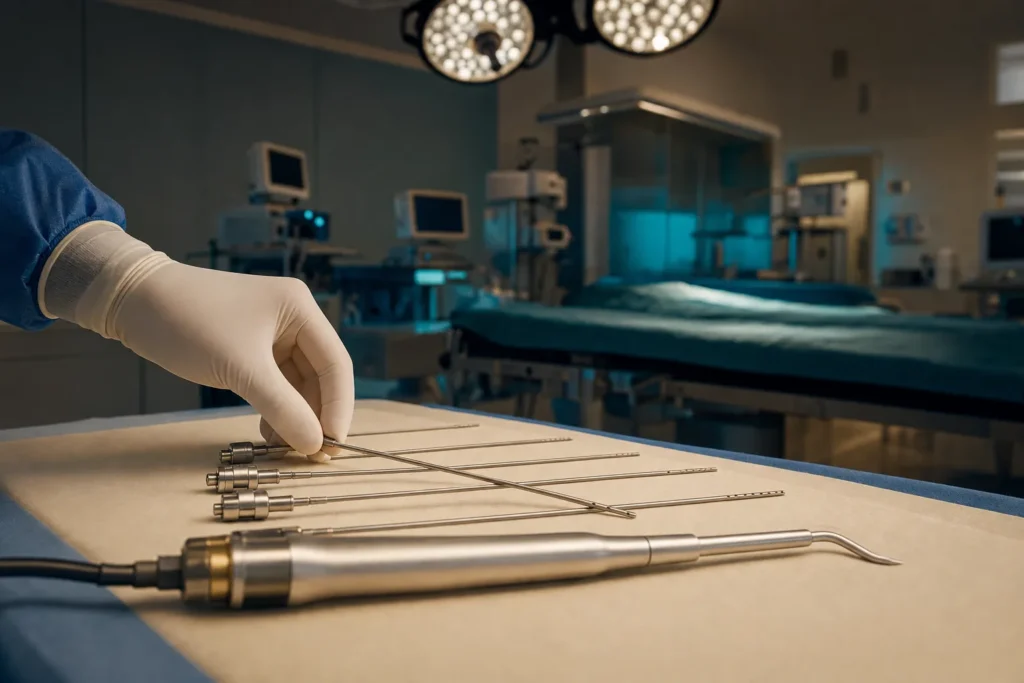
- Ultrasound-assisted liposuction (UAL) and VASER. Ultrasonic energy is used to liquefy or emulsify fat before suction. The ASPS describes the VASER probe as a form of ultrasound-assisted liposuction that delivers ultrasonic energy to disrupt and liquefy fat cells while aiming to preserve surrounding tissue, which can support more detailed sculpting.
- Laser-assisted liposuction. Laser energy is used to break down fat before removal, conceptually similar to UAL.
- Water-assisted liposuction. A pressurised stream of saline loosens fat cells.
High-definition lipo-sculpting is a more advanced application, frequently performed with a VASER probe, that strategically removes fat to highlight underlying muscular contours (for example the abdominal lines). The ASPS describes it as creating a sculpted, athletic appearance; it is technically demanding and is generally discussed in the context of patients seeking a defined, toned result.
How it is performed
Liposuction is performed in an operating facility, with medication given for comfort. The NHS notes that the procedure is usually carried out under general anaesthesia, although an epidural may be used for lower-body areas; smaller, single-area procedures may be done under local (tumescent) anaesthesia with sedation.
The surgeon typically marks the areas to be treated, and small, inconspicuous incisions are made through which the tumescent solution is infused. A cannula is then introduced through the incisions and moved in a controlled back-and-forth motion to loosen fat, which is suctioned out through a vacuum or syringe; with VASER or laser techniques, energy is applied to emulsify the fat first. Excess fluid and blood are drained, and the small incisions are closed and dressed.
The NHS gives a typical duration of 1 to 3 hours depending on how many areas are treated and how much fat is removed. The NHS notes that most people need to stay in hospital overnight, although smaller procedures may be done as day surgery; overnight monitoring is recommended for large-volume procedures.
Recovery timeline
Recovery is gradual, and swelling is the main reason the final result takes months to appear. Individual experiences vary, so the stages below are a general guide drawn from the NHS and Cleveland Clinic.
- First days: bruising, swelling and soreness are expected. A compression garment or elasticated support is fitted; the NHS advises wearing it constantly for several weeks to reduce swelling and help the skin contract. Painkillers and sometimes a short course of antibiotics may be used.
- Week 1: stitches are typically removed after about a week, unless dissolvable stitches are used. Walking and gentle movement are encouraged to lower the risk of blood clots, but strenuous activity is avoided.
- Weeks 3 to 4: light exercise can usually resume. Much of the early bruising fades, though firmness and swelling persist.
- Weeks 6 to 8: numbness in the treated area, common after surgery, generally resolves around this point.
- Weeks 10 to 12: more strenuous activity is usually permitted.
- Up to 6 months: residual swelling settles and the treated area takes on its final shape.
Less invasive tumescent techniques performed under local anaesthesia can allow a quicker return to light activity, sometimes within a few days, but the full settling of the contour still takes months.
Risks and complications
Liposuction is generally regarded as safe when performed appropriately, but it is surgery and carries real risks. The NHS and Cleveland Clinic describe the following.
Common, usually temporary: bruising and swelling (swelling can last up to several months), numbness or altered sensation (often resolving within about 6 to 8 weeks), scars at incision points, inflammation, and some fluid leakage from incisions.
- Contour irregularities: lumpy or uneven results, which may be persistent.
- Persistent numbness or changes in skin sensation, and changes in skin colour.
- Bleeding and infection, and reactions to anaesthesia.
- Serious but uncommon events: blood clots (including in the lungs), fluid in the lungs (pulmonary oedema), and damage to internal structures or organs.
Volume and safety. Removing very large amounts of fat raises risk. Peer-reviewed plastic surgery literature defines large-volume liposuction as a total aspirate exceeding about 5,000 mL (5 litres); it recommends that such cases be performed in an accredited or licensed facility with overnight monitoring of vital signs and urine output, and additional intravenous fluid management. The same literature advises caution about staging procedures or combining large-volume liposuction with other operations.
Results and longevity
Results emerge slowly. As the ASPS and Cleveland Clinic explain, the improved contour becomes apparent once swelling and fluid retention subside, typically over three to six months. The improvement can be long-lasting because, as Cleveland Clinic notes, liposuction permanently removes fat cells from the treated area.
However, this does not make the result immune to weight change. Cleveland Clinic notes that liposuction does not prevent you from gaining weight afterwards, and significant weight gain can alter or diminish the result. Maintaining a stable weight through healthy diet and regular activity is what helps preserve the outcome over time.
Liposuction reshapes fat but does not tighten skin. The ASPS notes that skin which is soft and thin from stretch marks, weight loss or ageing will not reshape as well, and that additional surgery may be needed to remove and tighten extra skin. This is why skin quality is assessed beforehand and why some patients are advised to combine liposuction with a skin-tightening or skin-removal procedure.
Costs
Liposuction pricing varies widely and depends on the number of areas treated, the volume of fat removed, the technique used (VASER and high-definition work are typically more involved), the anaesthesia and facility, and the surgeon's experience. As a broad, indicative guide, prices in many Western European private clinics commonly fall in the region of EUR 2,500 to 7,000 or more for multi-area or advanced procedures.
Publicly reported figures for liposuction in Turkiye are frequently quoted at the lower end of, or below, that range, and packages there often bundle the surgery with hospital monitoring, hotel nights and transfers.
Important: all figures here are indicative ranges for general orientation only. Actual cost varies by case, surgeon and clinic, and these figures are not a quotation. The only reliable price is a written, itemised quote from a clinic after an individual assessment, and you should confirm exactly what is and is not included (anaesthesia, garments, follow-up, and management of any complications).
Why Turkiye, and choosing a qualified surgeon
Turkiye has become a major destination for body-contouring surgery, drawing international patients with lower prices, established private hospitals and all-inclusive packages. Cost should not be the deciding factor; the surgeon's qualifications and the facility's standards matter far more. The same principles apply wherever you choose to be treated.
- Verify the surgeon's credentials. Look for board certification in plastic, reconstructive and aesthetic surgery. Internationally recognised markers include membership of ISAPS (the International Society of Aesthetic Plastic Surgery) and certification by EBOPRAS (the European Board of Plastic, Reconstructive and Aesthetic Surgery). In Turkiye, confirm the surgeon is registered with the national authorities.
- Check the facility. Confirm the hospital or clinic is licensed by the Turkish Ministry of Health, and ideally holds international accreditation such as JCI.
- Confirm who operates. Make sure the certified surgeon you researched is the person who will actually perform your procedure.
- Ask about volume and safety. For larger procedures, confirm that fluid monitoring and overnight observation are available.
- Plan for complications. Understand what happens, and who pays, if a revision or treatment for a complication is needed after you return home.
Preparing and what to ask in consultation
A thorough consultation is the foundation of a good outcome. Expect the surgeon to take a medical history, examine the areas of concern and your skin quality, and discuss realistic goals. You will likely be asked to stop smoking and to avoid certain medications and supplements that increase bleeding risk before surgery.
Useful questions to ask include:
- Are you board-certified, and are you a member of ISAPS or certified by EBOPRAS (or an equivalent national board)?
- Which technique do you recommend for me (for example tumescent or VASER), and why?
- How many areas will be treated, and roughly what volume do you expect to remove?
- Will this be a day case or require an overnight stay, and what anaesthesia will be used?
- Is my skin quality good enough for liposuction alone, or would skin tightening also be advisable?
- What are the realistic limits of what liposuction can achieve in my case?
- What is your approach if the result is uneven or a revision is needed?
Be cautious of anyone promising a specific guaranteed outcome or pressuring you to commit quickly. Honest counselling about limitations is a good sign.
Aftercare, follow-up and travelling for surgery
Aftercare centres on the compression garment, which the NHS advises wearing constantly for several weeks to control swelling and support the tissue; some VASER and high-definition protocols also include post-operative massage. Keep incisions clean as instructed, take prescribed medication, stay well hydrated, and start gentle walking early to reduce the risk of blood clots while avoiding strenuous activity until cleared. Attend all follow-up appointments.
Travelling for surgery adds a specific consideration: flying. Both surgery and prolonged immobility on a flight can raise the risk of blood clots, and the risk is greater after longer or large-volume procedures. Many surgeons therefore advise delaying flights for a period after surgery rather than flying immediately; the appropriate interval depends on the extent of your operation and must be confirmed with your surgeon. If you travel abroad, plan to stay locally for the early recovery and follow-up; packages in destinations such as Turkiye commonly include several nights of clinic and hotel stay for this reason.
When you do fly, sensible general measures to reduce clot risk include wearing compression stockings, moving your legs and walking periodically during the flight, and keeping well hydrated. Always confirm your specific clearance to fly with the operating surgeon.
Frequently asked questions
Is liposuction a way to lose weight?
What is the difference between VASER and standard liposuction?
How much fat can be removed safely?
Does liposuction tighten loose skin?
How long is the recovery?
Are the results permanent?
What are the main risks?
How soon can I fly after liposuction?
What should I check before having liposuction in Turkiye?
Can liposuction treat cellulite?
Will I need to wear a compression garment?
Sources
- American Society of Plastic Surgeons - Liposuction
- American Society of Plastic Surgeons - Liposuction Procedure Steps
- American Society of Plastic Surgeons - High-definition liposuction
- American Society of Plastic Surgeons - Liposuction principles for patient safety
- NHS - Liposuction
- Cleveland Clinic - Liposuction
- Advances in Liposuction: Five Key Principles (PMC, peer-reviewed)
- ISAPS - Global Survey 2024 Full Report
This article is for general information only and is not medical advice. Always consult a qualified doctor about your individual case.
Specialists in Plastic & Aesthetic Surgery
Doctors of the department we work with directly. Which doctor takes your case is decided after the specialists have reviewed your records — your coordinator confirms it, not this page.


Considering this procedure?
Send us your photos and questions. A BergemHealth coordinator and a senior specialist will review your case and reply with honest, personalised guidance — no obligation.
Free consultation