Sleep apnea (OSA)
Obstructive sleep apnea (OSA) is a common, very treatable condition in which the airway briefly narrows or closes during sleep, interrupting breathing. This calm, practical guide explains the signs to look for, how a sleep study confirms the diagnosis, and the full range of treatments, from CPAP and oral devices to surgery, so you can have a confident conversation with a specialist.
What sleep apnea (OSA) is
Sleep apnea is a condition in which your breathing repeatedly stops and starts while you are asleep. The most common form is obstructive sleep apnea (OSA). During sleep the muscles that hold your throat open relax, and the soft tissue at the back of the throat narrows or briefly collapses. Air can no longer flow freely, so breathing pauses for a few seconds before your brain nudges you to wake just enough to reopen the airway, often with a snort or a gasp. These pauses can happen many times an hour, night after night, usually without you remembering them.
Two medical terms describe these events. An apnea (also spelled apnoea) is a near-total stop in airflow. A hypopnea is a shallower, partial reduction in airflow. Both disturb sleep and can briefly lower the oxygen in your blood.
OSA is genuinely common. The World Health Organization-cited estimates referenced by major health bodies suggest roughly one billion adults aged 30 to 69 worldwide have obstructive sleep apnea, although many do not yet know it. The reassuring part is that OSA is one of the more treatable long-term conditions, and most people feel noticeably better once it is managed.
Types and subtypes of sleep apnea
Doctors generally describe three patterns of sleep apnea:
- Obstructive sleep apnea (OSA) is by far the most common. The problem is mechanical: the throat tissues press on the airway during sleep and block airflow, even though the brain is correctly telling the body to breathe.
- Central sleep apnea (CSA) is less common. Here the airway is open, but the brain does not send the right signals to the breathing muscles for short periods. It is more often linked to other conditions, such as certain heart or neurological problems.
- Mixed or complex sleep apnea is a combination of both obstructive and central features.
Severity is described using the apnea-hypopnea index (AHI), the average number of breathing events per hour of sleep. As a general guide used by health services such as the NHS: 5 to 14 events per hour is considered mild, 15 to 30 is moderate, and more than 30 is severe. Your specialist interprets this number alongside your symptoms and oxygen levels rather than treating it as a score in isolation.
Causes and risk factors
OSA happens when the upper airway is prone to narrowing during sleep. Many things can make this more likely, and often several add up together. None of them mean you have done something wrong, they simply help explain why the airway is vulnerable.
Commonly recognised risk factors include:
- Carrying excess weight, which can add soft tissue around the neck and airway. That said, anyone can develop OSA, including people who are slim.
- A larger neck circumference.
- Getting older, as throat muscles tend to relax more.
- Being male, although the risk in women rises after menopause.
- Family history of sleep apnea.
- Enlarged tonsils or adenoids, or a naturally narrow airway or small/recessed jaw.
- Alcohol, sedatives and smoking, which relax or irritate the airway tissues.
- Sleeping on your back, which lets the tongue and soft palate fall backward.
- Certain conditions such as high blood pressure, type 2 diabetes, an underactive thyroid, and chronic lung disease (COPD).
Having one or more of these does not guarantee you have OSA, and it is not a personal failing, it is simply useful information for you and your doctor.
Signs and symptoms, and when to see a doctor
Many symptoms happen during sleep, so a partner is often the first to notice them. Common night-time signs include:
- Loud snoring (though most people who snore do not have sleep apnea).
- Pauses in breathing, followed by gasping, snorting or choking sounds.
- Waking repeatedly, restless sleep, or needing to pass urine at night.
Daytime symptoms are the ones most people actually feel:
- Excessive daytime sleepiness or fatigue, even after a full night in bed.
- Difficulty concentrating, memory lapses, or low mood and irritability.
- Morning headaches and dry mouth.
- Reduced interest in sex.
When to see a doctor: contact your GP or a sleep specialist if you snore loudly and feel tired during the day, or if someone has seen you stop breathing, gasp or choke in your sleep. Seek prompt advice if sleepiness is affecting your driving or your work, because falling asleep at the wheel is a real and serious risk. Persistent loud snoring with daytime tiredness is worth checking even if you feel otherwise well.
Screening and early detection
There is no routine population-wide screening programme for sleep apnea in the way there is for some cancers. Instead, OSA is usually picked up because someone notices symptoms, either you or a bed partner, and raises them with a doctor.
Clinicians often use simple questionnaires to decide who should be tested. The Epworth Sleepiness Scale asks how likely you are to doze off in everyday situations, and the STOP-Bang questionnaire asks about snoring, tiredness, observed breathing pauses, blood pressure, body mass index, age, neck size and sex. These tools do not diagnose OSA on their own, but they help flag who is likely to benefit from a formal sleep study.
Because untreated OSA is linked with conditions such as high blood pressure, it is reasonable to mention snoring and daytime sleepiness during routine check-ups, particularly if you also have heart disease, type 2 diabetes or hard-to-control blood pressure.
How sleep apnea is diagnosed
Diagnosis starts with a conversation and examination. Your doctor will ask about your symptoms, your sleep, your medical and family history, and may examine your nose, mouth and throat. A sleep diary or input from your partner is very helpful.
The diagnosis is confirmed with a sleep study, which records what happens to your breathing overnight. There are two main types:
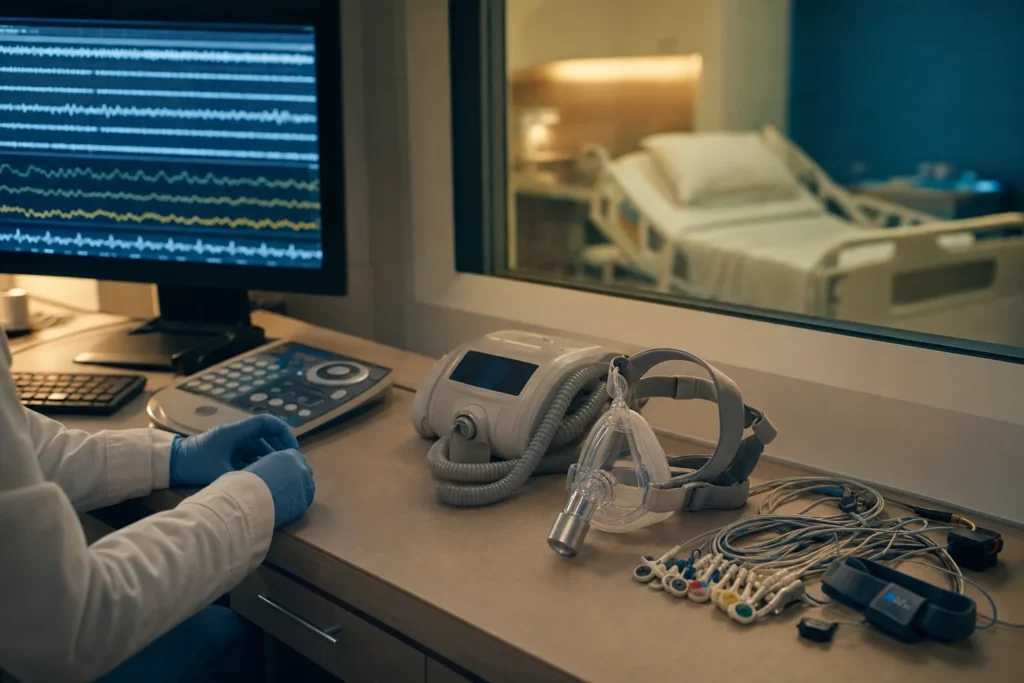
- Polysomnography is the more detailed, hospital- or clinic-based study. Sensors record your brain waves, breathing, airflow, blood oxygen level, heart rate, and body and limb movements while you sleep.
- A home sleep apnea test uses a smaller, portable kit you wear at home for a night. It is convenient and well suited to confirming suspected obstructive sleep apnea, though it does not capture everything a full in-lab study does and is not used to diagnose central sleep apnea.
The results give your AHI (the number of breathing events per hour) and show how much your oxygen levels dipped. Together these define whether OSA is mild, moderate or severe, which guides treatment. Your doctor may also check for related issues, for example a blood test for thyroid function, since these can contribute to symptoms.
Treatment options
Treatment is tailored to how severe your OSA is, what is driving it, and what fits your life. Care is often shared by a multidisciplinary team, which may include a sleep physician, an ear, nose and throat (ENT) surgeon, a respiratory specialist, a dentist with sleep training, a dietitian, and sometimes a cardiologist. The aim is to keep your airway open through the night, restore restful sleep and lower long-term health risks.
Lifestyle and self-help measures are a foundation for almost everyone: reaching and keeping a healthy weight, regular physical activity, reducing or avoiding alcohol (especially in the evening), stopping smoking, and treating nasal congestion. Positional therapy, simply learning to sleep on your side rather than your back, helps some people whose apnea is worse lying flat.
Positive airway pressure (PAP) devices are the most common and effective treatment, particularly for moderate to severe OSA. A quiet machine gently blows air through a mask to splint the airway open. CPAP delivers one steady pressure; APAP adjusts pressure automatically through the night; and BiPAP uses different pressures for breathing in and out. They work very well when used consistently, and comfort tips and follow-up help most people adjust.
Oral appliances, fitted by a suitably trained dentist, are mouthpieces worn at night. A mandibular advancement device holds the lower jaw slightly forward to keep the airway open. These are a good option for mild to moderate OSA, or for people who cannot get on with CPAP.
Surgical and procedural options may help selected people, especially where there is a clear anatomical cause. These include removing enlarged tonsils or adenoids, nasal surgery (such as straightening a deviated septum), uvulopalatopharyngoplasty (UPPP) to remove or reshape soft tissue at the back of the throat, and jaw advancement (maxillomandibular advancement) surgery for certain jaw structures. Hypoglossal nerve stimulation is an implanted device that gently activates the tongue muscle during sleep to keep the airway open, offered to specific patients who cannot tolerate CPAP. Weight-loss (bariatric) surgery may be considered when obesity is a major factor.
Medication: in December 2024 the US FDA approved tirzepatide (Zepbound), an injectable weight-management medicine, for adults who have moderate-to-severe OSA together with obesity, used alongside a reduced-calorie diet and more activity. It works by reducing weight rather than directly on the airway, and is not a treatment for everyone, so suitability is a decision for your specialist.
Outlook: what to expect
The outlook for obstructive sleep apnea is generally encouraging. While there is no single universal cure, OSA can usually be controlled well, and for some people weight loss or surgery resolves it. With consistent treatment, most people notice they sleep more soundly, feel far less tired during the day, think more clearly and feel better in their mood, often within weeks.
Treating OSA also matters for long-term health. Authoritative bodies note that untreated sleep apnea is associated with higher risks of high blood pressure, heart rhythm problems such as atrial fibrillation, heart disease, stroke and type 2 diabetes, as well as accidents caused by sleepiness. These are population-level associations, not a prediction for any one person, and effective treatment is specifically aimed at reducing these risks and improving quality of life.
Your own outlook depends on the severity of your OSA, other health conditions, and how well a chosen treatment suits you. A specialist can talk you through what is realistic in your situation.
Living with sleep apnea and follow-up
OSA is usually a long-term condition that is managed rather than cured overnight, and day-to-day habits make a real difference. Using your CPAP or oral appliance every night, including naps, gives the best results, and modern devices are quieter and more comfortable than older models. If a mask feels awkward at first, your clinic can adjust the fit, the pressure or the mask style rather than you giving up.
Helpful everyday steps include keeping a regular sleep schedule, maintaining a healthy weight, staying active, limiting alcohol near bedtime, and treating nasal stuffiness. Sleeping on your side can also help.
Follow-up is part of good care. Many CPAP machines record how many hours you use them and how well your breathing events are controlled, and your team reviews this to fine-tune therapy. Expect periodic check-ins, and tell your doctor if you remain sleepy despite treatment, if your weight changes significantly, or if symptoms return. If you drive, be aware that many countries have specific rules about sleepiness and OSA; ask your clinician how local regulations apply to you.
Planning treatment abroad: what affects cost and how to prepare your records
If you are considering arranging diagnosis or treatment for sleep apnea abroad, it helps to understand what shapes the overall cost rather than focusing on a single headline figure. Because we do not quote prices here, the most useful thing is to know the factors so you can request an accurate, personalised estimate.
Costs are typically influenced by:
- The pathway you need, for example a home sleep test versus a full in-lab polysomnography study, and whether you need a new diagnosis or a review of an existing one.
- The treatment chosen, since a CPAP setup, a custom oral appliance, and surgery each involve very different resources.
- If surgery is recommended, the specific procedure, the type of anaesthesia, the length of any hospital stay, and the surgical team involved.
- Pre-operative tests and specialist consultations, and any follow-up or device adjustments.
- Travel-related items such as accommodation, transfers, interpreter support and the length of your stay.
To prepare, gather your medical records: any previous sleep study results and AHI, a list of current medicines, relevant heart, blood pressure or diabetes history, and reports from any ENT or dental assessments. Having these ready lets a specialist review your case properly and give you a tailored plan and estimate. You are welcome to request a free consultation to discuss your situation and receive a personalised quotation.
Why Turkiye, and how to choose a good centre
Turkiye (Turkey) has become a well-known destination for medical travel, with many hospitals experienced in caring for international patients, English-speaking coordinators and modern sleep-medicine and ENT facilities. As with anywhere, the quality of individual centres varies, so it is worth doing some checks before you commit.
Things sensible to verify:
- Accreditation. Look for hospitals accredited by Joint Commission International (JCI), a respected international standard for quality and patient safety; you can confirm a hospital's status on the accrediting body's own listings. Turkiye has a number of JCI-accredited hospitals.
- The specialist team. Check that a qualified sleep physician and ENT surgeon will be involved, and ask about their experience with the specific treatment you need.
- A proper diagnostic pathway. A reputable centre will base treatment on a sleep study and a full assessment, not offer surgery without it.
- Clear, written information about the plan, the risks and benefits, and aftercare, plus how follow-up and any device support will work once you return home.
- Realistic communication. Be cautious of anyone promising a guaranteed cure or using superlative claims; good clinicians talk in terms of likely benefits and honest expectations.
A concierge service can help you compare accredited centres, organise records and arrange logistics, while leaving the clinical decisions to qualified specialists.
Prevention and self-care
You cannot change some risk factors, such as your age, sex, family history or natural airway shape. But several everyday measures can reduce your risk of developing OSA or help keep it under control alongside any medical treatment:
- Aim for a healthy weight. For people carrying excess weight, even a modest, sustained reduction can meaningfully ease OSA.
- Stay physically active, which supports weight management and sleep quality.
- Limit alcohol, particularly in the hours before bed, and avoid sedatives unless prescribed.
- Stop smoking, which reduces airway irritation and inflammation.
- Try side-sleeping if your symptoms are worse on your back.
- Treat nasal congestion and keep a consistent sleep routine.
Most importantly, do not ignore loud snoring with daytime tiredness or witnessed pauses in breathing. OSA is common, manageable and worth checking. If you are unsure, a second opinion from a qualified sleep specialist is always reasonable, especially before agreeing to surgery.
Frequently asked questions
What is the difference between snoring and sleep apnea?
How do I know if I have obstructive sleep apnea?
Is sleep apnea dangerous?
What is the AHI and what do the numbers mean?
Can sleep apnea be cured, or only managed?
Is CPAP the only treatment?
What happens during a sleep study?
Is surgery always needed for sleep apnea?
Does losing weight help sleep apnea?
Can I drive if I have sleep apnea?
Should I get a second opinion before treatment abroad?
This article is for general information only and is not medical advice. Always consult a qualified doctor about your individual case.
Considering this procedure?
Send us your photos and questions. A BergemHealth coordinator and a department-head specialist will review your case and reply with honest, personalised guidance — no obligation.
Free consultation