Voice & swallowing disorders
Your voice and your ability to swallow rely on the same small, busy part of the body — the throat and voice box. When something goes wrong, it can affect how you sound, how you eat, and how confident you feel in everyday life. This guide explains voice and swallowing disorders in clear, everyday language: what they are, why they happen, how doctors find the cause, and the treatments that can help.
What voice and swallowing disorders are
Your throat does two important jobs that often overlap. It produces your voice, and it moves food and drink safely from your mouth into your stomach when you swallow. Both jobs happen in and around the larynx (the voice box) — a small structure in your neck that holds your vocal cords (also called vocal folds). These are two bands of tissue that vibrate to make sound and close to protect your airway when you swallow.
A voice disorder means your voice does not work the way it normally does. Doctors call this dysphonia (dis-FOH-nee-uh). Your voice might sound hoarse, raspy, breathy, strained, weak, or it might tire quickly or disappear. Hoarseness is very common — Cleveland Clinic notes that about one in three people experience it at some point in their lives.
A swallowing disorder means it is hard or uncomfortable to swallow. The medical word is dysphagia (dis-FAY-juh). You might feel food sticking, cough or choke when eating or drinking, or notice it takes real effort to get a meal down.
These two problems are grouped together because they share the same anatomy and are often handled by the same specialists. Many people have one without the other, but some conditions — such as a stroke, a growth in the throat, or a nerve problem — can affect both at once. The encouraging news is that most voice problems can be improved by treating the underlying cause, and many swallowing problems can be managed well with the right plan.
Types and subtypes
It helps to think of these as two families of problems that sometimes overlap.
Voice disorders (dysphonia)
- Laryngitis — swelling of the voice box, usually from a cold, overuse, or irritation. It is often short-lived.
- Benign vocal cord growths — non-cancerous lumps such as nodules (small calluses from voice overuse, common in teachers and singers), polyps (which can appear after a single episode of vocal strain), and cysts (fluid-filled sacs).
- Vocal cord paralysis or weakness — when a nerve that moves a vocal cord stops working properly, the voice may sound breathy or weak.
- Muscle tension dysphonia — the voice muscles work too hard, often from stress or strain.
- Age-related voice change — the vocal cords can thin with age, making the voice softer or shakier.
- Laryngeal cancer — an uncommon but important cause that needs prompt evaluation.
Swallowing disorders (dysphagia)
- Oropharyngeal dysphagia — trouble starting a swallow, in the mouth or upper throat. It is often linked to nerve or muscle problems, such as after a stroke.
- Esophageal dysphagia — a feeling that food sticks or stops in the chest, caused by problems lower down in the food pipe (the esophagus), such as narrowing or a muscle disorder.
Causes and risk factors
Voice and swallowing problems are symptoms, not diseases in themselves, so there are many possible causes. According to the National Institute on Deafness and Other Communication Disorders (NIDCD) and the NHS, common contributors include:
For the voice
- Infections and irritation — colds, throat infections, and allergies.
- Voice overuse or misuse — shouting, prolonged talking, or singing without rest.
- Acid reflux (GERD) — stomach acid rising and irritating the throat.
- Smoking — a major irritant and an important risk factor for laryngeal cancer.
- Growths on the vocal cords and, less commonly, cancer.
- Neurological conditions that affect nerve or muscle control.
For swallowing
- Neurological conditions — stroke, Parkinson's disease, multiple sclerosis, ALS, and dementia.
- Head and neck problems — cancers, surgery in the area, or poorly fitting dentures.
- Conditions of the food pipe — narrowing, inflammation from reflux, or muscle disorders.
- Some medications that cause dry mouth or affect muscle control.
- Ageing, which can gradually weaken the muscles used to swallow.
Risk factors that apply to both include smoking, heavy alcohol use, untreated acid reflux, and certain long-term medical conditions. Having a risk factor does not mean you will develop a problem — it simply raises the chance, which is why prevention and early review matter.
Signs and symptoms (and when to see a doctor)
Symptoms vary with the cause, but common ones are easy to recognise.
Voice symptoms
- A hoarse, raspy, breathy, or strained voice
- A voice that tires quickly or fades by the end of the day
- Changes in pitch or sudden deepening of the voice
- Frequent throat clearing or a raw, dry throat
- Losing your voice completely
Swallowing symptoms
- Coughing or choking while eating or drinking
- A feeling that food is stuck in the throat or chest
- A wet or gurgly-sounding voice after eating
- Drooling, or food coming back up
- Unexplained weight loss or repeated chest infections over time
When to see a doctor
Most short-lived hoarseness from a cold settles on its own. The NHS and Cleveland Clinic advise seeing a doctor if hoarseness lasts more than three weeks, or sooner if it comes with pain, difficulty breathing or swallowing, coughing up blood, a lump in the neck, or complete loss of voice. For swallowing, the NHS advises contacting a doctor if you regularly have difficulty swallowing, keep choking, feel food is stuck, or become short of breath after eating or drinking. Seek urgent help if a piece of food is fully stuck and you cannot breathe. These warnings are not meant to frighten you — most causes turn out to be treatable — but prompt review helps rule out serious problems and gets you the right help faster.
Screening and early detection
There is no routine population-wide screening test for voice or swallowing disorders, the way there is for some cancers. Instead, early detection relies on noticing symptoms and acting on them, and on doctors paying attention to risk factors.
The most useful early step is simple: take a persistent change seriously. A hoarse voice that lasts more than three weeks, or new difficulty swallowing, deserves a professional look — even if it seems minor. This is especially true for people who smoke or drink heavily, because they have a higher risk of laryngeal and throat cancers, and early evaluation gives the best chance to find and treat any problem while it is small.
For people with conditions that affect swallowing — such as after a stroke, or with Parkinson's disease — clinicians often do a swallow assessment as a precaution, because catching dysphagia early helps prevent complications like chest infections and poor nutrition. If you care for someone in one of these groups, mention any coughing at meals or wet-sounding voice to their medical team.
How it is diagnosed
Diagnosis starts with a conversation and an examination. A doctor — usually a primary care doctor first, then an otolaryngologist (an ear, nose and throat, or ENT, specialist) — will ask about your symptoms, how long they have lasted, your habits (such as smoking and voice use), and your general health.
Looking at the voice box
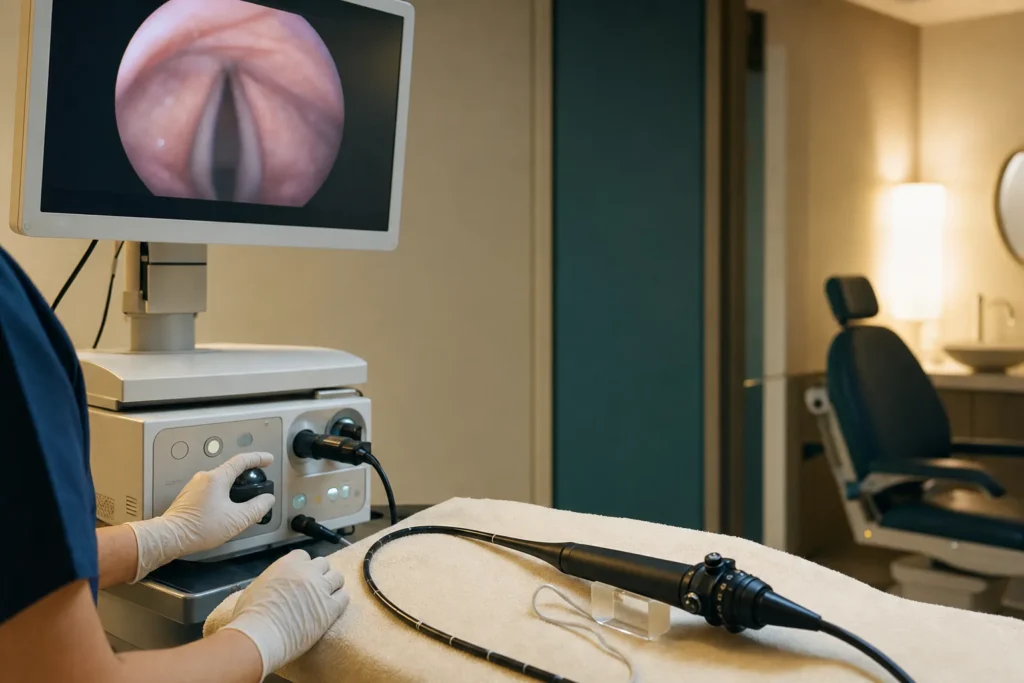
- Laryngoscopy — a thin, flexible tube with a camera, passed gently through the nose or mouth, lets the doctor see the vocal cords directly.
- Videostroboscopy — a special flashing light shows the vocal cords vibrating in slow motion, which helps spot subtle problems.
Assessing swallowing
Swallowing is often evaluated by a speech-language pathologist (a therapist who specialises in voice and swallowing), who watches you eat and drink and checks the muscles involved. Two common tests, described by the American Speech-Language-Hearing Association (ASHA), are:
- Modified barium swallow (MBS) — you eat or drink food mixed with barium, a substance that shows up on X-ray, so the team can watch your swallow on a moving image.
- Endoscopic assessment (FEES) — a small camera passed through the nose shows how the throat handles food and liquid.
Other tests may include a manometry study (which measures pressure in the food pipe), an endoscopy of the food pipe, or imaging such as a CT or MRI scan if the doctor needs a fuller picture. If a growth is found, a small sample (a biopsy) may be taken so it can be examined under a microscope. The aim of all this is simple: to find the exact cause so the treatment can be matched to it.
Treatment options
Treatment depends entirely on the cause, and many people improve without surgery. Care is usually delivered by a multidisciplinary team — an ENT specialist, a speech-language pathologist, and, depending on the situation, a dietitian, a gastroenterologist (digestive specialist), a neurologist, or a surgeon.
Behavioural and therapy-based care
- Voice therapy — guided exercises with a speech-language pathologist to use the voice more safely, reduce strain, and let the vocal cords heal. This is the mainstay for many voice problems and often resolves nodules without surgery.
- Swallowing therapy — exercises to strengthen the swallowing muscles, plus techniques and postures that make swallowing safer.
- Voice rest and lifestyle changes — resting the voice, stopping smoking, treating reflux, and staying well hydrated.
Medical treatment
- Treating the underlying cause — for example, medication for acid reflux or for an infection.
- Botulinum toxin (Botox) injections for certain voice or swallowing muscle disorders.
Procedures and surgery
- Phonomicrosurgery — delicate, precise surgery to remove benign vocal cord growths such as polyps or cysts when therapy alone is not enough.
- Procedures to support a weak vocal cord in cases of vocal cord paralysis.
- Widening (dilation) of a narrowed food pipe for some types of swallowing difficulty.
- Feeding support, such as modified diets, thickened drinks, or, in severe cases, a feeding tube to maintain nutrition.
- For cancer, treatment is planned by a cancer team and may combine surgery, radiotherapy, and other therapies.
Outlook: what to expect
The outlook is generally reassuring, though it depends on the specific cause. The NIDCD notes that most voice problems can be reversed by treating the underlying cause or through behavioural and surgical treatments. For benign vocal cord nodules, Cleveland Clinic notes that most improve within about two to six months with conservative treatment such as voice therapy.
Swallowing disorders also often improve with the right plan, especially when an underlying condition is treated and a speech-language pathologist guides rehabilitation. When dysphagia is part of a long-term neurological condition, the goal is often to swallow as safely and comfortably as possible and to protect nutrition and the airway, rather than a complete cure.
It is important to be honest about uncertainty: outcomes vary from person to person, and no article can predict your individual result. Any figures here describe groups of people, not a forecast for you. What helps most is getting an accurate diagnosis early and following the agreed treatment plan. If a serious cause such as cancer is found, a specialist team will explain the outlook in your specific situation, based on the type and stage — and these conversations are best had directly with the clinicians who know your case.
Living with it and follow-up
Living well with a voice or swallowing disorder is very achievable, especially with the right support and habits.
For voice problems, day-to-day care makes a real difference. The NIDCD suggests staying well hydrated, avoiding smoking, not speaking or singing when your voice is hoarse or tired, using good breathing technique, and using a microphone in noisy settings rather than straining. Treating reflux and limiting throat-drying habits also helps.
For swallowing problems, follow the plan your team gives you. This may include eating softer foods, thickening drinks, taking smaller bites, eating slowly, sitting upright at meals, and doing your swallowing exercises regularly. Family members can play a big role by helping prepare safe meals and supporting home exercises.
Follow-up matters. Many conditions need a review to confirm improvement, adjust therapy, or check that a treated growth has not returned. If your symptoms change — for example, swallowing becomes harder, or your voice changes again — let your team know promptly rather than waiting for the next scheduled visit. Ongoing care is a normal part of recovery, not a sign that something has gone wrong.
Planning treatment abroad: what affects cost and how to prepare your records
If you are considering having tests or treatment in another country, a little preparation makes the process smoother and the cost clearer. Voice and swallowing care covers a wide range — from a single diagnostic examination to voice therapy sessions to delicate surgery — so there is no one figure that fits everyone.
Factors that affect cost typically include:
- The exact diagnosis and how complex your case is.
- Which tests are needed (for example, laparoscopy of the voice box, videostroboscopy, a barium swallow, manometry, or scans).
- Whether treatment is therapy-based, a minor procedure, or surgery requiring an operating theatre.
- The number of voice or swallowing therapy sessions recommended.
- Whether you need follow-up appointments or rehabilitation.
Because these vary so much, we do not list prices here. Instead, the most reliable approach is to share your information and request a personalised estimate through a free consultation, so the quote reflects your actual needs.
To prepare your records, gather: a summary of your symptoms and how long you have had them; any previous diagnoses, scan images, or test results; reports from any laryngoscopy or swallow studies; a list of your current medications; and details of relevant medical history such as reflux, smoking, or neurological conditions. Translated copies are useful. The more complete your records, the more accurate the assessment and estimate will be.
Why Turkiye, and how to choose a good centre
Turkiye has become a well-known destination for medical care, including ear, nose and throat services, because it combines experienced specialists, modern hospitals, and the convenience of arranging diagnosis and treatment in one trip. As a concierge service, BergemHealth helps you organise consultations, tests, and treatment, and coordinate travel and translation.
Rather than relying on labels, focus on what you can verify. When choosing a centre for voice or swallowing care, it is sensible to check:
- Accreditation — look for recognised hospital accreditation, such as Joint Commission International (JCI), and appropriate national licensing.
- A genuine multidisciplinary team — voice and swallowing care works best when an ENT specialist, a speech-language pathologist, and, where needed, a gastroenterologist or neurologist work together.
- The right diagnostic equipment — for example, the ability to perform videostroboscopy and instrumental swallow assessments such as FEES or a modified barium swallow.
- Specialist experience with your specific condition, including access to phonomicrosurgery if a procedure may be needed.
- Clear communication — a written plan, interpreter support, and a named contact for follow-up questions.
It is always reasonable to ask about a doctor's qualifications and experience, to request your records and reports in writing, and to seek a second opinion before agreeing to surgery. A good centre will welcome these questions.
Prevention and self-care
You cannot prevent every voice or swallowing problem, but everyday habits can lower your risk and protect your throat. The NIDCD's voice-health guidance and the NHS both point to the same practical steps.
Protecting your voice
- Stay well hydrated and consider a humidifier in dry indoor air.
- Do not smoke, and avoid breathing in others' smoke.
- Rest your voice when it is hoarse or tired, and avoid shouting or prolonged loud talking.
- Use a microphone in noisy rooms instead of straining, and avoid cradling the phone against your shoulder.
- Manage acid reflux, including avoiding spicy foods that trigger it for you, and limit alcohol.
Protecting safe swallowing
- Eat slowly, take smaller bites, and sit upright while eating.
- Keep good oral and dental health, and make sure dentures fit well.
- If you have a condition that affects swallowing, follow your team's diet advice and exercises.
Above all, treat persistent changes seriously. A hoarse voice lasting more than three weeks, or new difficulty swallowing, is worth a professional review — not because the cause is usually serious, but because early answers bring peace of mind and the best chance of a simple solution. If you are unsure where to start, a consultation with a qualified ENT specialist is the right first step.
Frequently asked questions
What is the difference between a voice disorder and a swallowing disorder?
When should I worry about a hoarse voice?
What causes difficulty swallowing?
Who treats voice and swallowing disorders?
How are these conditions diagnosed?
Do voice problems always need surgery?
Can swallowing problems be cured?
Is hoarseness a sign of cancer?
How can I protect my voice?
How do I get a price estimate for treatment in Turkiye?
What records should I bring or send before a consultation?
This article is for general information only and is not medical advice. Always consult a qualified doctor about your individual case.
Considering this procedure?
Send us your photos and questions. A BergemHealth coordinator and a department-head specialist will review your case and reply with honest, personalised guidance — no obligation.
Free consultation