Scar & burn hair restoration
A scar that won't grow hair, whether from a burn, an accident, or old surgery, can feel impossible to hide. Modern hair restoration can place living follicles into scar tissue and coax it to grow again. This guide explains, in plain language, how it works, who it suits, what it costs, and how to choose a clinic you can trust.
- Anaesthesia
- Local anaesthetic, sometimes with mild sedation; you stay awake and pain-free.
- Duration
- Around 2 to 8 hours per session, depending on the number of grafts and scar size.
- Recovery
- Back to light activity in a few days; 1 to 2 weeks off work; full results in 10 to 18 months.
- Hospital stay
- Day case, no overnight stay; usually 2 to 4 days in Turkey for consultation and a check-up.
Minimum price, for reference only — the final cost is calculated individually after your records are reviewed. You pay the hospital’s price; our service is free for you.
What scar and burn hair restoration is
Scar and burn hair restoration is a type of hair transplant done on skin that no longer grows hair because it was injured. The damage might come from a burn, a deep cut or accident, an old operation (for example a facelift, a brain or skull operation, or a previous hair-transplant strip scar), radiotherapy, or a skin infection.
When skin heals from a serious injury, the body fills the gap with scar tissue. Scar tissue is tougher and less stretchy than normal skin, and crucially it usually has no working hair follicles left, the tiny pockets in the skin from which each hair grows. That is why scars stay smooth and bare.
A transplant cannot wake up follicles that are gone. Instead, the surgeon takes healthy follicles from an area where your hair grows well, usually the back and sides of the scalp (the donor area), and moves them one small graft at a time into the scar (the recipient area). If the grafts take, they grow real, permanent hair in a place that was bare. The same approach can rebuild eyebrows, a beard, or a moustache lost to a scar.
The big difference from a routine cosmetic hair transplant is the ground the surgeon is planting into. Scar tissue is harder to work with, so the techniques, expectations, and timeline are all adjusted, as we explain below.
Who is a good candidate, and who should wait or avoid it
Good candidates usually share a few things. The scar comes from a one-off injury that has fully healed and is now stable, soft and pale, the underlying cause is no longer active, and there is enough healthy donor hair elsewhere to harvest. Restoration tends to work better for so-called secondary scarring, meaning a scar from a burn, trauma, surgery or infection, than for primary scarring conditions where the body keeps attacking its own follicles.
Two points about timing matter a great deal:
- The scar must be mature. Surgeons generally want a scar that is as pale, flat, soft and supple as it is going to get. A young, pink, raised scar bleeds during the procedure, and that bleeding can push freshly placed grafts back out.
- Any active disease must be quiet. If the hair loss comes from a scarring skin condition such as lichen planopilaris or frontal fibrosing alopecia, specialists usually advise that the disease be inactive for around two years before transplanting, because these conditions can destroy the new grafts too. Outcomes in these conditions are the least predictable, and some people are advised against surgery altogether.
You may need to wait or be turned down if the scar is fresh or unstable, if a skin disease is still active, if the donor hair is too thin, if you have a bleeding disorder or poorly controlled diabetes, or if you smoke heavily (smoking reduces blood flow to the skin and lowers graft survival). A specialist will also screen for realistic expectations, because scar work often needs more than one session.
Types and techniques used on scars
There are two main ways to harvest the grafts, and surgeons often pick one specifically because of the scar.
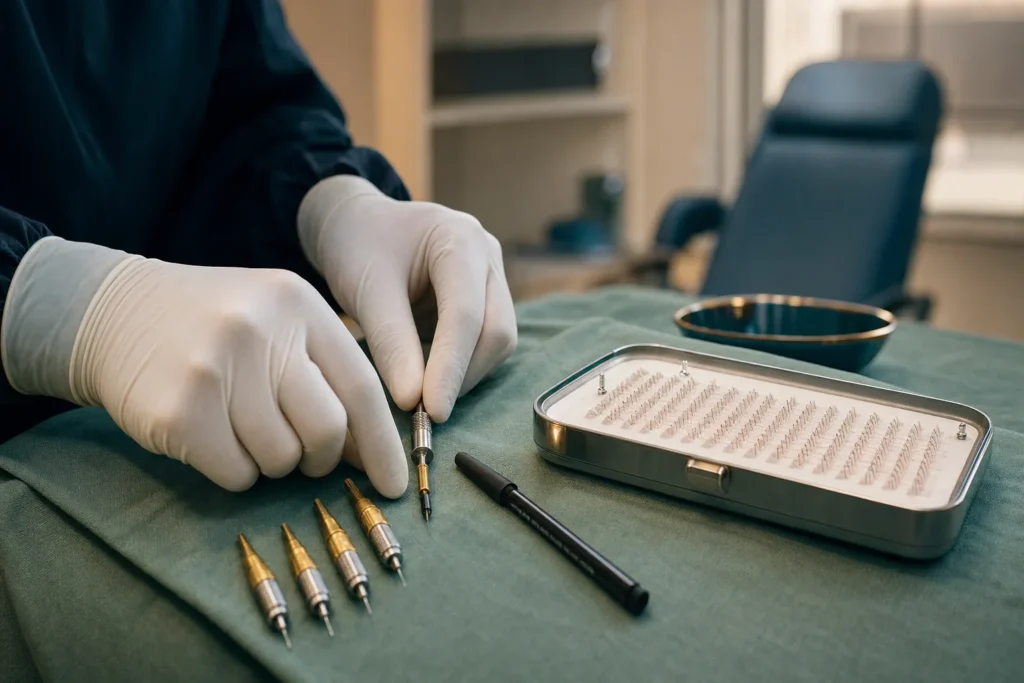
- FUE (Follicular Unit Extraction) removes follicles one by one using a tiny punch about 0.8 to 1 mm across. It leaves a scatter of small dot-like marks in the donor area rather than a line. FUE is often preferred for burn cases because burned scalps are frequently tight and stiff, which makes the strip method harder.
- FUT (Follicular Unit Transplantation), or the strip method, removes a thin strip of hair-bearing scalp, which is then divided under a microscope into grafts of 1 to 4 hairs. It leaves one fine line scar that hair usually hides. It can be faster for large numbers of grafts but needs enough scalp looseness.
Whichever harvest is used, the grafts placed into a scar are usually small, often single-hair or two-hair units, so the surgeon can build a natural, soft hairline and avoid stressing the limited blood supply. Eyebrows and moustaches are rebuilt almost entirely with single-hair grafts.
To give scar tissue a better chance, surgeons may add regenerative steps before or alongside transplanting. These can include platelet-rich plasma (PRP), where a small amount of your own blood is spun down and the growth-factor-rich part injected into the scar; fractional laser treatment to soften and remodel the scar; and, for thin sunken scars, small fat grafting injections to plump the tissue and improve blood flow. For very large bald scars, plastic surgeons sometimes first use tissue expansion or flaps to recruit hair-bearing skin before any transplant.
How the procedure is done, step by step
Scar restoration is almost always done under local anaesthetic, sometimes with mild sedation to help you relax. You stay awake but should feel no pain after the numbing injections. Local anaesthesia is generally preferred over a general anaesthetic even for long sessions.
A typical day looks like this:
- Planning and shaving. The surgeon marks the area, decides graft numbers and the direction hair should grow, and shaves the donor zone (and sometimes the recipient zone for FUE).
- Numbing. Local anaesthetic is injected into the donor and recipient areas.
- Testing the scar's blood supply. Because scar tissue can be poorly nourished, surgeons often make a tiny pinprick or test incision and watch whether it bleeds. Good bleeding suggests the tissue can support grafts; poor bleeding means fewer grafts placed more sparingly, or doing a small test graft session first and waiting about six months to see how it grows.
- Harvesting. Follicles are removed by FUE or FUT and kept in a chilled holding solution.
- Placing. The surgeon makes fine recipient sites in the scar, angled to match natural growth, and inserts the grafts. In scar tissue, grafts are spaced more widely, often around 15 to 30 follicular units per square centimetre rather than the higher density used in healthy scalp, to protect the blood supply.
A session usually lasts about 2 to 8 hours depending on size. It is a day case, so you go home or back to your hotel the same day with no overnight stay.
Recovery, step by step
Recovery from scar restoration follows the same broad path as any hair transplant, with a little extra care around the more delicate scar tissue.
- First 2 to 3 days: expect mild soreness, tiny scabs around each graft, and sometimes forehead or eyelid swelling that peaks around day two or three. Keeping your head elevated, including when sleeping, helps reduce it.
- First week: you gently wash as instructed, avoid scratching, picking or knocking the grafts, and skip the gym, swimming, alcohol and direct sun. Most people take 1 to 2 weeks off work; desk work may be possible sooner.
- Weeks 2 to 8: the transplanted hairs typically shed. This is normal and expected: the hair shaft falls out but the follicle stays alive under the skin. It can be alarming, but it is part of the cycle.
- Months 3 to 4: new hairs start to push through, growing roughly half an inch a month.
- Months 9 to 18: the result thickens and matures into its final look.
Because scar tissue can be slower and less predictable, your surgeon may ask you to be especially gentle and patient, and may plan staged sessions months apart to build density gradually.
Risks and possible complications
Hair restoration is generally low-risk, but no surgery is risk-free, and scar tissue adds its own challenges. Possible problems include:
- Lower graft survival. This is the main scar-specific issue. Healthy scalp commonly sees around 90% or more of grafts survive; in scar tissue survival is more variable and can be lower, because the blood supply that feeds new follicles is reduced. Reported survival in scarred skin ranges widely, which is why surgeons place grafts cautiously and may stage the work.
- Bleeding and infection at the donor or recipient sites.
- Swelling, scabbing and temporary numbness or tingling.
- Folliculitis, small inflamed bumps around grafts, usually treatable.
- Donor-area scarring, a line (FUT) or dots (FUE).
- An unnatural look or uneven density, which can need a touch-up session.
- Allergic reaction to the local anaesthetic, which is uncommon.
- Tissue damage from over-packing: placing grafts too densely in a scar can further choke its limited blood supply, so a careful surgeon deliberately under-packs.
Serious complications such as significant infection or skin death are reported to be rare. Report increasing pain, spreading redness, pus or fever to your clinic promptly.
Results and how long they last
When grafts take, the result is permanent in the sense that the transplanted follicles keep the genetic behaviour of the donor area; if they came from a zone that resists balding, they generally continue to grow for life. The hair can be cut, washed and styled normally once it has grown.
That said, scar restoration usually aims for a natural-looking coverage rather than the thick density of an uninjured scalp. To create the illusion of fullness over a scar, surgeons often need more than one session, spaced roughly 9 to 12 months apart, and large or complex scars can take several procedures and a few years to finish. Studies of scar and burn cases report follicular survival above 75% in many patients, with growth starting around four months and improving through the first year, but each scar behaves differently.
Be wary of any promise of a guaranteed graft count or a fixed percentage of survival; honest clinics talk in ranges and stage the work based on how your scar actually responds.
Costs and what changes the price
Scar and burn restoration is usually a cosmetic procedure paid for privately, and the price depends heavily on the case. As an indicative range, scar and burn hair restoration in Turkey often falls between roughly 1,500 and 6,000 EUR per session, with smaller eyebrow or single-scar cases at the lower end and large multi-session scalp work at the higher end. For context, the UK's NHS notes private hair transplants there can run anywhere from about 1,000 to 30,000 GBP depending on extent and clinic.
These figures are an illustration, not a quote. The real price varies by case, surgeon and clinic, and only a personalised assessment can tell you what your situation needs. Things that move the price include:
- The number of grafts and the size of the scar.
- How many sessions are needed.
- The technique (FUE tends to cost more per graft than FUT) and any add-ons like PRP, laser or fat grafting.
- The surgeon's experience and the clinic's accreditation.
- Whether consultation, medication, aftercare and follow-up are bundled in.
Always ask for an itemised, written quote and check what happens if a second session or a touch-up is needed.
Why people travel to Turkiye, and how to choose a safe clinic
Turkiye has become one of the world's busiest destinations for hair restoration. People travel there mainly for the combination of price and high case volume: many surgeons and teams perform these procedures very frequently, and packages often bundle the surgery, hotel and transfers. High volume can mean experience, but it can also mean assembly-line clinics, so choosing carefully matters more here, not less, especially for the trickier scar and burn work.
Before you book, verify:
- The surgeon's credentials. Look for a doctor licensed by Turkiye's Ministry of Health and board-certified in a relevant specialty such as dermatology or plastic surgery, ideally a member of a recognised body like the International Society of Hair Restoration Surgery (ISHRS).
- Facility accreditation. Internationally recognised standards such as JCI (Joint Commission International) accreditation, or ISO certification, signal that a hospital meets global benchmarks for patient safety and infection control.
- Who actually does the surgery. Confirm in writing that a qualified surgeon, not unsupervised technicians, performs the key steps, and that they have real experience with scar and burn cases specifically.
- Honest expectations. A good clinic will discuss graft survival in scars realistically, possibly suggest a test-graft, and never promise a guaranteed result.
Treat warning signs seriously: rock-bottom prices, claims of unlimited grafts, no direct contact with a surgeon, no clear plan for complications, and pressure to book quickly.
How to prepare and what to ask at your consultation
Good preparation starts weeks before the procedure. Typical advice includes stopping smoking, avoiding alcohol for a few days beforehand, and reviewing any blood-thinning medicines or supplements with your doctor (never stop a prescribed medicine without medical advice). Bring your full medical history, including how and when the scar formed and any treatments it has had.
Because scar work is specialised, a thorough consultation is essential. Useful questions to ask:
- Is my scar mature and stable enough to transplant now, or should I wait?
- Have you tested, or how will you test, the blood supply in my scar?
- How many grafts and how many sessions do you realistically expect I will need?
- What graft survival rate do you typically see in scar tissue like mine?
- Will you do a test graft first?
- Which technique do you recommend for my case, and why?
- Who exactly will perform the surgery, and what are their qualifications?
- What does the price include, and what would a touch-up cost?
- What are my specific risks, and how do you handle complications from abroad?
Ask to see before-and-after photos of scar and burn cases, not just routine transplants, and make sure you leave with a written plan.
Aftercare and travelling for treatment, including when it is safe to fly
If you travel abroad for treatment, plan the trip around your recovery, not the other way round. The first 24 to 48 hours are the most delicate, because the grafts are still settling into the scalp. Many clinics ask you to stay nearby for a couple of days for a check-up and a first wash, so allow for roughly 2 to 4 days in the destination.
On flying: there is no single official rule, and you should follow your own surgeon's instructions, but clinics commonly advise waiting a day or two, until the first check-up and wash are done, before flying home; your surgeon may suggest a longer wait after a large session or if swelling is marked, because cabin pressure can worsen scalp and forehead swelling. If you must fly sooner, do so only with your surgeon's approval, protect the grafts from anything that presses on them, use a neck pillow rather than resting your head back, stay hydrated, and avoid alcohol.
For aftercare at home: follow the washing routine exactly, keep the area out of strong sun, avoid heavy exercise, swimming and saunas for the first couple of weeks, do not pick scabs, and attend any remote follow-ups your clinic offers. Keep their emergency contact details handy, and have a local doctor you can see if redness, pain or fever develops once you are back.
Frequently asked questions
Can you really transplant hair into a scar?
How successful is a hair transplant on burn or scar tissue?
Does it hurt, and what anaesthetic is used?
How long before I see results?
Will I need more than one session?
How much does scar and burn hair restoration cost in Turkey?
When can I fly after the procedure?
Does my scar need to be old before treatment?
Can it be used for eyebrows, beard or moustache scars?
Are there cases where it should not be done?
How do I choose a safe clinic abroad?
Sources
- Hair transplantation in burn scar alopecia (Farjo et al., Scars, Burns & Healing, PMC/NIH)
- Role of Hair Transplantation in Scarring Alopecia: To Do or Not to Do (PMC/NIH)
- Head and Neck Restoration in Scar Alopecia: Scalp, Eyebrows, Beard and Mustache (PMC/NIH)
- NHS: Cosmetic procedures - Hair transplant
- American Society of Plastic Surgeons: Hair transplant recovery
- Memorial Health Group (Turkey): JCI accreditation
- Joint Commission International (JCI) accreditation overview
- International Society of Hair Restoration Surgery (ISHRS)
This article is for general information only and is not medical advice. Always consult a qualified doctor about your individual case.
Specialists in Hair Transplant
Doctors of the department we work with directly. Which doctor takes your case is decided after the specialists have reviewed your records — your coordinator confirms it, not this page.

Considering this procedure?
Send us your photos and questions. A BergemHealth coordinator and a senior specialist will review your case and reply with honest, personalised guidance — no obligation.
Free consultation