Interstitial lung disease (ILD)
Interstitial lung disease (ILD) is not a single illness but a large family of conditions that affect the delicate tissue around the lungs' air sacs. The name can sound frightening, but understanding what ILD is, how it is diagnosed, and what treatments exist can make the path ahead feel much clearer. This guide explains the condition in plain language, so you can ask better questions, work confidently with your specialist, and plan the right care for you.
What interstitial lung disease is
Interstitial lung disease, usually shortened to ILD, is an umbrella term for a large group of conditions that cause inflammation (swelling and irritation) and scarring in the lungs. The word interstitial refers to the interstitium — the thin layer of supportive tissue that surrounds the tiny air sacs (called alveoli) where your lungs pass oxygen into your blood.
In healthy lungs this tissue is soft and stretchy, so the air sacs expand and shrink easily with each breath. In ILD the tissue becomes inflamed, thickened, or scarred. Scarring of lung tissue is known as pulmonary fibrosis. When the tissue stiffens, the lungs cannot expand as fully, and oxygen finds it harder to cross into the bloodstream. That is why the main symptom of most types of ILD is shortness of breath.
ILD is sometimes called a restrictive lung disease, because the stiffer lungs are restricted from filling up with as much air as before. This is different from conditions such as asthma or chronic obstructive pulmonary disease (COPD), where the problem is mainly air struggling to get out. There are more than 200 recognised types of ILD, which is why getting the right diagnosis matters so much — the cause and the best treatment can differ greatly from one type to another.
Types and subtypes of ILD
Because ILD is a family of conditions, doctors usually sort the types into groups by their cause. Knowing which type you have shapes both treatment and what to expect.
ILD with a known cause.
- Occupational and environmental ILD — caused by breathing in harmful particles over a long time. Examples include asbestosis (from asbestos fibres), silicosis (from silica dust, common in stone, glass, and mining work), and coal workers' lung (sometimes called black lung).
- Hypersensitivity pneumonitis — an allergic-type reaction in the lungs to substances such as mould, fungi, or bird droppings. "Farmer's lung" and "bird fancier's lung" are well-known examples.
- Connective tissue disease ILD — ILD that develops alongside autoimmune conditions such as rheumatoid arthritis, lupus, or scleroderma, where the body's own immune system affects the lungs.
- Drug- or radiation-induced ILD — triggered by certain medicines (for example some chemotherapy drugs, the heart medicine amiodarone, or the antibiotic nitrofurantoin) or by radiotherapy to the chest.
ILD with no known cause (idiopathic). When no cause can be found, the condition is called idiopathic, which simply means "of unknown cause."
- Idiopathic pulmonary fibrosis (IPF) is the most common type of ILD. It mainly affects older adults and causes progressive scarring of the lungs.
- Nonspecific interstitial pneumonia (NSIP) and cryptogenic organising pneumonia are other idiopathic forms.
Granulomatous ILD, such as sarcoidosis, is a further group, in which tiny clumps of inflammatory cells form in the lungs and sometimes other organs.
Causes and risk factors
ILD generally develops when something injures the lung tissue and the body's healing response goes wrong — instead of repairing neatly, the tissue becomes inflamed and scarred. Sometimes the trigger is clear; often it is not.
Known causes and contributing factors include:
- Breathing in harmful substances over months or years, such as asbestos, silica dust, hard-metal dusts, mould, or animal proteins from droppings and feathers.
- Autoimmune (connective tissue) diseases, including rheumatoid arthritis, lupus, scleroderma, and others, which can affect the lungs.
- Certain medicines, including some chemotherapy drugs, the heart-rhythm drug amiodarone, methotrexate, and some antibiotics.
- Radiotherapy to the chest, for example as part of treatment for breast or lung cancer.
- Genetic factors — some types of ILD, including a minority of IPF cases, can run in families.
Things that raise the risk of developing ILD include being older (IPF most often appears between ages 70 and 75), a history of smoking, certain jobs with dust or fume exposure, and having an autoimmune condition. Smoking and acid reflux (where stomach acid rises into the gullet) are linked with some types and may make the condition worse, though they are not proven to be direct causes on their own. Having a risk factor does not mean you will develop ILD, and many people with ILD have none of these.
Signs and symptoms — and when to see a doctor
The symptoms of ILD usually build up slowly, often over months or years, which is one reason it can be easy to dismiss at first. The two most common symptoms are:
- Shortness of breath (breathlessness), especially during activity such as climbing stairs or walking uphill. As the condition progresses, breathlessness may appear even at rest.
- A persistent dry cough that does not bring up phlegm and does not seem to go away.
Other symptoms that can appear, particularly as the disease advances, include:
- Tiredness and a general feeling of being run down.
- Unintended weight loss and reduced appetite.
- Discomfort in the chest.
- Clubbing — a widening and rounding of the fingertips and nails, which can develop over time.
When to see a doctor. The UK's NHS advises contacting your GP if you have struggled with your breathing for a while, or if you have had a cough that has lasted more than three weeks. These symptoms have many possible causes, most of them not serious, but they should always be checked. Seek urgent medical help if you suddenly become severely breathless, your lips or fingertips turn blue, or you have chest pain. The earlier ILD is identified, the more options there usually are to manage it.
Screening and early detection
There is currently no routine screening programme for interstitial lung disease in the general population, the way there is for some cancers. Most cases are picked up because a person sees a doctor about breathlessness or a lingering cough, or because a chest X-ray or CT scan done for another reason shows changes in the lungs.
However, some people are watched more closely because they are at higher risk. For example, if you have an autoimmune disease such as rheumatoid arthritis or scleroderma, your specialist may check your breathing and arrange lung scans or breathing tests from time to time, because these conditions can affect the lungs. People in jobs with known dust or fume exposure may also have lung-health checks as part of workplace health monitoring.
If ILD runs in your family, it is worth mentioning this to your doctor, as a small number of types have a genetic link. The most useful step for early detection is simply not to ignore slowly worsening breathlessness or a cough that will not settle — getting these assessed promptly gives the best chance of identifying any lung problem early.
How ILD is diagnosed
Diagnosing ILD is often described as detective work, because the doctor must work out not only whether you have ILD but, where possible, which of the many types it is. The process usually combines several steps.
History and examination. The doctor will ask about your symptoms, your jobs and hobbies (to look for dust, mould, or bird exposure), your medicines, your smoking history, and any family history or autoimmune conditions. They will listen to your chest with a stethoscope — ILD often produces a distinctive crackling sound — and check for finger clubbing.
Breathing and oxygen tests. Pulmonary function tests (also called lung function tests) measure how much air your lungs can hold and how well oxygen passes into your blood. A simple clip on your finger (a pulse oximeter) checks your oxygen level, sometimes during a walking test to see how it changes with activity.
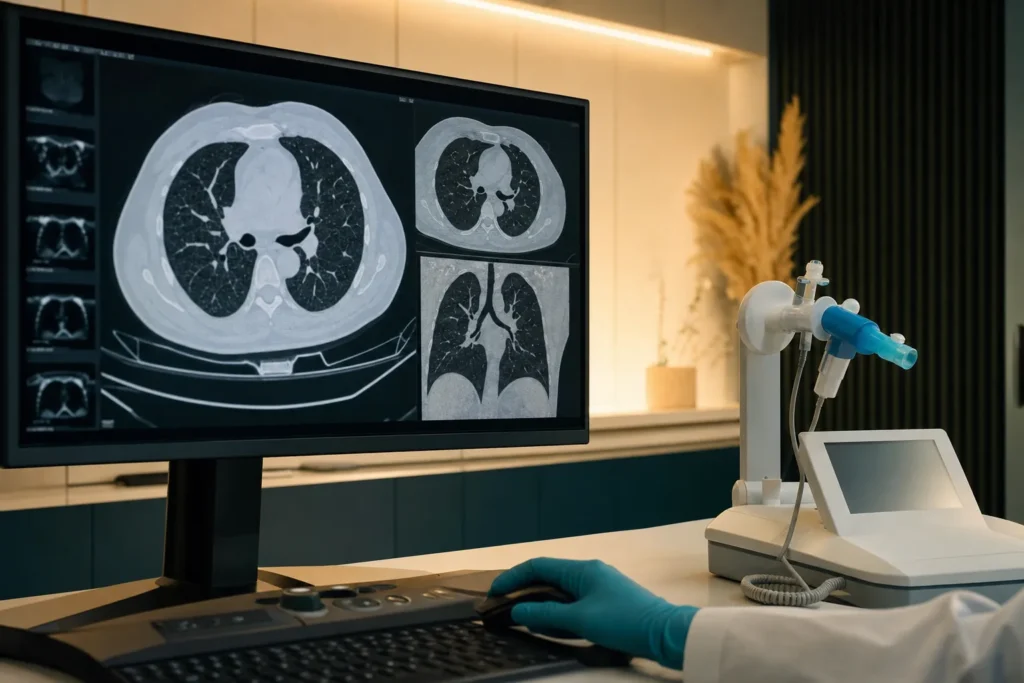
Imaging. A chest X-ray may be the first scan, but the key test is a high-resolution CT scan (HRCT) of the chest. This detailed scan shows the pattern and extent of inflammation or scarring and is central to identifying the type of ILD.
Blood tests look for signs of autoimmune disease or other causes.
Lung tissue samples. If the diagnosis is still unclear, the doctor may suggest a bronchoscopy (passing a thin, flexible camera into the airways to take small samples or fluid) or, less often, a surgical lung biopsy to examine a piece of tissue.
Because no single test gives the whole answer, specialist centres use a multidisciplinary team (MDT) — lung doctors, radiologists who read the scans, and pathologists who examine tissue — who review all the information together. This team approach is regarded as the reference standard for diagnosing ILD and improves both confidence and accuracy.
Treatment options
There is no single treatment for ILD, because it depends heavily on the type, the cause, and how far it has progressed. The goals are usually to treat any underlying cause, reduce inflammation or slow scarring, ease symptoms, and help you stay as active and comfortable as possible. Treatment is normally guided by a specialist team.
Treating the cause. If a medicine or an exposure (such as mould or birds) is triggering the ILD, stopping the medicine or removing the exposure is a vital first step. If an autoimmune condition is involved, treating that condition helps the lungs too.
Medicines.
- Corticosteroids (such as prednisone/prednisolone) and other immune-calming drugs (for example mycophenolate or azathioprine) are used for ILD driven by inflammation, such as some autoimmune-related types.
- Antifibrotic drugs — pirfenidone and nintedanib — do not cure ILD, but can slow the rate of scarring in idiopathic pulmonary fibrosis and certain other progressive fibrotic types.
- Medicines for acid reflux or cough may be added to ease symptoms.
Supportive treatments matter for almost everyone, whatever the cause:
- Oxygen therapy at home or during activity if your blood-oxygen level is low, to ease breathlessness and reduce strain on the heart.
- Pulmonary rehabilitation — a supervised programme of exercise, breathing techniques, and education that can improve fitness and quality of life.
- Stopping smoking and keeping up with vaccinations (such as flu and pneumonia jabs) to protect the lungs from infection.
Lung transplant may be considered for some people with severe, advancing ILD who are otherwise suitable. Your team can explain whether this is relevant for you.
Outlook: what to expect
The outlook for ILD varies enormously, and it is important not to assume the worst from a single label. Some types are mild, stay stable for years, or even improve once a cause is removed or inflammation is treated. Others, particularly the progressive fibrotic forms, tend to worsen gradually over time.
Idiopathic pulmonary fibrosis is one of the more serious types. Published guidelines from major lung societies describe a median (typical) survival of roughly 3 to 5 years from diagnosis for untreated IPF, while noting that this figure comes from older studies and may underestimate outcomes for people diagnosed earlier or with better-preserved lung function. The American Lung Association similarly notes that for the most severe and rapidly worsening forms, life expectancy may be as low as three to five years after diagnosis, while many other people with ILD live for many years.
It is essential to understand what these numbers are and are not. They are population-level averages drawn from groups of patients; they are not a prediction for any individual. Your own outlook depends on your specific type of ILD, how early it was found, your lung function, your overall health, and how you respond to treatment. Modern antifibrotic medicines, oxygen, and rehabilitation have changed what is possible for many people. The most reliable picture of your own situation will come from your specialist, who knows the details of your case.
Living with ILD and follow-up
Living well with ILD is about steady, practical management rather than dramatic change. Most people are seen regularly by a lung specialist, with repeat breathing tests and sometimes scans to track how the condition is behaving over time. This monitoring helps your team adjust treatment and spot any complications early.
Day to day, several habits help:
- Stay as active as you safely can. Pulmonary rehabilitation and gentle regular exercise help keep your muscles strong and your breathing efficient. Your team can advise on the right level for you.
- Protect your lungs from infection by keeping up with recommended vaccinations and seeking prompt help for chest infections.
- Stop smoking if you smoke, and avoid second-hand smoke and other lung irritants.
- Eat well and manage other conditions such as reflux, heart problems, or your autoimmune disease.
- Use oxygen as prescribed if your team has recommended it.
ILD can affect mood as well as the body. Breathlessness can be frightening, and a long-term diagnosis can feel isolating. Talking to your team, connecting with patient support organisations, and involving family or carers can all make a real difference. Many lung charities run helplines and peer-support groups for patients and carers.
Planning treatment abroad: what affects cost and how to prepare your records
Some people with ILD choose to seek specialist assessment or treatment abroad, for example to access an experienced ILD centre, a multidisciplinary team review, pulmonary rehabilitation, or evaluation toward advanced options. Because ILD care is highly individual, the cost of treatment abroad is not a single fixed figure — it depends on what you actually need.
Factors that affect cost include:
- The type and stage of your ILD, and how much investigation is required.
- Which tests are needed — for example HRCT scans, full pulmonary function testing, blood panels, bronchoscopy, or a surgical biopsy.
- The treatments involved, from medicines and oxygen to a structured pulmonary rehabilitation programme.
- Length of stay and whether inpatient care is needed.
- Follow-up, travel, accommodation, and translation or coordination services.
To prepare, gather your medical records before you travel: recent CT scans and X-rays (ideally the original image files, not just the reports), lung function test results, blood test results, biopsy or bronchoscopy findings if you have had them, a full list of your medicines and doses, and a summary letter from your current doctor. Good records help the overseas team avoid repeating tests and give faster, more accurate advice. Because every case differs, the sensible step is to request a personalised estimate after a free consultation, where the team can review your records and explain exactly what your plan would involve.
Why Turkiye, and how to choose a good centre
Turkiye (Turkey) has become a well-established destination for international patients, partly because it has a large number of internationally accredited hospitals. Many Turkish hospitals hold Joint Commission International (JCI) accreditation — a globally recognised standard that assesses hospitals against detailed criteria for patient safety, hygiene, infection control, and quality of care. Major hospital groups in cities such as Istanbul, Ankara, Izmir, and Antalya treat patients from many countries and often provide coordinated services for international visitors, including interpreters and help with travel logistics.
For a condition like ILD, where accurate diagnosis and ongoing specialist care are so important, the priority is the quality of the team and follow-up rather than any single feature of a clinic. When choosing a centre, it is wise to verify:
- Recognised accreditation, such as JCI, which you can check on the accrediting body's own website.
- A dedicated pulmonology (lung medicine) department with experience in interstitial lung disease specifically.
- Access to a multidisciplinary team — lung specialists, chest radiologists, and pathologists who review cases together.
- The full range of diagnostics on site, including HRCT and pulmonary function testing.
- A clear follow-up plan, including how care will be coordinated with your doctors back home.
It is reasonable to ask any centre about the experience of the specialists, what is included in any quoted plan, and how aftercare will work once you return home. A reputable team will answer these questions openly.
Self-care, second opinions, and looking ahead
While many causes of ILD cannot be fully prevented, you can lower your risk and protect your lungs. Avoid smoking and second-hand smoke; use proper respiratory protection if you work around dust, fumes, or chemicals; reduce exposure to mould and bird droppings at home; and keep on top of any autoimmune condition with your doctor. Staying physically active and keeping vaccinations up to date all help your lungs cope.
If you have been diagnosed with ILD, it is completely reasonable to seek a second opinion, especially given how many types exist and how much the right diagnosis shapes treatment. A fresh review by another specialist or multidisciplinary team can confirm the diagnosis or open up options you had not discussed.
You may also wish to ask your specialist about clinical trials. Research into ILD, and into new antifibrotic and anti-inflammatory medicines, is active, and trials sometimes offer access to treatments not yet widely available. Your specialist or a national lung charity can advise whether any current trials might suit you. Above all, stay in regular contact with a qualified lung specialist — ILD is a long-term condition that is best managed as a partnership between you and your care team.
Frequently asked questions
What does "interstitial" actually mean?
Is interstitial lung disease the same as pulmonary fibrosis?
What are the first symptoms most people notice?
Is ILD contagious?
Can ILD be cured?
How is ILD diagnosed?
What is the outlook for someone with ILD?
What are antifibrotic medicines?
Will I need oxygen?
How should I prepare my medical records before seeking care abroad?
Why do people consider Turkiye for ILD care?
Should I get a second opinion?
This article is for general information only and is not medical advice. Always consult a qualified doctor about your individual case.
Considering this procedure?
Send us your photos and questions. A BergemHealth coordinator and a department-head specialist will review your case and reply with honest, personalised guidance — no obligation.
Free consultation