Cardiac check-up
A heart-focused check-up is a calm, planned way to understand your cardiovascular health before symptoms appear. This guide explains the LIV SHAPE Advanced Cardiac Diagnostics programme in Turkiye in plain words, what each test looks for, what the evidence does and does not promise, and how to decide whether it is right for you.
- Duration
- 1 day, outpatient
- Hospital stay
- Outpatient - no overnight stay
Minimum price, for reference only — the final cost is calculated individually after your records are reviewed. You pay the hospital’s price; our service is free for you.
What this cardiac check-up is and who it is for
A cardiac check-up is a structured set of heart-focused tests and doctor visits, done in a single visit, that builds a clear picture of your cardiovascular health. The aim is not to treat an illness you already know about, but to look for early, silent signs of heart and blood-vessel disease so you can act sooner rather than later.
The LIV SHAPE - Advanced Cardiac Diagnostics programme at LIV Hospital in Turkiye packs four examinations, five imaging tests and thirteen laboratory tests into one outpatient day. It is more intensive than a basic annual physical and is built specifically around the heart and arteries.
This kind of programme tends to make most sense for adults who have at least one reason to pay closer attention to their heart, for example:
- A family history of early heart attack, stroke or sudden cardiac death
- Known risk factors such as high blood pressure, raised cholesterol, diabetes or pre-diabetes, or current or past smoking
- Being overweight, very sedentary, or under sustained stress
- Being middle-aged or older and wanting a thorough baseline before increasing exercise
It matters because cardiovascular disease is the world's leading cause of death. The World Health Organization estimates that around 19.8 million people died from cardiovascular diseases in 2022, roughly 32 percent of all deaths globally, and about 85 percent of those were due to heart attack and stroke. The encouraging part is that a large share of cardiovascular disease is preventable, and the WHO stresses the value of detecting it as early as possible so that lifestyle changes and medicines can begin in time. A check-up is one practical way to find out where you stand.
What is included in the programme
The LIV SHAPE cardiac package brings together three layers of assessment: people who interpret your health, pictures of your heart and arteries, and numbers from your blood. Here is how the contents group together in plain terms.
Examinations (4). A cardiologist and a check-up physician take your history, examine you, decide which findings matter, and tie everything together into advice you can use, so your results are reviewed in context rather than handed over as a stack of unexplained numbers. The package also includes a body-composition analysis (bioimpedance - how your body weight is split between fat, muscle and water) and a dental examination.
Imaging tests (5). These create direct images or measurements of your heart and blood vessels:
- Coronary calcium score CT - a quick, low-dose scan that measures hardened (calcified) plaque in the arteries that feed the heart.
- Carotid intima-media thickness (IMT) - an ultrasound that measures the thickness of the inner wall of the neck arteries, an early sign of artery ageing.
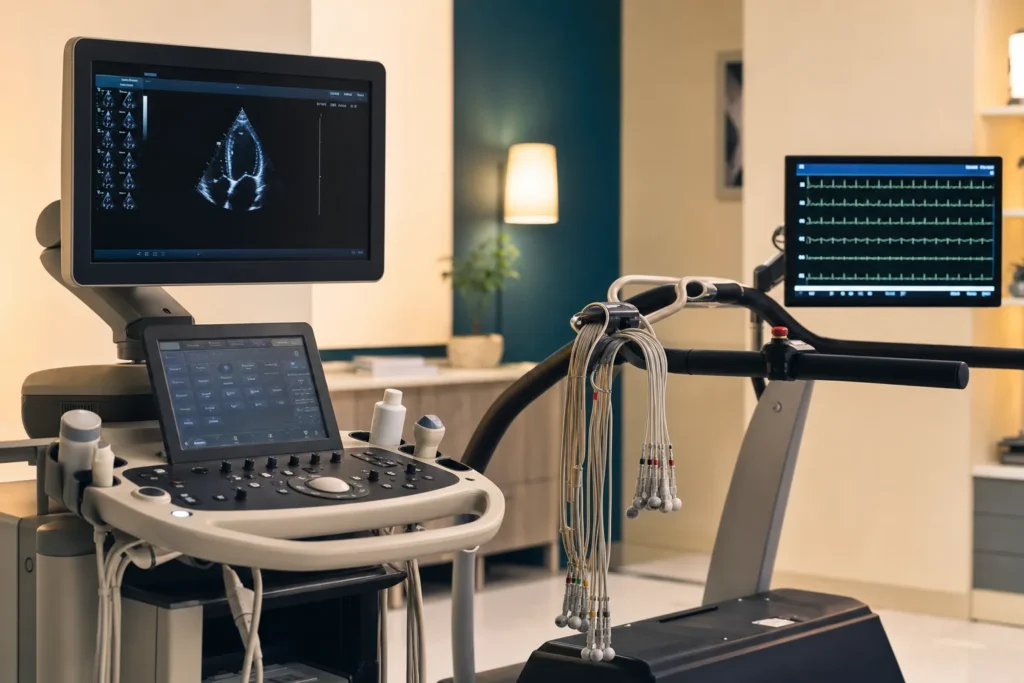
- Cardiovascular stress test (EFOR) - records your heart's electrical activity and response while you exercise, usually on a treadmill.
- Transthoracic echocardiography - a painless ultrasound of the heart showing the size of the chambers, how the valves work and how strongly the heart pumps.
- Chest X-ray (cardiac teleradiography) - a standard X-ray that shows the size and outline of the heart and the lungs, with a very small dose of radiation.
Laboratory tests (13). A blood draw covers a metabolic and cardiovascular panel that includes HbA1c (average blood sugar over about three months), insulin, a full lipid (cholesterol) profile, and micro-CRP (high-sensitivity C-reactive protein, a marker of low-grade inflammation), alongside other routine blood chemistry. Together these reveal risk factors such as diabetes, pre-diabetes and unhealthy cholesterol that often have no symptoms at all.
What it screens for and why that matters
Each part of the programme targets a different piece of the cardiovascular picture. Understanding what each is looking for helps the results make sense.
Hidden plaque in the heart's arteries. The coronary calcium score detects calcified plaque, a direct sign of atherosclerosis (the gradual narrowing and stiffening of arteries). A large body of research, including the long-running Multi-Ethnic Study of Atherosclerosis, shows that the calcium score predicts future heart events and can refine risk beyond standard calculators, often helping decide whether someone should start a cholesterol-lowering statin. A score of zero is reassuring in many people, though it does not entirely rule out risk.
Early artery ageing. Carotid IMT measures the thickness of the neck-artery wall. Studies such as the Rotterdam Study linked a thicker wall to a higher risk of heart attack and stroke, but adding IMT to standard risk scores improves prediction very little, so current US and European guidelines do not recommend it for routine risk assessment; plaque seen on the same ultrasound, and the calcium score, carry more weight.
How your heart copes under load. The exercise stress test can reveal reduced blood flow or rhythm problems that only show up when the heart works harder, and the echocardiogram checks the structure and pumping function of the heart and its valves.
Metabolic risk factors. HbA1c and insulin screen for diabetes and pre-diabetes; the U.S. Preventive Services Task Force recommends screening adults aged 35 to 70 who are overweight, because finding and treating pre-diabetes early reduces the chance it progresses. The lipid profile measures cholesterol, a core driver of artery disease, and the USPSTF supports periodic cholesterol checks from age 40 to 75 to guide prevention. High-sensitivity (micro) CRP adds information about inflammation that is linked to cardiovascular risk in some people.
Benefits and honest limitations of screening
A good check-up can genuinely change your future, but it is fair to be clear about what it can and cannot do.
The real benefits.
- It can uncover silent risk factors, such as high cholesterol, raised blood sugar or early plaque, while they are still easy to address.
- It gives you a concrete baseline to track over the years.
- It can motivate and guide change, helping you and your doctor decide on lifestyle steps or medicines that have strong evidence for preventing heart attack and stroke.
- Sometimes a normal result is itself valuable, offering genuine reassurance.
The honest limitations. Screening reduces risk; it does not remove it, and no check-up can catch everything or guarantee a healthy heart.
- Tests can produce false positives - a worrying result that turns out, after further testing, to be nothing. This can cause anxiety and lead to extra scans or procedures that carry their own small risks.
- Tests can also miss things. The calcium score, for example, detects hardened plaque but not soft, non-calcified plaque, so it can underestimate risk in some people, particularly smokers and those with diabetes.
- For some individual tests, expert bodies are cautious. The USPSTF currently finds the evidence insufficient to recommend the routine use of calcium scoring or high-sensitivity CRP for everyone, and recommends against routine resting or exercise ECG screening in low-risk people without symptoms. These tools add the most value when chosen for the right person, which is exactly why specialist consultations are part of the package.
- Imaging such as CT involves a small dose of radiation, and incidental findings may occasionally need follow-up.
The sensible way to read all this: a check-up is a powerful tool when interpreted by experienced clinicians for someone who has a reason to use it, not a magic guarantee.
How to prepare
A little preparation makes the day smoother and your results more accurate. Always follow the specific instructions the hospital sends you, as they take priority, but typical guidance for a cardiac and metabolic check-up includes:
- Fasting. Many of the blood tests, especially glucose, insulin and the cholesterol profile, are usually done after roughly 8 to 12 hours without food. Plain water is generally fine and helps with the blood draw. Confirm the exact fasting window with the clinic.
- Medicines. Ask in advance whether to take your regular medicines on the morning of the visit. Some heart medicines can affect the stress test, so the clinic may give you tailored advice. Do not stop any prescribed medicine on your own.
- For the stress test. Bring comfortable clothing and trainers suitable for walking on a treadmill. Avoid heavy meals, caffeine and tobacco for several hours beforehand if advised.
- What to bring. Photo identification, a list of your current medicines and doses, and any previous test results, ECGs or scans you have. A summary of your family medical history is useful too.
- Plan your day. Allow plenty of time and avoid scheduling anything stressful straight afterwards, so the day feels unhurried.
What the day looks like
The LIV SHAPE cardiac programme is designed to be completed in one day on an outpatient basis, meaning there is no overnight hospital stay. You arrive, complete the tests in sequence, and go home the same day.
A typical flow starts with registration and the fasting blood draw first thing, so you can eat soon afterwards. From there you move between stations for the imaging tests: the chest X-ray, the echocardiogram and carotid ultrasound, the low-dose calcium-score CT, and the exercise stress test. The cardiology and check-up examinations are woven through the day, often beginning with a history and examination and finishing with a session to discuss your overall picture; the body-composition measurement and the dental examination fit in between.
Most of the tests are quick, painless and non-invasive. The ultrasound scans involve a gel probe on the skin; the stress test involves walking on a treadmill while your heart is monitored; the CT is over in minutes. Staff at an international hospital are used to coordinating these visits efficiently and to working with patients who have travelled from abroad.
Understanding your results and follow-up
The point of a check-up is not the raw numbers but what they mean for you, which is why the consultations matter as much as the tests. Expect a clinician to walk you through the findings and put them in context with your age, history and lifestyle.
Results usually fall into a few categories:
- Reassuring. Nothing concerning, with general advice on keeping your heart healthy and a suggested interval before your next check.
- A risk factor to manage. For example raised cholesterol, borderline blood sugar, or some early artery change. The plan here is typically lifestyle change, sometimes with preventive medicine, and a date to recheck.
- Something that needs further assessment. Occasionally a finding warrants an additional test or a referral to a cardiologist. This does not necessarily mean something is seriously wrong; it means a question deserves a clearer answer.
It helps to ask three simple questions before you leave: What did you find? What does it mean for my risk? What, specifically, should I do next? Keep a copy of every report so you have a baseline to compare against in future, and share the results with your usual doctor at home so your care stays joined up. The American Heart Association's framework of cardiovascular health, sometimes called Life's Essential 8, is a useful anchor for the changes that matter most: not smoking, healthy eating, physical activity, good sleep, and keeping weight, blood pressure, cholesterol and blood sugar in healthy ranges.
Cost and what is included
The indicative price for the LIV SHAPE - Advanced Cardiac Diagnostics programme is 1,450 US dollars. For that price the package brings together four examinations, five imaging tests and thirteen laboratory tests in a single outpatient day, including the coronary calcium score CT, carotid IMT measurement, exercise stress test, echocardiogram, chest X-ray and the metabolic and cardiovascular blood panel.
A few honest points about pricing:
- This is an indicative figure and can change over time and with currency movements; always confirm the current price and exactly what is included before you travel.
- The price covers the listed check-up itself. Any extra tests, follow-up appointments, treatment or medicines that turn out to be needed would be separate.
- It does not include flights, accommodation, transfers or travel insurance.
- Bundling everything into one package and one day is often more convenient and predictable than arranging the same tests piecemeal.
When you compare programmes, look beyond the headline number to what is genuinely included, who interprets the results, and whether the centre is internationally accredited.
Why do your check-up in Turkiye, and how to choose a centre
Turkiye has become a well-known destination for planned, preventive healthcare. International patients are often drawn by accredited private hospitals, modern imaging equipment, English-speaking staff and coordinators, short waiting times, and the ability to complete a comprehensive work-up in a single trip, frequently at a lower price than comparable private care in Western Europe or North America.
Wherever you go, the same principles help you choose a trustworthy centre:
- Accreditation. Look for international quality accreditation such as JCI (Joint Commission International), which signals recognised standards of safety and care.
- Who interprets your results. Make sure board-certified cardiologists and specialists review and explain your findings, not just a printout.
- Clear, written pricing. Ask for an itemised list of what is and is not included, in writing.
- Reporting you can use at home. Request your full results and images in a language and format your own doctor can read, so follow-up is seamless.
- Honest expectations. A reputable centre will explain the limitations of screening, not promise that a check-up guarantees a healthy heart.
A medical-tourism concierge can help with the logistics, but the medical questions above are the ones that protect you.
Who should consider a more or less intensive programme
Not everyone needs the same depth of testing, and matching the programme to your situation is part of doing this well.
A more intensive cardiac programme like LIV SHAPE tends to suit people with a meaningful reason to look closely at the heart: a strong family history of early heart disease, several risk factors together (such as high blood pressure plus raised cholesterol plus diabetes), past smoking, or simply a wish for a detailed cardiovascular baseline in mid-life and beyond. The advanced imaging earns its place when there is genuine risk to clarify.
A lighter approach may be entirely appropriate for younger adults with no symptoms, no significant family history and no risk factors. For many such people, the highest-value steps are the simple ones: regular blood pressure checks, a periodic cholesterol and blood-sugar test, and attention to lifestyle. International guidelines deliberately reserve some of the more advanced tests for people likely to benefit, partly to avoid the downsides of over-testing.
If you already have symptoms such as chest pain, breathlessness, palpitations or dizziness, that is not a job for a routine check-up. Seek prompt medical assessment, and call emergency services for sudden or severe chest pain. Screening is for people who feel well; symptoms need diagnosis. When in doubt, a short conversation with a cardiologist about your personal risk is the best way to choose the right level of testing for you.
Frequently asked questions
Is a cardiac check-up the same as having heart symptoms investigated?
Does a normal cardiac check-up mean my heart is definitely healthy?
What is a coronary calcium score and what does the number mean?
Are the tests safe? Is there radiation?
Do I need to fast before the check-up?
How long does the LIV SHAPE cardiac programme take?
What does the check-up cost, and what is included?
Can a check-up cause unnecessary worry or extra tests?
How often should I repeat a cardiac check-up?
Will I be able to share my results with my own doctor at home?
Who is this programme most suitable for?
Sources
- World Health Organization - Cardiovascular diseases (CVDs) fact sheet
- USPSTF - CVD Risk Assessment With Nontraditional Risk Factors (CAC, hsCRP)
- USPSTF - Cardiovascular Disease Risk: Screening With Electrocardiography
- USPSTF - Prediabetes and Type 2 Diabetes: Screening
- USPSTF - Statin Use for the Primary Prevention of Cardiovascular Disease in Adults
- American Heart Association - Life's Essential 8
- Cleveland Clinic - Transthoracic Echocardiogram (TTE)
- Journal of the American Heart Association - Carotid Intima-Media Thickness and Prediction of Cardiovascular Disease
- Yale Medicine - Is a Coronary Artery Calcium Scan Right for You?
- PubMed - Common carotid intima-media thickness and risk of stroke and myocardial infarction: the Rotterdam Study
This article is for general information only and is not medical advice. Always consult a qualified doctor about your individual case.
Specialists in Health Check-up
Doctors of the department we work with directly. Which doctor takes your case is decided after the specialists have reviewed your records — your coordinator confirms it, not this page.



Considering this procedure?
Send us your photos and questions. A BergemHealth coordinator and a senior specialist will review your case and reply with honest, personalised guidance — no obligation.
Free consultation