
Uterus transplantation
A uterus transplant is an attempt to let a woman born without a womb, or who has lost one, carry her own pregnancy. It is still a rare operation — more than 140 had been performed worldwide by the end of 2024 — and it is temporary by design: the graft is removed once a family is complete, so that immunosuppression can stop. Türkiye's programme at Akdeniz University performed the world's first uterus transplant from a deceased donor in 2011, and the recipient gave birth nine years later.
- Anaesthesia
- General anaesthesia for the transplant and for the later caesarean delivery; embryo transfer needs none.
- Duration
- Recipient surgery usually 4-6 hours. Organ retrieval and bench preparation add several hours before it.
- Recovery
- Six to twelve months of monitoring before any embryo transfer is attempted. Full immunosuppression throughout.
- Hospital stay
- Roughly 1-2 weeks after the transplant, with frequent outpatient visits for months afterwards.
What a uterus transplant is
A uterus transplant places a donated womb into a woman who does not have a functioning one, so that she can carry a pregnancy herself. It is the only treatment for absolute uterine factor infertility that ends in the woman giving birth; the alternatives — surrogacy and adoption — build a family in other ways.
Two things make it unlike every other transplant. First, it is not life-saving. Nobody dies of not having a uterus, so the whole risk calculation is different: a healthy woman accepts major surgery and years of immunosuppressive drugs for a quality-of-life goal, and an ethics committee has to be satisfied that the trade is reasonable before anything happens.
Second, it is ephemeral — meant to be removed. Once the family is complete, usually after one or two births, the graft is taken out so the immunosuppression can stop. A kidney is for life; a transplanted uterus is for a few years.
Who it is for
The indication is absolute uterine factor infertility (AUFI): there is no uterus, or the one present cannot carry a pregnancy. It affects roughly one woman in five hundred of reproductive age, and reaches that figure through several very different routes.
- MRKH syndrome — Mayer-Rokitansky-Küster-Hauser, a condition a girl is born with, in which the uterus and upper vagina never form while the ovaries work normally. About one in 4,500 female births. Because the ovaries are healthy, these women can produce their own eggs, which is why transplantation is possible at all.
- Hysterectomy — the uterus removed for cancer, for bleeding that would not stop after a birth, or for severe fibroids.
- Asherman syndrome and other severe scarring that leaves the cavity unable to support implantation.
- Congenital malformations other than MRKH, where a uterus exists but has never been capable of a pregnancy.
Having one of these diagnoses is where assessment starts, not where it ends. Working ovaries, a body that will tolerate immunosuppression, no recent cancer, and a thorough psychological evaluation are all part of the same decision.
The IVF that has to come first
A transplanted uterus is not connected to the fallopian tubes. There is no route from ovary to womb, which means natural conception is impossible by design and every pregnancy begins as an embryo transfer.
So the order is fixed, and it surprises people: IVF comes before the transplant, not after. Eggs are collected, fertilised and frozen while the woman still has her own hormonal baseline and before any immunosuppressive drug is in her system. Most programmes want several good-quality embryos banked before they will list someone for surgery at all.
This sequencing has a hard consequence worth knowing early. In Türkiye, assisted reproduction is restricted by law to married couples using their own gametes. A woman who would need donor eggs or donor sperm, or who is not married, cannot complete the IVF step here — and without banked embryos the transplant has no purpose. That is a legal limit, not a medical one, and it is the point at which many enquiries end.

Where the donated uterus comes from
Internationally, programmes work with two donor routes. A living donor is usually a mother, sister or close friend who has completed her own family and gives up her uterus; this is how the Swedish programme achieved the first live birth after a uterus transplant in 2014. A deceased donor gives the organ through the ordinary transplant system, which spares a healthy woman major surgery but offers much less control over timing and matching.
Each has real costs. Living donation means operating on someone who is perfectly well, with a dissection that is technically demanding and takes longer than the recipient's own surgery. Deceased donation means waiting, and accepting an organ assessed in hours rather than months.
In Türkiye, every uterus transplant performed to date has used a deceased donor. The regulation that governs composite tissue transplantation defines the donor as a deceased person and does not set out a living-donor category for this organ, and the uterus is not among the tissues named on the standing licence list — each case proceeds as an individual authorisation from the Ministry of Health. Anyone telling you that bringing a relative as a donor makes this straightforward in Türkiye is describing a pathway that the published framework does not currently contain.
How the operation is done
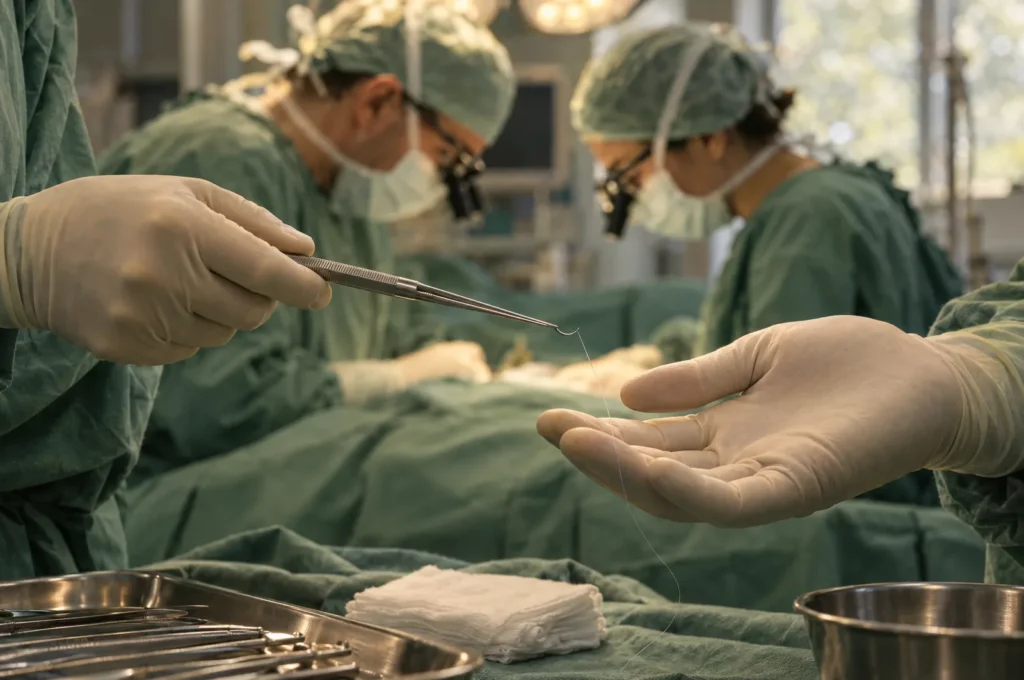
The recipient operation reaches the pelvis through an open abdominal incision. The graft is placed and then connected in a fixed order: the vascular anastomoses first, joining the uterine vessels to the recipient's iliac vessels, then the vaginal anastomosis, then fixation of the supporting ligaments so the organ sits where a uterus should sit.
Blood supply is the whole problem. The vessels are small, deep in the pelvis, and the graft tolerates very little ischaemia; most of the difficulty and most of the published failures come down to vascular thrombosis in the days afterwards. This is why the first week is spent on intensive Doppler monitoring rather than on recovery in any ordinary sense.
Immunosuppression begins immediately and continues for as long as the graft is in place. Rejection is watched for with regular cervical biopsies, which are simple to take and are the main reason uterus transplantation can be monitored closely at all — most transplanted organs offer nothing so accessible.
From transplant to a baby: the timeline
Nothing about this is quick. The published sequence runs roughly like this, and every stage can stop it.
From first consultation to a birth, three to five years is a realistic span for the cases that succeed.
- Medical file review Records go to the relevant specialists before any travel is discussed. Ovarian function, marital and gamete status under Turkish law, previous cancer, fitness for immunosuppression.
- Eligibility decision Including when the answer is no. The legal restriction on assisted reproduction ends the pathway here for a significant share of enquiries.
- IVF and embryo banking Before the transplant, never after: a transplanted uterus has no fallopian tubes. Several good-quality embryos are usually required before anyone is listed.
- Ministry authorisation and ethics committee Each case is an individual permission, not a programme to join. We prepare and track the paperwork; nothing is arranged outside the legal framework.
- Transplant Open abdominal surgery, 4–6 hours. The first week is intensive Doppler monitoring for vascular thrombosis, which is where most failures happen.
- Waiting and monitoring First menstruation usually at four to eight weeks — the first sign the graft works. Rejection is watched for with cervical biopsies.
- Embryo transfer and pregnancy One embryo at a time; several attempts are normal. The pregnancy is managed as high-risk throughout, with immunosuppression continued.
- Caesarean delivery, then graft removal Always a caesarean — a transplanted uterus has no nerve supply. The graft is removed after the last planned pregnancy so immunosuppression can stop.
Risks, stated plainly
This is major surgery with a long drug burden, undertaken for a condition that is not threatening the woman's health. The risks deserve to be read before the success stories.
- Graft failure. A substantial minority of transplanted wombs are removed within the first year, most often because of vascular thrombosis. The operation can simply not work, and the woman is then back where she started, having taken all the risk.
- Rejection. Episodes are common and usually treatable when caught on biopsy, but they mean more drugs and more monitoring.
- Infection. Immunosuppression is systemic; so is the vulnerability it creates.
- Drug effects. Tacrolimus and the agents used alongside it affect kidney function, blood pressure and glucose, over years rather than weeks.
- Pregnancy complications. Pre-eclampsia, growth restriction and preterm delivery are all reported more often than in ordinary pregnancies.
- Two more operations. The caesarean and the later removal of the graft are both planned surgeries in their own right.
- It may all come to nothing. Not every transplant leads to a pregnancy, and not every pregnancy leads to a live birth.

What the results actually show
Between the first attempt in 2000 and the end of 2024, more than 140 uterus transplants were performed worldwide, by the estimate of the Swedish team behind the first birth (Brännström et al., Reproductive Medicine and Biology, 2025), across a small number of programmes. That is not enough for the kind of statistics patients are used to seeing, and any centre quoting you a confident success rate for your particular case is going beyond what the literature supports.
What can be said is narrower and more useful. Live births have been achieved from both living and deceased donors. The first came from Sweden in 2014, from a living donor. The first from a deceased donor came from Brazil, where a child was delivered in December 2017 and the case was published in The Lancet. Where a graft survives the first year and a pregnancy is established, the chance of taking a baby home is reasonably good — the attrition happens earlier, in the transplant itself and in the transfers that do not implant.
We do not publish a percentage here, because no verified figure exists for any single centre at a volume that would make one meaningful.
What Türkiye's programme has done
In 2011 the surgical team of Prof. Ömer Özkan at Akdeniz University Hospital in Antalya performed the world's first uterus transplant from a deceased donor. It was the second uterus transplant attempted anywhere, and the first that succeeded surgically: the graft took, and the recipient menstruated about three weeks later.
The case is documented in the peer-reviewed literature rather than in press releases. Nine years after that transplant the same recipient delivered a healthy baby, reported in Annals of Surgery in 2022 — the first birth after a uterus transplant in Türkiye. Further transplants were performed by the programme in 2021 and in 2026.
Two things that are often said about this programme are not accurate, and we would rather correct them than repeat them. The 2020 delivery was not the world's first birth from a deceased-donor uterus; that was the Brazilian case three years earlier. And the first birth after any uterus transplant was in Sweden in 2014, from a living donor. Türkiye's genuine first — the deceased-donor transplant itself, in 2011 — stands on its own without being enlarged.
Cost, and why we do not print a price
There is no price list for this operation, here or anywhere, and a page that gave you a figure would be inventing one. The cost of a uterus transplant is not a single procedure fee: it is the IVF cycles beforehand, the donor and recipient surgeries, weeks of inpatient care, years of immunosuppressive drugs and monitoring, a high-risk pregnancy, a caesarean delivery and a final operation to remove the graft.
It is also not an operation that can be bought. Each case in Türkiye requires individual authorisation, and no amount of willingness to pay substitutes for that. Where we can be concrete is on the parts around it — what a medical file review costs, what accommodation and interpreting cost, what the IVF stage costs — and we will put those in writing once we know which of them apply to you.
What happens if you contact us
We will not promise you this operation. What we can do is tell you honestly and early whether your situation is one the Turkish framework can accommodate, which is more than most enquiries get.
BergemHealth works with Prof. Ömer Özkan directly, not through an aggregator. We will pass your records to him and his team and arrange a consultation with him personally — a conversation about your situation, not a promise of surgery.
- A file review first. Your records go to the relevant specialists before anyone discusses travel. Most of what determines the answer — ovarian function, marital and gamete status under Turkish law, previous cancer, general fitness for immunosuppression — is visible on paper.
- A straight answer about eligibility. Including when it is no. The legal restrictions on assisted reproduction here rule out a significant share of the people who write to us, and we would rather say so in the first week than the sixth month.
- The paperwork, if you proceed. Ministry authorisation, hospital ethics submission, residence and translation of records — we prepare and track all of it, in the legal framework as it stands, with nothing arranged outside it.
- A named coordinator in the room. Not a call centre. The same person through assessment, surgery and follow-up, interpreting at every appointment.
- Hospital pricing. What you pay is what the hospital charges. We take nothing from your side of the transaction.
If your answer turns out to be surrogacy or adoption in your own country, we will tell you that too.
Frequently asked questions
Can a woman born without a uterus really carry her own baby?
Is the transplanted uterus permanent?
Can I get pregnant naturally after a uterus transplant?
Can my mother or sister be the donor in Türkiye?
Who performed the first uterus transplant from a deceased donor?
Was the 2020 birth in Türkiye a world first?
What are the chances it works?
How long does the whole process take?
Is a uterus transplant available to foreign patients in Türkiye?
Does it matter that I am not married, or that I would need donor eggs?
How is the baby delivered?
What does it cost?
Sources
- Ozkan Ö et al. Birth of a Healthy Baby 9 Years After a Surgically Successful Deceased Donor Uterus Transplant. Ann Surg, 2022
- Uterus Transplantation: From a Deceased Donor or Living Donor? J Clin Med, 2022
- Brännström M et al. Livebirth after uterus transplantation. The Lancet, 2015
- Ejzenberg D et al. Livebirth after uterus transplantation from a deceased donor. The Lancet, 2018
- American Society for Reproductive Medicine: position statement on uterus transplantation
- MedlinePlus Genetics: Mayer-Rokitansky-Küster-Hauser syndrome
- Orphanet: Mayer-Rokitansky-Küster-Hauser syndrome
- UAB Medicine: Uterus Transplant programme
- Baylor Scott & White Health: Uterus Transplant
- T.C. Sağlık Bakanlığı — organ and tissue transplantation directorate
This article is for general information only and is not medical advice. Always consult a qualified doctor about your individual case.
Specialists in Organ Transplantation
Doctors of the department we work with directly. Which doctor takes your case is decided after the specialists have reviewed your records — your coordinator confirms it, not this page.

Considering this procedure?
Send us your photos and questions. A BergemHealth coordinator and a senior specialist will review your case and reply with honest, personalised guidance — no obligation.
Free consultation