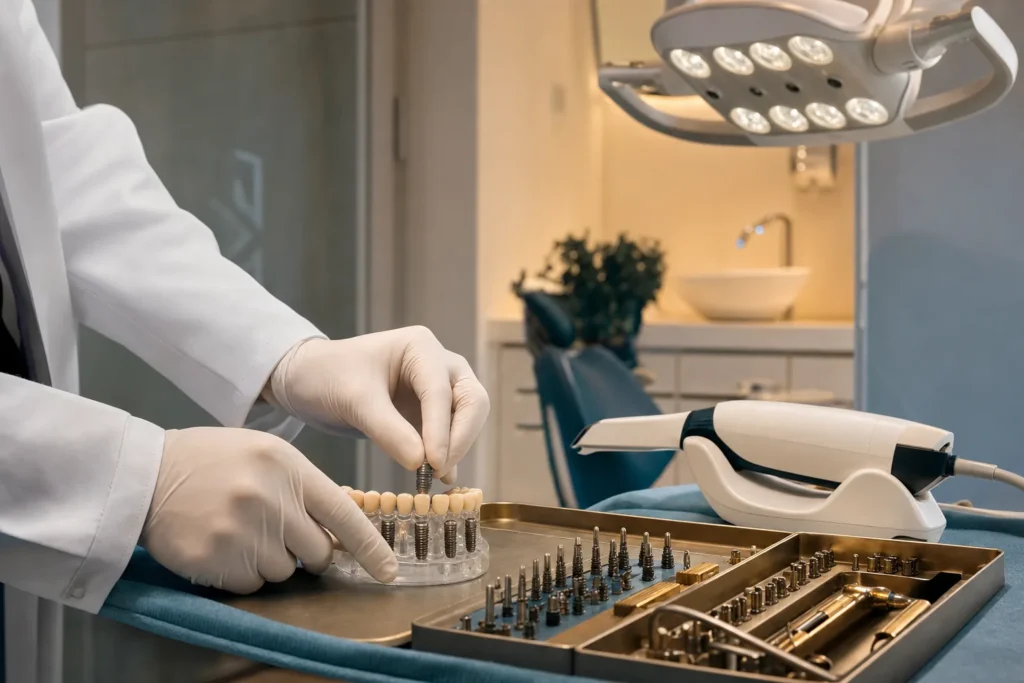
All-on-4 & All-on-6 dental implants
If you are missing most or all of the teeth in one jaw, All-on-4 and All-on-6 are a way to fix a full set of teeth onto just four or six implants, often with temporary teeth the same day. This guide explains, in plain words, how it works, what recovery is really like, the risks, how long results last, what it costs, and how to choose a safe clinic if you travel to Turkiye.
- Anaesthesia
- Usually local anaesthesia (the area is numbed), often with sedation; general anaesthesia is sometimes offered.
- Duration
- Around 2-4 hours per jaw (arch); both jaws on the same day takes longer.
- Recovery
- Most people feel close to normal within about a week; swelling and bruising settle over 1-2 weeks.
- Hospital stay
- Day case (no overnight stay needed); the implants then fuse to bone over about 3-6 months before final teeth are fitted.
Minimum price, for reference only — the final cost is calculated individually after your records are reviewed. You pay the hospital’s price; our service is free for you.
What All-on-4 and All-on-6 actually are
All-on-4 and All-on-6 are ways to replace a whole row of teeth (a full "arch" — either your top jaw, your bottom jaw, or both) using a fixed set of teeth anchored to dental implants. The names simply tell you how many implants hold the new teeth: four in All-on-4, six in All-on-6.
A dental implant is a small threaded post, usually made of titanium, that a surgeon places into your jawbone. It acts like an artificial tooth root. Over a few months the bone grows tightly around it — a natural process called osseointegration — so the implant becomes a stable foundation. Onto these few implants, the dentist fixes a single bridge: one solid piece carrying all the teeth for that jaw.
The clever part is that you do not need one implant per tooth. By spreading the chewing load across four or six well-placed posts, a full arch of 10-14 teeth can be supported. Unlike a traditional denture that rests on the gums and can slip, an All-on-4 or All-on-6 bridge is screwed onto the implants and stays put. You do not take it out at night; only your dentist removes it, for cleaning or maintenance. People also search for this as a "fixed full-arch implant bridge," "implant-supported denture," or "teeth in a day."
Who is a good candidate — and who should think twice
This treatment is designed for people who have lost most or all of their teeth in a jaw, or whose remaining teeth are failing and need to be removed. It also suits people who already wear a full denture and are tired of it moving, clicking, or limiting what they can eat.
The main requirement is having enough healthy jawbone to hold the implants. A big advantage of the angled-implant approach is that it often reaches the firmer bone at the front of the jaw, so many people can avoid bone grafting (adding bone) that would otherwise add months to treatment. Where bone is very thin, a graft or sinus lift may still be needed first.
You should also have healthy gums and be willing to keep up good daily cleaning. There is usually no upper age limit, but you generally need to be an adult whose jaw has finished growing.
Who should be cautious or wait:
- Smokers and vapers. Smoking reduces blood flow and slows healing, which lowers implant success. Quitting before and after surgery improves your odds.
- People with untreated gum disease, heavy tooth decay, or active mouth infection — these are usually treated first.
- People with poorly controlled diabetes, certain bone or blood disorders, or some autoimmune conditions, which can affect healing.
- People who have had radiotherapy to the head or neck, or who take certain bone-strengthening drugs — always tell your surgeon.
- Anyone with heavy night-time teeth grinding (bruxism), which can stress the bridge.
None of these is always an absolute "no." They are reasons for a careful assessment and, sometimes, treatment of the underlying issue first.
Types and techniques
The core idea is the same for both, with sensible differences:
- All-on-4: Two implants are placed upright at the front of the jaw, where bone is usually thicker, and two are placed at an angle (tilted) toward the back. Tilting them avoids thin bone and important structures like the sinus or nerves, and gives a wider, more stable spread for the bridge.
- All-on-6: The same principle with two extra implants. More support points can be helpful in the upper jaw, where bone tends to be softer, or for people who chew very forcefully. It may add cost and needs adequate bone.
You will also choose how soon the teeth go on:
- Immediate loading ("teeth in a day"): A temporary fixed bridge is attached the same day as surgery, so you leave with teeth. This is common with All-on-4.
- Delayed loading: The implants are left to heal first, with no bridge or a soft denture, then teeth are attached later.
The final teeth themselves come in different materials — commonly acrylic on a metal frame, or stronger, more natural-looking zirconia (a tough ceramic). The material affects both look and price. Implant brands vary too; well-known names are used as neutral examples, not endorsements.
How it is done — anaesthesia, steps and timing
The surgery is usually a day case, meaning you go home the same day. Most people have local anaesthesia (the mouth is fully numbed so you feel no pain), often combined with sedation to keep you relaxed and drowsy. General anaesthesia (fully asleep) is offered in some cases.
A typical sequence:
- Planning. Beforehand, you have a 3D scan (a CT scan) and impressions so the team can map your bone and plan exactly where each implant goes.
- Anaesthesia. The area is numbed (and you are sedated if chosen).
- Preparing the gum and removing teeth. Any failing teeth are taken out, and the gum is opened to reach the bone.
- Placing the implants. The surgeon prepares precise channels in the bone and inserts the four or six implants, tilting the back ones as planned.
- Attaching teeth. Connectors (abutments) are fitted, and — if you are having same-day teeth — a temporary fixed bridge is attached. Otherwise the gum is stitched to heal.
Plan for roughly 2-4 hours per jaw. Doing both jaws on the same day takes longer. Months later, after the implants have fused, you return for the permanent bridge.
Recovery, step by step
Recovery has two parts: feeling better day to day (fast), and the implants fully fusing to bone (slow but mostly invisible to you).
- First 24-48 hours: Expect some swelling, bruising and oozing. Rest, keep your head raised when lying down, use any prescribed pain relief or cold packs, and stick to cool liquids and very soft foods. Avoid strenuous exercise for about 48 hours.
- Days 2-7: Most people return to routine activities within a few days and feel close to normal within about a week. Continue soft foods such as soups, yoghurt, eggs and smoothies, and follow the gentle cleaning instructions you are given.
- Weeks 1-2: Swelling and bruising settle. You may have stitches removed or a check-up.
- Months 1-6 (osseointegration): The implants quietly fuse with the bone over about 3-6 months (sometimes longer, especially after a bone graft). During this time you wear the temporary bridge and eat carefully, avoiding very hard or sticky foods that could overload the implants.
- Final fitting: Once healing is confirmed, your permanent bridge is made and fitted, and you can return to a normal diet.
Contact your clinic urgently if you have heavy bleeding, pain not helped by medication, pus or signs of infection, or a fever of 38°C (101°F) or higher.
Risks and possible complications
Implant surgery is generally safe and well established, but no surgery is risk-free. Most problems are treatable, though some, such as chips in the bridge, are common over the years. Possible complications include:
- Infection at an implant site.
- Nerve injury, which can cause tingling, numbness or pain in the lip, chin, gums or teeth (usually temporary, rarely lasting).
- Sinus problems when upper implants are near the sinus cavity, including a small hole in the sinus membrane.
- Implant failure — an implant that does not fuse properly or loosens later. With only four implants, losing one can affect the whole bridge, so it is taken seriously.
- Peri-implantitis, a gum-and-bone infection around an implant, usually linked to plaque build-up and more common in smokers.
- Chips, fractures, loose screws or wear of the bridge, which are common over the years and can usually be repaired.
- Less often, bleeding, delayed healing or jaw injury.
You can lower these risks a great deal by not smoking, cleaning thoroughly, attending check-ups, and choosing an experienced surgical team.
Results and how long they last
For most people the result is a fixed, natural-looking set of teeth that restores comfortable chewing, clearer speech and confidence — without the slipping of a loose denture. Because the implants stimulate the jaw, they also help slow the bone shrinkage that often follows tooth loss.
Long-term studies of the full-arch approach report high implant survival. One long follow-up of hundreds of patients (3-17 years) found implant survival around 97-99%, with lower-jaw results slightly better than upper-jaw. Across dental implants generally, success is often quoted near 95%, with smokers somewhat lower.
The implants themselves can last many years — potentially decades — with good care. The bridge of teeth on top is a wear item and is generally expected to need replacement after roughly 15-20 years, sometimes sooner depending on material and habits. There are no guarantees: results vary with bone quality, oral hygiene, smoking, grinding and regular maintenance.
Costs and what changes the price
All-on-4 and All-on-6 are private (paid) procedures in most countries; they are rarely funded by public health systems except in special medical cases. Prices vary widely by country, clinic and case.
As an indicative guide, an All-on-4 arch in Turkiye is often advertised from roughly EUR 4,000 to EUR 9,000 per jaw, with premium materials or All-on-6 sitting at the higher end; both jaws together cost more. By comparison, the same treatment in the UK, US or Western Europe is typically several times higher. These figures are indicative ranges only — the price varies by case, surgeon and clinic, and is not a quote. Always get a written, itemised plan after a personal assessment.
What moves the price up or down:
- Number of implants and arches (one jaw vs both; four vs six).
- Implant brand and the bridge material (basic acrylic vs stronger, more natural zirconia).
- Extra procedures such as tooth extractions, bone grafting or a sinus lift.
- Temporary vs final teeth and how many review visits are included.
- The surgeon's experience, the clinic's standards, and what a "package" actually covers (scans, follow-ups, warranty).
When comparing quotes, check exactly what is included so you compare like with like — the cheapest headline number is rarely the full story.
Why people travel to Turkiye, and how to choose a safe clinic
Turkiye has become a popular destination for dental implants because prices are markedly lower than in much of Western Europe and North America, many clinics are modern and English-speaking, and packages often bundle scans, transfers and hotel stays. The key is choosing carefully so you get safe, high-quality care — not just a low price.
Before you book, verify:
- Accreditation. Look for internationally recognised standards such as JCI (Joint Commission International) or ISO certification, plus a valid local Ministry of Health licence for the clinic.
- The surgeon's credentials. Confirm the named dentist or surgeon is properly qualified and registered, and ask how many full-arch cases they do. Ask who actually performs the surgery.
- Real evidence. Genuine before-and-after cases, independent patient reviews, and clear answers to your questions.
- Written plan and pricing. An itemised treatment plan, the implant and material brands, and what happens if something goes wrong.
- Aftercare and guarantee. Who you contact after you fly home, how revisions or warranty claims work, and whether records are shared with your home dentist.
- Clear communication in a language you understand, including consent forms.
A trustworthy clinic will welcome these questions and never pressure you to decide on the spot.
How to prepare and what to ask at your consultation
Good preparation makes treatment smoother and safer:
- Share your full medical history and a list of all medicines and supplements, including blood thinners and bone drugs.
- Get any gum disease or decay treated and your mouth as clean as possible beforehand.
- If you smoke, stop — or cut down as much as you can — before and after surgery to help healing.
- Arrange the 3D scan and assessment; for remote planning, clinics may review your scans before you travel.
- Plan time off and someone to help in the first day or two, especially if you have sedation.
Useful questions to ask:
- Am I a good candidate, or do I need a graft or sinus lift first?
- Will it be All-on-4 or All-on-6, and why? What implant brand and bridge material?
- Will I get same-day temporary teeth, and when are the final teeth fitted?
- What anaesthesia will be used?
- What are the specific risks in my case, and what is the success record?
- What is the total cost, what is included, and what is the aftercare and guarantee?
- How many follow-up visits do I need, and can my home dentist do them?
Aftercare and travelling for treatment
Looking after your new teeth is what makes them last. Clean thoroughly every day with the brushes and aids your clinic recommends, including under the bridge where food can collect, and keep up regular check-ups and professional cleans. Watch for warning signs — bleeding gums, swelling, looseness or pain — and report them early. While the implants fuse, stick to softer foods and avoid biting very hard or sticky things.
If you travel abroad for treatment, plan the trip around healing, not just the surgery:
- Allow enough days in the country. You will usually need the assessment and surgery, plus at least one review before flying home. Build in buffer days.
- Avoid flying too soon. Many clinics advise not flying for a couple of days after surgery, as cabin pressure and long periods of sitting can worsen swelling. Follow your surgeon's specific advice.
- Remember the second trip. The final bridge is fitted months later, so factor in returning, or arranging a clear plan for follow-up.
- Keep your records. Take home your treatment notes, implant details and a contact for problems, and share them with your dentist at home.
- Have a plan for complications. Know who to call and where you would be treated if an issue arises after you return.
Treated as a partnership between you, the clinic and your home dentist, All-on-4 and All-on-6 can be a durable, life-changing way to replace a full set of teeth.
Frequently asked questions
What is the difference between All-on-4 and All-on-6?
Is it true you can get teeth in a day?
Does the procedure hurt?
How long does recovery take?
How long do All-on-4 and All-on-6 implants last?
Will I still need bone grafting?
Can I have this treatment if I smoke or have diabetes?
What can go wrong?
How much does All-on-4 cost in Turkiye?
How do I choose a safe clinic abroad?
When is it safe to fly after the surgery?
Do I need to remove the new teeth at night?
Sources
- Cleveland Clinic — Implant-Supported Dentures (incl. All-on-4)
- Cleveland Clinic — Dental Implants
- The All-on-four concept for fixed full-arch rehabilitation: longitudinal study (PMC)
- Impact of smoking on dental implants: a review (PMC)
- Smoking, radiotherapy, diabetes and osteoporosis as risk factors for implant failure: meta-analysis (PMC)
- Full Arch Rehabilitations Through the Contemporary All-on-4 Concept (ClinicalTrials.gov)
- Joint Commission International — Accreditation
This article is for general information only and is not medical advice. Always consult a qualified doctor about your individual case.
Specialists in Dentistry
Doctors of the department we work with directly. Which doctor takes your case is decided after the specialists have reviewed your records — your coordinator confirms it, not this page.

Considering this procedure?
Send us your photos and questions. A BergemHealth coordinator and a senior specialist will review your case and reply with honest, personalised guidance — no obligation.
Free consultation