Dental veneers
Veneers are thin, custom-made covers bonded to the front of your teeth to change their colour, shape or alignment. This guide explains how they work, who they suit, what the procedure and recovery really involve, how long they last, and what to check before treating abroad — in clear, everyday language.
- Anaesthesia
- Usually local anaesthetic (numbing of the gum and tooth); often none needed for minimal-prep or composite cases.
- Duration
- About 1-2 hours per visit; porcelain typically needs two visits a week or two apart, composite often one visit.
- Recovery
- No real downtime; you can eat and return to normal activities the same day. Mild temperature sensitivity may last days to a few weeks.
- Hospital stay
- None — veneers are an outpatient dental procedure with no overnight stay.
Minimum price, for reference only — the final cost is calculated individually after your records are reviewed. You pay the hospital’s price; our service is free for you.
What dental veneers are
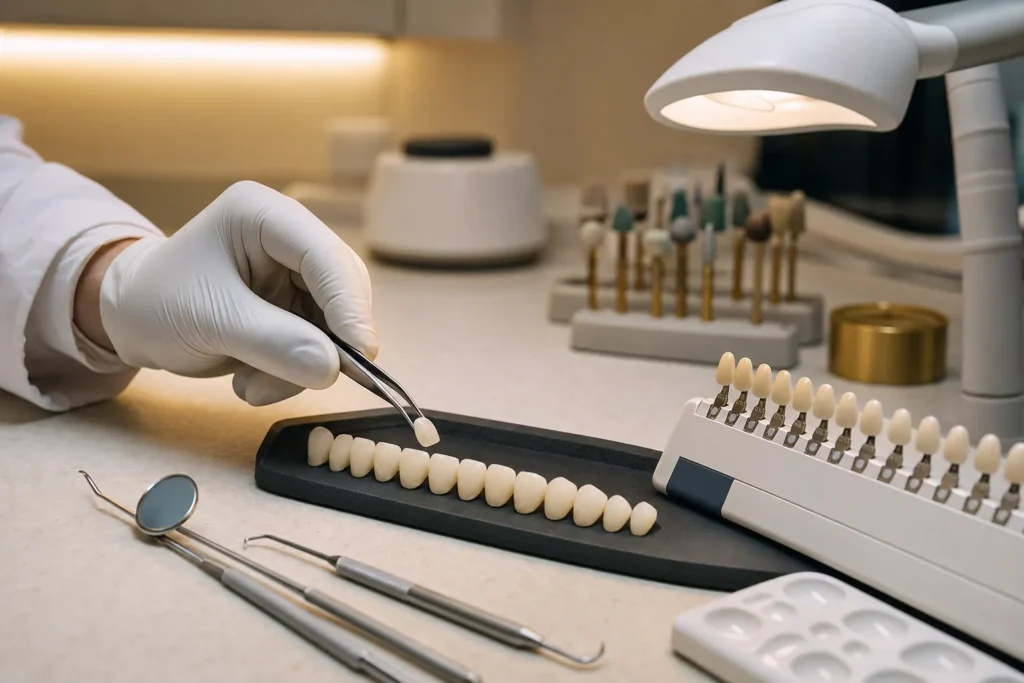
A dental veneer is a thin, custom-made shell that covers the front surface of a tooth. Think of it like a fitted cover that changes how the tooth looks while leaving most of the natural tooth underneath. The American Dental Association describes veneers as custom-made, natural-looking coverings made of high-quality dental material.
People choose veneers to improve the appearance of teeth that are stained and won't whiten, chipped or worn, slightly crooked, unusually small or misshapen, or separated by small gaps. Veneers are mainly a cosmetic treatment — they change the look of a smile rather than treat a disease.
There are two main materials. Porcelain veneers are thin ceramic shells made in a dental laboratory; they are strong, look very natural and resist staining well. Composite veneers are built up from a tooth-coloured resin (the same family of material used for white fillings), usually shaped directly onto the tooth in a single visit. A full upper-and-lower set styled for a bright, even look is what social media often calls a "Hollywood smile," but that is a marketing phrase, not a separate type of veneer.
Who is a good candidate (and who should think twice)
Veneers tend to suit people whose teeth are basically healthy but who are unhappy with colour, shape or minor positioning. Good signs you may be a candidate:
- Healthy gums and teeth free of active decay
- Stains that whitening can't fix, or chips, worn edges and small gaps
- Realistic expectations — you want improvement, not perfection
- Enough healthy enamel for the veneer to bond to
Some situations mean veneers may not be right, or that other work must come first. The ADA and Cleveland Clinic note that a dentist must treat existing tooth decay or gum disease before placing veneers. Veneers may also be a poor choice if you:
- Clench or grind your teeth (bruxism), which can crack or chip veneers
- Have a deep "bite" where teeth meet heavily, putting stress on the veneers
- Have weakened, heavily filled or very worn teeth that may need a crown instead
- Have unhealthy gums or untreated cavities
One point that matters for everyone: because some enamel is usually removed, traditional veneers are not reversible. Once a tooth is prepared, it will always need a veneer or crown. That is a permanent commitment, so it deserves a careful conversation with your dentist.
Types and techniques
The main choice is the material, and each has trade-offs.
Porcelain veneers. Custom-made in a lab from an impression or digital scan of your teeth. They are strong, long-lasting and very natural-looking, and they resist staining better than natural enamel. They usually need a little more enamel removed and at least two visits because the lab makes them.
Composite veneers. Tooth-coloured resin shaped and hardened directly on the tooth, often in a single visit. They generally need less enamel removed and cost less, but they are more likely to chip, wear or pick up stains over time, and they don't usually last as long as porcelain.
Minimal-prep or "no-prep" veneers. Very thin veneers that need little or no enamel removed. They suit only some cases (for example, small teeth or modest changes), and not everyone is a candidate.
You may also hear about removable or "pop-on" veneers. These clip over the teeth and are not bonded; they can affect eating and speech and are not a substitute for bonded veneers. A separate option for badly damaged teeth is a crown, which covers the whole tooth rather than just the front — your dentist will advise if a crown is the safer choice.
How veneers are fitted, step by step
For porcelain veneers, treatment usually runs across two appointments. The NHS describes the process clearly.
- Consultation and planning. The dentist examines your teeth and gums, discusses the shade and shape you want, and confirms you're suitable. Photos, X-rays or a digital scan may be taken.
- Preparation. A thin layer of enamel — typically around 0.3-0.7 mm, often about 0.5 mm — is removed from the front of each tooth so the veneer sits flush and looks natural. This is the irreversible step.
- Impression and temporaries. The dentist takes an impression or scan and sends it to the lab. Temporary veneers may be fitted while the permanent ones are made, typically over a week or two.
- Bonding. At the second visit the dentist checks the fit, shape and colour, then bonds the veneer permanently in place with a special dental cement, often set hard with a curing light, and adjusts your bite.
Anaesthesia. A local anaesthetic (an injection that numbs the area) is commonly used during preparation so you feel no pain, though minimal-prep and many composite cases may need none. Veneers do not require general anaesthetic or sedation in the vast majority of cases.
How long it takes. Each visit usually lasts around one to two hours depending on how many teeth are treated. Composite veneers are often completed chair-side in a single visit because no lab work is needed.
Recovery, step by step
One of the appealing things about veneers is that there is essentially no downtime. Cleveland Clinic notes you can return to normal activities the same day, and the NHS notes veneers become strong quickly so you can eat with them soon after fitting.
That said, here is what to expect in the days afterwards:
- First 24-48 hours. Mild sensitivity to hot and cold is common, because removing enamel briefly exposes the inner part of the tooth. If the area was numbed, take care eating until the numbness wears off.
- First couple of weeks. Sensitivity usually settles as the tooth adjusts. Your bite may feel slightly different at first; tell your dentist if it feels high or uneven, as it can be adjusted.
- Getting used to them. Speech and the feel of the new edges normally feel natural within a few days.
Practical tips: brush gently with a soft brush, avoid biting very hard foods directly with the veneered teeth for the first day or two, and keep any follow-up appointment so the dentist can check the bite and bond.
Risks and possible complications
Veneers are generally low-risk, but no dental treatment is risk-free. Honest things to know:
- Permanent enamel loss. For traditional veneers, enamel removal can't be undone, so the tooth will always need covering.
- Sensitivity. Temperature sensitivity is common after preparation and usually fades, though it can last longer for some people.
- Chips, cracks or coming loose. The ADA notes veneers can chip, crack, wear down or loosen over time, especially if you grind your teeth or bite hard objects. A loose or damaged veneer needs professional repair or replacement.
- Colour mismatch. Veneers don't change colour once made, so they won't whiten later. If you want whiter natural teeth too, whitening is usually done before veneers are matched.
- Decay or gum problems underneath. Cavities can still form at the edges of veneers, so good cleaning matters.
- An imperfect cosmetic result. Shade or shape may not be exactly as hoped; reviewing the plan and a trial smile beforehand reduces this risk.
See a dentist promptly if a veneer feels loose, an edge becomes sharp, sensitivity worsens, or a gum becomes sore or swollen.
Results and how long they last
Well-made, well-cared-for veneers can transform a smile and look natural for many years. Lifespan depends mainly on the material and how you look after them.
- Porcelain veneers commonly last around 10 to 15 years, and Healthline notes some last 20 years or longer in studies. Cleveland Clinic gives a general figure of 10 to 15 years with proper care.
- Composite veneers generally last a shorter time — often around 5 to 7 years — and are more prone to staining and chipping, though they're easier and cheaper to repair.
What makes them last longer: good daily cleaning, regular dental check-ups, wearing a night guard if you grind your teeth, not using your teeth as tools, and going easy on very hard foods. Veneers don't last forever, so plan on eventual replacement as part of the long-term cost.
Costs and what changes the price
Veneers are usually a private, cosmetic cost rather than something covered by public health systems. The NHS, for example, only provides veneers in rare cases of clear clinical need, not for appearance. Prices vary widely by country, clinic, material and how many teeth you treat.
As an indicative guide, the price for a single veneer in Turkiye often falls roughly in the range of EUR 150 to EUR 450, with porcelain at the higher end and composite lower. A full smile of multiple veneers is therefore a multiple of that per-tooth figure. By comparison, single porcelain veneers in Western Europe, the UK or the US commonly cost several times more per tooth.
What moves the price:
- Material — porcelain (including premium ceramics) costs more than composite
- Number of teeth — a full upper-and-lower set is a large project
- Lab work and technology — digital scanning, trial smiles and high-end ceramics add cost
- The dentist's experience and the clinic's standards
- Extra treatment first — fillings, gum treatment or whitening before veneers
These figures are indicative ranges only and vary by case, dentist and clinic — they are not a quote. Always ask for a written, itemised treatment plan with the final price before you commit.
Why people travel to Turkiye, and how to choose a safe clinic
Turkiye has become a popular destination for dental work because prices are often substantially lower than in Western Europe, the UK or the US, many clinics are modern and used to international patients, and treatment can sometimes be condensed into a short trip. Lower cost should never be the only factor, though — quality and safety come first.
Here is what to verify before booking:
- Accreditation. Look for internationally recognised accreditation such as Joint Commission International (JCI), which you can check on JCI's official directory. In Turkiye, also confirm the facility holds the Ministry of Health's International Health Tourism Authorisation.
- The dentist's qualifications. Ask about the dentist's training, registration and experience specifically with veneers, and ask to see before-and-after cases of their own work.
- Materials. Ask which veneer brand and material will be used, and whether they meet recognised standards (such as CE marking).
- A written plan. A trustworthy clinic gives a clear, itemised treatment plan and price in advance. Be cautious of anyone who can't.
- Realistic case planning. Be wary of plans to file down many healthy teeth for a fast, dramatic result. Reputable dentists protect healthy tooth structure.
- Aftercare and guarantees. Ask what happens if a veneer chips or fails after you fly home, and who will handle follow-up care in your own country.
A medical-tourism concierge can help arrange consultations, translations and logistics, but you should still ask these questions yourself.
How to prepare and what to ask at your consultation
Good preparation makes for a smoother result. Before treatment:
- Have any decay or gum problems treated first
- Decide on whitening beforehand if you want brighter natural teeth, so the veneers can be matched
- Gather your dental history and any X-rays to share
- Bring photos of smiles you like, and be open about what bothers you
Questions worth asking your dentist:
- Am I a good candidate, or would crowns, bonding or orthodontics suit me better?
- How much enamel will be removed, and is the treatment reversible?
- Which material do you recommend for my case, and why?
- Can I see a digital preview or trial smile before anything is filed?
- How many visits will I need, and how long apart?
- What is the full, itemised cost, including any extra treatment?
- What is the expected lifespan, and what's the plan if a veneer fails?
- Do I grind my teeth, and would I need a night guard?
If you are traveling, also ask how long you should stay in the country between visits and what follow-up looks like once you're home.
Aftercare and travelling for treatment
Veneers don't need exotic maintenance — they need the same good habits that protect natural teeth, plus a little care. Cleveland Clinic and the ADA recommend:
- Brush twice daily with a soft brush and non-abrasive fluoride toothpaste, and floss daily
- Keep up regular dental check-ups and cleanings
- Limit staining drinks like coffee, tea and red wine, especially with composite veneers
- Avoid biting hard items (ice, pens, fingernails) and don't use your teeth as tools
- Wear a mouthguard for sport, and a night guard if you grind your teeth
Travelling and flying. Veneers are not surgery, so there is no major recovery to delay a flight. Because the procedure typically uses only local anaesthetic (or none), it is generally fine to fly the same day or soon after fitting once you feel comfortable. Two small tips for the plane: cabin air is dry, so sip water to ease any dry mouth, and if your teeth feel sensitive after preparation, cold cabin air can briefly aggravate it — staying warm and hydrated helps.
If you're treating abroad, plan enough time for porcelain veneers, which usually need two visits a week or two apart (composite is often one visit), and make sure you have a clear aftercare plan and a local dentist who can help once you return home.
Frequently asked questions
Do veneers hurt?
Are veneers permanent or reversible?
How long do veneers last?
Porcelain or composite veneers — which is better?
How many veneers will I need?
Can veneers fall off?
Will veneers fix crooked teeth?
Can I whiten veneers later?
Why are veneers cheaper in Turkiye?
Is it safe to fly after getting veneers?
Do I still need to brush and floss with veneers?
How do I know if a clinic abroad is safe?
Sources
- NHS — Veneers (cosmetic procedures)
- Cleveland Clinic — Dental Veneers
- American Dental Association (MouthHealthy) — Veneers
- Cleveland Clinic — Dental Bonding (composite)
- Healthline — How Long Do Veneers Last?
- Colgate — Dental Veneers: Pros and Cons
- Joint Commission International — accreditation
- MoneyHelper — NHS dental charges (bands)
This article is for general information only and is not medical advice. Always consult a qualified doctor about your individual case.
Specialists in Dentistry
Doctors of the department we work with directly. Which doctor takes your case is decided after the specialists have reviewed your records — your coordinator confirms it, not this page.


Considering this procedure?
Send us your photos and questions. A BergemHealth coordinator and a senior specialist will review your case and reply with honest, personalised guidance — no obligation.
Free consultation