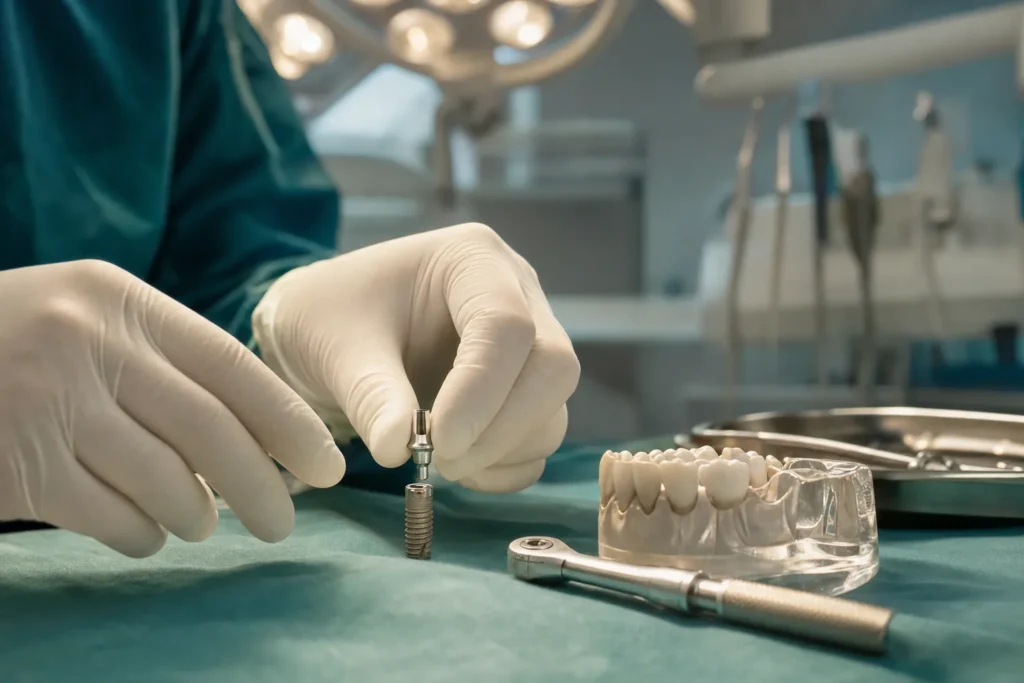
Single dental implants
A single dental implant replaces one missing tooth with a small titanium post that acts as a new root, topped by a custom crown. This plain-language guide explains how the procedure really works, who it suits, what recovery feels like, how long implants last, what they cost, and how to choose a safe clinic if you are considering treatment in Turkiye.
- Anaesthesia
- Usually local anaesthesia (numbing injection); optional sedation for anxious patients.
- Duration
- Placing one implant typically takes about 30 to 60 minutes.
- Recovery
- Initial healing 7 to 10 days; bone fusion (osseointegration) about 3 to 6 months before the crown.
- Hospital stay
- Day case (outpatient); no overnight hospital stay needed.
Minimum price, for reference only — the final cost is calculated individually after your records are reviewed. You pay the hospital’s price; our service is free for you.
What a single dental implant is
A single dental implant is a way to replace one missing tooth from the root up. Instead of grinding down the teeth on either side to support a bridge, the dentist places a small post into your jawbone. That post acts as an artificial tooth root, and a lifelike crown is fixed on top.
A complete single implant has three parts:
- The implant (post or fixture): a small threaded screw, usually made of titanium (sometimes ceramic), placed into the jawbone. Titanium is used because bone naturally bonds to it.
- The abutment: a small connector that sits on top of the implant and pokes just above the gum line.
- The crown: the visible, tooth-shaped cap, custom-made to match the colour and shape of your other teeth.
The reason implants feel so natural is a process called osseointegration ("osseo" means bone). Over several months, living bone grows onto the surface of the titanium and locks it firmly in place, the way a real root sits in the jaw. Once that bond forms, you can bite and chew with a single implant much as you would with a natural tooth.
Who is a good candidate, and who should be cautious
Single implants suit most adults who have lost one tooth to decay, a crack, an accident, or gum disease and who want a fixed replacement that does not touch the neighbouring teeth. To be a good candidate you generally need:
- A fully grown jaw (usually age 18 or older), because implants are not placed while the jaw is still developing.
- Enough healthy jawbone to hold the post. If bone has shrunk where the tooth was missing for a long time, a graft can often rebuild it.
- Healthy gums and good day-to-day oral hygiene.
- General health good enough for minor oral surgery.
Some people should be more cautious or need extra planning. Implants may be delayed or discouraged if you have:
- Active, untreated gum disease or heavy plaque, which must be controlled first.
- Significant bone loss at the site (often solvable with grafting, but it adds time).
- Smoking or vaping: these slow healing and raise the risk of the implant failing.
- Poorly controlled diabetes, some autoimmune conditions, or treatments that affect bone or healing, such as certain bone medicines (bisphosphonates) or radiotherapy to the jaw.
None of these is an automatic "no." They simply mean your dentist will assess you carefully and may treat other problems before recommending an implant.
Types and techniques
For a single missing tooth, the standard choice is an endosteal implant a post placed directly into the jawbone. This is by far the most common type. (An older alternative, the subperiosteal implant, rests on top of the bone under the gum and is rarely used today.)
Within that, dentists use a few different timing approaches:
- Delayed (two-stage) placement: the most traditional and predictable route. The implant is placed, allowed to heal under or through the gum for a few months, and the crown is fitted later.
- Immediate implant placement: the implant is placed in the same visit a damaged tooth is removed, when the bone and gum allow it. This can reduce the number of procedures.
- Immediate-load or "same-day" implant: a temporary crown goes on right away. This is only suitable in selected cases where the implant is very stable from the start; the permanent crown still comes later.
Two preparatory techniques are common when there is not enough bone:
- Bone graft: bone (your own, donor, or synthetic) is added to build up a thin or shrunken ridge so it can hold the implant.
- Sinus lift: in the upper back jaw, the floor of the sinus is gently raised and bone added underneath, so an implant can be placed without entering the sinus. New bone usually needs several months to mature before the implant goes in.
How a single implant is placed, step by step
Most single implants are placed as a day case under local anaesthetic the same kind of numbing injection used for a filling so you stay awake but feel no pain. Anxious patients can often add sedation to feel relaxed and drowsy. General anaesthesia is rarely needed for a single tooth.
A typical placement looks like this:
- Numbing: the gum and jaw around the site are fully numbed.
- Opening the gum: a small incision exposes the bone (some techniques use a tiny punch instead).
- Preparing the bone: the dentist creates a precisely sized channel in the bone, often guided by a 3D scan.
- Placing the implant: the titanium post is screwed gently into the channel.
- Closing: the gum is stitched, sometimes over the implant, sometimes around a small healing cap.
Placing one implant usually takes about 30 to 60 minutes. Then comes the wait for osseointegration, commonly 3 to 6 months. After that, a short second visit attaches the abutment, a mould or digital scan is taken, and a lab makes your crown, usually ready in roughly one to two weeks. At a final appointment the crown is fitted and checked against your bite.
Recovery, step by step
Recovery from a single implant is usually milder than people expect. Here is a realistic timeline:
- First 24 to 48 hours: some swelling, mild bleeding, and tenderness are normal. Use cold packs, rest, and take any pain relief your dentist advises. Most discomfort responds to over-the-counter painkillers.
- Days 2 to 7: swelling settles. Eat soft, cool foods and chew on the other side. Keep the area clean as instructed, often with a gentle antiseptic rinse rather than vigorous brushing right at the site.
- Around 7 to 10 days: if you have stitches that are not dissolvable, they are removed, and the gum begins to look normal. Many people return to work within a few days.
- Weeks to months: on the surface things feel fine quickly, but underneath the bone is slowly bonding to the implant. This quiet healing phase is why the permanent crown waits a few months.
Throughout recovery, avoid smoking (it markedly slows healing), follow your hygiene instructions, and contact your clinic if you have increasing pain, swelling, fever, or the implant feels loose.
Risks and possible complications
Single implants have a strong safety record, but, like any surgery, they carry some risk. Most complications are uncommon and treatable. They include:
- Infection at the implant site soon after surgery.
- Peri-implantitis: a gum-disease-like inflammation around an established implant that can erode the supporting bone if not treated. Good hygiene and regular check-ups are the main defence.
- Nerve or tissue injury: rarely, numbness or tingling in the lip, gum, or chin, usually when an implant is close to a nerve in the lower jaw.
- Sinus problems when placing an upper back-jaw implant too close to the sinus cavity.
- Implant failure the bone not bonding, or the implant loosening over time. This is more likely in smokers and in people with uncontrolled diabetes or untreated gum disease.
The evidence is reassuring overall. Long-term studies report implant survival of roughly 90 percent or more after about a decade, with somewhat lower figures over 15 years. Smoking is repeatedly linked to more bone loss and a higher chance of peri-implantitis, which is why clinics stress stopping smoking around the procedure.
Results and how long they last
A well-placed, well-maintained single implant can restore near-natural chewing, speech, and appearance, and it protects the neighbouring teeth because they are not cut down to hold a bridge. It also helps preserve the jawbone in the gap, since the post stimulates the bone the way a natural root does.
How long does it last? It helps to separate the two parts:
- The implant post itself is designed to be permanent. With good oral hygiene and regular dental visits, many implants last for decades, and studies show high survival rates well beyond ten years.
- The crown on top is a wearing part. Crowns commonly last many years and can be replaced if they chip or wear, without removing the implant underneath.
The biggest factors in long-term success are everyday brushing and flossing around the implant, not smoking, professional cleanings, and keeping gum disease under control. No honest clinic can promise a specific outcome, but a properly maintained implant is one of the most durable tooth replacements available.
Costs and what changes the price
In Turkiye, an indicative price for a single dental implant including the crown commonly falls in roughly the EUR 400 to EUR 1,200 range. Premium implant brands, complex cases, or extra procedures can sit above this. These figures are illustrative ranges, not a quote the real cost varies by case, surgeon, clinic, and what your mouth actually needs, and only a personal assessment can give you an accurate price.
What moves the price up or down:
- Implant brand and components: well-known premium systems (used here only as neutral examples, such as Straumann or Nobel Biocare) typically cost more than value brands.
- Crown material: all-ceramic or zirconia crowns differ in price from metal-backed ones.
- Extra procedures: tooth extraction, a bone graft, or a sinus lift each add cost and time.
- Imaging and planning: 3D CT scans and guided surgery.
- Clinic, city, and surgeon experience.
Always ask exactly what a quoted price includes consultation, the implant, the abutment, the crown, scans, follow-ups, and any guarantee so you are comparing like with like rather than a low headline figure that excludes key items.
Why people travel to Turkiye, and how to choose a safe clinic
Turkiye has become a major destination for dental implants largely because prices are often well below those in the UK, much of Western Europe, North America, and Australia, while many clinics offer modern equipment, English-speaking coordinators, and package arrangements. The savings are real, but quality varies between clinics, so the choice of clinic and dentist matters far more than the country.
Before you commit, verify the following:
- Accreditation: look for recognised standards such as JCI (Joint Commission International) or ISO certification, and check the clinic is licensed by the Turkish Ministry of Health.
- The dentist's qualifications: confirm who will actually place your implant, their training in implant dentistry, and their experience with single implants specifically.
- Implant brand and traceability: ask which implant system is used and request the implant passport or batch details, so future dentists anywhere can service it.
- Hygiene and imaging: sterile protocols and proper 3D planning are basics, not extras.
- Clear written plan and price: an itemised treatment plan, a guarantee or warranty in writing, and a named point of contact.
- Aftercare and follow-up: how problems are handled once you are home, and who you call.
A reputable concierge or clinic should welcome these questions and answer them in writing. Be wary of pressure to decide instantly, prices that seem far below everyone else, or vague answers about who is doing the surgery.
How to prepare and what to ask at your consultation
Good preparation makes the whole process smoother and safer. Before treatment, expect a thorough assessment: a dental exam, X-rays or a 3D scan to check bone, and a review of your medical history and medicines. To prepare:
- Share a full medical history, including diabetes, bone medicines, blood thinners, and any heart or immune conditions.
- Stop or reduce smoking well before and after surgery if you can it genuinely improves your odds of success.
- Sort out any gum disease, decay, or infection first.
- Arrange soft foods and a couple of quiet days after placement.
Useful questions to ask:
- Do I have enough bone, or will I need a graft or sinus lift and how does that change the time and cost?
- Which implant brand will you use, and why?
- Who will place the implant, and what is their experience?
- What is the full timeline from placement to final crown?
- What are the realistic risks in my case, and what is your success rate?
- Exactly what does the price include, and is there a written guarantee?
- What happens if something goes wrong after I travel home?
Aftercare and travelling for treatment
Long-term, an implant is cared for like a natural tooth: brush twice a day, clean between the teeth (your dentist may suggest interdental brushes or floss designed for implants), and keep regular dental check-ups and cleanings so any early gum inflammation is caught before it threatens the bone.
If you are travelling for treatment, plan around the two-stage nature of implants. Because the bone needs months to fuse, the implant is often placed on one trip and the permanent crown fitted on a later visit, or arranged with a dentist at home. Discuss this split with your clinic in advance so you know how many trips to budget for.
On flying after surgery: a single implant under local anaesthetic is minor day surgery, and many people fly within a day or two once any bleeding has settled and they feel well. However, flying timing depends on your individual case especially if you had a tooth extraction, a bone graft, or a sinus lift, where your surgeon may advise waiting longer, since cabin pressure changes can affect a healing sinus. Always follow the specific advice of the dentist who treated you, carry your medicines and aftercare instructions, and keep a clear line of contact with the clinic for the first weeks at home. This article is general information and not a substitute for personal advice from a qualified dentist.
Frequently asked questions
Does getting a single dental implant hurt?
How long does the whole process take from start to finish?
Is a single implant better than a bridge?
What is osseointegration?
Can I get an implant if I have lost bone where the tooth used to be?
Will smoking affect my implant?
How long does a single dental implant last?
How much does a single dental implant cost in Turkiye?
How do I choose a safe clinic abroad?
When can I fly after implant surgery?
Do I need to stay overnight in hospital?
What can I eat after the procedure?
Sources
- Cleveland Clinic - Dental Implants
- American Academy of Implant Dentistry - What Are Dental Implants
- Cambridge University Hospitals NHS - Sinus Lift Procedures
- The Long-Term Effect of Smoking on 10 Years' Survival and Success of Dental Implants (PMC)
- Survival and complications: a 9- to 15-year follow-up of dental implant therapy (PubMed)
- Peri-Implantitis (PMC review)
- American Association of Endodontists - Implant failure in treated periodontitis
- Joint Commission International - Accreditation
This article is for general information only and is not medical advice. Always consult a qualified doctor about your individual case.
Specialists in Dentistry
Doctors of the department we work with directly. Which doctor takes your case is decided after the specialists have reviewed your records — your coordinator confirms it, not this page.

Considering this procedure?
Send us your photos and questions. A BergemHealth coordinator and a senior specialist will review your case and reply with honest, personalised guidance — no obligation.
Free consultation