Eyebrow transplant
An eyebrow transplant moves your own living hair follicles from the back of your scalp into your brows to rebuild thin, patchy, or missing areas. This guide explains, in plain language, how the procedure works, who it suits, what recovery really feels like, and how to choose a safe clinic if you are considering treatment in Turkiye.
- Anaesthesia
- Local anaesthetic (the area is numbed; you stay awake), sometimes with mild sedation
- Duration
- Around 2 to 4 hours, depending on the number of grafts
- Recovery
- Tiny crusts fall off in about 3 to 5 days; presentable within roughly a week; transplanted hairs shed then regrow over months
- Hospital stay
- Day case (outpatient) - no overnight stay needed
What an eyebrow transplant is
An eyebrow transplant is a cosmetic procedure that rebuilds thin, patchy, or missing eyebrows by moving healthy hair follicles from one part of your body - almost always the back of your scalp - into the brow area. A follicle is the tiny pocket of skin that a single hair grows from. Because these are your own living follicles, they keep growing in their new home, which is why a well-done transplant can be permanent.
The Cleveland Clinic describes it as a permanent procedure to make eyebrows appear fuller or to replace hair that has been lost. The surgeon takes individual hairs - usually single-hair grafts, meaning each graft carries just one hair so the result looks delicate and natural rather than tufted - and places them one by one into the brow, angling each hair to follow the natural growth pattern of an eyebrow.
It helps to know what an eyebrow transplant is not. It is not a tattoo and not microblading (a semi-permanent technique that draws pigment under the skin to mimic hairs). Those add the look of hair; a transplant adds real, growing hair. One practical consequence: because the donor hair comes from your scalp, it tends to grow longer and faster than normal brow hair, so you will need to trim your new brows regularly - often a couple of times a month.
Who is a good candidate (and who should wait)
You may be a good candidate if you have eyebrows that are sparse, uneven, or partly or completely missing. Common reasons people seek the procedure include:
- Over-plucking or years of waxing that has thinned the brows so much they no longer grow back.
- Scars or burns across the brow where hair no longer grows.
- Trichotillomania - a condition where a person repeatedly pulls out their own hair - once the urge to pull is under control.
- Alopecia areata, an autoimmune condition that causes patchy hair loss, in stable cases.
- Faded or unwanted cosmetic tattoos, or simply naturally thin brows.
A few people should pause or avoid the procedure. If your hair loss is from an active, unstable condition - for example alopecia that is still spreading, or hair-pulling that is ongoing - a surgeon will usually advise treating that first, because new grafts can be lost to the same process. Reputable clinics also ask you to be in good general health, to have realistic expectations, and to have a usable donor area at the back of the scalp. Pregnancy, uncontrolled diabetes, bleeding disorders, or certain medications may mean delaying. A proper consultation with the operating surgeon - not just a salesperson - is the only way to know for sure.
Types and techniques
Two main methods are used to harvest (collect) the donor hair. Both are well established for hair restoration in general; for eyebrows, the work is finer because so few hairs are needed and each one must be placed precisely.
FUE - follicular unit extraction. The surgeon removes follicles one at a time from the back of the scalp using a very small punch tool (often under 1 mm across). The NHS describes FUE as shaving an area at the back of the head and removing individual grafts one by one. It leaves many tiny dots rather than a line, heals quickly, and is the most common choice for eyebrows today.
FUT - follicular unit transplantation (the strip method). Here a thin strip of skin is taken from the back of the scalp, then divided under magnification into individual grafts. The NHS notes this leaves a single fine scar that is usually hidden by surrounding hair. FUT can yield many grafts in one go, but for brows - which need only a small number - FUE is often more practical.
Whichever harvest method is used, the defining feature of brow work is the use of single-hair grafts placed at very shallow, natural angles. A medical review of eyebrow restoration notes that grafts are placed flush to the skin to control direction: hairs at the inner end point upward, the middle slopes down and out, and the tail slopes down - mimicking how a real eyebrow lies.
How it is done, step by step
An eyebrow transplant is almost always a day case done under local anaesthetic, which means the donor and brow areas are numbed with injections so you feel no pain, but you stay awake. Some clinics add light sedation to help you relax. (Note: a few sources describe deeper sedation for nervous patients - your surgeon will explain which applies to you.) The whole session typically takes around two to four hours, depending on how many grafts are needed.
A typical sequence looks like this:
- Design. Before any numbing, the surgeon draws the new brow shape with you in a mirror, agreeing the arch, thickness, and where each end should sit. This is one of the most important steps - the artistry matters as much as the surgery.
- Harvesting. The donor area at the back of the scalp is numbed, and follicles are extracted (FUE) or a small strip is removed and dissected (FUT). A medical review notes women often need roughly 70 to 90 grafts and men around 150 to 200 per brow for full restoration, though numbers vary widely with the look you want.
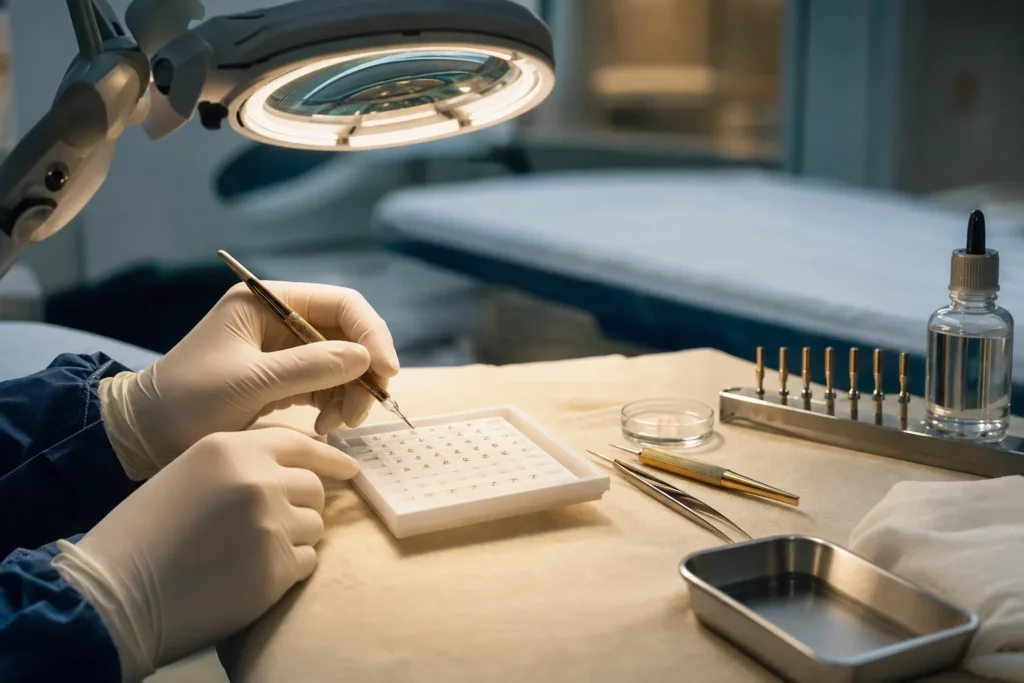
- Preparing grafts. Each graft is trimmed under magnification down to a single hair.
- Making sites. The surgeon makes tiny slits in the brow skin at precise angles and directions.
- Placing. Grafts are inserted one by one, spaced about 1 to 1.5 mm apart in an overlapping pattern so the result looks dense but natural.
You go home the same day with detailed aftercare instructions.
Recovery, step by step
Recovery from an eyebrow transplant is usually mild compared with bigger operations, but the timeline has a surprising twist that catches people off guard - more on that below.
- First night. Expect mild redness and some swelling. Clinics commonly advise sleeping with your head elevated on several pillows to limit swelling.
- Days 1 to 5. Tiny crusts form where each graft was placed. One clinic's instructions note these crusts typically fall off around three to four days, and that most patients look presentable about five days after surgery. Keep the brows dry at first and avoid rubbing the area.
- Around day 5 to 6. Gentle washing usually resumes per your clinic's guidance; the NHS notes gentle hand-washing of grafts is often allowed from about day 6 in hair transplants generally.
- Weeks 2 to 4. Here is the twist: the transplanted hairs fall out. This is normal and expected - the hair sheds while the follicle stays alive and resets to grow again. Try not to panic; almost everyone goes through it.
- Exercise. Strenuous activity is limited in the first days to a week or two; follow your clinic's exact advice (swimming is often delayed to around 10 days).
Many people return to desk work within a few days. Avoid excess sun on the area for the first couple of weeks and protect it with a hat outdoors.
Risks and possible complications
An eyebrow transplant is generally low-risk, but no procedure is risk-free, and it is right to know the possibilities before you decide. Sources including the NHS and Cleveland Clinic list the following.
- Swelling, bruising, redness, and soreness - common and temporary.
- Crusting and scabbing in the first days.
- Bleeding and infection - uncommon, and reduced by good clinic hygiene and aftercare.
- Scarring - tiny dots with FUE, or a fine line at the back of the scalp with FUT.
- Temporary numbness or altered sensation at the donor or brow site.
- Graft failure or poor growth - not every transplanted hair survives.
- Hairs growing at the wrong angle or with a kink - a known issue in brow work, since the surgeon is recreating a very specific natural direction. A medical review notes distorted or misdirected growth can occur, and that some patients need a second session to refine density or correct direction.
Because eyebrows demand precision, the experience of the surgeon has a large effect on how natural the result looks and how often a touch-up is needed. Report unusual pain, spreading redness, pus, or fever to your clinic promptly.
Results and how long they last
Patience is essential, because the result builds slowly. After the shedding phase in weeks two to four, the follicles rest, then begin to grow new hair. A medical review of eyebrow restoration reports that growth from roughly half the grafts begins at three to four months, with fuller regrowth by about six to eight months. The Cleveland Clinic notes noticeable growth generally starts around six to twelve weeks, and for hair transplants in general the NHS describes full results appearing over roughly ten to eighteen months. So the realistic message is: do not judge your brows until close to a year.
Once established, results can be very long-lasting - the Cleveland Clinic says they can last a lifetime, because the transplanted follicles are your own. The trade-off is maintenance: scalp hair grows longer and faster than brow hair, so you will trim the new brows regularly, often a couple of times a month, and may brush them into shape. Some people, especially those wanting maximum density, choose a second session to add grafts after the first has matured.
Costs - indicative ranges and what changes the price
Prices for an eyebrow transplant vary a great deal by country, clinic, and surgeon. As a broad indication, treatment in Turkiye is often advertised in the region of EUR 1,500 to 3,000, frequently as an all-inclusive package. For wider context, the NHS notes a hair transplant in the UK can cost anywhere from about GBP 1,000 to GBP 30,000 depending on the extent of work and the clinic - eyebrow work sits at the smaller end because it uses relatively few grafts.
Important: these figures are indicative only. They are not a quote, and the real price varies by case, surgeon, and clinic. What moves the number includes:
- Number of grafts needed - a light touch-up costs less than rebuilding two full brows.
- Surgeon experience and reputation - eyebrow work is delicate, and skill commands a premium.
- Technique and clinic setup, including whether a hospital-grade, accredited facility is used.
- What the package includes - consultation, medications, follow-up, and (for travellers) hotel and transfers.
- Whether a second session is later needed for density.
Be wary of prices that look too good to be true, or of clinics advertising vague extras. The cheapest option is rarely the right way to choose surgery on your face.
Why people travel to Turkiye, and how to choose a safe clinic
Turkiye has become a major destination for hair restoration because high patient volumes, experienced teams, and favourable costs let clinics offer all-inclusive packages - often covering the procedure, hotel, and transfers - for less than equivalent care in many Western countries. That can be excellent value, but value only counts if the clinic is genuinely safe and skilled. The goal is a careful choice, not the lowest sticker price.
Before you book, verify the following:
- Accreditation. Look for a facility licensed by the Turkish Ministry of Health and, ideally, recognised international standards such as JCI (Joint Commission International) or ISO certification, which reflect infection control and patient-safety protocols. Ask to see the documentation.
- A board-certified surgeon, not just technicians. Confirm a qualified doctor - typically a dermatologist or plastic surgeon - leads your procedure. Membership of professional bodies such as the ISHRS (International Society of Hair Restoration Surgery) is a good sign.
- A real consultation with that surgeon before you commit, where the brow design and graft count are discussed for your specific face.
- Independent reviews and before-and-after photos of eyebrow cases specifically (not just scalp transplants), ideally on independent platforms.
- A written follow-up and aftercare plan, and clarity on what happens if you need a revision.
Red flags include unusually low prices, promises of "unlimited grafts," no direct surgeon contact, and an inability to provide accreditation paperwork. As a concierge, BergemHealth can help you check these credentials, but you should always confirm them for yourself.
How to prepare and what to ask in your consultation
Good preparation makes for a smoother procedure and a better result. In the weeks before, your clinic will give you tailored instructions; common advice includes:
- Tell the surgeon about all medicines and supplements you take, especially blood thinners and anything that affects bleeding (some, such as aspirin or certain supplements, may be paused on medical advice).
- Avoid alcohol and smoking for a period before surgery, as both can affect healing and graft survival.
- Arrange the practical side: time off, someone to help, and - if travelling - flights and accommodation that fit the recovery timeline.
Bring questions to your consultation. Useful ones include:
- Will you, the surgeon, perform and design my brows, and what is your experience with eyebrow cases specifically?
- How many grafts do you recommend for me, and why?
- Can I see before-and-after photos of patients with brows like mine?
- What technique will you use, and what aftercare and follow-up are included?
- What are the realistic results, the chance I will need a second session, and the total cost including any revision?
Aftercare and travelling for treatment
Aftercare protects your investment, especially in the first few days when grafts are most fragile. Typical guidance from clinics and the NHS includes:
- Do not touch, rub, or pick the brows in the early days; let the small crusts fall off on their own around days three to five.
- Sleep with your head elevated the first night or two to limit swelling, and follow your clinic's washing schedule precisely.
- Protect from sun and avoid strenuous exercise and swimming for the period your clinic specifies.
- Expect the transplanted hairs to shed in weeks two to four - this is normal, not a failure.
If you are travelling to Turkiye, plan the flight home around your grafts. The first 48 to 72 hours carry the highest risk of dislodging new grafts, so many surgeons advise staying near the clinic for a day or two for the first wash and a check-up before you fly. Guidance commonly suggests that short trips may be fine soon after, while for longer journeys some surgeons prefer you wait several days; on the plane, avoid anything pressing on the brows, stay well hydrated, and don't let your head rest back against the seat. Always follow the specific flying advice your own surgeon gives, since it depends on your case and your flight length. A planned, unhurried return is far safer than rushing.
This article is general information, not medical advice. Decisions about an eyebrow transplant should be made with a qualified surgeon who has assessed you in person.
Frequently asked questions
Is an eyebrow transplant permanent?
Does it hurt?
Why did my new eyebrows fall out after a few weeks?
When will I see the final result?
How many grafts will I need?
How is it different from microblading or an eyebrow tattoo?
How much does an eyebrow transplant cost in Turkiye?
How do I know a Turkish clinic is safe?
When can I fly home after the procedure?
Might I need a second session?
Can the new eyebrow hairs grow at the wrong angle?
How soon can I go back to work and exercise?
This article is for general information only and is not medical advice. Always consult a qualified doctor about your individual case.
Considering this procedure?
Send us your photos and questions. A BergemHealth coordinator and a department-head specialist will review your case and reply with honest, personalised guidance — no obligation.
Free consultation