Hair transplant for male pattern baldness
If your hairline has been creeping back or your crown is thinning, you have probably wondered whether a hair transplant could actually help, what it involves, and why so many men travel to Turkiye for it. This guide walks you through how the procedure works for male pattern baldness, who it suits, what recovery really looks like, the honest risks, indicative costs, and how to choose a clinic and surgeon you can trust.
- Anaesthesia
- Local anaesthetic in the scalp, sometimes with light (conscious) sedation; you stay awake.
- Duration
- Roughly 4 to 8 hours in one day, depending on the number of grafts.
- Recovery
- Back to desk work in about 2 to 5 days; scabs shed within 1 to 2 weeks; full results in 9 to 12 months.
- Hospital stay
- Day case (outpatient); no overnight hospital stay, though many travellers stay 1 to 2 nights for the first wash and check.
What a hair transplant actually is
A hair transplant is a surgical way to move hair you already have into the areas where you have lost it. The key idea is simple: the hair at the back and sides of your head is genetically tougher than the hair on top. In male pattern baldness, a hormone called DHT (dihydrotestosterone) slowly shrinks the follicles on the crown and hairline until they stop producing visible hair. The follicles at the back and sides are far less sensitive to DHT, so they tend to keep growing for life.
A surgeon takes small groups of these resistant follicles, called follicular units (natural clusters of 1 to 4 hairs), and moves them to the thinning zones. Once they settle in, transplanted hairs usually keep their original, DHT-resistant nature, so they continue to grow in their new home.
It is worth being clear about what a transplant is not. It does not create new hair from nothing, and it does not stop your remaining native hair from thinning in the future. It redistributes the hair you have to where it shows most.
Who is a good candidate (and who should wait or avoid it)
The best candidates are men whose hair loss has stabilised and who still have a healthy donor area at the back and sides. Surgeons often map your stage of loss on the Hamilton-Norwood scale, a 7-stage chart running from slight temple recession (stages 1 to 2) to extensive crown and front loss (stages 6 to 7). The more donor hair you have relative to the area you want to cover, the better your likely result.
You may be a good candidate if:
- You have a clearly defined area of loss, such as a receding hairline or thinning crown.
- Your loss has slowed and you are realistic about coverage and density.
- You are in good general health.
It may be better to wait or reconsider if:
- You are in your late teens or early twenties and your pattern is still changing fast. Operating too early can leave odd-looking gaps as native hair keeps receding around the grafts.
- Your donor area is thin or you have very widespread loss, so there simply is not enough hair to relocate.
- You have an unstable scalp condition, a tendency to thick (keloid) scarring, a bleeding disorder, or uncontrolled health problems. Tell the surgeon about any medicines, including blood thinners.
- Your hair loss has a non-genetic cause (for example a patchy autoimmune type), which needs a different approach. A dermatologist can confirm the diagnosis.
Many men do best by combining surgery with medical treatment to protect the hair they still have, which we cover below.
Types and techniques: FUE, FUT and DHI
There are two main ways to harvest the donor hair, plus a popular variation on how grafts are implanted.
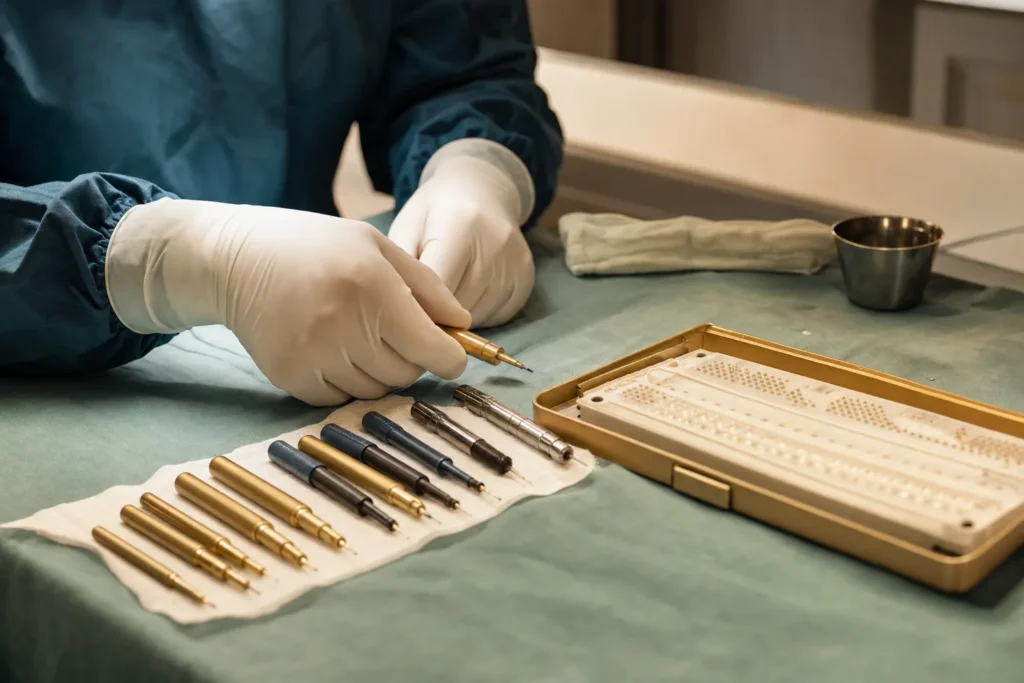
FUE (follicular unit excision). The surgeon removes individual follicular units one by one using a tiny punch, usually 0.7 to 1.2 mm wide. This leaves many tiny dot-shaped marks rather than one long scar, so you can wear your hair short. FUE tends to mean less post-operative discomfort and a quicker recovery. It is the most common technique chosen by travellers today.
FUT (follicular unit transplantation), also called the strip method. The surgeon removes a thin strip of skin from the back of the scalp, then a team divides it into individual grafts under magnification. This can yield a large number of grafts in one session and is efficient, but it leaves a fine linear scar across the back of the head. That scar is normally hidden by surrounding hair but can show if you shave very short.
DHI (direct hair implantation) is a style of FUE where grafts are placed using a pen-like implanter tool rather than first making the holes and then filling them. Supporters say it gives precise control over angle and depth. It is a delivery method, not a fundamentally different operation.
The right choice depends on your donor supply, how short you like to wear your hair, the size of the area, and your surgeon's judgement, not on marketing labels.
How it is done: anaesthesia, steps and how long
A hair transplant is almost always a day procedure done under local anaesthetic. You stay awake and comfortable; some clinics add light (conscious) sedation to help you relax. General anaesthesia is not normally needed.
A typical day looks like this:
- Planning and design. The surgeon agrees your new hairline and the areas to fill, then shaves the donor (and often recipient) area as needed.
- Numbing. Local anaesthetic is injected into the scalp. The first injections sting briefly; after that you should feel pressure but not pain.
- Harvesting. Grafts are removed by FUE punch or by removing a strip (FUT). Skilled teams keep follicle damage (transection) low, ideally only a few percent.
- Site creation. Tiny channels are made in the bald area at careful angles, which is what makes results look natural.
- Placement. Grafts are inserted one by one. Single-hair grafts go at the very front for a soft hairline; multi-hair grafts add density behind.
Expect the whole day to run roughly 4 to 8 hours depending on graft numbers, with breaks for food and rest. You go home (or back to your hotel) the same day.
Recovery, step by step
Recovery is gradual. Here is a realistic timeline.
- First 24 to 72 hours. This is the most delicate period, when grafts are settling and most easily dislodged. You will have redness, tiny scabs and possibly some forehead or eyelid swelling. Sleep semi-upright as advised and avoid touching the new grafts.
- First wash (often day 2 to 3). Done gently, usually following clinic instructions or with their help, to start lifting scabs softly.
- Days 2 to 5. Many people return to non-physical desk work, accepting some visible redness and scabbing.
- Week 1 to 2. Scabs flake away and redness fades. The donor area continues to heal.
- Weeks 2 to 8: the shedding phase. The transplanted hairs usually fall out. This is normal and expected, the roots stay in place.
- Months 3 to 4. New growth begins from those roots.
- Months 9 to 12. The result matures, with the crown sometimes taking a little longer than the hairline.
Follow your clinic's advice on avoiding heavy exercise, sweating, sun, swimming, alcohol and smoking in the early days, all of which can affect healing and graft survival.
Risks and possible complications
A hair transplant is generally considered low-risk in experienced hands, but no surgery is risk-free. Reported overall complication rates are commonly in the low single digits, with most events being mild and temporary.
More common, usually short-lived effects include:
- Swelling of the forehead and around the eyes (reported in a large share of patients), bruising, numbness and tenderness.
- Tiny scabs and redness for a week or two.
- Folliculitis, small inflamed spots around new hairs, which usually settle.
Less common but more important risks include:
- Infection (uncommon, reported under about 1%).
- Shock loss, temporary shedding of nearby native hair, which usually regrows.
- Scarring: a fine line with FUT, or dot scars and possible patchy lightening (hypopigmentation) of the donor area with FUE.
- Poor graft growth or an unnatural look, especially if the hairline is poorly designed or grafts are placed at wrong angles. This is closely tied to surgeon skill.
- Rarely, skin breakdown (necrosis) or cyst formation.
Travelling abroad adds its own considerations. Studies in the UK have found that complications after cosmetic surgery overseas, including wound infections, can occasionally be serious and costly to treat once home. Choosing a properly accredited clinic and allowing time to heal before flying both lower this risk.
Results and how long they last
Because the moved follicles keep their DHT-resistant nature, transplanted hair is generally considered permanent and continues to grow, be cut and styled like normal hair. After the early shedding phase, you typically see meaningful growth by 3 to 4 months and a mature result around 9 to 12 months. Graft survival above 90% is reliably achievable with modern techniques and a skilled team.
Two honest caveats matter. First, density is rarely as thick as teenage hair, because a transplant redistributes a limited donor supply rather than multiplying it. A natural-looking, satisfying improvement is the realistic goal. Second, a transplant does not protect your native hair from future thinning. Without ongoing care, you can end up with transplanted hair surrounded by newly thinning areas, which is why many surgeons recommend continuing medical treatment. Some men need a second session later to add density or address further loss.
Costs: indicative ranges and what changes the price
Costs vary widely by country, technique, clinic and the number of grafts. As a rough guide, all-inclusive packages in Turkiye commonly fall in the region of EUR 2,000 to 6,000, often bundling the procedure, hotel, transfers and aftercare products. The same surgery in the UK, Western Europe or North America is frequently several times higher. These figures are indicative ranges only and vary by case, surgeon and clinic; they are not a quote, and your real price depends on an assessment.
What pushes the price up or down:
- Number of grafts needed, the single biggest driver.
- Technique (FUE, FUT or DHI) and whether the procedure spans more than one day.
- Surgeon experience and clinic reputation, plus whether a doctor (not only technicians) performs the key steps.
- Accreditation and facilities, which add cost but reflect safety standards.
- What is included: consultation, medications, follow-up, and travel extras.
Be cautious of prices that look far below the market, for example very large graft counts for a tiny fee. Unusually low pricing can signal corner-cutting on staff qualifications, hygiene or aftercare.
Why people travel to Turkiye, and how to choose a safe clinic
Turkiye has become a leading destination for hair transplants because it combines high demand, many experienced surgeons, and prices well below those in much of Europe and North America, often as an all-inclusive package. That value is real, but quality varies between clinics, so the choice of surgeon matters far more than the country.
Before you book, verify the following:
- A named, qualified surgeon. Confirm there is a specific doctor responsible for your case, ideally with training in dermatology or plastic/reconstructive surgery, not just a brand name. Professional membership of the International Society of Hair Restoration Surgery (ISHRS) is a useful signal.
- Facility accreditation. Look for recognised hospital accreditation such as JCI or ISO, and registration with the Turkish Ministry of Health.
- Who actually does the surgery. Ask how much of the harvesting and implantation the doctor personally performs versus technicians, and how many cases the clinic runs per day.
- Honest before-and-after evidence for cases like yours, plus clear written information.
- Red flags: no named surgeon, pressure to upsell after you arrive, prices far below market, or reluctance to discuss complications and aftercare.
A reputable clinic will give you a candid assessment, including telling you if you are not a good candidate.
How to prepare and what to ask in your consultation
Good preparation improves both safety and results. In the weeks before surgery, share your full medical history and medication list, and ask whether to pause anything such as blood thinners or certain supplements. Many surgeons advise avoiding alcohol and smoking around the procedure, as smoking in particular can reduce blood supply to the grafts. Arrange comfortable, loose clothing and someone to help with logistics.
Bring these questions to your consultation:
- What is my Norwood stage, and is my donor area strong enough for the coverage I want?
- Which technique do you recommend for me, and why?
- How many grafts do you expect, and how natural and dense can the result realistically be?
- Will you, the doctor, perform the harvesting and site creation?
- What graft survival do you typically see, and how do you keep follicle damage low?
- What are the main risks in my case, and how are complications handled?
- What aftercare, medications and follow-up are included?
- Should I also use finasteride or minoxidil to protect my existing hair?
About those medicines: minoxidil (a topical lotion or foam) can slow loss and stimulate growth, while finasteride (an oral tablet) lowers DHT. Both take months to show effect, need ongoing use to keep working, and have possible side effects, finasteride is associated with sexual side effects in a small percentage of users, so discuss them with a doctor.
Aftercare and travelling for treatment (including when it is safe to fly)
Aftercare is where good results are protected. Expect to follow detailed instructions on gentle washing, sleeping position, avoiding scratching, and steering clear of strenuous exercise, heavy sweating, swimming, saunas and direct sun for the first couple of weeks. Protect the new grafts from knocks, and take any prescribed medicines as directed. Mild redness and shedding are normal; rising pain, spreading redness, pus or fever are not, and should prompt you to contact the clinic.
If you are travelling for treatment, plan the trip around healing rather than sightseeing. The first 48 to 72 hours are when grafts are most fragile, so many clinics suggest staying nearby for one to two nights so they can do the first wash and a check before you fly. Advice on flying varies: some surgeons are comfortable with short flights soon after, while others prefer you wait several days, especially for long-haul journeys, to reduce swelling and the chance of disturbing grafts. Wear a loose hood rather than a tight cap, stay well hydrated, and avoid bumping your head on overhead lockers or seat-backs.
Finally, arrange your follow-up before you leave. A reputable clinic will stay reachable for questions during the months of regrowth, and will tell you how to get help locally if a problem appears once you are home.
Frequently asked questions
Is a hair transplant permanent?
Does a hair transplant hurt?
How long does it take to see results?
What is the difference between FUE and FUT?
How many grafts will I need?
Why are hair transplants so much cheaper in Turkiye?
When can I fly after a hair transplant?
Will the result look natural?
Do I still need to take medication after a transplant?
Can a hair transplant fail?
Am I too young or too old for a transplant?
This article is for general information only and is not medical advice. Always consult a qualified doctor about your individual case.
Considering this procedure?
Send us your photos and questions. A BergemHealth coordinator and a department-head specialist will review your case and reply with honest, personalised guidance — no obligation.
Free consultation