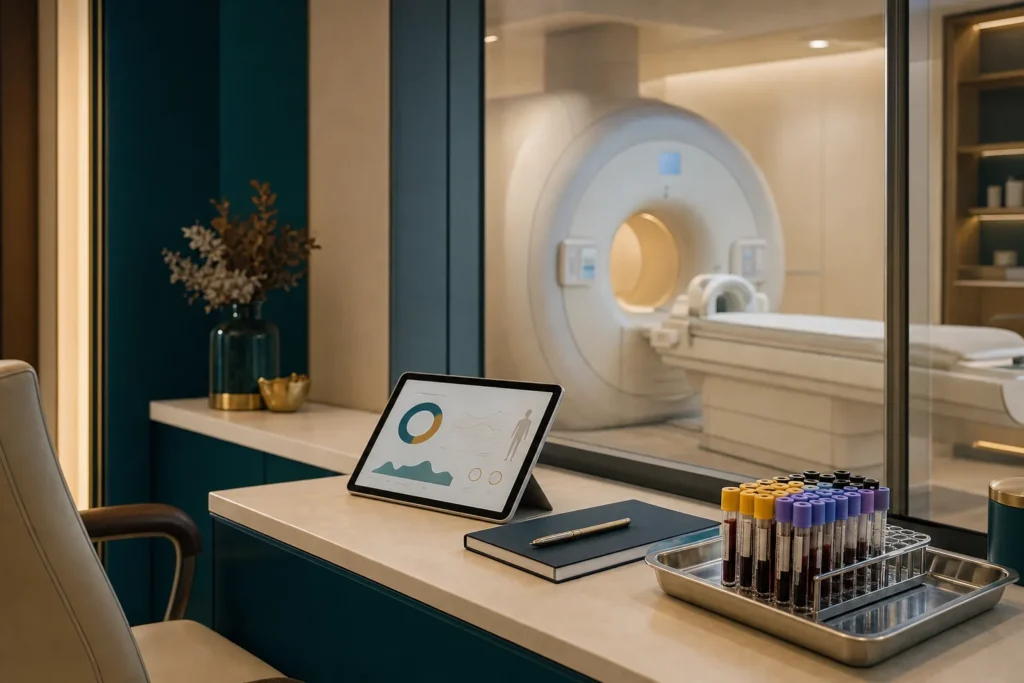
Gold oncology screening
A preventive check-up is a chance to step back and ask a simple question: how is my body doing right now, before anything feels wrong? The LIV GOLD oncology screening is one of the more thorough programmes of this kind offered at a JCI-accredited hospital in Turkiye, bundling specialist consultations, imaging, and a wide panel of laboratory tests into one or two outpatient days. This guide explains, in everyday language, exactly what is included, what each test is actually looking for, the honest benefits and limits of screening, how to prepare, and what it costs, so you can decide whether a programme like this is right for you.
- Duration
- 1 to 2 days, outpatient
- Hospital stay
- Outpatient - no overnight stay
What the LIV GOLD oncology screening is, and who it is for
The LIV GOLD oncology screening is a comprehensive preventive check-up built around the early detection of cancer and a broad look at your general health. It is what doctors call screening: testing people who feel well and have no symptoms, in the hope of finding a problem early, when it is usually easier to treat. It is not the same as a diagnostic work-up, which is what happens when you already have a complaint that needs explaining.
The programme comes in two versions tailored to the body being examined. The men's GOLD package includes 5 specialist consultations, 13 imaging tests, and 53 laboratory tests. The women's GOLD package includes 6 specialist consultations, 14 imaging tests, and 52 laboratory tests, adding breast and cervical examinations. Both are completed over one to two days entirely as an outpatient, meaning you go home or to your hotel each evening.
This kind of intensive programme tends to suit health-conscious adults from roughly their mid-40s onward, people with a family history of cancer, or anyone who simply wants a thorough baseline. It is worth being clear-eyed, though: most major health bodies, and a large Cochrane review of general health checks, have found that routinely screening every healthy adult with broad test panels does not reliably reduce deaths and can lead to unnecessary follow-up. The value of a programme like GOLD lies in how its individual, evidence-based components (such as colon, breast, and cervical screening) are interpreted by good doctors for the right person, not in the sheer number of tests.
What is included in the programme
The GOLD package groups its contents into three broad areas. Below is a plain-language summary of what each version contains, faithful to the real programme composition.
Specialist consultations. You meet several doctors in person, who review your history, examine you, and explain your results. The men's package includes 5 consultations; the women's includes 6, with the extra visits covering breast and gynaecological assessment. These conversations are the heart of the programme, because tests mean little without a clinician to put them in context.
Imaging tests. The men's package includes 13 imaging studies and the women's 14. Highlights common to both are a full colonoscopy and gastroscopy with endoscopic biopsy (a camera examination of the bowel and the stomach, with the option to sample any suspicious tissue), non-contrast MRI scans of the brain and abdomen (detailed magnetic images, no X-rays involved), a chest CT scan, a cardiac exercise stress test with ECG to check how your heart copes with effort, a carotid Doppler ultrasound of the neck arteries, and bone densitometry to measure bone strength. The women's package adds digital mammography and breast ultrasound.
Laboratory tests. Around 52 to 53 blood and urine tests cover the everyday essentials, things like blood count, blood sugar, cholesterol, kidney and liver function, thyroid hormones, and vitamins. The panel also includes more than 20 tumour markers, blood proteins that can be raised in some cancers. For men these include PSA, CEA, AFP, CA 19-9, and beta-hCG; for women they include CA 125, CA 15-3, CA 19-9, CEA, and AFP. The women's package also offers liquid-based cervical cytology (ThinPrep), a modern version of the Pap test.
What it screens for, and why that matters
The strongest parts of any oncology check-up are the tests that independent expert panels actually recommend for early cancer detection. The GOLD programme includes several of these.
Bowel (colorectal) cancer. Colonoscopy is one of the most effective screening tools in medicine because it does two jobs at once: it finds early cancers and it removes pre-cancerous growths (polyps) before they ever turn malignant. The US Preventive Services Task Force recommends screening all average-risk adults from age 45 to 75, with colonoscopy once every 10 years as one option.
Breast cancer (women). Mammography is the cornerstone of breast screening. The American Cancer Society advises annual mammograms for women aged 45 to 54, with the option to start at 40 and to move to every two years from 55. Breast ultrasound can add useful information, especially for denser breast tissue.
Cervical cancer (women). Cervical cytology and HPV testing have transformed cervical cancer from a common killer into a largely preventable disease. The USPSTF recommends screening women aged 21 to 65, with cytology every three years a recognised option.
Lung cancer. A chest CT can detect lung cancer early. The evidence for benefit, however, is strongest in a specific group: the USPSTF recommends low-dose CT screening only for adults aged 50 to 80 with a 20 pack-year smoking history who still smoke or quit within the past 15 years. For lifelong non-smokers, the benefit is far less certain.
Prostate (men). The PSA blood test can find prostate cancer early, but it is genuinely a balanced decision rather than a clear yes. The USPSTF advises that men aged 55 to 69 make an individual choice after discussing the trade-offs with a doctor, and does not recommend routine PSA screening from age 70.
The benefits and the honest limits of screening
Screening can save lives, and the case for it is real. Removing a colon polyp, catching a breast cancer while it is small, or treating a cervical change before it becomes cancer can change someone's future entirely. But screening is a tool with two edges, and a good programme is honest about both.
It reduces risk, it does not remove it. No check-up can guarantee you are cancer-free or that nothing will appear next month. Some cancers grow between screenings, and some tests simply miss things. A normal result is reassuring, not a certificate of perfect health.
False positives are common. A test can flag something that turns out to be harmless, but only after worry, repeat scans, and sometimes a biopsy. This is especially true of tumour markers. Major bodies such as the National Cancer Institute do not recommend most tumour markers for screening healthy people, because they are too often raised by non-cancerous conditions and too often normal in people who do have cancer. CA 125, for example, is raised in only about half of women with early ovarian cancer. In the GOLD programme these markers are best read as one small clue among many, never as a diagnosis on their own.
Broad imaging finds things that may not matter. Whole-body and multi-organ scanning frequently turns up incidental findings, small spots or cysts that are unrelated to any disease. Reviews of whole-body MRI in healthy people have found that the large majority of such findings are not clinically important, yet they can trigger a cascade of further tests. This is exactly why having experienced doctors interpret your results, rather than a list of numbers, matters so much.
Overdiagnosis is a real harm. Some screen-detected cancers, particularly certain prostate cancers, would never have caused harm in a person's lifetime, yet treating them can cause lasting side effects. Understanding this helps you and your doctor make calmer, wiser choices.
How to prepare for your check-up
A little preparation makes the programme run smoothly and your results more reliable. Your coordinator will give you exact instructions, but the general picture looks like this.
- Fasting. Many blood tests, the abdominal ultrasound or MRI, and the endoscopy require an empty stomach. You will usually be asked not to eat for around 8 to 12 hours beforehand, though small sips of water are often allowed. Confirm timings with the hospital.
- Bowel preparation for colonoscopy. The day before, you switch to a clear-liquid diet and drink a prescribed cleansing solution so the bowel is empty enough for the camera to see clearly. Mayo Clinic notes that chilling the solution and drinking it through a straw can make this easier.
- Medications. Tell the team about everything you take, especially blood thinners, diabetes medicines, and supplements. Some may need to be paused before the endoscopy; never stop a prescribed medicine without medical advice.
- What to bring. Previous medical records, imaging discs or reports, a list of your medications, and details of your family history of cancer or heart disease. For women, note the date of your last period, as it can affect the timing of breast imaging.
- Practicalities. Because the colonoscopy and gastroscopy usually involve sedation, you should not drive afterwards. Wear comfortable clothing and plan a calm rest of the day.
What the day actually looks like
The GOLD programme is designed to flow as a guided sequence over one to two days, fully outpatient, with no overnight hospital stay. A coordinator typically walks you between departments so you are not left navigating a large hospital alone.
A common rhythm is to begin early, while fasting, with the blood draws and the endoscopic procedures (colonoscopy and gastroscopy), which are done under light sedation so you are comfortable and usually remember little of them. Afterwards you rest until the sedation wears off, then have a meal. Imaging such as the MRI scans, chest CT, ultrasounds, mammography, and bone densitometry are spread through the day, along with the cardiac stress test, where you walk on a treadmill while your heart is monitored.
The specialist consultations are woven in so that doctors can examine you and, where results are ready, begin explaining them. Most people find the day full but manageable. The endoscopy sedation and the bowel prep are the parts most worth planning around; the rest is generally painless. By the end you will have completed a remarkable amount of assessment in a short, organised window.
Understanding your results and follow-up
The output of the programme is not just a folder of numbers; it is a conversation. Toward the end of your visit, and often in a final summary consultation, the doctors pull the threads together: what is normal, what needs watching, and what, if anything, needs action.
Results generally fall into three groups. Normal findings are reassuring and usually mean you simply return to age-appropriate screening intervals. Borderline or unclear findings, such as a slightly raised marker or a small spot on a scan, often just need a repeat test in a few months to confirm they are harmless; most turn out to be nothing. Findings that need attention, such as a polyp removed during colonoscopy or an abnormality on imaging, are explained along with the recommended next step, whether that is a biopsy, a specialist referral, or treatment.
Ask for your results in writing and, where possible, copies of your scans, so your own doctor at home can continue your care. A good check-up should leave you with a clear, personalised plan, not just a verdict. If anything is uncertain, it is entirely reasonable to seek a second opinion before agreeing to further procedures.
Cost and what is included
The indicative price for the LIV GOLD oncology screening is around 3,200 US dollars (USD) for either the men's or the women's package. This figure typically bundles the specialist consultations, the imaging studies, the laboratory tests, and the endoscopic procedures into a single package, completed over one to two outpatient days.
Treat this as a guide rather than a fixed quote. Prices vary with currency exchange rates, the exact contents on the day, and whether you need any extra tests prompted by a finding (for example, a biopsy result or a follow-up scan). Always ask for a written, itemised quote that states clearly what is and is not included, and confirm in advance how any additional, unplanned tests would be billed.
It is also worth weighing value rather than price alone. A long list of tumour markers and broad scans can look impressive, but, as the evidence above shows, more tests do not automatically mean better health. A well-run programme with strong consultations and sensible interpretation is worth more than a larger panel read by no one.
Why consider your check-up in Turkiye, and how to choose a centre
Turkiye has become a major destination for medical tourism, combining modern hospitals, internationally trained doctors, and prices that are often well below those in Western Europe or North America. Several Turkish hospitals hold JCI accreditation (Joint Commission International), a respected global standard for patient safety and quality of care, and many offer English-speaking coordinators and all-in-one programmes designed for international visitors.
When choosing where to have a check-up like GOLD, a few practical checks help:
- Accreditation and reputation. Look for JCI or equivalent accreditation and an established oncology and radiology department.
- Who reads your results. The single most important factor is the quality of the doctors interpreting your tests. Ask whether you will have a proper consultation, ideally a summary appointment, rather than just a printed report.
- Clarity on costs and follow-up. Insist on a written package list and a clear plan for how any abnormal findings will be handled, both during your stay and after you return home.
- Continuity of care. Confirm you will receive your results and images in a portable format, and ideally in a language your home doctor can use.
A reputable concierge or hospital coordinator should be happy to answer all of these questions before you commit, and to tailor the programme to your age, sex, and personal risk rather than simply selling the largest package.
Who should consider a more, or less, intensive programme
No single check-up suits everyone, and the right intensity depends mostly on your age and risk profile.
A more intensive programme may make sense if you have a strong family history of cancer (for example, several close relatives affected), known genetic risk, a significant smoking history, or specific ongoing concerns. People in these groups often benefit from earlier and more frequent screening, which a doctor can plan around recognised guidelines.
A less intensive approach is often wiser for younger, low-risk adults. For a healthy non-smoker in their 30s, for instance, a brain MRI, chest CT, and a long list of tumour markers are unlikely to add real value and may simply raise the odds of a false alarm. For most people, sticking to the screening that expert panels actually endorse, such as bowel screening from 45, breast screening from around 40 to 45 for women, and cervical screening from the 20s, delivers the bulk of the proven benefit with far less downside.
The honest takeaway is this: screening is genuinely valuable when it is matched to the person. The best version of a check-up like LIV GOLD is one shaped to your individual situation by a doctor you trust, used as the start of an ongoing conversation about your health rather than a one-off scoreboard.
Frequently asked questions
Is the LIV GOLD oncology screening the same as a cancer diagnosis test?
Can this check-up guarantee I do not have cancer?
Are the tumour markers in the package reliable for finding cancer?
Is the colonoscopy painful?
How long does the whole programme take?
Do I need to fast before the tests?
How much does the LIV GOLD oncology screening cost?
Is a brain MRI and chest CT useful if I have no symptoms?
What happens if the check-up finds something abnormal?
Should men in the package have the PSA test?
Why do experts say broad health checks may not save lives if screening is good?
This article is for general information only and is not medical advice. Always consult a qualified doctor about your individual case.
Considering this procedure?
Send us your photos and questions. A BergemHealth coordinator and a department-head specialist will review your case and reply with honest, personalised guidance — no obligation.
Free consultation