Parkinson's disease
Parkinson's disease is a slowly progressing brain condition that affects movement, and often sleep, mood and other functions too. If you or someone you love has just been told it might be Parkinson's, the word can feel frightening. This guide explains in plain language what Parkinson's actually is, how doctors recognise and diagnose it, the treatments that genuinely help people live well for many years, and the practical questions to ask if you are considering arranging neurology care abroad in Turkiye.
What Parkinson's disease is
Parkinson's disease is a long-term (chronic) condition in which certain nerve cells deep inside the brain are gradually lost over many years. The cells most affected sit in a small area called the substantia nigra (Latin for "black substance"). These cells make a chemical messenger called dopamine, which the brain uses to send smooth, well-timed signals to the muscles.
As dopamine levels slowly fall, those signals become less reliable. This is why the most recognisable features of Parkinson's are movement problems: shaking, slowness and stiffness. Parkinson's is described as progressive, meaning the symptoms tend to develop and increase over time. It is also described as a neurodegenerative condition, which simply means it involves the gradual loss of nerve cells.
It is important to keep this in perspective. Parkinson's usually develops slowly, often over years, and there are effective treatments that can ease symptoms considerably. According to the NHS, Parkinson's does not directly cause people to die, and with modern care many people have a normal or near-normal life expectancy. Worldwide it is one of the most common conditions affecting movement, and a large community of doctors, therapists and researchers works on it every day.
Types and subtypes
When doctors talk about "Parkinson's disease" they usually mean idiopathic Parkinson's disease. Idiopathic means the exact cause is not known. This is by far the most common form. In these cases, a protein called alpha-synuclein is thought to build up abnormally inside nerve cells.
A smaller number of cases are genetic (familial) Parkinson's, linked to specific inherited gene changes. The Cleveland Clinic notes this rarer form sometimes begins before age 50. Even so, the Parkinson's Foundation explains that most people who carry a known Parkinson's-related gene change never go on to develop the condition.
You may also hear the broader term parkinsonism. This is an umbrella word for symptoms that look like Parkinson's, such as slowness and stiffness, but which can have other causes, including certain medicines or other neurological conditions. Specialists distinguish true Parkinson's disease from these "Parkinson-plus" or drug-induced forms, because the treatment and outlook can differ. Doctors also sometimes describe Parkinson's by when it starts, for example young-onset Parkinson's (diagnosed before about age 50) versus the more typical later onset.
Causes and risk factors
The honest answer is that, for most people, no single cause can be pinned down. Experts believe Parkinson's results from a combination of factors rather than one thing. The Parkinson's Foundation describes it as an interaction between a person's genes, their environment and lifestyle, and explains that this combination determines whether someone develops the condition.
Age is the strongest known risk factor. Symptoms most often begin after the age of 60, although younger people can be affected. Sex also plays a part: Parkinson's is roughly 1.5 times more common in men than in women.
Family history and genetics contribute in some cases. The Parkinson's Foundation estimates that genetic factors account for around 10 to 15 percent of cases, involving genes such as LRRK2, GBA and the gene for alpha-synuclein. Carrying one of these changes raises risk but, importantly, does not guarantee the condition will appear.
Environmental factors may also play a role. Long-term exposure to certain pesticides or industrial chemicals, and a history of head injury, have been linked with higher risk in research. Even here, exposure alone usually does not cause Parkinson's. If you are worried about your own risk, none of these factors mean Parkinson's is inevitable, and a specialist can help you understand your individual picture.
Signs and symptoms (and when to see a doctor)
Parkinson's affects everyone a little differently, and symptoms often start so gently that they are easy to miss. There are three classic motor (movement) symptoms that doctors look for:
- Tremor – a rhythmic shaking, often in a hand or arm, that is usually most noticeable when the limb is at rest. It very often begins on one side of the body.
- Slowness of movement (doctors call this bradykinesia) – everyday actions such as walking, getting up from a chair or doing up buttons take longer and feel harder.
- Stiffness (rigidity) – muscles feel tense or rigid, which can be uncomfortable and limit how freely you move.
Other movement changes can include smaller handwriting, a quieter voice, reduced facial expression, a stooped posture and problems with balance.
Parkinson's also commonly causes non-motor symptoms, which can appear even before the movement changes. These include loss of the sense of smell, constipation, sleep problems, low mood or anxiety, and tiredness. These are real, recognised parts of the condition and are worth mentioning to your doctor.
When to see a doctor: if you notice a persistent tremor, ongoing stiffness, or movements becoming slower for no clear reason, it is sensible to see your family doctor (GP). Many of these symptoms have other, often harmless explanations, so finding out is reassuring rather than alarming. Your GP can refer you to a specialist if needed.
Screening and early detection
It helps to know up front: there is currently no routine screening test for Parkinson's disease for the general public, and no single blood test or scan that can detect it before symptoms appear. This is different from conditions like high blood pressure or certain cancers, where screening programmes exist.
Because there is no screening test, Parkinson's is usually picked up when a person, or someone close to them, notices early changes and sees a doctor. Some non-motor signs — such as a reduced sense of smell, constipation, or acting out dreams during sleep — can appear years before the movement symptoms, but on their own they are common and have many ordinary causes, so they are not used as a stand-alone screening tool.
What you can do is pay attention to gradual, persistent changes and raise them early. There is no need to self-diagnose using checklists online. If something feels different about your movement, mood or sleep over weeks or months, an unhurried conversation with your doctor is the right next step. Researchers are actively working on early markers and tests for the future, but these are not yet part of standard care.
How it is diagnosed
There is no single test that confirms Parkinson's disease. Instead, the diagnosis is what doctors call clinical: it is based on your symptoms, your medical history and a careful physical examination by a specialist.
Usually your GP will refer you to a neurologist (a doctor specialising in conditions of the brain and nervous system) or, in older patients, a geriatrician. The specialist will ask detailed questions and watch how you move — for example, walking, tapping your fingers, or rising from a chair — to assess slowness, stiffness, tremor and balance.
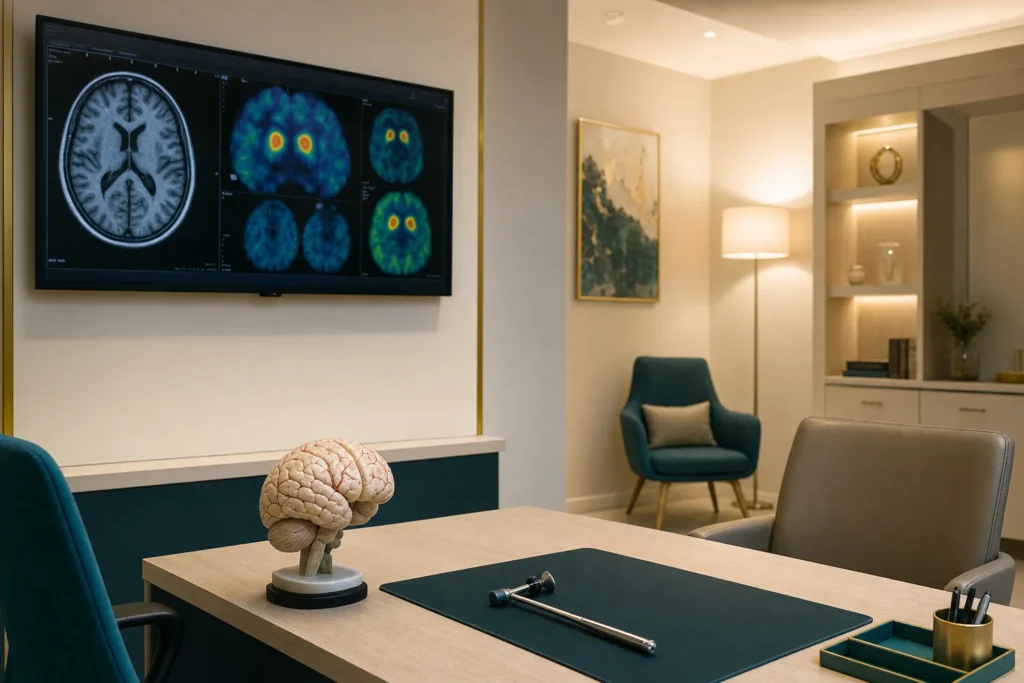
Brain scans are sometimes used, mainly to rule out other conditions that can mimic Parkinson's, rather than to prove the diagnosis. An MRI scan can check the structure of the brain. A specialised scan called a DaTscan (a type of SPECT scan) can show the dopamine system and help distinguish Parkinson's from look-alike conditions in uncertain cases. A reassuring response to Parkinson's medication can also support the diagnosis over time.
To describe how far the condition has progressed, specialists may refer to the Hoehn and Yahr scale, a five-stage framework. In simple terms: early stages (1–2) involve mild symptoms, often starting on one side and then both sides; the middle stage (3) adds balance difficulty while independence is largely kept; and advanced stages (4–5) mean more help is needed day to day. Many people stay in the earlier stages for a long time.
Treatment options
While there is no cure for Parkinson's at present, there are genuinely effective treatments that can control symptoms and help people stay active and independent for years. Care works best when delivered by a multidisciplinary team — typically a neurologist or movement-disorder specialist, a Parkinson's nurse, plus physiotherapists, occupational therapists, speech therapists and dietitians.
Medications are the foundation of treatment. The main types include:
- Levodopa (usually combined with carbidopa) — the brain converts it into dopamine. It is often the most effective medicine for movement symptoms. Doses start low and increase gradually. After long-term use, some people develop involuntary movements or "on–off" fluctuations, where mobility varies through the day.
- Dopamine agonists — medicines that act like dopamine in the brain. They can be taken as tablets or skin patches.
- MAO-B inhibitors (such as selegiline or rasagiline) and COMT inhibitors — these help dopamine last longer in the brain.
Procedures and surgery may be considered when medicines no longer give smooth control. Deep brain stimulation (DBS) involves implanting fine electrodes in the brain, connected to a pacemaker-like device, which delivers gentle electrical pulses to ease movement symptoms. The Parkinson's Foundation explains that DBS is generally reserved for people whose tremor or motor fluctuations are no longer well managed by medication, and it works best on symptoms that previously responded to levodopa. Infusion therapies (such as a levodopa gel delivered continuously) and, in some centres, focused ultrasound are other options for selected patients.
Supportive therapies are just as important. Physiotherapy helps with movement, stiffness and walking; occupational therapy makes daily tasks easier at home; speech therapy supports voice and swallowing; and regular exercise and good nutrition are encouraged for everyone.
Outlook and what to expect
A Parkinson's diagnosis is not the emergency it can feel like at first. The condition usually progresses slowly, and progression varies a great deal from person to person. The Parkinson's Foundation notes that some people experience changes over 20 years or more, while for others the condition moves more quickly.
The NHS states clearly that Parkinson's disease does not directly cause people to die, although in advanced stages it can make people more vulnerable to other serious problems, such as chest infections. With regular medical care and the right treatment, many people live with Parkinson's for many years and maintain a good quality of life, especially in the earlier stages where symptoms respond well to medication.
It is worth saying plainly: figures about progression and life expectancy describe groups of people, not any one individual. They cannot predict how your own condition will unfold. Your specialist, who knows your full picture, is the right person to talk to about what to expect, and that conversation usually becomes more reassuring once treatment is underway and symptoms are better controlled.
Living with Parkinson's and follow-up
Living well with Parkinson's is very much possible, and a lot of it comes down to steady, consistent support rather than dramatic intervention. Most people are followed up regularly by their specialist team so that medication can be fine-tuned as needs change — this ongoing adjustment is a normal and expected part of care, not a sign that something has gone wrong.
Day-to-day, the things that help most are often practical:
- Stay active. Regular exercise — walking, stretching, balance work, dancing, tai chi or swimming — is widely recommended to help maintain movement, strength and confidence.
- Take medication on time. Parkinson's medicines work best on a steady schedule, so timing matters. A Parkinson's nurse can help you build a routine.
- Look after mood and sleep. Low mood, anxiety and sleep problems are common and treatable; tell your team rather than waiting.
- Adapt the home and tasks. Occupational therapists can suggest simple changes that keep everyday activities manageable.
- Lean on support. Family, carers and patient organisations such as Parkinson's UK or the Parkinson's Foundation offer information, helplines and community.
Care partners matter too. Sharing information, attending appointments together and accepting help early all make the journey easier for everyone involved.
Planning treatment abroad: what affects cost and how to prepare your records
Some people choose to arrange part of their Parkinson's care, such as a specialist assessment, a medication review, or an evaluation for deep brain stimulation, at a hospital abroad. If you are exploring treatment in Turkiye, it helps to understand what shapes the overall cost and how to prepare so any quote you receive is accurate and personalised.
Because Parkinson's care is highly individual, there is no single price. The main factors that affect cost include:
- The type of care you need — a consultation and diagnostic work-up is very different from a surgical procedure such as DBS, which involves implanted devices, imaging, an operating team and inpatient time.
- Diagnostic tests required, such as MRI or a DaTscan.
- The specialist team and hospital involved.
- Length of stay and any rehabilitation or therapy sessions.
- Medications and devices, and ongoing follow-up needs.
- Practical extras such as translation, transfers and accommodation for you and a companion.
To prepare your records, gather your diagnosis details, a current list of medications and doses, recent clinic letters, and copies of any brain scans (ideally the images, not just the reports). Note when symptoms began and how they have changed. Sharing these in advance lets the receiving team review your case and give a realistic, individualised plan. Rather than relying on generic figures, the most reliable next step is to request a personalised estimate through a free consultation, where your specific needs can be assessed properly.
Why Turkiye, and how to choose a good centre
Turkiye has become a well-known destination for medical care, including neurology, with many hospitals experienced in treating international patients. The goal is not to chase any single "best" hospital — a claim no one can honestly make — but to choose a centre that is genuinely well suited to your needs and that you can trust.
Useful things to verify when choosing a centre:
- Accreditation. Look for hospitals with recognised quality accreditation, such as Joint Commission International (JCI), which assesses patient safety and care standards.
- Specialist expertise. Check that the team includes a neurologist or movement-disorder specialist experienced in Parkinson's, and, for surgery such as DBS, a neurosurgical team that performs these procedures regularly.
- A multidisciplinary set-up. Good Parkinson's care relies on physiotherapy, occupational therapy, speech therapy and specialist nursing, not just doctors.
- Clear communication. Confirm language support, who your point of contact is, and how follow-up will work once you return home.
- A written plan and itemised estimate. A reputable centre will explain what is proposed, why, and what it includes.
As a medical-tourism concierge, BergemHealth's role is to help you organise consultations, gather and share your records securely, and coordinate the practical side, so you can focus on your health. The aim is informed, unhurried decisions — never pressure.
Prevention, self-care and getting a second opinion
There is currently no proven way to prevent Parkinson's disease, largely because its causes are not fully understood. That said, the general habits that support brain and overall health — regular physical activity, a balanced diet, not smoking, and staying socially and mentally engaged — are sensible for everyone and are increasingly highlighted in Parkinson's research and care.
If you already have Parkinson's, self-care centres on staying active and consistent: keeping up exercise, taking medicines on schedule, attending follow-up appointments, and flagging new symptoms early so your team can respond.
It is also completely reasonable to seek a second opinion, especially before major decisions such as surgery, or if you are unsure about your diagnosis. A second specialist view is a normal part of good medicine and a sign of careful decision-making, not distrust. Many people also ask their team about clinical trials, which test new treatments and are an option some choose to explore; your neurologist or a major Parkinson's organisation can point you to reputable studies. Whatever path you take, decisions are best made together with a qualified specialist who knows your individual situation.
Frequently asked questions
Is Parkinson's disease fatal?
What is usually the first sign of Parkinson's disease?
Is there a test that can confirm Parkinson's disease?
Can Parkinson's disease be cured?
What causes Parkinson's disease?
Is Parkinson's disease hereditary?
How fast does Parkinson's disease progress?
What is deep brain stimulation, and who is it for?
Does exercise help with Parkinson's?
What should I bring if I plan a consultation in Turkiye?
How do I choose a good hospital for Parkinson's care abroad?
This article is for general information only and is not medical advice. Always consult a qualified doctor about your individual case.
Considering this procedure?
Send us your photos and questions. A BergemHealth coordinator and a department-head specialist will review your case and reply with honest, personalised guidance — no obligation.
Free consultation