Obstructive sleep apnea (OSA)
Obstructive sleep apnea is a common, very treatable condition in which the airway briefly closes during sleep, interrupting breathing again and again through the night. This guide explains in plain language what OSA is, why it happens, how it is diagnosed with a sleep study, and the treatments that help most people sleep and feel better, including CPAP, oral devices and surgery. If you snore loudly, wake gasping, or feel exhausted despite a full night in bed, the good news is that effective help exists and is worth seeking.
What obstructive sleep apnea is
Obstructive sleep apnea, often shortened to OSA, is a sleep disorder in which your breathing repeatedly stops and starts while you sleep. As the NHS describes it, sleep apnea is simply "when your breathing stops and starts while you sleep," and the obstructive type is the most common form.
Here is what happens inside the body. When you fall asleep, the muscles that hold your throat open relax. In some people the upper airway (the passage at the back of the nose and throat that carries air to the lungs) becomes too narrow or collapses completely. Air cannot get through, so breathing pauses for a few seconds. Your brain senses the drop in oxygen and briefly wakes you just enough to tighten those muscles and reopen the airway, often with a gasp, snort or choke. You usually do not remember these moments, but they can happen dozens of times an hour, fragmenting your sleep without you ever knowing.
This is different from central sleep apnea, where the airway is open but the brain does not send the signal to breathe. In OSA the problem is mechanical: a blockage. The repeated effort to breathe against a blocked airway, the dips in oxygen, and the constant micro-awakenings are why OSA leaves people tired during the day even after what felt like a full night in bed. OSA is genuinely common. According to estimates cited by health authorities, close to one billion adults aged 30 to 69 worldwide have some degree of obstructive sleep apnea, though many do not know it. It is also very treatable, which is the most important thing to hold onto as you read on.
Types and how doctors classify severity
Sleep apnea comes in three forms, and knowing which one you have shapes the treatment.
- Obstructive sleep apnea (OSA) is by far the most common. The throat muscles relax and physically block airflow. This is the focus of this guide.
- Central sleep apnea (CSA) is less common. The airway stays open, but the brain temporarily stops sending the signal to breathe. It is often linked to heart failure, stroke or certain medicines.
- Mixed or complex sleep apnea is a combination of both, where someone has features of obstructive and central apnea together.
Doctors also describe how severe OSA is using a number called the apnea-hypopnea index, or AHI. This counts how many times per hour of sleep your breathing either stops completely (an apnea) or becomes very shallow (a hypopnea). The widely used categories are: mild (5 to 14 events per hour), moderate (15 to 29 events per hour), and severe (30 or more events per hour). A higher AHI does not define you as a person, but it helps the team judge how urgently to treat and which options make sense. Severity can also change over time, for example with weight change, which is why the number is reviewed rather than fixed for life.
Causes and risk factors
OSA happens when the upper airway becomes too narrow or collapses during sleep. Several things make this more likely, and understanding them helps explain why treatment sometimes includes lifestyle changes, not just devices.
- Excess weight. Extra soft tissue around the neck and throat can press on the airway. Carrying more weight is one of the strongest and most changeable risk factors.
- A larger neck circumference. A thicker neck often means a narrower airway.
- Age. OSA becomes more common as people get older.
- Being male. Men are diagnosed more often, particularly before age 50, though women are affected too, especially after menopause.
- Family history and airway shape. A naturally narrow airway, a small or set-back jaw, or a family history of OSA can all play a part.
- Enlarged tonsils or adenoids. These are a common cause in children and can contribute in some adults.
- Alcohol and sedatives. These relax the throat muscles further, making collapse more likely.
- Smoking. Smoking can increase inflammation and fluid in the upper airway.
- Sleeping on your back. Gravity makes airway collapse more likely in this position for some people.
- Nasal congestion and some medical conditions. A blocked nose, and conditions such as chronic obstructive pulmonary disease (COPD, a long-term lung disease), can add to the risk.
Having one or more of these does not mean you definitely have OSA, and many people with OSA have only a couple of them. They simply help you and your doctor understand your personal picture.
Signs, symptoms and when to see a doctor
Many symptoms of OSA happen while you are asleep, so a partner or family member often notices them first. Common nighttime signs include:
- Loud, persistent snoring
- Breathing that stops and starts, often noticed by someone sharing the room
- Gasping, snorting or choking noises during sleep
- Waking repeatedly through the night, sometimes needing to pass urine
- Night sweats or restless sleep
During the day, OSA can cause:
- Strong tiredness and excessive daytime sleepiness, even after a full night in bed
- Difficulty concentrating or memory lapses
- Morning headaches
- Irritability, low mood or other mood changes
- Reduced interest in sex
It is worth remembering that loud snoring on its own does not always mean OSA, and not everyone with OSA snores. It is the combination, especially snoring plus breathing pauses plus daytime tiredness, that points toward it.
When to see a doctor. Contact a GP or doctor if someone has seen your breathing stop during sleep, if you wake gasping or choking, or if you feel persistently sleepy during the day in a way that affects your work, mood or driving. The NHS notes that sleep apnea "can be serious if it's not diagnosed and treated," so it is worth raising even if it feels minor. If you ever fall asleep unintentionally while driving or operating machinery, treat that as urgent and stop driving until you have been assessed.
Screening and early detection
There is no routine population-wide screening program for OSA in the way there is for some cancers. Doctors do not test everyone. Instead, OSA is usually picked up because someone, or their partner, notices symptoms and mentions them, or because a doctor asks about sleep when assessing related conditions such as high blood pressure, type 2 diabetes, an irregular heartbeat, or obesity.
To decide who needs a formal sleep study, clinicians often use simple questionnaires. One widely used tool is the Epworth Sleepiness Scale, which asks how likely you are to doze off in everyday situations such as watching television or sitting in traffic. Another, the STOP-Bang questionnaire, asks about snoring, tiredness, observed breathing pauses, blood pressure, body mass index, age, neck size and sex to estimate risk. These are not diagnoses; they are a quick way to flag who should be tested.
If you suspect OSA, the most useful early step you can take is to keep a short sleep diary and, if possible, ask whoever shares your room to note any snoring, pauses or gasping. Bringing that information to your appointment can speed up the path to the right test.
How OSA is diagnosed
Diagnosis starts with a conversation. A doctor will ask about your sleep, your daytime energy, your snoring and any breathing pauses a partner has seen, and about risk factors such as weight, alcohol and family history. They may examine your nose, mouth and throat. From there, the diagnosis is confirmed with a sleep study, because OSA is defined by what happens to your breathing overnight.
There are two main kinds of sleep study:
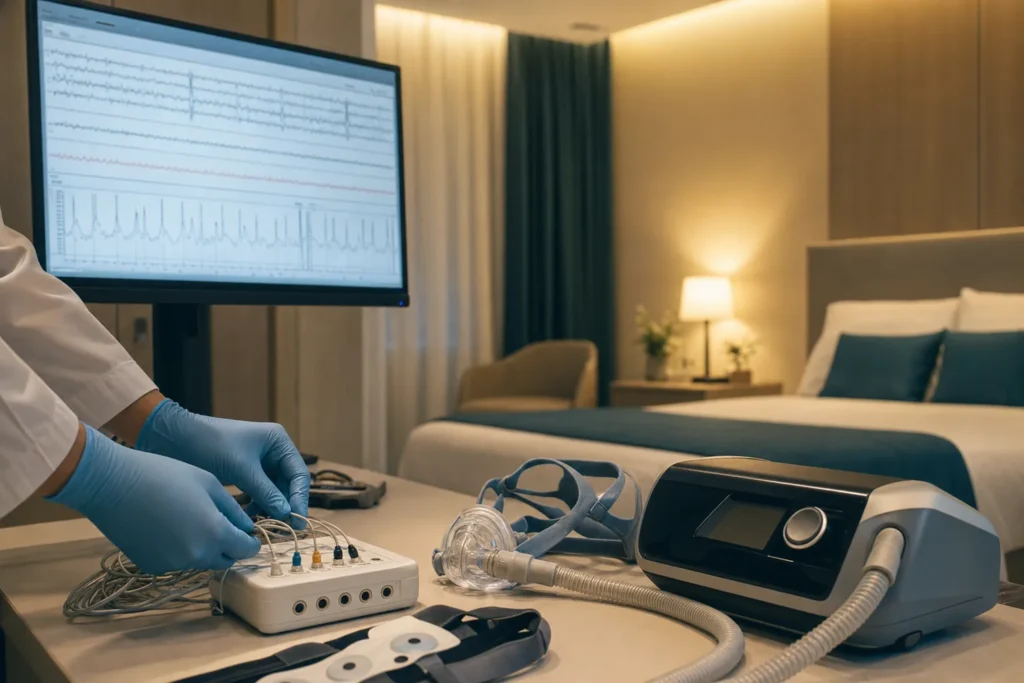
- Home sleep apnea test. You take a small device home and wear sensors that record things such as airflow, breathing effort, oxygen levels and heart rate while you sleep in your own bed. It is convenient and works well for many people with a clear picture of likely OSA.
- In-lab sleep study (polysomnography). You spend a night in a sleep unit while a wider set of sensors records brain waves, eye movements, muscle activity, airflow, breathing effort, oxygen and heart rhythm. Sleep specialists often recommend this fuller test when there are other medical concerns, such as significant heart or lung disease, possible muscle weakness, long-term opioid use, a history of stroke, or severe insomnia.
Both tests produce the apnea-hypopnea index (AHI) described earlier, which sorts OSA into mild, moderate or severe. The results, together with your symptoms, guide the treatment plan. Diagnosis is not about labeling you; it is about measuring what is happening so the right help can be matched to it.
Treatment options
OSA is best thought of as a long-term condition that is managed by a team, often including a sleep physician, a respiratory (lung) doctor, an ear-nose-throat (ENT) surgeon, a dentist trained in sleep devices, and sometimes a dietitian. Sleep specialists emphasize that you should be involved in choosing your treatment, because what works depends on the severity, the cause and what you can comfortably stick with. There is no single best option for everyone.
CPAP (continuous positive airway pressure). CPAP is the main treatment for moderate and severe OSA and works for many people with milder disease too. The NHS describes it as a machine that "gently pumps air into a mask you wear over your nose, or nose and mouth, while you sleep." That steady flow of air acts like a splint, holding the airway open so breathing does not pause. It does not cure OSA, but used regularly it controls it and can dramatically reduce symptoms. Comfort matters: trying different masks, using the machine's humidifier, and getting support in the first weeks all help people get used to it.
Oral appliances (mandibular advancement devices). These are custom mouthpieces, fitted by a dentist, that hold the lower jaw slightly forward to keep the airway open. They are often used for mild to moderate OSA, or for people who cannot tolerate CPAP.
Lifestyle and behavioral measures. Losing excess weight, reducing alcohol (especially in the evening), stopping smoking, and avoiding sedatives can all reduce the number of breathing events. For some people weight loss substantially improves or even resolves OSA. Positional therapy, which discourages sleeping on the back, helps those whose apnea is worse when lying flat.
Surgery. Surgery is considered when other treatments have not worked or are not suitable, and the type depends on where the blockage is. Options include procedures to remove or reshape soft tissue at the back of the throat (such as uvulopalatopharyngoplasty), surgery to correct a deviated nasal septum (septoplasty), removal of enlarged tonsils or adenoids (very effective in children), and, in selected cases, jaw repositioning surgery.
Hypoglossal nerve stimulation. This is a newer option for selected adults with moderate to severe OSA who cannot use CPAP. A small implanted device gently stimulates the nerve that controls tongue movement, keeping the airway open during sleep.
Supportive care. Treating nasal congestion, reviewing medicines, and, where needed, cognitive behavioral therapy to help with sleep habits or with sticking to treatment, all play a part. The right plan is usually a combination tailored to you.
Outlook: what to expect
The outlook for OSA is generally good, especially when it is diagnosed and treated, and when treatment is used consistently. OSA is a chronic condition, meaning it is managed rather than cured for most people, but effective management lets the great majority of people sleep properly and feel far better during the day.
With CPAP or another suitable treatment, many people notice less daytime sleepiness, clearer thinking, steadier mood and better quality of life within weeks to a few months. Research into people using CPAP has reported improvements in sleepiness, mood, concentration and overall wellbeing, with the strongest benefits seen in those who use their treatment regularly. The key word is regularly: the benefit comes from consistent use, not from owning the device.
Why this matters beyond comfort: untreated OSA is linked over time to higher rates of high blood pressure, stroke, coronary heart disease, irregular heart rhythms such as atrial fibrillation, heart failure, type 2 diabetes and depression, and to the very real danger of falling asleep at the wheel. These are population-level associations, not a personal forecast for any one individual, and treating OSA is one of the practical steps that can reduce these risks. The honest, encouraging summary is that this is a condition where treatment genuinely changes how you feel and helps protect your long-term health.
Living with OSA and follow-up
Once treatment starts, OSA care becomes a long-term partnership rather than a one-off fix. The first weeks with CPAP or an oral device are usually the hardest, and this is exactly when support pays off. Studies have found that a large share of people stop using CPAP within the first year, often because of fixable problems like an uncomfortable mask, a dry nose or a noisy machine. None of these mean the treatment cannot work for you; they mean the setup needs adjusting. Tell your team early if something is uncomfortable.
Practical tips that help many people:
- Wear the mask a little while awake at first, watching television or reading, to get used to the airflow.
- Use the humidifier setting if your nose or throat feels dry.
- Keep the equipment clean and replace worn parts as advised.
- Treat a blocked nose, since nasal congestion makes any therapy harder.
- Keep up the lifestyle measures, since weight, alcohol and sleeping position all still matter even when you use a device.
Modern CPAP machines record how many hours you use them and how well they are controlling events, and your team will review this data at follow-up visits. Follow-up also checks that symptoms have improved, that the mask or device still fits, and whether the plan needs adjusting, for example after significant weight change. If you drive, be aware that many countries have rules about reporting OSA that causes sleepiness to the driving authority; your doctor can advise you on what applies where you live.
Planning treatment abroad: what affects cost and how to prepare your records
If you are considering arranging OSA assessment or treatment in Turkiye, it helps to understand what shapes the overall cost so you can ask informed questions and request a personalised estimate. We do not list fixed prices here, because the right plan, and therefore the cost, depends entirely on your individual situation.
Factors that typically affect the cost of OSA care include:
- Which tests you need, for example a home sleep apnea test versus a full in-lab overnight study (polysomnography).
- The treatment chosen, since a CPAP machine and mask, a custom oral appliance, surgery, or an implanted nerve-stimulation device differ greatly in what they involve.
- Whether surgery is required, and if so the type, the surgical team, and any hospital stay.
- Specialist consultations and follow-up, including any device titration (fine-tuning CPAP pressure) and review visits.
- Your length of stay and travel, and any need for interpreter support or accommodation.
To prepare, gather as much of your medical history as you can: any previous sleep study reports and their AHI results, a current list of medicines, details of related conditions such as high blood pressure, heart disease or diabetes, and notes on your symptoms from you and anyone who shares your room. Having these ready lets a specialist give accurate advice and a meaningful estimate. The most reliable way to understand costs for your situation is to request a personalised quote through a free consultation, where the team can review your records before recommending anything.
Why Turkiye, and how to choose a good centre
Turkiye has become a well-known destination for international medical care, with many hospitals that treat patients from abroad and a number of internationally accredited facilities. For a condition like OSA, the priority is not a destination but the quality and continuity of the sleep service, so the same checklist applies wherever you are treated.
Things worth verifying before you commit:
- Accreditation. Look for recognised hospital accreditation such as Joint Commission International (JCI), an independent standard for patient safety and quality. Turkiye has a notably high number of JCI-accredited hospitals.
- A proper sleep service. Check that the centre has a dedicated sleep unit able to perform recognised sleep studies (home testing and in-lab polysomnography) and to interpret them, rather than only selling a device.
- A multidisciplinary team. Good OSA care draws on sleep physicians, respiratory doctors, ENT surgeons and dentists trained in oral appliances. Ask who will oversee your care.
- Clear specialist credentials. Ask about the qualifications and experience of the doctors who will diagnose and treat you.
- Follow-up and support. Because OSA is a long-term condition, ask how device fine-tuning, troubleshooting and review will work after you return home, and how you will get help if a mask or device needs adjusting.
- Honest, individualised advice. Be cautious of anyone promising a guaranteed cure or pushing one product before you have been properly assessed.
A trustworthy centre will welcome these questions and explain its approach clearly.
Prevention and self-care
You cannot change some risk factors for OSA, such as your age, your family history or the natural shape of your airway. But several everyday measures can lower your risk or reduce the severity of OSA, and they support whatever medical treatment you use.
- Aim for a healthy weight. Because excess weight around the neck is one of the strongest contributors, reaching and keeping a healthy weight can meaningfully reduce breathing events, and for some people substantially improve OSA.
- Be mindful of alcohol, especially in the evening. Alcohol relaxes the throat muscles and worsens airway collapse.
- Avoid sedatives unless prescribed, since they too relax the airway.
- Stop smoking. Smoking adds inflammation and fluid to the upper airway and is worth quitting for many reasons.
- Try sleeping on your side if your apnea is worse on your back.
- Keep your nose clear, treating allergies or congestion, since easier nasal breathing helps both natural sleep and any device you use.
- Keep regular sleep habits, giving yourself enough time for sleep and a consistent routine.
None of these replace getting assessed if you have symptoms. If you snore loudly, wake gasping, or feel persistently sleepy in the day, the single most useful self-care step is to see a qualified doctor and ask about a sleep study. Catching and treating OSA early protects both how you feel each day and your long-term health.
Frequently asked questions
Is obstructive sleep apnea dangerous?
Does snoring mean I have sleep apnea?
How is OSA diagnosed?
What is the AHI and what counts as severe?
What is the main treatment for OSA?
Can OSA be cured, or only managed?
What if I cannot tolerate CPAP?
Will treating OSA help my daytime tiredness?
Can children have obstructive sleep apnea?
What affects the cost of OSA treatment in Turkiye?
How do I choose a good centre for OSA care?
This article is for general information only and is not medical advice. Always consult a qualified doctor about your individual case.
Considering this procedure?
Send us your photos and questions. A BergemHealth coordinator and a department-head specialist will review your case and reply with honest, personalised guidance — no obligation.
Free consultation