Arrhythmia & catheter ablation
An arrhythmia simply means your heart's rhythm is off — beating too fast, too slow, or unevenly. Many arrhythmias are harmless, some need treatment, and a few are serious, so it helps to understand what is happening. This guide explains arrhythmia in everyday language: the main types, what causes them, how doctors diagnose them, and the treatments available — including catheter ablation, a keyhole procedure that can correct certain rhythm problems. We also cover what to expect, how to live well with an arrhythmia, and practical points if you are considering care in Turkiye.
What an arrhythmia is
Your heart has its own electrical system. A small cluster of cells called the sinoatrial (SA) node acts as a natural pacemaker, sending out steady electrical signals that tell the heart muscle when to squeeze and pump blood. In a healthy adult at rest, this usually produces a regular beat of about 60 to 100 beats per minute.
An arrhythmia (also written as arrhythmia or dysrhythmia) is any problem with the rate or rhythm of your heartbeat. The electrical signals may fire too fast, too slow, or in a disorganised way, so the heart beats irregularly. Some people feel this as a racing, fluttering, pounding, or skipping sensation; others feel nothing at all and only find out during a routine check.
It is important to keep this in perspective. Occasional extra or skipped beats are extremely common and are very often harmless. Other arrhythmias do need treatment because, over time, they can make the heart pump less effectively or raise the risk of complications such as blood clots. A doctor can tell the difference, which is why a proper assessment matters more than worry.
Types and subtypes
Doctors group arrhythmias in a few ways. The simplest is by speed:
- Tachycardia means the heart beats too fast — generally faster than 100 beats per minute at rest.
- Bradycardia means the heart beats too slowly — generally slower than 60 beats per minute (which can be normal in fit, athletic people, but a problem if it causes symptoms).
Within these, the common named types include:
- Atrial fibrillation (AF or AFib) — the most common arrhythmia. The heart's upper chambers (the atria) quiver instead of beating cleanly, giving an irregular and often fast pulse. Because blood can pool and form clots, AF raises the risk of stroke, which is why treatment focuses partly on clot prevention.
- Atrial flutter — similar to AF, but the upper chambers beat rapidly in a more regular, organised pattern.
- Supraventricular tachycardia (SVT) — sudden episodes where the heart races, starting in or above the upper chambers. SVT often begins between roughly the ages of 25 and 40 and is rarely life-threatening, though episodes can be distressing.
- Ventricular arrhythmias — including ventricular tachycardia and ventricular fibrillation, which start in the lower pumping chambers. These can be serious and need prompt medical attention.
- Premature (extra) beats — early beats from the atria (PACs) or ventricles (PVCs). These are very common and usually harmless.
Causes and risk factors
Arrhythmias happen when something disturbs the heart's electrical signalling. Often there is an underlying reason, but sometimes no clear cause is found, and that on its own is not a sign of danger.
Common contributors and risk factors include:
- Other heart conditions such as coronary heart disease, a previous heart attack, heart valve disease, or heart failure.
- High blood pressure, which over time strains the heart.
- Increasing age — arrhythmias such as AF become more common after about 55.
- An overactive thyroid, diabetes, kidney disease, or sleep apnoea (where breathing repeatedly pauses during sleep).
- Obesity, and sometimes intense long-term endurance exercise.
- Lifestyle triggers including caffeine, alcohol, smoking, and recreational drugs.
- Certain medicines, and imbalances in blood salts (electrolytes) such as potassium.
- Stress, illness, infection, or recent surgery.
- A family history of heart rhythm problems, and some conditions present from birth.
Identifying and managing these factors is part of treatment, because controlling the cause sometimes settles the rhythm.
Signs, symptoms, and when to see a doctor
Arrhythmia symptoms vary a great deal. Some people have none. Others notice:
- Palpitations — an awareness of your heartbeat that may feel fast, fluttering, pounding, or like a skipped beat.
- Feeling short of breath.
- Dizziness or light-headedness.
- Tiredness or reduced ability to exercise.
- Chest discomfort.
- In some cases, fainting or near-fainting.
You should make a routine appointment with a doctor if you have ongoing palpitations, an unusually fast or slow pulse, or unexplained breathlessness, dizziness, or tiredness — even if the episodes pass on their own. Getting checked brings answers and peace of mind.
Seek emergency help straight away (for example, call your local emergency number) if palpitations come with chest pain, severe shortness of breath, fainting, or collapse. These signs need urgent assessment. This is not meant to alarm you — most palpitations are not emergencies — but knowing the red flags helps you act calmly if they appear.
Screening and early detection
There is no single nationwide screening test that everyone is offered for arrhythmia. Many arrhythmias are found incidentally — during a routine examination, when a clinician feels an irregular pulse, or through a check done for another reason.
That said, simple awareness goes a long way. Knowing how to take your own pulse, and noticing whether it feels regular, can help you spot an irregular rhythm such as atrial fibrillation early. Some pulse-checking is now built into routine appointments and into some consumer wearables and smartwatches; these can flag a possible irregular rhythm, but they are not a diagnosis and any alert should be confirmed by a doctor with a proper recording.
If you have risk factors — high blood pressure, diabetes, sleep apnoea, thyroid problems, or a family history of heart rhythm disorders — it is reasonable to mention this to your doctor so your pulse and heart can be checked from time to time.
How an arrhythmia is diagnosed
The cornerstone of diagnosis is the electrocardiogram (ECG or EKG), a quick, painless test that records the heart's electrical activity through small stickers on the skin. It is the most common way to detect an arrhythmia and to identify which type it is.
Because many arrhythmias come and go, a single ECG may be normal even when a problem exists. Doctors then use longer recordings, including:
- A Holter monitor or other portable recorder worn for a day or several days (sometimes longer) to capture intermittent episodes.
- Event recorders or implantable loop recorders for rare episodes.
Other tests help find the cause and check the heart's structure:
- Echocardiogram — an ultrasound scan of the heart.
- Blood tests — for example to check thyroid function and electrolytes.
- Exercise (stress) test — to see how the heart behaves during activity.
- Electrophysiology (EP) study — a more detailed, specialist test in which thin wires are guided into the heart through a vein to map exactly where abnormal signals start. An EP study is often done at the same time as catheter ablation.
Treatment options
Treatment depends entirely on the type of arrhythmia, how troublesome it is, and your overall health. Many people need only monitoring and reassurance. Others benefit from one or more of the following, usually overseen by a multidisciplinary team that may include a cardiologist, an electrophysiologist (a heart-rhythm specialist), specialist nurses, and an anaesthetist.
Medicines are often the first step. Depending on the arrhythmia they may slow a fast heart, help restore or maintain a normal rhythm, or — in conditions such as atrial fibrillation — include anticoagulants (blood thinners) to lower the risk of clots and stroke.
Cardioversion uses a brief, controlled electrical shock (under sedation) to reset the heart to a normal rhythm; it can be used for AF and some other fast rhythms.
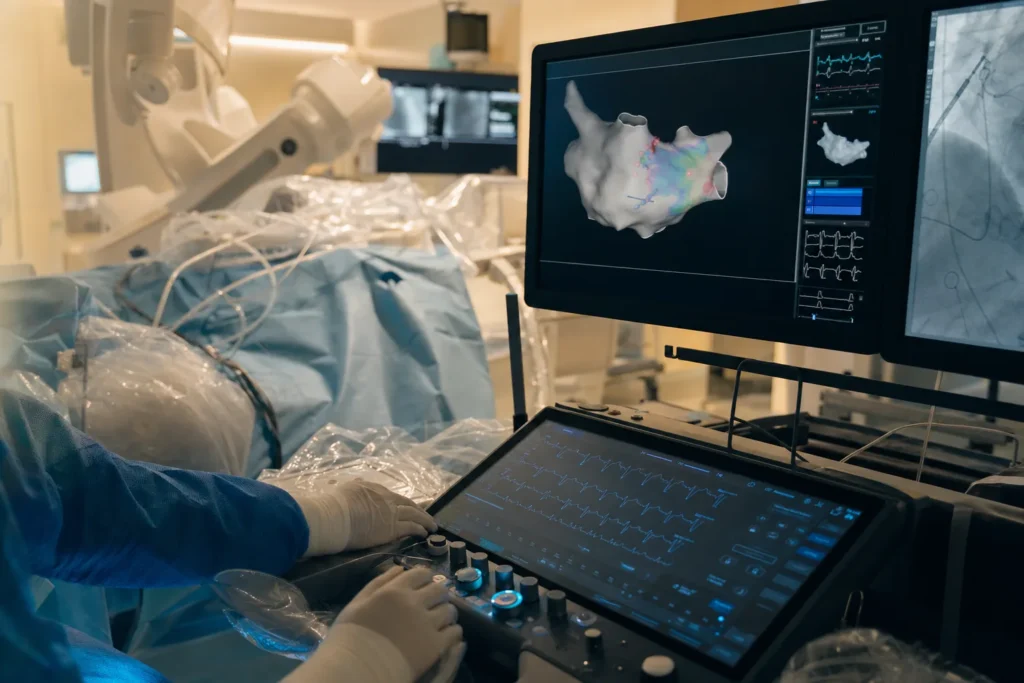
Catheter ablation is a keyhole procedure that treats the source of many arrhythmias, including SVT, atrial flutter, AF, and some ventricular rhythms. Thin flexible tubes (catheters) are guided to the heart through a vein, usually in the groin. The specialist first maps the faulty electrical pathways, then uses energy at the catheter tip to create tiny, precise areas of scar tissue that block the abnormal signals. The energy may be heat (radiofrequency ablation), intense cold (cryoablation), or, in some centres, newer pulsed-field energy. It is usually done with local anaesthetic and sedation, or sometimes general anaesthesia.
Implanted devices help in other situations: a pacemaker for a heart that beats too slowly, and an implantable cardioverter-defibrillator (ICD) to detect and stop dangerous fast rhythms in people at risk.
Alongside these, doctors treat any underlying cause, such as high blood pressure, thyroid problems, or sleep apnoea.
Outlook and what to expect
For most people, an arrhythmia is a manageable condition rather than a constant threat. Many arrhythmias — especially harmless extra beats — need no treatment at all. Others are well controlled with medicines, lifestyle changes, a procedure, or a device, and people go on to live full and active lives.
Outcomes depend on the type. For SVT, catheter ablation cures the problem in most people who have it. For atrial fibrillation, ablation can substantially reduce or stop episodes; published studies report that a large share of suitable patients remain free of AF in the year after the procedure, though some need a repeat procedure or ongoing medication, and individual results vary. These are population-level findings from research, not a prediction for any one person.
Some arrhythmias, particularly certain ventricular rhythms and untreated atrial fibrillation, carry more risk and need closer attention — but identifying them is exactly what allows effective treatment. Your own outlook depends on the specific diagnosis, the health of your heart, and how the condition responds, and is best discussed with a specialist who knows your case.
Living with an arrhythmia and follow-up
Living well with a heart rhythm condition is very achievable. A few practical habits help:
- Take medicines as prescribed, and do not stop blood thinners or rhythm medicines without medical advice.
- Know your triggers. For many people, cutting back on caffeine and alcohol, stopping smoking, managing stress, and getting good sleep reduce episodes.
- Manage related conditions such as blood pressure, weight, diabetes, thyroid problems, and sleep apnoea.
- Learn what to do during an episode. For SVT, doctors can teach simple vagal manoeuvres (such as the Valsalva manoeuvre) that may stop an episode.
- Keep a simple record of when symptoms happen and what you were doing — it helps your team.
After a procedure such as ablation, you will normally have follow-up appointments and may continue some medicines for a period while the heart settles. Tell your team about any new or returning symptoms, and keep your routine checks. Many people also find a cardiac rehabilitation programme or a patient support group helpful for confidence and information.
Planning treatment abroad: what affects cost and how to prepare
If you are considering catheter ablation or other arrhythmia care abroad, it helps to understand what shapes the overall cost rather than focusing on a single headline figure. Because every heart and every rhythm is different, a personalised estimate is the only meaningful one — which is why we do not publish prices here.
Factors that typically influence the cost of arrhythmia treatment include:
- The type of arrhythmia and the complexity of the ablation (a straightforward SVT differs from complex atrial fibrillation).
- The technology used — for example radiofrequency, cryoablation, or pulsed-field energy, and whether advanced 3D mapping systems are involved.
- Whether an electrophysiology study or additional procedures are needed.
- The type of anaesthesia, length of hospital stay, and any pre-procedure tests.
- The specialist team and the hospital chosen.
- Follow-up appointments, medicines, and travel or accommodation for you and a companion.
To prepare, gather your medical records: previous ECGs and any rhythm recordings, echocardiogram and other imaging, a list of your medicines and doses, blood test results, and a short summary from your current doctor. Sharing these allows a specialist to assess your case accurately and give you a clear, individual plan and estimate. The best next step is to request a free consultation so your situation can be reviewed properly.
Why Turkiye, and how to choose a good centre
Turkiye has become a well-established destination for cardiac care, with a number of large, modern hospitals that offer electrophysiology studies, catheter ablation, pacemakers, and other heart-rhythm treatments, often with internationally trained specialists and English-speaking coordinators. For many international patients, the combination of experienced teams, up-to-date technology, and shorter waiting times is appealing.
When choosing a centre, focus on objective markers of quality rather than marketing claims:
- Accreditation. Look for recognised international accreditation such as Joint Commission International (JCI), which sets global standards for quality and patient safety. Turkiye has many JCI-accredited hospitals.
- A dedicated electrophysiology team. Ask whether a qualified electrophysiologist (heart-rhythm specialist) will perform the procedure, and about their experience with your specific arrhythmia.
- Technology. Check that the centre offers modern mapping systems and the relevant ablation methods.
- Clear information. A good centre will explain the diagnosis, the plan, the risks, the expected outcomes, and the follow-up in writing, and will not promise a guaranteed cure.
- Communication and aftercare. Confirm how you will be supported before, during, and after treatment, and how follow-up will be handled once you return home.
As a concierge service, BergemHealth can help you compare its partner hospitals (including which hold JCI accreditation) and arrange a specialist review of your records.
Prevention and self-care
Not every arrhythmia can be prevented — some relate to age, inherited factors, or other heart conditions — but you can meaningfully reduce your risk and the frequency of episodes by looking after your heart in general. Sensible, evidence-based steps include:
- Keep blood pressure, cholesterol, and blood sugar in a healthy range, with your doctor's help.
- Stay physically active in a way that suits you, and maintain a healthy weight.
- Limit alcohol and caffeine if they trigger your symptoms, and stop smoking.
- Get treatment for sleep apnoea if you have it, as it is strongly linked to atrial fibrillation.
- Manage stress and aim for good-quality sleep.
- Use medicines and supplements carefully — some can affect heart rhythm, so check with a pharmacist or doctor.
Above all, do not self-diagnose or self-treat a suspected rhythm problem. If you notice persistent palpitations or any of the red-flag symptoms described earlier, see a qualified doctor. A clear diagnosis is the foundation of safe, effective care — and often, of reassurance.
Frequently asked questions
Is an arrhythmia dangerous?
What is the difference between an arrhythmia and palpitations?
What is catheter ablation and how does it work?
Which arrhythmias can catheter ablation treat?
Does catheter ablation cure the arrhythmia?
Is the procedure done awake or asleep?
What are the risks of catheter ablation?
Why is atrial fibrillation linked to stroke?
Can lifestyle changes help my arrhythmia?
How do I know if a hospital abroad is a good choice for arrhythmia treatment?
What should I bring or prepare before a consultation?
Sources
- NHS — Arrhythmia (heart rhythm problems)
- NHS — Atrial fibrillation
- NHS — Supraventricular tachycardia (SVT)
- American Heart Association — About Arrhythmia
- MedlinePlus — Arrhythmia
- NHLBI — Arrhythmias: Treatment
- Cleveland Clinic Newsroom — Ablation for atrial fibrillation (STOP AF First study)
- Cleveland Clinic — Atrial flutter ablation
- Joint Commission International — Accreditation
- Memorial Hospitals Istanbul — JCI Accreditation
This article is for general information only and is not medical advice. Always consult a qualified doctor about your individual case.
Specialists in Cardiology
Doctors of the department we work with directly. Which doctor takes your case is decided after the specialists have reviewed your records — your coordinator confirms it, not this page.



Considering this procedure?
Send us your photos and questions. A BergemHealth coordinator and a senior specialist will review your case and reply with honest, personalised guidance — no obligation.
Free consultation