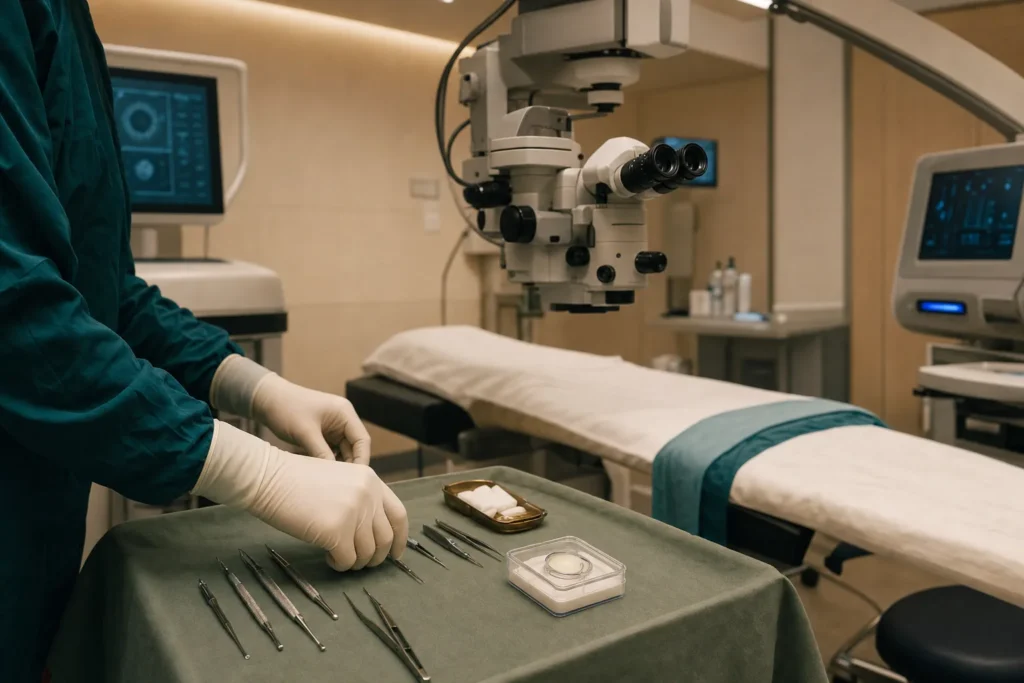
ICL (implantable contact lens)
An implantable contact lens, or ICL, is a soft, permanent lens placed inside the eye to correct short-sightedness without removing or reshaping any corneal tissue. It is a popular alternative to laser eye surgery, especially for people with strong prescriptions or corneas that are too thin for LASIK. This guide explains, in plain language, what the procedure involves, who it suits, what recovery is like, the real risks, and what it costs.
- Anaesthesia
- Numbing eye drops (topical anaesthesia), sometimes with a mild sedative; you stay awake.
- Duration
- Roughly 15-30 minutes per eye; often both eyes the same day or a week apart.
- Recovery
- Useful vision often within 24 hours; full settling over about 1-2 weeks; drops for 2-4 weeks.
- Hospital stay
- Day case (outpatient); no overnight stay. You go home the same day.
What an ICL actually is
An ICL stands for implantable contact lens (also called an implantable collamer lens). It is a thin, soft, prescription lens that an eye surgeon places inside your eye to correct your vision. Unlike a normal contact lens that sits on the surface of your eye and is taken out each night, an ICL is positioned permanently in a hidden space inside the eye, just behind the coloured part (the iris) and in front of your own natural lens. You cannot feel it and other people cannot see it.
The lens is made of a material called collamer — a soft, flexible blend of a plastic (a type of acrylic) and a small amount of collagen, a natural protein. The body tolerates it well, and it lets fluid and nutrients pass through. The most modern version, known as the EVO lens, has a tiny central hole about 0.36 mm wide that lets the eye's own fluid flow freely; this design removed the need for an extra laser step that older lenses required.
It helps to know how an ICL differs from LASIK. LASIK uses a laser to reshape the front surface of your eye (the cornea), permanently removing a little tissue. An ICL adds a lens instead of removing tissue, so nothing about your cornea is changed. That difference matters a lot for people whose corneas are too thin for laser surgery, and it is the main reason ICL exists as a separate option.
Who is a good candidate (and who should avoid it)
ICL is mainly used to correct short-sightedness (myopia) — trouble seeing things far away — and it can also correct astigmatism, which is blurring caused by an irregularly curved eye. A version designed to correct it uses a toric lens.
You may be a good candidate if you:
- Are roughly 21 to 45 years old (the age range studied and approved for the lens).
- Have a stable prescription — your glasses haven't changed much (within about 0.5 dioptres) over the past year.
- Have moderate to high myopia. The lens is approved to correct from about -3 up to -15 dioptres, and to reduce very strong prescriptions up to -20 dioptres.
- Have corneas too thin or too irregular for LASIK, or already have dry eyes that laser surgery could worsen.
- Have enough room inside the eye — surgeons measure the anterior chamber depth (the space at the front of the eye), which usually needs to be 3.0 mm or more.
ICL is generally not suitable if you are pregnant or breastfeeding, if the front chamber of your eye is too shallow, if your eye's inner cell layer (the corneal endothelium) is too low in number, or if you have certain eye conditions such as glaucoma, ongoing eye inflammation, or an eye disease that is not stable. Uncontrolled diabetes affecting the eyes is also a reason for caution. A thorough examination is the only way to know for sure — suitability is decided eye by eye, not by prescription alone.
Types and techniques
Most ICLs today are posterior chamber phakic lenses. "Phakic" simply means your natural lens stays in place — the ICL works alongside it rather than replacing it. "Posterior chamber" means the lens sits behind the iris.
The main variations you may hear about:
- EVO ICL (for myopia): the standard modern lens with the central flow hole, used to correct short-sightedness.
- EVO Toric ICL: the same lens with an added correction built in for astigmatism. It must be rotated to a precise angle during surgery and lined up with your eye's shape.
- Presbyopia-focused lenses: a newer design (sometimes called an extended-depth-of-focus or EDOF lens) aims to help people who also struggle with close-up reading vision as they get older. Availability varies by country.
A key part of the technique is choosing the correct lens size and power. The surgeon takes detailed measurements of the eye — including its internal width and depth — and uses a manufacturer's calculator to pick the lens. Getting the size right controls the vault: the small gap left between the ICL and your natural lens. A healthy vault (roughly 250–750 microns, about the thickness of a few sheets of paper) keeps fluid flowing properly. Too little or too much vault can cause problems, which is why precise measurement matters so much.
How it is done: anaesthesia, steps and timing
ICL surgery is a keyhole procedure, broadly similar in approach to cataract surgery, and it is done as a day case — you go home the same day.
Anaesthesia: the eye is numbed with anaesthetic eye drops (sometimes topped up with a numbing injection inside the eye). You stay awake, but you may be offered a mild sedative to help you relax. You will not see the details of the surgery, and you should not feel pain.
Step by step, the surgeon usually:
- Puts in drops to dilate (widen) the pupil and numb the eye.
- Makes a very small incision (about 3 mm) at the edge of the cornea — small enough that no stitches are normally needed.
- Inserts the folded ICL through that opening using a special injector; the lens gently unfolds inside the eye.
- Carefully tucks the lens into position behind the iris, in front of your natural lens. A toric lens is also rotated to the correct angle.
- Removes the protective gel used during surgery and checks the eye's pressure and the lens position.
The procedure itself usually takes about 15 to 30 minutes per eye. Many clinics treat both eyes the same day; others space them out by a week or two. You will rest briefly afterwards and then someone should drive you home, as your vision will be blurry at first.
Recovery, step by step
One of the appeals of ICL is a relatively quick recovery. Here is roughly what to expect.
- The first hours: vision is blurry and the eye may feel watery, gritty or sensitive to light. This is normal. You will rest, and the clinic will usually check your eye pressure the same day.
- Day 1: many people already notice clearer vision — sometimes within 24 hours. You will have a check-up the day after surgery.
- First week: you use antibiotic and anti-inflammatory eye drops as prescribed (typically antibiotics for about a week and steroid drops tapered over two to four weeks). Vision keeps sharpening; mild glare or haloes around lights at night are common early on and usually fade.
- About 1–2 weeks: vision generally settles, and most people return to normal daily activities, including work, within a few days.
During recovery you will usually be told to avoid rubbing the eye, keep water, soap and shampoo out of it, skip eye make-up for a couple of weeks, and stay away from swimming pools, hot tubs and dusty or dirty environments until your surgeon says it is safe. Strenuous exercise and contact sports are paused for a short period too. Wearing sunglasses outdoors helps with light sensitivity. Always follow your own surgeon's specific instructions, as they may differ.
Risks and possible complications
ICL is generally considered safe, and most people are satisfied with the result — one large clinic reports that nearly 95% of patients are happy with their outcome. But, like any eye surgery, it carries real risks, and it is important to understand them.
More common, usually temporary effects include:
- Glare, haloes and difficulty seeing in low light, especially when driving at night. These often improve over weeks.
- Light sensitivity, redness or a gritty feeling in the early days.
- A short-term rise in eye pressure after surgery, which usually settles or is treated with drops.
Less common but more serious risks include:
- Cataract — clouding of your natural lens — particularly if the vault is too low. The risk is much lower with modern central-port lenses but is not zero.
- Raised eye pressure or glaucoma, sometimes from a vault that is too high blocking fluid flow.
- Loss of cells on the inner surface of the cornea (endothelial cell loss) over time, which is why these cells are counted before surgery.
- The lens being slightly off-centre or rotated (mainly toric lenses), occasionally needing a second procedure to reposition it.
- Infection inside the eye, bleeding, or retinal detachment — rare but potentially sight-threatening.
- Under- or over-correction, meaning you might still need glasses or contact lenses for some tasks.
Warning signs that need urgent attention after surgery include increasing pain, growing redness, sudden loss of vision, or a shower of new floaters or flashing lights. Contact your surgeon or an emergency eye service straight away if these occur.
Results and how long they last
For the right candidate, ICL can give sharp, stable vision, and studies suggest the quality of vision is often very good — with fewer dry-eye complaints and good contrast compared with some laser procedures, particularly for stronger prescriptions. In high-myopia patients especially, ICL has performed at least as well as laser surgery in published comparisons.
The lens itself is designed to stay in your eye long term — potentially for the rest of your life — without needing routine replacement. An important and reassuring feature is that the procedure is, in principle, reversible: because no tissue is removed and the cornea is not reshaped, a surgeon can remove or exchange the lens if your needs change or a problem develops.
That said, ICL corrects your prescription as it is now; it does not stop your eyes from ageing. From your mid-forties onward you may still develop presbyopia (the normal age-related loss of close-up focus) and need reading glasses, and you can still develop a cataract later in life like anyone else. No surgeon can guarantee a specific result, and some people need a small touch-up or continue to use glasses for certain tasks.
Costs: indicative ranges and what changes the price
ICL is a private, elective procedure, so prices vary widely by country, clinic and lens type. As a rough guide, in Western Europe and the UK the price is commonly quoted per eye, often in the region of around EUR 2,400 to EUR 5,500 per eye, meaning both eyes can run from roughly EUR 5,000 to EUR 9,000 or more at premium clinics. In Turkiye, packages are frequently lower, which is part of why people travel for treatment.
The main things that change the price are:
- Standard vs toric lens: the astigmatism-correcting toric lens usually costs more.
- One eye or both, and whether the quote covers both.
- Surgeon's experience and clinic reputation.
- The diagnostic scans and tests needed to size and plan the lens.
- Aftercare — how many follow-up visits and how long they are included for.
These figures are indicative ranges only — they vary by case, surgeon and clinic, and are not a quote. Always ask for a written, itemised price that states exactly what is and isn't included (lens, scans, surgery, medications and follow-up). Be wary of unusually cheap headline prices that may exclude tests or aftercare.
Why people travel to Turkiye, and how to choose a safe clinic and surgeon
Turkiye has become a well-known destination for eye and other medical treatment because it combines experienced surgeons, modern equipment and lower prices than much of Western Europe, often within an organised package. For ICL specifically, the appeal is being treated by a high-volume refractive surgeon at a cost that may be a fraction of home-country prices.
Lower cost should never come at the expense of safety. Before booking, it is worth taking time to verify the clinic and the surgeon:
- Accreditation: look for hospitals with recognised quality accreditation, such as JCI (Joint Commission International), and check that the facility is licensed by the Turkish Ministry of Health.
- Surgeon credentials: confirm the surgeon is a qualified, board-certified ophthalmologist with specific experience in ICL, not only LASIK. Ask roughly how many ICL procedures they perform each year.
- A genuine assessment: a trustworthy clinic will insist on full eye measurements and may decline to operate if you are not a good candidate. Be cautious of anyone promising surgery sight-unseen.
- Clear written information: the lens type and power, the price breakdown, what happens if a complication occurs, and how follow-up works once you are home.
- Aftercare and communication: check you can reach the team in a language you understand, and that local follow-up at home is arranged or possible.
A reputable medical-travel organiser can help confirm these details, coordinate scans, and match you with an appropriate surgeon — but you should still ask the questions yourself.
How to prepare, and what to ask at your consultation
Good preparation makes the whole process smoother and safer. In the weeks before surgery you will usually be asked to:
- Stop wearing contact lenses for a period before your measurements (often several days for soft lenses, longer for rigid ones), because lenses temporarily change the shape of your eye.
- Attend a detailed eye assessment — including scans of the front of the eye, pressure checks, a count of the inner corneal cells, and a dilated look at the retina.
- Tell the team about all medicines, allergies and eye conditions, and any history of glaucoma or eye inflammation.
- Arrange time off and a lift home, since you cannot drive immediately afterwards.
Helpful questions to ask your surgeon include:
- Am I a suitable candidate, and if not, why — and what are my alternatives (such as LASIK or lens replacement)?
- Which lens type and power do you recommend, and what vault are you aiming for?
- How many ICL procedures have you done, and what are your typical results and complication rates?
- What are the specific risks for my eyes?
- Will I still need glasses for some tasks, now or as I get older?
- What does follow-up involve, and what do I do if there is a problem after I travel home?
Aftercare and travelling for treatment (including when it is safe to fly)
Aftercare is just as important as the surgery itself. You will go home with eye drops and a schedule for using them — usually antibiotics for about a week and anti-inflammatory drops tapered over a few weeks. Use them exactly as directed, attend your follow-up checks, and protect the eye from rubbing, water and dust during the early healing period.
If you are travelling for treatment, plan the trip around recovery rather than the other way around. A few practical points:
- Flying: air travel itself is generally not harmful to a healing eye after ICL, and short-haul flying is often considered reasonable within a day or two — but you should follow your own surgeon's advice, attend the day-after check first, and ideally allow a few days locally so any early pressure issue can be spotted and treated before you leave.
- Plan your stay: a typical visit allows a day for assessment, the surgery itself, and at least one post-operative check before flying home. Building in a small buffer is wise.
- Carry your records: take home a written summary of the lens type, power and serial details, plus your surgeon's contact information.
- Local follow-up: arrange a check with an eye specialist at home, and know where to go urgently if you develop pain, sudden redness, falling vision or new flashes and floaters.
With sensible preparation, clear aftercare and an experienced surgeon, most people travel, recover and enjoy their new vision without difficulty — but the safest plan is one built around your healing, not just your flights.
Frequently asked questions
Is an ICL the same as a normal contact lens?
Does ICL surgery hurt?
How long does the operation take?
When will I be able to see clearly?
Is ICL better than LASIK?
Can the lens be removed or is it permanent?
Will I still need glasses afterwards?
Who is not suitable for an ICL?
What are the main risks?
How much does ICL cost?
When is it safe to fly after ICL surgery?
Why do people travel to Turkiye for ICL?
This article is for general information only and is not medical advice. Always consult a qualified doctor about your individual case.
Considering this procedure?
Send us your photos and questions. A BergemHealth coordinator and a department-head specialist will review your case and reply with honest, personalised guidance — no obligation.
Free consultation