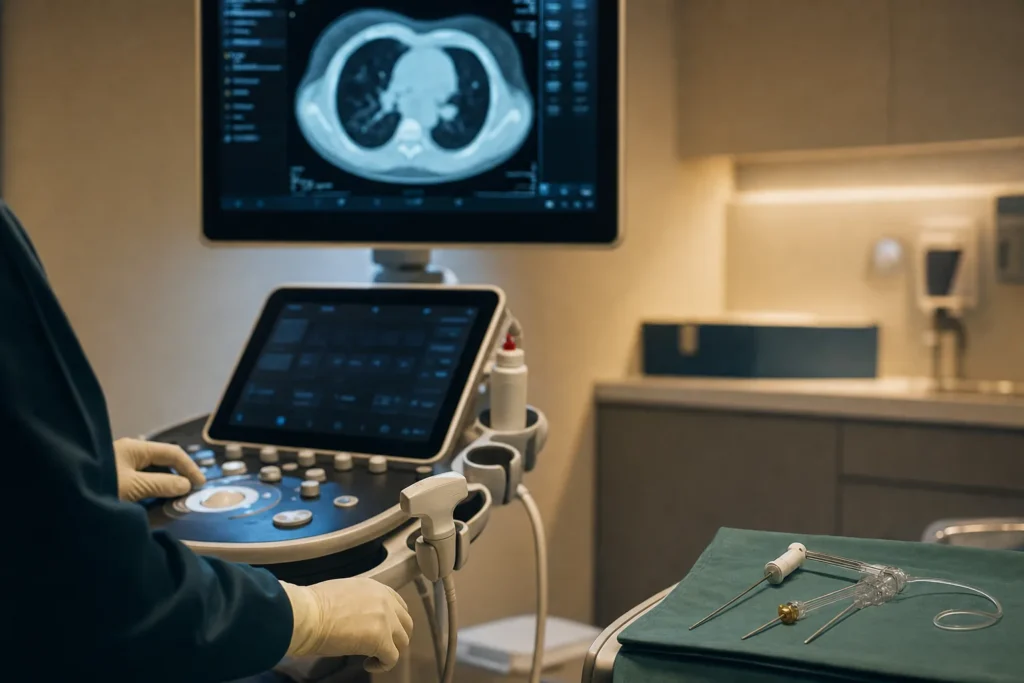
Pleural disease & mesothelioma
The pleura is the thin, two-layered lining that wraps around each lung and lines the inside of the chest. "Pleural disease" is an umbrella term for problems affecting this lining and the narrow space between its layers, from a build-up of fluid to inflammation, a collapsed lung, or, much more rarely, a cancer called mesothelioma. This guide explains, in plain language, what these conditions are, how doctors find and treat them, and what to expect. It is here to inform and reassure, not to alarm. Most pleural problems are not cancer, and many have clear, effective treatments. If you have ongoing breathlessness or chest pain, the most important step is to see a qualified doctor for a proper assessment.
What it is
Each of your lungs is wrapped in a thin, slippery, two-layered membrane called the pleura. One layer hugs the surface of the lung; the other lines the inside of the chest wall. Between them sits a tiny amount of fluid in a region called the pleural space. This fluid works like oil between two panes of glass: it lets the layers glide smoothly over each other every time you breathe in and out.
Pleural disease is a general term for anything that disturbs this normal arrangement. The most common problem is too much fluid collecting in the pleural space, called a pleural effusion (sometimes described as "water on the lung"). Other pleural problems include pleurisy (inflammation of the lining that makes breathing painful), pneumothorax (air leaking into the pleural space so the lung partly collapses), empyema (pus from infection), and pleural thickening or scarring.
Mesothelioma is a rare cancer that can grow in this lining. The pleural type, which affects the lining of the lung and chest, is the most common form. Because it is rare and usually linked to past asbestos exposure, it deserves its own careful explanation, which you will find throughout this guide. It is worth saying clearly at the start: the vast majority of pleural effusions and other pleural problems are not caused by cancer.
Types & subtypes
It helps to separate the broad family of pleural conditions from the specific cancer, mesothelioma.
Common pleural conditions include:
- Pleural effusion — fluid in the pleural space. Doctors divide it into two kinds based on the fluid. Transudative (protein-poor) effusions usually come from raised pressure in blood vessels, such as in heart failure, liver cirrhosis, or kidney problems. Exudative (protein-rich) effusions come from inflammation or leaky vessels, such as in pneumonia, cancer, or after surgery.
- Pleurisy — inflammation of the pleura that makes breathing sharply painful.
- Pneumothorax (collapsed lung) — air in the pleural space. It can happen spontaneously (sometimes when a small air pocket on the lung surface bursts), after an injury, or as a complication of a medical procedure.
- Empyema — a collection of infected fluid (pus) in the pleural space, often after pneumonia.
- Pleural thickening / plaques — scarring of the lining, which can follow infection, inflammation, or asbestos exposure.
Mesothelioma subtypes: Mesothelioma is grouped by where it grows and by how its cells look under a microscope. By location, the main types are pleural (lining of the lung and chest, the most common), peritoneal (lining of the abdomen), and rarer forms in the lining of the heart or around the testicles. By cell type, pathologists describe three patterns: epithelioid (the most common, reported in roughly 60–80% of cases and generally the most treatable), sarcomatoid (less common and faster-growing), and biphasic (a mixture of the two). Knowing the cell type helps the medical team plan treatment.
Causes & risk factors
The cause depends on which pleural condition is involved.
Pleural effusion most often reflects a problem somewhere else in the body. Common causes include heart failure, pneumonia, liver cirrhosis, and lung cancer; less common causes include tuberculosis, asbestos-related disease, pancreatitis, and certain medicines. Finding the underlying cause is a central part of the work-up, because treating that cause is often what resolves the effusion.
Pneumothorax can occur on its own, particularly in tall, slim young people or those with lung conditions such as asthma, COPD, or cystic fibrosis. It can also follow chest injury or a medical procedure. Smoking raises the risk.
Mesothelioma is strongly linked to asbestos, a building material widely used until it was banned (in the UK, in 1999). Tiny asbestos fibres breathed in years earlier can lodge in the pleura and, over a very long time, lead to cancer. According to the NHS, it can take 15 to 60 years for mesothelioma to develop after asbestos exposure, and Cleveland Clinic notes asbestos is responsible for about 70% of pleural mesothelioma cases. People at higher risk include those who worked with asbestos — for example construction workers, electricians, carpenters, plumbers, and heating engineers — and, in some cases, their household members. Less common factors include past radiation treatment to the chest and certain inherited gene changes (such as a faulty BAP1 gene). The American Cancer Society notes mesothelioma is more common in men, partly reflecting historical workplace exposure, and the average age at diagnosis of pleural mesothelioma is about 70.
Signs & symptoms (and when to see a doctor)
Symptoms vary by condition, but several overlap because they all affect breathing.
Pleural effusion may cause shortness of breath, chest pain (often worse with coughing or deep breaths), and a dry cough. Some people have no symptoms and the fluid is found on a scan done for another reason.
Pleurisy classically causes a sharp, stabbing chest pain from one specific spot that is clearly worse when you breathe deeply or cough.
Pneumothorax tends to cause sudden chest pain and breathlessness.
Pleural mesothelioma, per the NHS, may cause chest pain, shortness of breath, a cough that does not go away, difficulty swallowing, a hoarse voice, high temperature and heavy night sweats, fatigue, and unintended weight loss; some people develop curved nails over rounded fingertips ("clubbing"). Peritoneal mesothelioma (in the abdomen) may cause tummy pain, a swollen tummy, nausea or vomiting, loss of appetite or weight loss, and changes in bowel habit.
When to see a doctor: See a doctor if you have ongoing breathlessness, chest pain, or a cough that will not settle — especially if you also have unexplained weight loss or night sweats, or if you know you were exposed to asbestos in the past. These symptoms are common to many ordinary conditions, so having them does not mean you have cancer; but they do deserve a proper check. Seek urgent or emergency care for sudden severe breathlessness, sudden sharp chest pain, or if your lips or fingertips turn bluish, as these can signal a collapsed lung or another emergency.
Screening & early detection
There is no routine population screening test for pleural disease in general or for mesothelioma specifically. Unlike breast or bowel cancer, there is no national programme that invites healthy people for regular pleural checks, and there is no proven blood or imaging test recommended to screen people without symptoms.
For people with a known history of significant asbestos exposure, doctors may discuss monitoring — for example a chest X-ray or low-dose CT scan and a review of any new chest symptoms — but this is individualised rather than a standardised screening programme. The most useful form of early detection remains practical: if you were exposed to asbestos, let your doctor know, and report new or persistent chest symptoms promptly rather than waiting. Because mesothelioma can take decades to appear, a long gap since exposure does not remove the value of mentioning it.
For ordinary pleural effusions, "early detection" usually means investigating breathlessness or chest pain when it first appears, so the underlying cause — whether the heart, an infection, or something else — can be identified and treated.
How it is diagnosed
Diagnosis usually begins with a conversation about your symptoms and history (including any asbestos exposure), a physical examination, and listening to your chest.
Imaging comes next. A chest X-ray can show fluid or a collapsed lung. A CT scan gives a more detailed picture, and ultrasound is very useful for seeing fluid and guiding procedures. For suspected mesothelioma, an MRI or PET scan may be added to see how far any abnormality extends.
Sampling the fluid (thoracentesis): If there is an effusion, doctors often perform a thoracentesis — numbing the skin and passing a thin needle between the ribs, usually with ultrasound guidance, to draw off fluid. Cleveland Clinic describes this as a common, low-risk procedure done while you are awake, taking around 15 minutes, that both relieves breathlessness and lets the laboratory analyse the fluid. Testing the fluid helps tell a transudative from an exudative effusion and can reveal infection or cancer cells.
Biopsy and direct inspection: Fluid alone does not always give the answer. To diagnose mesothelioma with confidence, doctors usually need a biopsy — a tissue sample examined under a microscope, which Cleveland Clinic notes is the only definitive way to confirm it. This may be taken during a thoracoscopy (also called VATS, video-assisted thoracoscopic surgery), where a small camera is passed into the chest so the surgeon can look directly at the pleura and take samples.
Staging: If cancer is confirmed, the team works out its stage (roughly stage 1, confined to the pleura, through stage 4, spread to distant organs). Staging guides treatment and helps the team explain what to expect.
Treatment options
Treatment is tailored to the specific condition, its cause, and your overall health. Care is usually delivered by a multidisciplinary team — which may include a chest physician (pulmonologist), a thoracic surgeon, a cancer specialist (oncologist), a radiologist, a pathologist, specialist nurses, and a palliative care team — who meet to agree the best plan together.
For pleural effusion: The first aim is to treat the underlying cause (for example, water tablets and heart medicines for heart failure, or antibiotics for infection). If fluid is causing breathlessness, it can be drained with a needle (thoracentesis) or a chest tube. When effusions keep coming back, options include pleurodesis — using a medicine to gently stick the two pleural layers together so fluid can no longer collect — or an indwelling pleural catheter, a small tube that lets fluid be drained at home.
For pneumothorax: A small collapsed lung may simply be observed and allowed to heal, sometimes with oxygen. Larger ones may need needle aspiration or a chest tube to remove the air; surgery (often with pleurodesis) may be advised to prevent repeated episodes.
For pleurisy and empyema: Treatment targets the cause — for example anti-inflammatory medicines for pain, antibiotics for infection, and drainage of infected fluid in empyema.
For mesothelioma: Options described by the NHS and the National Cancer Institute include chemotherapy (often the main treatment), immunotherapy (medicines such as nivolumab and ipilimumab that help the immune system fight cancer), radiotherapy, and, when the cancer is found very early and the person is fit enough, surgery to remove diseased lining (for example pleurectomy and decortication). Supportive (palliative) care — relieving breathlessness, pain, and other symptoms, including draining fluid or pleurodesis — is an important part of treatment at any stage, helping people feel as well as possible. Clinical trials may offer access to newer approaches; ask your team whether any are suitable.
Outlook / what to expect
The outlook depends entirely on which condition you have. Many pleural problems resolve well. A pneumothorax often heals within days to a couple of weeks as the body reabsorbs the trapped air. An effusion from a treatable cause, such as an infection or heart failure, usually improves when that cause is managed. Pleurisy frequently settles, especially when it follows a viral illness.
Mesothelioma is a serious cancer, and it is important to be honest about that while avoiding frightening generalisations. Authoritative sources describe it as treatable but, at present, not curable; the aim of treatment is often to control the disease, extend life, and maintain quality of life. Outlook varies with the stage at diagnosis, the cell type (the epithelioid type tends to do better than other types), and a person's age and general fitness.
Survival figures from the authorities are population-level statistics, not predictions for any one person. The American Cancer Society reports 5-year relative survival for pleural mesothelioma of about 23% when localised, 15% for regional spread, and 11% for distant spread (around 15% across all stages), based on people diagnosed between 2015 and 2021. Cancer Research UK reports that across all stages, around 45% of people in England survived at least one year. The American Cancer Society stresses these numbers reflect older data, do not capture recent treatment improvements, and cannot tell you what will happen in your individual case. As Cancer Research UK puts it plainly, no one can tell you exactly how long you will live. Your own specialist, who knows your full situation, is the right person to discuss what these figures mean for you.
Living with it & follow-up
Living with a pleural condition usually means a period of follow-up while doctors confirm that things are settling or being controlled. For an effusion or pneumothorax, this may involve repeat X-rays or scans to check the lung has re-expanded and fluid is not returning. For a long-term or recurring effusion, you may learn to manage an indwelling catheter at home with support from a specialist nurse.
For mesothelioma, follow-up is ongoing and tailored to your treatment. Practical steps that help many people include pacing daily activities to manage fatigue and breathlessness, gentle activity as advised, good nutrition, and stopping smoking, which supports overall lung health. Breathlessness can often be eased with simple techniques and, where needed, by draining fluid; ask your team about pulmonary rehabilitation or breathlessness clinics.
Emotional support matters as much as physical care. It is normal to feel anxious or low after a diagnosis. Specialist nurses, counsellors, and patient support organisations can help you and your family. If asbestos exposure at work caused your illness, you may be entitled to compensation or benefits in some countries; a specialist nurse or support charity can point you to the right advice.
Planning treatment abroad: what affects cost & how to prepare your records
If you are considering having pleural or mesothelioma care arranged abroad, it helps to understand the factors that affect cost rather than focusing on a single headline price. These include: the exact diagnosis and stage; which procedures are needed (for example a diagnostic thoracoscopy and biopsy versus a course of chemotherapy or surgery); the type of anaesthesia; how many nights in hospital are required; imaging and laboratory tests; medicines (some immunotherapy and chemotherapy drugs are costly); the seniority and make-up of the medical team; and any rehabilitation or follow-up. Because every situation is different, the only reliable figure is a personalised estimate based on your records.
To prepare, gather your medical records in one place: recent imaging (chest X-ray, CT, MRI, or PET on disc or in digital form), pathology and biopsy reports, results of any fluid analysis, blood tests, a list of your current medicines, and a summary letter from your doctor describing your history, including any asbestos exposure. Clear, complete records let the receiving team review your case accurately and give a realistic plan and estimate before you travel.
We can review your documents and arrange a free consultation to discuss your options and provide a personalised estimate. Always confirm exactly what is and is not included, ask about the plan if the situation changes once you arrive, and clarify arrangements for follow-up after you return home.
Why Turkiye & how to choose a good centre
Turkiye (Turkey) has become a well-known destination for medical care, with a large number of hospitals that hold international accreditation and treat patients from many countries. Convenient flight connections and coordinated concierge services can make the practical side of travel and treatment smoother. What matters most, though, is not the country but the quality and suitability of the specific centre and team for your condition.
When choosing a centre, it is sensible to verify a few things rather than rely on general claims:
- Accreditation: Look for recognised quality accreditation such as Joint Commission International (JCI). Turkiye has a substantial number of JCI-accredited hospitals.
- Specialist team: Confirm that care will be led by appropriately qualified specialists — for pleural disease and mesothelioma, that means pulmonology, thoracic surgery, and oncology working together as a multidisciplinary team.
- Relevant experience: Ask whether the centre regularly diagnoses and treats your specific condition and offers the full range of options, including pathology, imaging, and supportive care.
- Clear communication: Check that you can communicate in a language you understand, that you will receive a written plan, and that records will be shared with your doctors at home.
- Continuity of care: Clarify how follow-up and any complications will be handled once you return home.
A reputable concierge service should be happy to help you confirm these details and should never pressure you or promise a cure. Treat any guarantee of a cure, or claims of being the "best," as a reason for caution.
Prevention, clinical trials & getting a second opinion
Prevention is most relevant for asbestos-related disease. The single most important measure is avoiding exposure to asbestos: never disturb materials that may contain it, and use trained, licensed professionals to remove or manage asbestos safely. If you have worked with asbestos, mention it to your doctor and report new chest symptoms early. Not smoking and treating other lung and heart conditions support overall lung health and reduce the risk of some pleural problems.
Clinical trials can be an important option in mesothelioma, offering access to newer treatments that are being studied. The National Cancer Institute notes that joining a clinical trial may be appropriate for some people; your specialist can tell you whether any open trials fit your situation, and what taking part would involve.
Getting a second opinion is reasonable and common, especially for a rare condition like mesothelioma where confirming the diagnosis and cell type is so important. A second specialist can review your scans and biopsy and confirm or refine the plan. Good doctors expect and welcome this. Whatever you decide, the consistent advice from every authoritative source is the same: see a qualified specialist, take time to understand your options, and make decisions that fit your own values and circumstances.
Frequently asked questions
Is pleural disease the same as mesothelioma?
What is a pleural effusion?
Does having a pleural effusion mean I have cancer?
What causes mesothelioma?
How long after asbestos exposure can mesothelioma appear?
What are the first symptoms of pleural mesothelioma?
How is mesothelioma diagnosed?
Is there a screening test for mesothelioma?
Can mesothelioma be cured?
What do mesothelioma survival statistics actually mean?
How is a recurring pleural effusion managed?
Should I get a second opinion?
This article is for general information only and is not medical advice. Always consult a qualified doctor about your individual case.
Considering this procedure?
Send us your photos and questions. A BergemHealth coordinator and a department-head specialist will review your case and reply with honest, personalised guidance — no obligation.
Free consultation