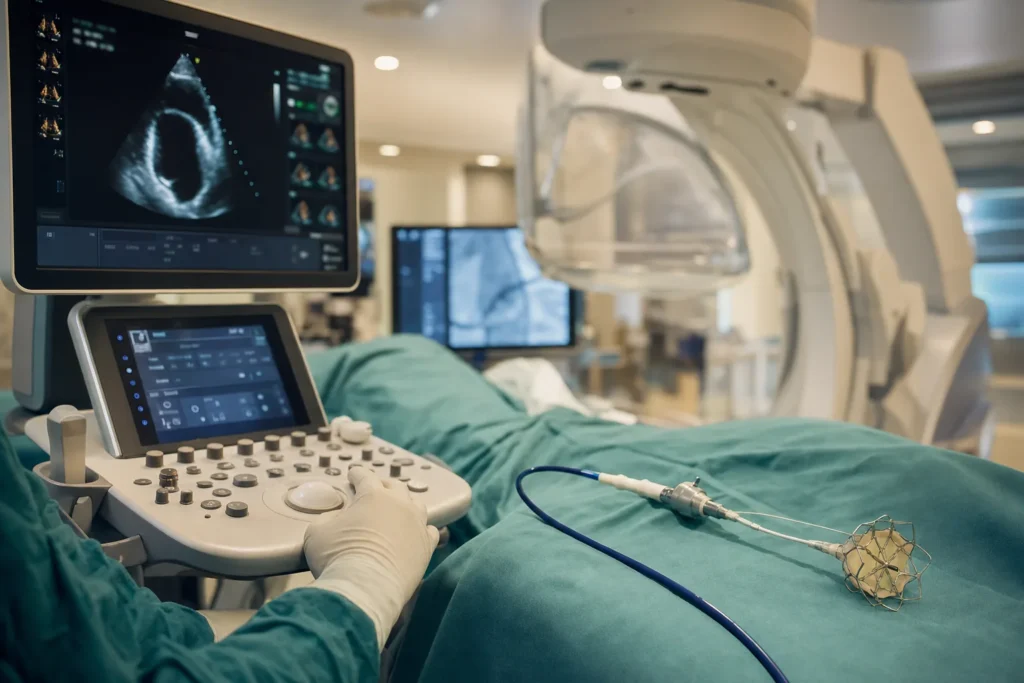
Aortic valve stenosis & TAVI
Aortic valve stenosis means one of the heart's valves has narrowed and no longer opens fully, making the heart work harder to push blood out to the body. It is one of the most common valve problems, especially after age 65, and it often develops slowly over years. The good news is that it can be diagnosed with a simple heart scan and treated effectively, including with a keyhole procedure called TAVI that does not require open-heart surgery. This guide explains, in plain language, what the condition is, how doctors find and treat it, what recovery looks like, and how to think about arranging care abroad.
What aortic valve stenosis is
Your heart has four valves that act like one-way doors, keeping blood flowing in the right direction. The aortic valve is the door between the heart's main pumping chamber (the left ventricle) and the body's largest artery (the aorta). With each heartbeat, this valve opens to let oxygen-rich blood out to the body, then closes so blood does not flow back.
Aortic valve stenosis (also written "aortic stenosis") means this valve has become narrowed and stiff, so it can no longer open fully. "Stenosis" simply means narrowing. When the opening shrinks, the heart has to push harder to force the same amount of blood through a smaller gap. Over time, this extra effort can thicken and tire the heart muscle.
The condition usually develops gradually, often over many years, and many people have no symptoms in the early stages. It is one of the most common valve conditions, particularly in people over 65, because it is frequently linked to a build-up of calcium on the valve as we age. Importantly, it can be measured precisely with a heart scan and, when needed, treated very effectively.
Types and how doctors grade severity
Doctors usually describe aortic stenosis by its cause and by its severity rather than by formal "subtypes."
By cause, the main forms are:
- Age-related (calcific) aortic stenosis — calcium gradually builds up on a normal three-flap valve, stiffening it. This is the most common form and usually appears after age 65.
- Bicuspid valve stenosis — some people are born with an aortic valve that has two flaps (leaflets) instead of the usual three. A bicuspid valve tends to wear out and narrow earlier in life.
- Rheumatic aortic stenosis — scarring of the valve years after rheumatic fever, an immune reaction that can follow an untreated streptococcal infection such as strep throat. This is now less common in countries with ready access to antibiotics.
By severity, cardiologists grade the narrowing as mild, moderate, severe, or critical, based on measurements taken during a heart ultrasound. Severity guides how often you need monitoring and whether and when treatment is recommended. Mild and moderate stenosis are usually watched; severe stenosis with symptoms is what most often leads to valve replacement.
Causes and risk factors
The most common driver is the slow build-up of calcium on the valve with age, which makes the leaflets thick and stiff so they cannot open properly. Other recognised causes include being born with a bicuspid (two-flap) valve, scarring from rheumatic fever, and, less often, certain chronic conditions such as kidney failure, Paget's disease of bone, lupus, rheumatoid arthritis, and inherited high cholesterol.
Factors that make aortic stenosis more likely include:
- Older age, particularly over 65
- Being born with a bicuspid aortic valve
- High blood pressure
- High cholesterol
- Smoking
- A history of rheumatic fever or chronic kidney disease
Some of these, such as blood pressure, cholesterol, and smoking, can be improved with everyday choices and medical care. Others, such as age and a valve you were born with, cannot be changed, which is why monitoring matters once stenosis is known.
Signs, symptoms, and when to see a doctor
In the early stages, aortic stenosis often causes no symptoms at all, and the first sign may simply be a heart murmur — an extra sound a doctor hears through a stethoscope as blood passes through the narrowed valve. Many people feel completely well for years.
As the valve narrows further, symptoms tend to appear, especially during activity. Common ones include:
- Chest pain or tightness (angina), often with exertion
- Breathlessness, particularly when active or lying flat
- Dizziness or fainting (syncope), sometimes during effort
- Unusual tiredness or reduced ability to exercise
- Palpitations (an awareness of the heartbeat)
- Swelling in the ankles or feet
The classic warning trio is chest pain, breathlessness, and fainting. Once these symptoms appear in severe stenosis, it is a signal to seek prompt medical advice, because symptomatic severe aortic stenosis is usually the point at which treatment is considered. If you have chest pain that does not ease, sudden severe breathlessness, or you faint, treat it as an emergency and call your local emergency number. For milder, gradual symptoms such as feeling more tired or breathless than usual, arrange to see a doctor so your heart can be checked.
Screening and early detection
There is no national screening programme that tests the general public for aortic stenosis. Instead, the condition is most often picked up by chance — when a doctor listens to your heart for another reason and notices a murmur, or when a heart scan done for some other purpose shows a stiff valve.
Because there is no routine screen, the practical message is straightforward: if you notice new breathlessness, chest discomfort, dizziness, or reduced stamina, or if a doctor mentions a heart murmur, ask whether an echocardiogram (a heart ultrasound) would be helpful. This simple, painless test is the main way the valve is assessed.
Once stenosis is found but is not yet severe enough to treat, doctors use watchful waiting — regular check-ups and repeat echocardiograms to track how the valve is changing. As a general guide reflected in clinical practice, mild stenosis may be re-scanned every few years, moderate stenosis every one to two years, and severe stenosis once or twice a year. Your own cardiologist will set the right interval for you.
How it is diagnosed
Diagnosis usually begins with a doctor listening to your heart and hearing a murmur, followed by tests that measure the valve and the heart's function. The key test is the echocardiogram, an ultrasound scan that shows how well the valve opens, how narrow the opening is, and how the heart muscle is coping. It is the main tool for grading severity as mild, moderate, severe, or critical.
Other tests your team may use include:
- Electrocardiogram (ECG) — records the heart's electrical activity and rhythm.
- Chest X-ray — shows the size and outline of the heart.
- Transoesophageal echocardiogram (TOE) — a more detailed ultrasound taken from a small probe in the food pipe, giving a closer view of the valve.
- Exercise (stress) testing — checks how your heart and symptoms respond to activity.
- Cardiac CT or MRI scans — give detailed images of the valve, heart, and blood vessels, and are especially important for planning a TAVI procedure.
- Cardiac catheterisation — a thin tube passed into the heart's arteries, often used to check the coronary arteries before treatment.
Together these tests confirm the diagnosis, measure severity, and help the team plan the safest treatment for your particular anatomy.
Treatment options
There is currently no medicine that reverses a narrowed aortic valve. Medications such as those for blood pressure, fluid build-up, or cholesterol can ease symptoms and protect the heart, but they do not fix the valve itself. When stenosis becomes severe and is causing symptoms, the definitive treatment is to replace the valve. There are two main ways to do this.
Surgical aortic valve replacement (SAVR) is open-heart surgery. The surgeon removes the diseased valve and sews in a new one, which may be a mechanical valve (durable but requiring lifelong blood-thinning medication) or a biological (tissue) valve made from animal tissue. A specialised option for some patients is the Ross procedure, where the patient's own pulmonary valve is moved into the aortic position.
TAVI (transcatheter aortic valve implantation), also called TAVR, is a minimally invasive, keyhole alternative that does not require opening the chest. A cardiologist threads a thin tube (catheter) — usually through an artery in the groin — up to the heart and places a new tissue valve inside the old one, where it is expanded and takes over the job. TAVI was first developed for people considered too high-risk for open surgery, and its use has since broadened. Because it avoids large incisions, it can mean less pain, a shorter hospital stay, and a quicker return to normal activities for suitable patients.
A related, usually temporary option is balloon valvuloplasty, where a balloon stretches the valve open; it is sometimes used as a bridge rather than a lasting fix in adults. The choice between SAVR, TAVI, and other options is made by a multidisciplinary heart team — typically cardiologists, cardiac surgeons, imaging specialists, and anaesthetists — who weigh your age, symptoms, valve anatomy, other health conditions, and personal preferences.
Outlook and what to expect
The outlook for aortic stenosis depends heavily on whether it is causing symptoms and whether it is treated. While the valve is only mildly or moderately narrowed and you feel well, you can usually carry on with normal life under regular monitoring.
Once severe stenosis begins to cause symptoms, however, authorities note that the outlook without treatment is poor, and survival is often limited to a few years if the valve is not replaced. This is why prompt assessment matters when symptoms appear. The encouraging side is that valve replacement — whether by surgery or TAVI — is generally very effective at relieving symptoms and is associated with a good or excellent outlook when carried out in good time, followed by lifelong follow-up.
These are population-level observations, not a prediction for any one person. Your individual outlook depends on your age, the cause and severity of the stenosis, how your heart muscle has responded, other medical conditions, and how soon treatment is provided. A qualified cardiologist who knows your full picture is the right person to discuss what you can realistically expect.
Living with it and follow-up
Living well with aortic stenosis is very possible, especially when it is monitored and treated at the right time. If your stenosis is mild or moderate, you can usually live a normal life, but you will need regular check-ups and repeat echocardiograms so any change is caught early. Always check with your doctor before starting strenuous or competitive exercise, and tell any new clinician about your valve condition.
Other practical points often raised by heart charities and clinics include:
- Dental and infection care — a damaged or replaced valve can be vulnerable to a serious infection called endocarditis, so good dental hygiene matters and, for some people, preventive antibiotics may be advised before certain dental procedures. Ask your team what applies to you.
- Medication — if you receive a mechanical valve, you will usually need lifelong blood-thinning medication and regular monitoring; tissue valves and TAVI valves often need only shorter-term or different medication. Follow your prescriptions carefully.
- Pregnancy — anyone with aortic stenosis who is pregnant or planning pregnancy should seek specialist advice in advance.
- After valve replacement — most people attend cardiac rehabilitation and have planned reviews, commonly at about one month and then yearly, to confirm the new valve is working well.
Looking after general heart health — managing blood pressure and cholesterol, not smoking, staying active within agreed limits, and eating well — supports the heart whether or not you have had treatment.
Planning treatment abroad: what affects cost and preparing your records
If you are considering valve treatment such as TAVI in another country, it helps to understand what shapes the overall cost so you can plan and compare fairly. We do not quote fixed prices here, because the right plan — and therefore the cost — is highly individual. Instead, ask any provider for a personalised estimate based on your records.
Factors that typically influence cost and planning include:
- The procedure chosen — TAVI versus surgical replacement, and the specific valve device used.
- Your overall health — other heart or medical conditions can affect the work-up, monitoring, and length of stay.
- Pre-procedure testing — scans such as CT, echocardiography, and coronary assessment needed to plan safely.
- Length of hospital stay and level of care, including any time in intensive care or cardiac rehabilitation.
- Follow-up arrangements and any medication you will need afterwards.
- Travel and accommodation for you and a companion, and interpreter or coordination support.
To prepare, gather your medical records before you travel: recent echocardiogram and any CT/MRI reports, ECGs, a list of your medications and allergies, a summary of your medical history and previous procedures, and the contact details of your usual doctor. Having these ready lets an overseas heart team review your case accurately and give you a clear, individual plan. The simplest first step is to request a free consultation so your records can be reviewed and a personalised estimate prepared.
Why Turkiye, and how to choose a good centre
Turkiye (Turkey) has become a well-known destination for heart care, with a number of hospitals that hold international accreditation and run high-volume cardiac programmes offering both surgical valve replacement and TAVI. For many international patients, the appeal is access to experienced heart teams, modern facilities, and coordinated support for travelling patients.
Rather than relying on rankings or superlatives, focus on objective things you can verify before choosing any centre:
- Accreditation — look for internationally recognised accreditation such as JCI (Joint Commission International), which sets standards for patient safety and quality.
- A genuine heart team — confirm that interventional cardiologists, cardiac surgeons, imaging specialists, and anaesthetists jointly assess valve cases, which is the recommended way to decide between TAVI and surgery.
- Experience with your procedure — ask how regularly the centre performs TAVI and aortic valve surgery.
- Clear, written information — on the planned procedure, the valve device, risks, expected recovery, and follow-up.
- Aftercare and communication — how follow-up will work once you are home, and how your records will be shared with your local doctor.
- Specialist credentials — the qualifications and registration of the doctors who will treat you.
A reputable centre or concierge service will welcome these questions and help you check the answers. Verifying accreditation, team make-up, and aftercare matters more than any marketing claim.
Prevention and self-care
Not all aortic stenosis can be prevented — you cannot change the valve you were born with or your age. But you can lower some risks and protect your heart, and you can take steps that help your valve be found and treated at the right time.
Sensible measures include:
- Manage blood pressure and cholesterol with your doctor's guidance.
- Do not smoke, and seek support to stop if you do.
- Treat strep throat infections promptly, which reduces the risk of rheumatic fever, a cause of valve damage.
- Look after your teeth and gums and follow advice on preventing valve infection (endocarditis).
- Stay active within limits agreed with your doctor, and eat a balanced, heart-healthy diet.
- Keep your monitoring appointments if stenosis is already known, so treatment can be timed well.
If you have already been diagnosed, the most valuable self-care is simple: attend your reviews, report new symptoms such as breathlessness, chest pain, or fainting without delay, and take any prescribed medication as directed. Early, well-timed treatment is what most strongly shapes a good outcome. When in doubt, ask a qualified cardiologist — and consider a second opinion if you want added confidence in your treatment plan.
Frequently asked questions
Is aortic valve stenosis serious?
What is the difference between TAVI and open-heart valve surgery?
How do I know if I need treatment now or just monitoring?
What are the warning symptoms I should not ignore?
Can medication cure a narrowed aortic valve?
Is there a screening test for aortic stenosis?
How long is recovery after TAVI?
What valve types are used, and will I need blood thinners?
What should I bring if I plan treatment abroad?
How do I choose a safe hospital in Turkiye for valve treatment?
Can I exercise and live normally with aortic stenosis?
Should I get a second opinion?
This article is for general information only and is not medical advice. Always consult a qualified doctor about your individual case.
Considering this procedure?
Send us your photos and questions. A BergemHealth coordinator and a department-head specialist will review your case and reply with honest, personalised guidance — no obligation.
Free consultation