Braces & Invisalign
Crooked or crowded teeth and an uneven bite are some of the most common reasons people see a dentist, and modern orthodontics offers gentle, well-proven ways to fix them. This guide explains, in plain words, how traditional braces and clear aligners like Invisalign actually work, who they suit, what treatment feels like month by month, the risks worth knowing, and what it tends to cost, including why many people choose to have their treatment in Turkiye.
- Anaesthesia
- Usually none needed; topical or local anaesthetic only for any pre-treatment dental work (e.g. fillings, extractions)
- Duration
- Fitting appointment about 1-2 hours; adjustments every 4-12 weeks; full treatment typically 6-24 months
- Recovery
- A few days of soreness after fitting and each adjustment; eased with soft foods and pain relief
- Hospital stay
- None; orthodontics is an outpatient (walk-in, walk-out) treatment
Minimum price, for reference only — the final cost is calculated individually after your records are reviewed. You pay the hospital’s price; our service is free for you.
What braces and Invisalign actually are
Braces and clear aligners are tools that slowly move your teeth into better positions. The medical name for the field is orthodontics (from Greek words meaning "straight teeth"). It is one of the dental specialties, and the people who train extra years to do it are called orthodontists.
Both methods work on the same simple idea: when you put steady, gentle pressure on a tooth, the bone around its root gradually remodels, and the tooth drifts in the direction of that pressure. Do this carefully over months and you can line up crooked teeth, close gaps, and correct the way the upper and lower teeth meet (your bite).
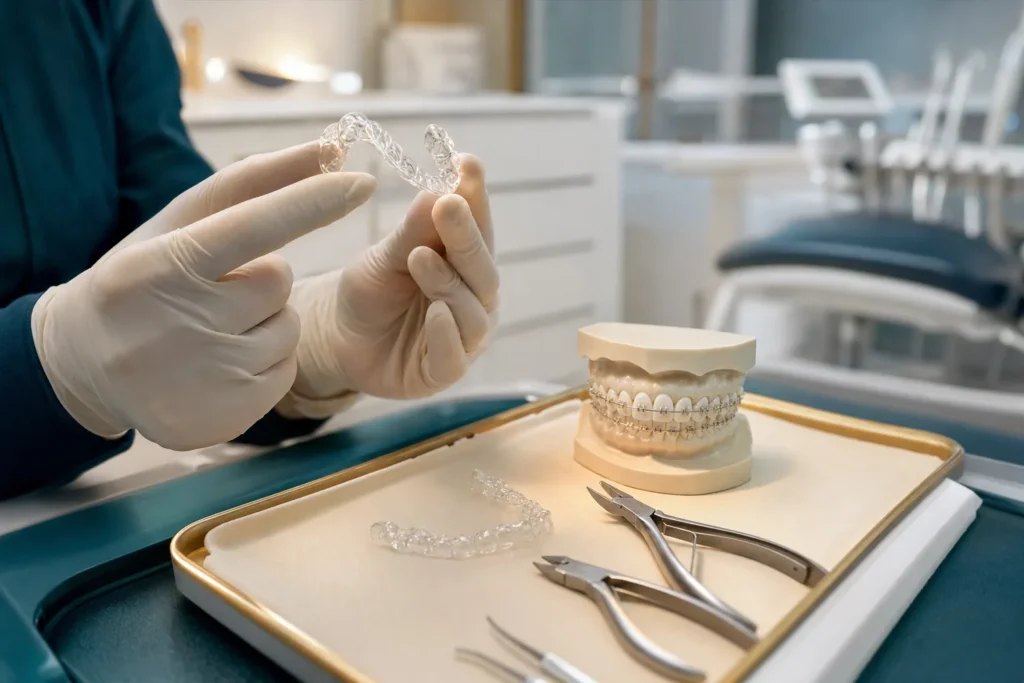
Traditional braces use small squares called brackets glued to the front of each tooth, joined by a thin metal wire. The wire is shaped to a target position, so it constantly nudges the teeth toward it. Your orthodontist tightens or changes the wire every few weeks.
Clear aligners (Invisalign is the best-known brand, alongside others such as ClearCorrect and Spark) take a different route. Instead of wires, you wear a series of see-through plastic trays moulded to fit snugly over your teeth. Each tray is shaped slightly differently from the last, so swapping to the next one keeps the teeth moving in small steps. They are removable, which is their biggest selling point.
A misaligned bite has a name too: malocclusion, which just means "bad bite." It covers crowded teeth, gaps, an overbite (upper front teeth sit too far forward), an underbite (lower teeth sit in front), a crossbite, and rotated or tilted teeth.
Who is a good candidate (and who should wait)
Orthodontics can help almost anyone with crowded, crooked, gappy or poorly meeting teeth. The American Dental Association notes that healthy teeth can be moved at any age, which is why roughly one in three orthodontic patients is now an adult.
You may be a good candidate if you have any of these:
- Crowded teeth that overlap or have no room to sit straight
- Noticeable gaps between teeth
- An overbite, underbite or crossbite that affects how you chew or speak
- Teeth that are hard to clean because of their angle, raising the risk of decay and gum problems
- Discomfort or wear caused by an uneven bite
For children, the American Association of Orthodontists suggests a first check-up by around age 7. That does not mean braces at 7; it lets the orthodontist spot problems early and pick the best time to act, often around age 11-13 when most adult teeth have come through.
Who should pause or get other care first. Orthodontics works on a healthy mouth, so treatment usually cannot start until existing problems are dealt with. You should hold off, or be treated cautiously, if you have:
- Untreated cavities or active gum disease (these must be fixed first, as moving teeth through unhealthy bone and gums can cause harm)
- Poor day-to-day brushing and flossing habits, especially for fixed braces where plaque builds up easily
- Very few remaining natural teeth or significant bone loss, which may need a different plan
Clear aligners have an extra catch: they only work if you actually wear them. If you know you will not keep them in 20-22 hours a day, fixed braces, which you cannot take out, may give more reliable results.
Types and techniques
There is no single "best" appliance; the right one depends on your teeth, your goals and your budget. Here are the main options.
Metal braces. The classic stainless-steel brackets and wires. They are strong, work for almost any case including complex ones, and are usually the most affordable. The trade-off is that they are visible.
Ceramic (clear) braces. The same design but with tooth-coloured or clear brackets that blend in, so they are far less obvious from a distance. They tend to cost more and can be more fragile than metal.
Lingual braces. Brackets fixed to the back (tongue side) of the teeth, so they are hidden from view. They are technically demanding and can take some getting used to, but they are essentially invisible from the front.
Self-ligating braces. A variation that uses a built-in clip or door to hold the wire instead of small elastic bands. This can reduce friction and sometimes means fewer or shorter adjustment visits.
Clear aligners (Invisalign and similar). Removable plastic trays you change every one to two weeks. Often the orthodontist bonds tiny tooth-coloured bumps called attachments to some teeth so the trays can grip and move them precisely. Aligners are popular with adults who want a discreet, removable option, though very complex cases may still be handled better with fixed braces.
Your orthodontist may also use small helpers: elastics (rubber bands) to correct the bite, a palate expander to widen a child's upper jaw, or, in a small number of cases, headgear or temporary mini-screws for difficult movements.
How it is done, step by step
Do you need anaesthesia? For the orthodontics itself, no. Fitting braces or aligners is not surgery and is not usually painful. You may need a local anaesthetic only for separate dental work beforehand, such as a filling or a tooth extraction if there is no room to straighten the teeth.
Step 1: Consultation and records. The orthodontist examines your teeth and bite, takes photographs, X-rays and a digital or putty mould (impression) of your teeth. From these they map out exactly which teeth need to move and where.
Step 2: Any prep work. Cavities are filled, gum disease is treated, and occasionally a tooth is removed to make space. Orthodontic treatment generally cannot start until the mouth is healthy.
Step 3: Fitting. For braces, the orthodontist cleans each tooth, glues on the brackets and threads the wire; this appointment usually takes one to two hours and is painless, if a little tedious. For aligners, you simply receive your first trays (and any attachments are bonded on) and learn how to insert and remove them.
Step 4: The active phase. This is where the months go. With braces you return every 4 to 12 weeks so the wire can be adjusted or changed. With aligners you swap to a fresh tray yourself every week or two and check in with the clinic roughly every 6 to 8 weeks. Aligners must be worn 20-22 hours a day, taken out only to eat, drink anything but water, and brush.
How long overall? It varies with how much your teeth need to move. Mild cases can finish in around 6 months; the typical range is about 12 to 24 months, and complex cases can run longer.
Recovery, step by step
Orthodontics has no real "recovery" in the surgical sense; you walk out and carry on with your day. What you do feel is mild soreness as the teeth begin to move.
- First few days after fitting. Teeth often feel tender or achy and may be sensitive when you bite. This is the bone responding to pressure and is completely normal. Soft foods (soup, pasta, yoghurt, eggs) and over-the-counter pain relief help. With braces, the brackets can rub the inside of your cheeks until the tissue toughens up; orthodontic wax smoothed over a sharp spot solves this.
- First week or two. Speech can feel slightly different, especially with lingual braces or aligners, but your tongue adapts quickly. Eating becomes easier as the soreness fades.
- After each adjustment or new aligner. Expect a day or two of the same mild ache each time the teeth get a fresh nudge. It is much milder than the first round.
- Throughout treatment. The real work is hygiene. Food traps around brackets, so you brush after meals and floss daily (special floss threaders or small interdental brushes make this easier). Aligner wearers simply remove the trays to clean, then rinse the trays and pop them back in.
None of this needs time off work or school beyond the odd quiet evening after a fitting.
Risks and possible complications
Orthodontics is a well-established, low-risk treatment, but no medical procedure is risk-free. Knowing the possibilities helps you avoid them.
- White spots and decay. The most common problem. Plaque collects around brackets, and if it sits there it can leave permanent chalky white marks on the enamel, an early sign of decay. Good brushing and cutting back on sugary drinks prevent it.
- Gum irritation and inflammation. Poor cleaning during treatment can inflame the gums. This usually settles once hygiene improves.
- Soreness and ulcers. Temporary tenderness after adjustments and small mouth ulcers from rubbing brackets are common and minor.
- Root shortening (root resorption). In some people the tips of the tooth roots shorten slightly during treatment. It is usually small and harmless, but your orthodontist monitors it.
- Relapse. Teeth naturally try to drift back. If you stop wearing your retainer afterwards, the improvement can partly undo itself; see the next section.
- Allergy. Rarely, someone reacts to the nickel in metal braces; alternative materials exist.
Most of these are preventable or easily managed. The two things most within your control are excellent daily cleaning and wearing your aligners (and later your retainer) as instructed.
Results and how long they last
Done properly, orthodontics gives straight, well-aligned teeth and a bite that meets evenly, which can make chewing more comfortable and teeth easier to keep clean. You usually start to see visible change within the first few months, with the full result at the end of treatment.
Here is the crucial part many people miss: the result is only permanent if you protect it. Teeth have a memory and will try to slide back toward where they started. That is why every orthodontic treatment ends with a retainer, a custom appliance that holds the teeth in their new position.
Retainers come in two forms. A removable retainer is a clear tray or wire-and-plate device you typically wear every night. A fixed retainer is a thin wire bonded permanently behind the front teeth, out of sight. Many orthodontists use a combination.
If you wear your retainer as directed, your results can last the rest of your life. If you stop, the teeth can gradually drift back over the years. So think of orthodontics as two stages: an active phase of months to straighten the teeth, and a lifelong, low-effort maintenance phase of wearing a retainer.
Costs and what changes the price
The price of straightening teeth depends heavily on the method, the complexity of your case and where you have it done. As a rough guide, private treatment in the UK is often quoted from around £2,000 to £6,000, and prices in the US are frequently higher. Treatment for under-18s with a clear clinical need can be free on the NHS, but waiting lists apply.
In Turkiye, the same treatments are typically far less expensive. As an indicative range for self-paying international patients, plan for roughly EUR 1,500 to EUR 4,500, with simple metal braces at the lower end and full clear-aligner courses such as Invisalign toward the upper end.
What moves the number up or down:
- Method. Metal braces are usually cheapest; ceramic, lingual and clear aligners cost more. Aligners and lingual braces often carry a noticeable premium for being discreet.
- Complexity and length. A mild correction over 6 months costs far less than a complex case over 2 years.
- One arch or both. Treating only the top or bottom row is cheaper than both.
- Brand and materials. Genuine branded aligners cost more than generic systems.
- Extras. Pre-treatment fillings or extractions, X-rays, retainers and follow-up reviews may be included in a package or charged separately, so always ask.
These figures are indicative ranges to help you plan, not a quote. The actual price varies by case, by orthodontist and by clinic, and can only be confirmed after an in-person or detailed remote assessment of your teeth.
Why people travel to Turkiye, and how to choose a safe clinic
Turkiye has become a popular destination for dental care, treating large numbers of international patients each year. The main draw is cost: prices are often a fraction of those in Western Europe or North America for comparable, brand-name treatment. Many clinics are set up specifically for overseas patients, with English-speaking coordinators and packages that bundle in airport transfers and hotel stays.
That said, quality varies between clinics anywhere in the world, so it pays to choose carefully. Things worth verifying before you commit:
- The clinician is a qualified orthodontist or experienced dentist. Ask about their specific orthodontic training and how many cases like yours they handle. Tooth movement is a specialist skill.
- Licensing and accreditation. The clinic should be licensed by the Turkish Ministry of Health. International accreditation such as JCI (Joint Commission International) or ISO certification is a further reassurance of quality and safety standards.
- Genuine materials. If you want Invisalign specifically, confirm they use authentic Invisalign aligners rather than an unnamed substitute.
- A clear written plan and quote. You should receive a treatment plan, total cost, and what is and is not included, in writing, before paying.
- Aftercare and follow-up. Orthodontics needs regular check-ups over many months. Ask exactly how reviews, adjustments and any problems will be handled once you are home, and who provides your retainer.
- Reviews and real before-and-after cases. Look for independent patient feedback, not just the clinic's own gallery.
A reputable concierge service can help match you to an accredited clinic and an appropriately qualified orthodontist, and organise the logistics around your treatment.
How to prepare and what to ask at your consultation
A little preparation makes your consultation far more useful. Before you go:
- Get a routine dental check-up so any cavities or gum issues are known about; these usually need fixing before braces or aligners can start.
- Note your own goals (straighter front teeth, closing a gap, a more comfortable bite) so you can be specific.
- Gather any recent X-rays or dental records if you have them.
Good questions to ask the orthodontist:
- What is wrong with my bite, and which options would realistically fix it?
- Do you recommend fixed braces or clear aligners for my case, and why?
- How long will treatment take, and how many visits or adjustments will I need?
- Will I need any teeth removed or other prep work first?
- What is the total cost, and exactly what does it include (X-rays, retainers, follow-ups)?
- What retainer will I need afterwards, and for how long?
- What are the main risks in my specific case, and how do we keep my teeth healthy during treatment?
- If I am travelling, how will check-ups and any problems be handled after I go home?
If you are considering treatment abroad, also ask how the clinic will assess your teeth remotely (photos, scans, X-rays) before you travel, and what happens if the plan needs to change once you arrive.
Aftercare and travelling for treatment (including flying)
Orthodontics is not a one-and-done procedure; it unfolds over many months, which shapes how travel works. There are two common patterns for treatment in Turkiye.
Clear aligners suit travel well. After an initial visit (or a remote scan) to plan and start treatment, you can often take your full series of trays home and change them yourself on schedule, checking in remotely or on a return visit. This means most of the treatment happens in your own country.
Fixed braces need regular hands-on adjustments every few weeks, which is harder to manage from abroad. Some patients have braces fitted in Turkiye and arrange adjustments with a local orthodontist back home, or plan periodic return trips; discuss the practicalities openly before committing, and line up who will look after you between visits.
Is it safe to fly? Yes. Braces and aligners do not contain anything that reacts to cabin pressure, and there is no surgery or wound, so there is no waiting period before flying as there is with operations. You can fly the same day you have braces fitted if you wish. You may feel mild tooth tenderness after a fitting or adjustment, so pack soft snacks and any pain relief you normally use. Carry your aligners and retainer in your hand luggage, never left behind in checked baggage, so you do not miss wear time.
Day-to-day aftercare is the same wherever you are: brush after meals, floss daily, keep up your check-ups, avoid hard and sticky foods that can break braces, and wear your retainer faithfully once treatment ends. That last habit is what keeps your new smile straight for life.
Frequently asked questions
Are braces or Invisalign better?
How long does treatment take?
Does getting braces or aligners hurt?
Can adults get braces or Invisalign?
How much do braces and Invisalign cost in Turkey?
Will I need to wear a retainer forever?
Can I eat normally with braces or aligners?
Is it safe to fly after having braces fitted?
What are the main risks?
How do I manage check-ups if I have treatment in Turkey?
Sources
- Cleveland Clinic - Orthodontics
- American Association of Orthodontists - How Do Braces Work?
- American Association of Orthodontists - Treatment Methods
- American Dental Association (MouthHealthy) - Braces
- NHS - Orthodontics (Braces)
- Invisalign UK - Your Guide to Clear Aligners
- American Association of Orthodontists - Adult Orthodontic Treatment
- American Dental Association (MouthHealthy) - Orthodontics
This article is for general information only and is not medical advice. Always consult a qualified doctor about your individual case.
Specialists in Dentistry
Doctors of the department we work with directly. Which doctor takes your case is decided after the specialists have reviewed your records — your coordinator confirms it, not this page.


Considering this procedure?
Send us your photos and questions. A BergemHealth coordinator and a senior specialist will review your case and reply with honest, personalised guidance — no obligation.
Free consultation