GERD & Barrett's esophagus
If heartburn has become a regular part of your week, or a doctor has mentioned the words "Barrett's esophagus," it is natural to feel uneasy. The good news is that both conditions are common, well understood, and manageable. This guide explains, in plain language, what acid reflux disease and Barrett's esophagus actually are, how they are diagnosed and treated, what the cancer risk really is (it is smaller than many people fear), and how to prepare if you are considering care abroad.
What GERD and Barrett's esophagus are
GERD stands for gastro-esophageal reflux disease. In everyday words, it is acid reflux that happens often enough, and is bothersome enough, to be considered a medical condition rather than the occasional heartburn most people feel after a heavy meal. The esophagus is the muscular tube that carries food from your throat to your stomach. At the bottom of it sits a ring of muscle called the lower esophageal sphincter, which is meant to act like a one-way valve: it opens to let food into the stomach, then closes to keep stomach contents down. In GERD, that valve does not seal properly, so acidic stomach juices flow back up (reflux) and irritate the lining of the esophagus.
Doctors generally describe reflux as GERD when symptoms happen roughly twice a week or more for several weeks, or when reflux is causing damage you can see on testing. The most familiar symptom is heartburn, a burning feeling in the chest behind the breastbone.
Barrett's esophagus is a change that can develop in some people after years of acid reflux. When the lining of the lower esophagus is exposed to stomach acid over a long time, the normal pale, flat cells can be gradually replaced by a different, more acid-resistant type of cell that normally lines the intestine. Doctors call this intestinal metaplasia (metaplasia simply means one mature cell type replacing another). On endoscopy the changed lining looks salmon-pink instead of the usual pale colour. Barrett's esophagus itself is not cancer and usually causes no symptoms of its own. It matters because, in a small number of people, it slightly raises the long-term risk of a type of esophageal cancer, which is why it is monitored.
Types and subtypes
Reflux disease is described in a few different ways depending on what doctors find when they look inside the esophagus with a camera (endoscopy):
- Erosive esophagitis means the acid has caused visible inflammation, redness or small breaks (erosions) in the lining.
- Non-erosive reflux disease (NERD) means a person has typical reflux symptoms but the lining looks normal on endoscopy. This is actually very common.
- Laryngopharyngeal reflux, sometimes called "silent reflux," is when reflux reaches the throat and voice box and causes hoarseness, throat clearing or a chronic cough, often without much heartburn.
Barrett's esophagus is grouped by length and, more importantly, by whether the cells show dysplasia. Dysplasia means the cells look abnormal under the microscope but are not yet cancer; it is a sign that the tissue is changing. Pathologists (doctors who examine tissue samples) usually sort Barrett's into:
- No dysplasia (the cells are changed but stable). This is by far the most common situation.
- Indefinite for dysplasia (the cells look unsettled, often because of inflammation, and need a re-check).
- Low-grade dysplasia (mild abnormal change).
- High-grade dysplasia (more pronounced abnormal change, the stage that most warrants treatment).
Barrett's segments are also measured and recorded using a standard system called the Prague classification, which notes how far the changed lining extends. Longer segments are generally watched a little more closely.
Causes and risk factors
The root cause of GERD is a lower esophageal sphincter that does not close tightly, allowing stomach acid to wash back up. Several things make this more likely, and Barrett's esophagus shares most of the same risk factors because it grows out of long-standing reflux.
Common contributors include:
- Hiatus hernia, where part of the stomach slides up through the diaphragm (the breathing muscle), which weakens the valve mechanism.
- Excess weight, especially around the abdomen, which raises pressure on the stomach.
- Smoking, which relaxes the valve and increases acid.
- Pregnancy, because of hormonal changes and pressure on the stomach (this reflux usually settles after birth).
- Certain foods and drinks such as coffee, alcohol, chocolate, fatty or spicy foods and tomatoes, which can trigger symptoms in some people.
- Some medicines, including certain anti-inflammatory painkillers (NSAIDs like ibuprofen), some blood-pressure tablets and others.
- Large or late meals and lying down soon after eating.
For Barrett's esophagus specifically, the people most likely to develop it tend to have several of these features together: long-standing reflux (often five years or more), being over 50, being male, being of white background, carrying extra weight around the middle, a history of smoking, and a close relative who has had Barrett's or esophageal cancer. Having these factors does not mean you will get Barrett's; it simply raises the odds enough that doctors may suggest a look with a camera.
Signs and symptoms, and when to see a doctor
The typical symptoms of GERD include:
- Heartburn, a burning feeling rising from the upper stomach or chest, often worse after meals, when lying down, or when bending over.
- An unpleasant sour or bitter taste in the mouth from acid coming up (regurgitation).
- A persistent cough, hoarseness, sore throat, frequent throat clearing or bad breath.
- Bloating, nausea, or a sensation of food sticking.
Barrett's esophagus usually produces no symptoms of its own. People who have it generally feel the same reflux they always have, or sometimes feel better, which is one reason it can go unnoticed and is found during an endoscopy done for reflux.
Most reflux is not dangerous, but some symptoms deserve prompt medical attention because they can point to a complication or another condition. See a doctor without delay if you have:
- Difficulty or pain when swallowing, or a feeling that food gets stuck.
- Unintended weight loss.
- Vomiting blood, or black, tarry stools (signs of bleeding).
- Persistent vomiting, or symptoms that keep returning despite treatment.
Also book a routine appointment if heartburn happens most days, if pharmacy remedies are not helping, or if you have been taking acid medicines regularly for several weeks. Chest pain that is severe, crushing, or spreads to the arm or jaw should be treated as a possible heart emergency, not assumed to be reflux.
Screening and early detection
There is no population-wide screening programme for GERD; it is diagnosed when people report symptoms. For Barrett's esophagus, there is no universal screening either, but specialists do recommend a one-time screening endoscopy for certain higher-risk people, because finding Barrett's early allows it to be monitored.
Gastroenterology guidelines suggest considering a screening endoscopy in people who have had chronic reflux symptoms plus several additional risk factors, typically three or more, such as being over 50, male, white, overweight (especially around the abdomen), a current or past smoker, or having a first-degree relative (parent, sibling or child) with Barrett's or esophageal cancer. The idea is to look for Barrett's in those most likely to have it, rather than to scan everyone with occasional heartburn.
If you think you might fit this picture, the practical step is to talk to a doctor about whether a one-off endoscopy makes sense for you. Newer, less invasive sampling devices (for example, a small sponge on a string that collects cells from the esophagus) are being studied and used in some settings, but a camera examination with biopsies remains the standard way to confirm Barrett's.
How it is diagnosed
Mild, typical reflux is often diagnosed on symptoms alone, and a doctor may simply recommend lifestyle measures and a trial of acid-lowering medicine. If symptoms are persistent, severe, or come with any of the warning signs above, or if Barrett's is suspected, several tests can give a clearer picture:
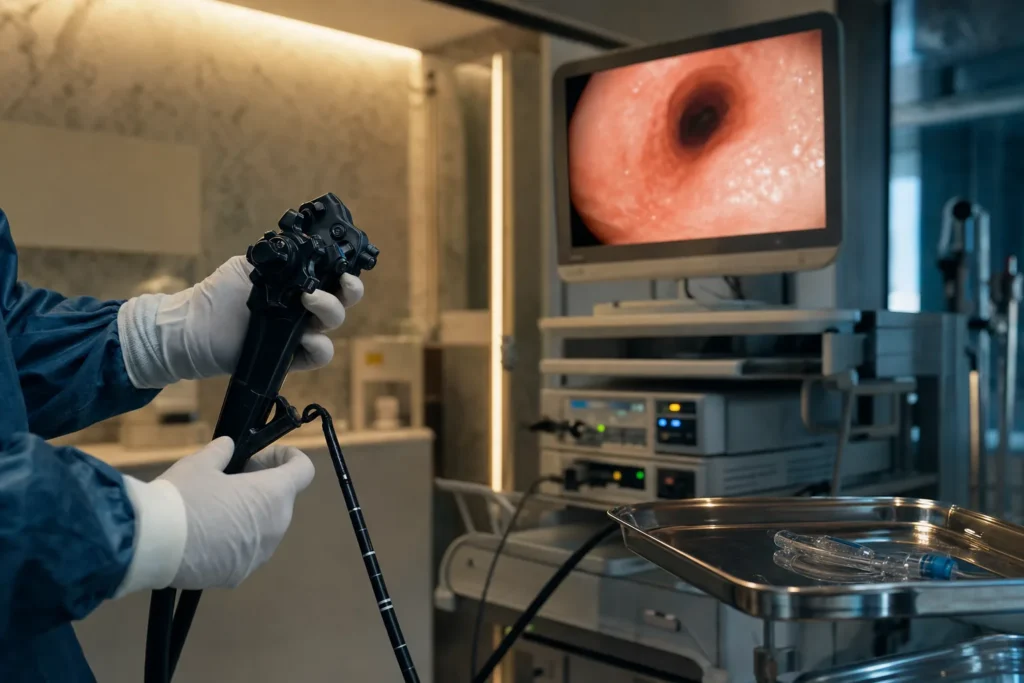
- Upper endoscopy (gastroscopy) is the key test. A thin, flexible tube with a camera is passed through the mouth into the esophagus and stomach, usually under sedation, so the doctor can see the lining directly, look for inflammation, narrowing or the salmon-pink colour of Barrett's, and take small tissue samples (biopsies).
- Biopsy samples are examined under a microscope to confirm Barrett's and to check carefully for dysplasia. For Barrett's, a structured biopsy pattern is used, taking several samples around and along the affected segment so nothing is missed.
- Esophageal pH monitoring measures how much acid actually reaches the esophagus over about 24 hours, which helps confirm reflux when the diagnosis is uncertain.
- Esophageal manometry measures the muscle squeeze and the valve pressure in the esophagus. It is often done before anti-reflux surgery to make sure the muscles work normally.
- Barium swallow (esophagram), an X-ray taken after drinking a chalky liquid, can show a hiatus hernia or narrowing.
If dysplasia or early cancer is found, a sample of the abnormal area may be removed during endoscopy both to treat it and to examine it in detail, which helps determine the depth of any change. This careful, step-by-step assessment is what guides the right treatment.
Treatment options
Treatment is matched to the situation, from simple measures for ordinary reflux to targeted procedures for advanced Barrett's. Care is usually guided by a team, often a gastroenterologist (digestive specialist), a pathologist, a dietitian, and, when surgery is involved, an upper-gastrointestinal surgeon.
Lifestyle measures are the foundation for everyone: losing excess weight, eating smaller meals, not eating in the three to four hours before bed, raising the head of the bed, limiting trigger foods, stopping smoking and moderating alcohol. These help many people considerably.
Medicines reduce or neutralise stomach acid:
- Antacids and alginates give quick, short-term relief.
- H2 blockers lower acid production and are available over the counter or on prescription.
- Proton pump inhibitors (PPIs), such as omeprazole or lansoprazole, are the most effective acid-suppressing medicines and help heal an inflamed esophagus. They are commonly prescribed for a course of several weeks and, in Barrett's, are often continued long term to calm reflux.
Procedures and surgery are options when medicines and lifestyle changes are not enough, or when there are complications:
- Anti-reflux surgery (fundoplication) wraps the top of the stomach around the lower esophagus to strengthen the valve. It is usually done with keyhole (laparoscopic) techniques.
- Magnetic sphincter devices and certain endoscopic procedures are newer ways to reinforce the valve in selected patients.
- Endoscopic eradication therapy is used for Barrett's with dysplasia. Radiofrequency ablation uses controlled heat to remove the abnormal lining so healthy cells can regrow; endoscopic mucosal resection (EMR) removes raised or nodular areas; and cryotherapy uses extreme cold. These are done through the endoscope, without external cuts.
- Esophagectomy, surgery to remove part of the esophagus, is now reserved for selected cases of early cancer, as endoscopic treatments handle most dysplasia.
For Barrett's without dysplasia, treatment is usually controlling reflux plus regular monitoring rather than removing the lining.
Outlook and what to expect
For most people, GERD is a long-term but very manageable condition. With lifestyle changes and acid-lowering medicines, symptoms can usually be controlled well, and inflamed tissue can heal. Some people need treatment on and off for years; others choose a procedure to reduce reliance on daily tablets.
The question most people with Barrett's esophagus want answered is about cancer, and here the honest picture is reassuring. Barrett's does slightly raise the risk of a type of esophageal cancer called adenocarcinoma, but the great majority of people with Barrett's never develop it. Patient information from the American College of Gastroenterology notes that more than 90% of people with Barrett's esophagus will not develop cancer, and that the chance of developing esophageal adenocarcinoma is less than about 1 in 200 per year for someone without dysplasia. Cancer Research UK similarly describes the yearly risk as less than 1 in 100, with a lifetime risk somewhere in the range of roughly 3 to 13 in 100 in the UK.
The risk is higher when dysplasia is present, and higher still with high-grade dysplasia, which is exactly why monitoring exists: to catch any worrying change early, when it can be treated through the endoscope. These figures are population averages drawn from large studies; they describe groups of people, not any single person, and they are not a prediction of what will happen to you. A specialist who knows your individual findings is the right person to discuss your situation.
Living with it and follow-up
Living well with reflux is largely about steady habits: keeping to a healthy weight, eating earlier in the evening, identifying your personal trigger foods, not smoking, and taking medicines as advised. Many people find that small, consistent changes make a real difference to day-to-day comfort.
If you have Barrett's esophagus, the central part of follow-up is surveillance endoscopy, a periodic camera check with biopsies to make sure the lining stays stable. How often depends on what was found:
- With no dysplasia, surveillance is typically every three to five years, with shorter intervals for longer segments.
- With low-grade dysplasia, doctors often recommend treatment, or closer monitoring (for example every six to twelve months) if treatment is declined.
- After treatment for dysplasia, regular checks continue to confirm the abnormal lining does not return.
It is normal to feel anxious about a diagnosis that mentions cancer risk, even a small one. Remember that surveillance is a protective routine, not a sign that something is wrong. Keeping a record of your endoscopy dates and biopsy results, and bringing them to each appointment, helps your team make consistent decisions over time. If you ever develop new swallowing difficulty, weight loss or bleeding between scheduled checks, contact your doctor rather than waiting.
Planning treatment abroad: what affects cost and how to prepare your records
Many people look into having an endoscopy, anti-reflux procedure or Barrett's treatment in another country to combine quality care with shorter waiting times. Because every case is different, there is no single price, and we do not quote fixed figures here. Instead, it helps to understand what drives the cost so you can request an accurate, personalised estimate.
The main factors include:
- What is being done, for example a diagnostic endoscopy with biopsies versus radiofrequency ablation, endoscopic mucosal resection, or anti-reflux surgery. More involved procedures naturally cost more.
- Tests needed before and after, such as pH monitoring, manometry, imaging and pathology.
- Type of anaesthesia or sedation and how long any hospital or clinic stay lasts.
- Whether more than one session is required, as some Barrett's treatments are completed in stages.
- Hospital category, the specialist team, and any accommodation, transfers or interpreting bundled into a package.
To get a reliable estimate, gather your records before you ask: recent endoscopy reports and images, pathology (biopsy) results stating whether dysplasia is present, a list of your current medicines, and a summary of your symptoms and how long you have had them. Clear, complete records let a specialist advise what you actually need, avoid repeating tests, and prepare a tailored plan. The most accurate way to learn what your care would involve is to request a free, no-obligation consultation and a personalised quotation based on your own documents.
Why Turkiye, and how to choose a good centre
Turkiye (Turkey) has become a well-established destination for medical travel, with modern hospitals, experienced gastroenterology and upper-gastrointestinal surgery teams, and the endoscopic equipment used for diagnosing and treating reflux and Barrett's. For many international patients it also offers shorter waits and the convenience of arranging tests, procedure and follow-up in a single trip. None of this replaces careful checking, and the most important thing is to choose a centre on its merits rather than on marketing.
When comparing centres, it is reasonable to verify:
- Accreditation, such as international hospital accreditation (for example, Joint Commission International) and proper national licensing.
- The specialist team, including whether an experienced gastroenterologist performs the endoscopic treatments, whether there is access to an upper-GI surgeon, and whether a pathology service reviews biopsies, ideally with a second pathologist confirming any dysplasia.
- Volume and experience with the specific procedure you need, such as radiofrequency ablation or endoscopic resection.
- Clear information about what the plan involves, the follow-up arrangements, and how results will be shared with you and your doctor at home.
- Honest communication, meaning realistic explanations rather than promises of a cure or claims of being the "best."
A reputable concierge service can help you compare options, organise your records, and arrange interpreting and logistics, while leaving the medical decisions to qualified specialists. Take your time, ask questions, and make sure you understand the plan before you commit.
Prevention and self-care
You cannot always prevent reflux entirely, but you can reduce how often it happens and how much it irritates your esophagus, which in turn lowers the long-term wear that can lead to Barrett's. Practical, evidence-based steps include:
- Reach and keep a healthy weight, particularly reducing fat around the abdomen, which is one of the most effective single measures.
- Eat smaller meals and finish eating earlier, leaving three to four hours before lying down.
- Raise the head of your bed by about 10 to 20 centimetres so gravity helps keep acid down overnight.
- Learn your triggers, which commonly include coffee, alcohol, chocolate, and fatty or spicy foods, and adjust rather than eliminate everything.
- Stop smoking and moderate alcohol, both of which directly worsen reflux.
- Review medicines with your doctor if you suspect a tablet is contributing.
If you already have Barrett's, controlling reflux well and attending your scheduled surveillance endoscopies are the two most useful things you can do. And if your situation is more complex, or you have been told you have dysplasia, getting a second opinion from an experienced centre is entirely reasonable; it is your right, and good specialists welcome it. Above all, keep the perspective that both GERD and Barrett's are common, treatable, and, with sensible care, very often kept under good control.
Frequently asked questions
Is GERD the same as ordinary heartburn?
Does GERD always lead to Barrett's esophagus?
Does Barrett's esophagus cause symptoms?
Does having Barrett's esophagus mean I will get cancer?
What is dysplasia, and why does it matter?
How is Barrett's esophagus diagnosed?
Can Barrett's esophagus be cured or reversed?
How often will I need an endoscopy if I have Barrett's?
Are proton pump inhibitors safe to take long term?
When should heartburn make me seek urgent care?
What should I prepare before asking about treatment abroad?
This article is for general information only and is not medical advice. Always consult a qualified doctor about your individual case.
Considering this procedure?
Send us your photos and questions. A BergemHealth coordinator and a department-head specialist will review your case and reply with honest, personalised guidance — no obligation.
Free consultation