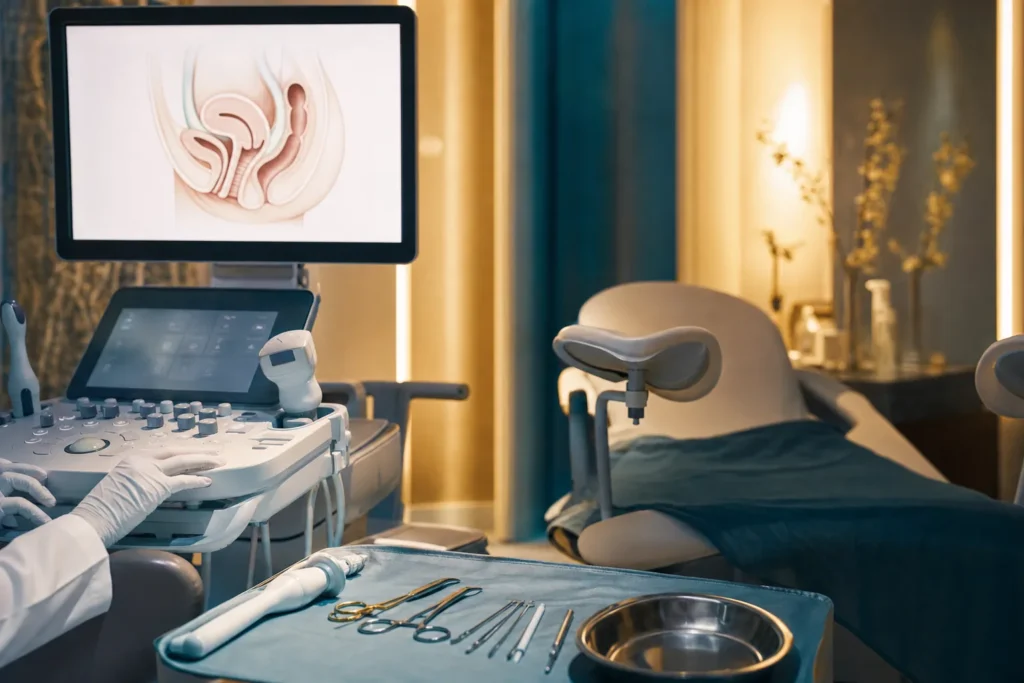
Pelvic organ prolapse
Pelvic organ prolapse is common, usually not dangerous, and very treatable. This plain-language guide explains what it is, why it happens, the symptoms to watch for, and the full range of options, from simple exercises to surgery, so you can talk to a specialist with confidence.
What pelvic organ prolapse is
Pelvic organ prolapse (often shortened to POP) happens when one or more of the organs inside the pelvis slip down from their normal position and press into, or bulge out of, the vagina. The organs involved are usually the bladder (which holds urine), the uterus or womb, the bowel, or the top of the vagina itself.
To picture why this happens, it helps to know about the pelvic floor. This is a group of muscles and tough, sheet-like tissues (called ligaments and fascia) that stretch across the bottom of the pelvis like a supportive hammock. They hold the pelvic organs up in place. When this hammock becomes weak or stretched, the organs above it can sag downward into the vagina. That sagging is what we call prolapse.
Prolapse is very common and is considered a benign condition, meaning it is not cancer and is not life-threatening. Many women have a mild degree of prolapse without ever noticing it. According to the Cleveland Clinic, between roughly 3% and 11% of women report symptoms of prolapse, and it becomes more common with age. It is something that can be managed well, and you do not have to simply live with the discomfort.
Types and subtypes
Prolapse is named according to which organ has dropped and which wall of the vagina is affected. A person can have more than one type at the same time. The main types, as described by the Cleveland Clinic and the NHS, are:
- Anterior vaginal wall prolapse (cystocele) — the bladder bulges into the front wall of the vagina. This is the most common type. A dropped urethra (the tube that carries urine out of the body), called a urethrocele, often goes along with it.
- Posterior vaginal wall prolapse (rectocele) — the rectum (the lower part of the bowel) bulges into the back wall of the vagina.
- Uterine prolapse — the uterus (womb) drops down into the vaginal canal.
- Vaginal vault prolapse — the top of the vagina sags downward. This can happen after the uterus has been removed in a hysterectomy.
- Enterocele — part of the small intestine pushes against the upper or back wall of the vagina.
Specialists also describe prolapse by which area or compartment is involved: the front (anterior), the back (posterior), or the top (apical). This matters because the treatment is tailored to the area affected.
Causes and risk factors
Prolapse develops when the pelvic floor muscles and supporting tissues become weakened or overstretched over time. It is almost always caused by a combination of factors rather than a single event. The most important ones, drawn from the NHS, Cleveland Clinic, and medical literature, include:
- Pregnancy and childbirth — especially vaginal births. The risk is higher with more births, larger babies, and deliveries assisted by forceps. This is considered the single most common contributing factor.
- Getting older and the menopause — tissues naturally become less firm with age, and the drop in the hormone estrogen after menopause can reduce tissue strength.
- Carrying extra body weight — this adds steady downward pressure on the pelvic floor.
- Long-term pressure on the abdomen — from chronic constipation and straining, a persistent cough (for example from smoking or lung conditions), or repeated heavy lifting.
- Previous pelvic surgery — including a hysterectomy.
- Family history — prolapse can run in families.
- Connective tissue conditions — such as joint hypermobility syndrome, Marfan syndrome, or Ehlers-Danlos syndromes, which affect the strength of supportive tissues.
Having one or more of these does not mean prolapse is certain. They simply raise the likelihood, and several can be reduced through everyday measures discussed later.
Signs, symptoms, and when to see a doctor
Many women with mild prolapse have no symptoms at all and only learn about it during a routine check-up. When symptoms do appear, they often come on gradually. Common ones described by the NHS and Cleveland Clinic include:
- A feeling of heaviness, pressure, or fullness in the lower tummy or vagina, often described as a sense that something is 'coming down' or 'falling out'.
- A noticeable bulge or lump in or at the opening of the vagina, which you may be able to see or feel.
- Discomfort or reduced sensation during sex.
- Bladder problems, such as needing to urinate more often, a sense of not fully emptying, or leaking urine when you cough, laugh, or exercise.
- Bowel problems, such as constipation or a feeling that the bowel does not empty completely.
Symptoms often feel worse at the end of the day, after standing for long periods, or after lifting, and tend to ease when lying down.
It is worth seeing a doctor whenever these symptoms affect your comfort or daily life. There is nothing to be embarrassed about — this is a common, well-understood condition. Seek prompt medical advice if a bulge becomes sore, bleeds, or is difficult to push back, or if you have trouble passing urine, as these are less usual and should be checked.
Screening and early detection
There is no routine population screening programme specifically for pelvic organ prolapse, in the way there is for some cancers. Most prolapse is found either because a woman notices symptoms and mentions them, or because it is spotted incidentally during a routine pelvic examination or cervical screening.
Because of this, the most useful form of early detection is simply talking to a healthcare professional about any pelvic symptoms, even if they seem minor. Catching prolapse early often means that simpler, non-surgical approaches such as pelvic floor exercises can be enough to keep it from progressing or causing more bother. If you have known risk factors, such as having had several vaginal births, it is reasonable to raise the topic at your regular gynaecology visits rather than waiting for symptoms to become severe.
How it is diagnosed
Diagnosing prolapse is usually straightforward and based mainly on a conversation and a physical examination. A doctor will ask about your symptoms, your births, your general health, and how the problem affects your daily life.
The key step is a pelvic examination. You may be examined lying down and sometimes standing, and you may be asked to cough or bear down (a 'strain' or Valsalva manoeuvre) so the doctor can see how far the organs move. A speculum (a smooth instrument that gently holds the vaginal walls apart) is often used to view each wall in turn. For many women, this examination alone is enough to make the diagnosis.
To describe how advanced a prolapse is, specialists commonly use the POP-Q system (Pelvic Organ Prolapse Quantification), which measures how far the organs have dropped in relation to the hymen. As outlined by the Cleveland Clinic, it gives stages from 0 to 4: stage 0 means no prolapse; stage 1 is mild (the organ sits at least 1 cm above the hymen); stage 2 is moderate (within 1 cm of the hymen); stage 3 is more advanced (more than 1 cm below the hymen but not fully outside); and stage 4 means complete prolapse, where the organ bulges fully outside the vagina.
Depending on your symptoms, further tests may be suggested, such as bladder function tests (urodynamics), a look inside the bladder (cystoscopy), or imaging like ultrasound or MRI for more complex cases. These are not always needed.
Treatment options
Treatment is guided by how much the prolapse bothers you, not just by its stage on examination. Care is often provided by a multidisciplinary team, which may include a gynaecologist, a urogynaecologist (a specialist in pelvic floor disorders), and a specialist pelvic floor physiotherapist. Options range from doing nothing actively to surgery.
Watchful waiting. If the prolapse is mild and not troublesome, simply monitoring it over time is a perfectly reasonable choice.
Lifestyle measures. Reaching and keeping a healthy weight, treating constipation with a fibre-rich diet and good fluid intake, avoiding heavy lifting, and stopping smoking to reduce coughing can all ease symptoms and slow progression.
Pelvic floor muscle training. Guided exercises (often called Kegel exercises) strengthen the supporting muscles. They work best when taught by a trained physiotherapist and are most effective for milder prolapse.
Vaginal pessary. A pessary is a small, removable silicone device placed in the vagina to support the organs and hold them in position. Many women feel relief almost immediately. It is a good option for those who want to avoid surgery or are not yet ready for it. Reviews of the evidence suggest most women can be successfully fitted with a pessary, and many continue to use one over the longer term.
Topical estrogen. For women after the menopause, estrogen applied as a cream, tablet, or vaginal ring may improve the condition of the vaginal tissues and is sometimes used alongside a pessary or before surgery.
Surgery. Surgery may be considered for more advanced or persistent prolapse that affects quality of life. There are two broad approaches. Reconstructive surgery aims to restore the normal position of the organs — examples include colporrhaphy (repairing and reinforcing the vaginal wall), sacrocolpopexy (lifting and securing the top of the vagina), and sacrohysteropexy (supporting the uterus). Obliterative surgery, such as colpocleisis, narrows or closes the vagina to provide support; it is highly effective but means penetrative sex is no longer possible, so it is generally reserved for those who do not wish to keep that option. Surgery can be done through the vagina or the abdomen, sometimes using keyhole (laparoscopic) techniques. Your surgeon will explain which method suits your situation, including any role for surgical mesh, which is now used in more limited and carefully regulated ways.
Outlook: what to expect
The overall outlook for pelvic organ prolapse is reassuring. It is a benign condition, and the Cleveland Clinic notes plainly that it is treatable and that most people find relief with the right approach. Many women manage their symptoms well for years with non-surgical measures alone.
It is also worth knowing that prolapse does not always get worse. Long-term studies summarised in the medical literature show that progression varies a great deal from person to person: over periods of a year or more, many women see little or no change, while a smaller proportion progress to a more noticeable prolapse. Some mild cases can even improve slightly on their own.
For those who choose surgery, success rates are generally high and most women report meaningful improvement in symptoms and quality of life at follow-up. As with any surgery, prolapse can sometimes return over time, and the likelihood depends on the type of operation, individual tissue strength, and ongoing risk factors. These are points to discuss honestly with your surgeon. Any figures here describe groups of patients studied in research and are not a prediction for any one individual.
Living with prolapse and follow-up
Living well with prolapse is very achievable, and the day-to-day adjustments are usually modest. Continuing pelvic floor exercises, managing weight, keeping the bowels regular to avoid straining, and lifting carefully all help protect the pelvic floor over the long term, whether or not you have had treatment.
If you use a pessary, you will have it checked and cleaned periodically by a clinician, and some women learn to remove and reinsert it themselves. After surgery, your team will give specific guidance on activity, lifting, and returning to exercise and intimacy, along with follow-up appointments to check healing.
The emotional side matters too. Some women feel self-conscious or worried about their bodies, intimacy, or being active. These feelings are common and understandable. Speaking openly with your healthcare team, and with a partner if you have one, often relieves much of the worry, and effective treatment frequently restores both comfort and confidence.
Planning treatment abroad: what affects cost and preparing your records
If you are considering having prolapse treatment in another country, it helps to understand the factors that shape the overall cost, so you can ask for a clear, personalised quote rather than relying on headline figures. We do not list prices here because they vary widely from case to case. The main factors include:
- The type and complexity of treatment — a pessary fitting, a single-compartment repair, or a more extensive reconstruction differ greatly.
- The surgical approach chosen — vaginal, abdominal, or keyhole (laparoscopic), and whether more than one area needs repair.
- The type of anaesthesia and the length of any hospital stay.
- Pre-operative tests and specialist consultations.
- Follow-up care, medications, and aftercare arrangements.
- Accommodation and travel for you and anyone accompanying you.
To prepare, gather your medical records before you travel: a summary of your symptoms and how long you have had them, your birth history, any previous pelvic surgery, a current list of medicines and allergies, and copies of any recent test results or imaging. Having these ready allows a specialist to give accurate advice and a tailored estimate. The most reliable way to understand your own situation and likely costs is to request a free consultation and a personalised estimate based on your records.
Why Turkiye and how to choose a good centre
Turkiye (Turkey) has become a well-established destination for medical care, including gynaecology and pelvic floor surgery, with experienced specialist teams and dedicated international patient services. Many hospitals offer coordinators and interpreters to support patients travelling from abroad. When comparing options, focus on the quality and credentials of the centre and the team rather than on cost alone.
Practical things to verify before committing include:
- Accreditation — look for internationally recognised standards such as Joint Commission International (JCI), which assesses patient safety and care quality. Turkiye has a large number of JCI-accredited hospitals.
- Specialist expertise — confirm that your surgeon is a qualified gynaecologist or urogynaecologist with specific experience in pelvic floor and prolapse surgery.
- A multidisciplinary team — access to physiotherapy, urology input, and anaesthetic and nursing care that supports complex cases.
- Clear information — written explanations of the proposed procedure, alternatives, risks, recovery, and what is included.
- Aftercare and follow-up — how complications or questions will be handled once you return home, and how follow-up will be coordinated with your local doctor.
A reputable concierge service can help you arrange consultations, gather your records, and compare accredited centres so that your decision is based on solid information.
Prevention and self-care
While not every case can be prevented, several everyday habits genuinely lower the risk of prolapse or help keep an existing one from worsening. The NHS and Cleveland Clinic highlight the following:
- Do regular pelvic floor exercises, particularly during and after pregnancy, ideally learned correctly from a physiotherapist.
- Keep a healthy weight to reduce constant downward pressure on the pelvic floor.
- Avoid constipation and straining by eating enough fibre, drinking plenty of fluids, and not delaying when you need the toilet.
- Lift carefully, bending at the hips and knees and avoiding very heavy loads where you can.
- Stop smoking to reduce a chronic cough that strains the pelvic floor.
- Treat a persistent cough and manage any long-term chest conditions.
These measures are gentle, low-risk, and good for general health as well. If you are unsure where to start, a pelvic floor physiotherapist or your doctor can guide you, and seeking advice early gives you the widest range of simple options.
Frequently asked questions
Is pelvic organ prolapse dangerous?
What does pelvic organ prolapse feel like?
Will pelvic organ prolapse go away on its own?
Do I need surgery for prolapse?
What is a pessary and how does it work?
Can I still have sex with prolapse?
How is prolapse diagnosed?
Can pelvic floor exercises fix prolapse?
How common is pelvic organ prolapse?
What should I prepare before a consultation about treatment abroad?
This article is for general information only and is not medical advice. Always consult a qualified doctor about your individual case.
Considering this procedure?
Send us your photos and questions. A BergemHealth coordinator and a department-head specialist will review your case and reply with honest, personalised guidance — no obligation.
Free consultation