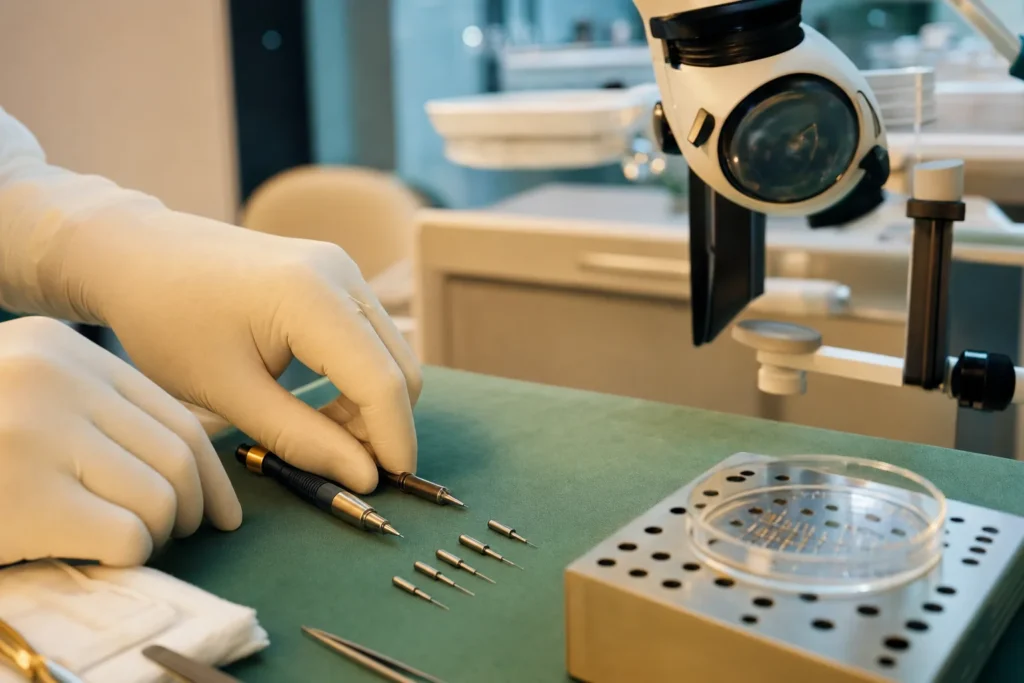
Beard transplant
A beard transplant moves your own hair follicles, usually from the back of your scalp, into your face to fill patchy, thin, or bare areas. Done well, it can give a fuller, natural-looking beard that you can shave and trim like any other facial hair. This guide explains, in plain language, how it works, who it suits, what recovery feels like, the realistic risks and results, what it costs, and how to choose a safe clinic if you are considering treatment in Turkiye.
- Anaesthesia
- Local anaesthetic (numbing injections), often with a tumescent solution; you stay awake.
- Duration
- Roughly 3-8 hours in one day, depending on the number of grafts.
- Recovery
- Back to non-strenuous daily life in about 7-14 days; scabs fall off within 7-10 days.
- Hospital stay
- None - it is a day-case (outpatient) procedure; you go home or to your hotel the same day.
What a beard transplant actually is
A beard transplant is a type of hair restoration surgery. A surgeon takes healthy hair follicles from an area where you have plenty (the donor area) and moves them, one small cluster at a time, into the parts of your face where beard hair is missing or thin (the recipient area). A follicle is the tiny pocket in your skin that a hair grows out of.
The donor hair almost always comes from the back and sides of the scalp - the band of hair that tends to stay put even in men who go bald on top. Surgeons sometimes call this the "safe zone." Because these follicles keep their original genetic programming, they generally keep growing once moved to the face, which is why a beard transplant is considered a long-term result.
The hairs are placed in small groups called follicular units - natural bundles of one to four hairs that grow together. The surgeon controls the angle and direction of each one so the finished beard grows the way facial hair naturally does: flatter against the skin on the cheeks, and at sharper angles under the chin. People search for this in many ways - "beard implants," "facial hair transplant," "patchy beard fix" - but they all describe the same idea.
Who is a good candidate (and who should wait or avoid it)
You may be a good candidate if you have:
- A patchy or thin beard that has not filled in despite reaching adulthood.
- Bare areas from scarring - for example after burns, injuries, acne, surgery, or cleft-lip repair, where hair will not grow back on its own.
- Facial hair that is naturally absent or sparse from birth.
- A wish for facial masculinisation, including transgender men, where the goal is to create a fuller beard line.
The two things that matter most are a healthy, stable donor area (enough good scalp hair to harvest) and realistic expectations. A surgeon cannot create more hair than your donor supply allows.
You should pause or reconsider if you:
- Have active acne, eczema, infection, or inflammation on the face, which should be treated first.
- Have a tendency to form keloid or thick raised scars.
- Have unstable or ongoing hair loss that has not been assessed, or very limited donor hair.
- Have a bleeding disorder, poorly controlled diabetes, or an autoimmune condition affecting the skin (such as some forms of alopecia) - these need medical review first.
- Are looking for a guaranteed exact density - no honest surgeon can promise a precise number of hairs that will survive.
A proper consultation with a qualified doctor is the only way to know if it is right for you.
Types and techniques
Beard transplants today almost always use one of two closely related methods. Both move individual follicular units; the difference is mainly in how the hairs are taken and placed.
FUE (Follicular Unit Excision/Extraction). The surgeon removes follicles one at a time from the donor scalp using a tiny round punch, usually about 0.7-1 mm across. Because each follicle is taken individually, FUE leaves only scattered tiny dot-like marks rather than one long scar - a key reason it is popular for facial work. The grafts are then placed into small channels made in the beard area.
DHI (Direct Hair Implantation). A variation of FUE that uses a pen-shaped implanter tool (often called a "Choi pen"). It holds the graft and creates the opening and places the hair in one motion, giving the surgeon fine control over the depth, angle, and direction of each hair. Clinics often promote DHI for delicate facial areas, though good results depend far more on the surgeon's skill than on the brand of tool.
FUT (Follicular Unit Transplantation, the "strip" method). The older approach removes a thin strip of scalp, which is then dissected into grafts. It leaves a single fine line scar at the back of the head. FUT is rarely the first choice for beards today because FUE avoids a linear scar, but a surgeon may discuss it in specific cases.
A full beard usually needs somewhere in the region of 1,500 to 3,000 grafts, and a complete reconstruction from very little existing hair can need more. Your face size, the zones being filled, and the density you want all change that number.
How it is done, step by step
A beard transplant is a day-case (outpatient) procedure - no overnight hospital stay. It is done under local anaesthetic, meaning the donor and recipient areas are numbed with injections (often using a diluted "tumescent" solution that also reduces bleeding). You stay awake and comfortable throughout, and many clinics offer mild relaxing medication. The whole session typically takes about 3 to 8 hours depending on how many grafts are needed.
A typical day looks like this:
- Planning and marking. The surgeon draws your new beard line and density with you, agreeing the shape before anything starts. Existing facial hair may be trimmed short.
- Numbing. Local anaesthetic is applied to the donor scalp and the face.
- Harvesting. Follicles are extracted one by one from the back of the scalp with a fine punch and kept in a cool holding solution. Graft survival is time-sensitive, which is why an experienced, efficient team matters.
- Placing. The surgeon makes tiny openings in the beard area at the correct angle and direction, then inserts each graft (by forceps or implanter pen). This is the artistic part - natural beards grow at varied, often steep angles.
- Finishing. The areas are cleaned and you are given aftercare instructions. You go home or back to your hotel the same day.
Recovery, step by step
Most people are pleasantly surprised by how manageable recovery is, but the face is visible, so plan for a week or two of looking like you have had something done.
- First 2-3 days: Expect redness, mild swelling, and small scabs (crusts) around each transplanted hair, plus tiny dots in the donor area. Some pinpoint bleeding or oozing settles quickly. Sleep with your head slightly raised and avoid touching your face.
- First wash: Your clinic will tell you exactly when and how to wash - often gently from around day 2-3. Do not pick or rub the scabs; the grafts are still settling and become securely anchored roughly between days 6 and 9.
- Day 7-10: Scabs usually flake away on their own with gentle washing. Redness fades over the following days to weeks.
- Around 2-4 weeks: The transplanted hairs often shed - this is normal and expected ("shock loss"). The follicle stays alive under the skin and will grow a new hair.
- Going back to normal: Most people return to non-strenuous work and daily life within 7-14 days. Avoid heavy exercise, swimming, saunas, heavy sweating, and sun exposure on the face for the first couple of weeks, and shave or trim only when your surgeon says it is safe.
Risks and possible complications
A beard transplant is generally considered safe when done by a trained, experienced surgeon, but no surgery is risk-free. Honest clinics discuss these openly. Possible problems include:
- Swelling, redness, and mild discomfort - common and usually short-lived.
- Folliculitis - small inflamed or infected bumps around hairs, which often settle on their own but may need treatment.
- Infection at the donor or recipient site - uncommon with good hygiene and aftercare.
- Scarring and skin marks. FUE leaves tiny dot scars in the donor area; the term "scarless" is misleading. Some people notice small pale dots, dimpling, or pitting, especially after multiple sessions.
- Pigment changes - lighter or darker patches at extraction sites, more noticeable on some skin tones.
- Temporary numbness in treated areas, which usually resolves.
- Uneven growth or an unnatural look if hairs are placed at the wrong angle or density - this depends heavily on the surgeon's skill.
- Cysts or ingrown hairs, and rarely poor graft survival, meaning a touch-up is needed.
Contact your clinic promptly if you develop spreading redness, increasing pain, pus, a fever that does not settle, or bleeding that does not stop after 15-20 minutes of gentle pressure.
Results and how long they last
Beard transplant results take patience. After the early shedding, the transplanted follicles start growing new hairs at around 3-4 months. The beard thickens steadily, and the final result usually becomes clear at about 10-14 months, once the hairs have completed a full growth cycle and texture and density have settled.
Because the moved follicles keep their scalp "programming," the new beard is considered long-lasting and behaves like normal facial hair - you can shave, trim, and style it. Reported graft survival rates with skilled surgeons are often in the region of 85-95%, though individual results vary and no surgeon can promise an exact outcome.
Two honest caveats: transplanted scalp hair may differ slightly in texture from your original beard hair, and some people choose a small second session to add density. Avoid any clinic that guarantees a specific look or uses words like "best" or "perfect" - good medicine deals in realistic ranges, not promises.
Costs and what changes the price
Beard transplant prices vary widely by country, clinic, and how many grafts you need. As a rough, indicative guide, all-inclusive packages in Turkiye often fall in the region of EUR 1,500-3,500, while the UK and Europe commonly run EUR 4,000-8,000 and the United States higher still. These are ballpark figures to help you plan - they vary by case, surgeon, and clinic, and are not a quote. Always get a written, personalised price after a proper consultation.
What moves the price up or down:
- Number of grafts - the single biggest factor; a small patch costs far less than a full reconstruction.
- Technique - DHI and pen-based placement are sometimes priced higher than basic FUE.
- Surgeon and clinic reputation, and how much of the work the doctor personally performs versus technicians.
- What is included - consultation, medications, aftercare products, follow-up, and (for travellers) hotel and transfers in package pricing.
- Whether you need more than one session.
Be cautious of prices that look too good to be true. A very low headline figure can mean inexperienced staff, rushed sessions, or hidden extras.
Why people travel to Turkiye, and how to choose a safe clinic
Turkiye has become a major hub for hair and beard restoration because of high procedure volumes, experienced teams, and lower prices driven by lower running costs and favourable exchange rates - often bundled into all-inclusive packages with hotel and transfers. Quality, however, ranges from excellent to poor, so vetting the clinic matters more than the destination.
Before you book, verify:
- Who actually performs your surgery. Ask whether a qualified doctor does the key steps (planning, incisions, harvesting) or whether technicians do most of it. The surgeon's training and skill are the biggest drivers of a natural result.
- Board certification and credentials. Look for a licensed physician with documented training in hair restoration; membership of a recognised body such as the ISHRS (International Society of Hair Restoration Surgery) is a reasonable sign of professional standards.
- Accreditation and facility standards. Ask whether the clinic or hospital meets recognised quality standards (for example JCI international accreditation or national health-ministry licensing) and operates in a proper clinical setting.
- Genuine before-and-after evidence of beards (not only scalp cases), ideally at 12 months, and the chance to speak to past patients.
- Clear aftercare and follow-up, including how problems are handled once you are home.
- A real consultation that assesses your donor area and gives a realistic graft estimate - not just a sales chat.
Treat any clinic that pressures you, refuses to name your surgeon, or guarantees results as a red flag.
How to prepare and what to ask at your consultation
Good preparation makes the day smoother and the result better. In the weeks before:
- Share your full medical history and all medicines and supplements - especially blood thinners, which your doctor may ask you to adjust.
- Avoid alcohol and smoking for the period your clinic advises, as both can affect healing and bleeding.
- Follow any instructions on washing, trimming, and what to bring on the day.
- Plan time off and a way to keep your face covered from the sun afterwards.
Useful questions to ask your surgeon:
- Are you a licensed doctor, and will you personally perform my procedure? What are your qualifications?
- How many grafts do I realistically need, and is my donor area sufficient?
- Which technique do you recommend for me, and why?
- What results are realistic, and might I need a second session?
- What are the specific risks for my skin and case?
- What does the price include, and is follow-up covered?
- What is your aftercare plan, and who do I contact if something goes wrong once I am home?
Aftercare and travelling for treatment (including when it is safe to fly)
If you travel for a beard transplant, build your trip around healing, not sightseeing. The first few days are when grafts are most fragile.
- Follow the written aftercare exactly - gentle washing as instructed, no picking or scratching scabs, sleeping with your head raised, and protecting your face from the sun.
- Skip heavy exercise, swimming, saunas, and heavy sweating for around two weeks.
- Avoid alcohol and smoking in the early days, as alcohol can thin the blood and make minor bleeding more likely.
- Plan for the shedding phase at a few weeks - it is normal and not a sign of failure.
On flying: many surgeons say short-haul flights are generally fine from about 24 hours afterwards, but most advise leaving a buffer of a few days to a week where possible, so any early bleeding or swelling has settled and you can attend a first wash or check before you leave. Confirm timing with your own surgeon. On the plane, keep the area clean, avoid bumping your face, wear a loose hat or hood for sun and comfort rather than anything that rubs the grafts, and stay hydrated. Make sure you have a clear way to reach your clinic remotely, and know where you would seek care at home if you needed it.
Frequently asked questions
Is a beard transplant permanent?
Does it hurt?
Where does the donor hair come from?
How many grafts will I need?
When will I see the final result?
Can I shave and trim a transplanted beard?
What is the difference between FUE and DHI for beards?
Will it leave scars?
When can I fly after a beard transplant?
Is a beard transplant safe?
Why are beard transplants cheaper in Turkiye?
This article is for general information only and is not medical advice. Always consult a qualified doctor about your individual case.
Considering this procedure?
Send us your photos and questions. A BergemHealth coordinator and a department-head specialist will review your case and reply with honest, personalised guidance — no obligation.
Free consultation