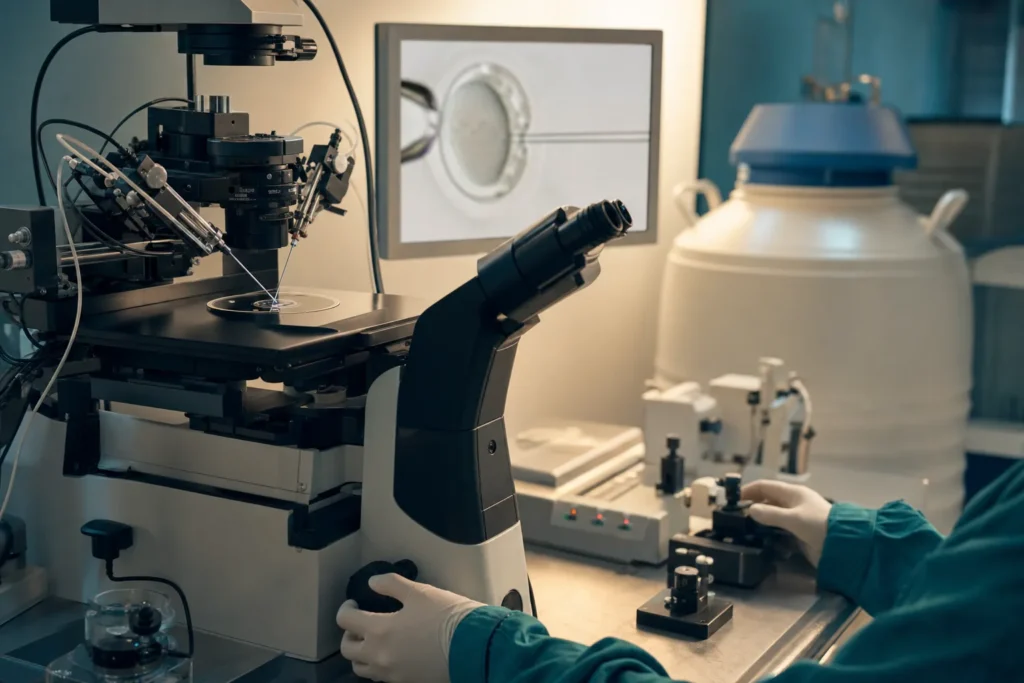
IVF with ICSI
IVF with ICSI is a laboratory technique where a single sperm is injected directly into an egg to help fertilisation happen. This friendly, plain-language guide explains who it helps, how each step works, what recovery feels like, the risks, realistic success rates by age, indicative costs, and how to choose a safe, licensed clinic if you are considering treatment in Turkiye.
- Anaesthesia
- Egg collection under sedation or light general anaesthetic; embryo transfer needs none
- Duration
- One full cycle takes about 3-6 weeks; egg collection itself takes around 20-30 minutes
- Recovery
- Most people rest the day of egg collection and return to normal activity within 1-2 days
- Hospital stay
- Day-case (outpatient); no overnight stay needed for egg collection or transfer
Minimum price, for reference only — the final cost is calculated individually after your records are reviewed. You pay the hospital’s price; our service is free for you.
What IVF with ICSI actually is
IVF stands for in vitro fertilisation — Latin for “in glass”. It simply means that an egg and sperm are brought together in a laboratory dish instead of inside the body. The fertilised egg grows for a few days into an early embryo, which is then placed gently into the womb in the hope it will implant and grow into a pregnancy.
ICSI stands for intracytoplasmic sperm injection. “Cytoplasm” is the jelly-like inside of the egg, so the name literally describes the technique: injecting a sperm into the inside of the egg. In standard IVF, thousands of sperm are placed next to each egg in the dish and fertilisation is left to happen on its own. In ICSI, an embryologist (a laboratory scientist who handles eggs and embryos) picks up one single healthy-looking sperm with an extremely fine glass needle and injects it directly into a single egg.
So ICSI is not a different treatment from IVF — it is one specific step within IVF. Everything else (the medication, the egg collection, the embryo transfer) is the same. The only difference is how the egg is fertilised in the lab. ICSI was developed mainly to help when the sperm cannot fertilise an egg easily on its own.
Who is a good candidate — and who may not need it
ICSI was designed above all for male-factor infertility — problems on the sperm side. Your fertility doctor may suggest it if there is:
- A low sperm count (few sperm in the semen).
- Poor motility — the sperm do not swim well.
- Poor morphology — many sperm are an unusual shape.
- No sperm in the ejaculate, so sperm must be collected surgically from the testicle.
- Previous IVF where fertilisation failed or very few eggs fertilised.
- Sperm that has been frozen and is of lower quality, or sperm with anti-sperm antibodies.
ICSI is also used when embryos will undergo genetic testing, because stray sperm stuck to the outside of the egg could contaminate the test result.
Who probably does not need ICSI: The Human Fertilisation and Embryology Authority (HFEA) is clear that there is currently no scientific evidence to support using ICSI when sperm are normal and the cause of infertility is not male-related. For couples with healthy sperm, standard IVF gives similar results, and adding ICSI mainly adds cost. ICSI also cannot fix problems caused by egg quality or age. If you are told you “need” ICSI but sperm tests are normal, it is reasonable to ask why.
Types and techniques
The core technique — one sperm, one needle, one egg — is the same everywhere, but you may hear about variations and add-ons:
- Conventional ICSI: the embryologist selects a sperm visually under a microscope based on how it looks and moves.
- Surgical sperm retrieval with ICSI: when there is no sperm in the semen, sperm can be taken directly from the testicle or the tubes behind it (procedures with names like TESA, TESE or PESA) and then used for ICSI.
- ICSI with frozen eggs or sperm: ICSI is often the chosen method when eggs or sperm have been frozen and thawed.
You may also be offered add-on procedures that sit alongside ICSI:
- Preimplantation genetic testing (PGT): checking embryos for certain chromosome or gene problems before transfer.
- Blastocyst culture: growing embryos to about day 5 (the “blastocyst” stage) so the strongest one can be chosen.
- Freezing spare embryos for a later attempt without a full new stimulation.
Some add-ons (such as certain laboratory “glues” or assisted hatching) have limited evidence. The HFEA publishes a traffic-light rating of add-ons, and it is worth asking your clinic what each one is actually expected to do for you.
How it is done — anaesthesia, steps and timing
One full cycle usually takes about 3 to 6 weeks from the first medication to the pregnancy test. Here is the journey, step by step.
1. Ovarian stimulation. Normally the body releases one egg a month. To improve the odds, you take hormone injections for roughly 8 to 14 days to encourage several eggs to mature at once. Some protocols first use a medicine to quieten your natural cycle. Throughout, you have ultrasound scans and blood tests so the team can track how the eggs are developing and adjust the dose.
2. Egg collection (retrieval). This is a short procedure done under sedation or a light general anaesthetic, so you are comfortable and not aware of it. Using ultrasound for guidance, the doctor passes a thin needle through the vaginal wall to gently draw the fluid (and the eggs) out of each ovarian follicle. It takes around 20 to 30 minutes. It is a day-case procedure — no overnight stay.
3. Sperm collection. On the same day, a fresh semen sample is provided, or frozen or surgically retrieved sperm is prepared in the lab.
4. ICSI fertilisation. The embryologist injects one sperm into each suitable mature egg. The eggs are then kept in an incubator and checked the next day to see how many have fertilised.
5. Embryo culture. The fertilised eggs grow for several days. Around day 5, a healthy embryo has many actively dividing cells.
6. Embryo transfer. Two to five days after collection, the best embryo is passed through a thin soft tube (catheter) through the cervix into the womb. This is quick, usually painless and needs no anaesthetic. Any good-quality spare embryos can be frozen.
Recovery, step by step
IVF with ICSI is not surgery in the usual sense, so recovery is mostly about rest and patience rather than wounds healing.
- The day of egg collection: Because you have had sedation, plan to rest, do not drive, and have someone with you. Mild cramping, bloating and a little spotting are common and usually settle within a day or two.
- The next 1–2 days: Most people feel back to normal and can return to gentle daily activity and work. Heavy lifting and very intense exercise are best avoided for a few days.
- After embryo transfer: There is no medical need for strict bed rest. You can carry on with ordinary life. You will usually continue hormone support (often progesterone) as prescribed.
- The two-week wait: A pregnancy blood test is done about 10 to 14 days after the transfer. This waiting period can feel emotionally hard — that is completely normal, and many clinics offer counselling.
Contact your clinic promptly if you develop severe abdominal pain, rapid bloating or weight gain, breathlessness, heavy bleeding or a fever — these can be signs of ovarian hyperstimulation syndrome (see Risks) and need to be checked.
Risks and possible complications
IVF with ICSI is generally safe, but no fertility treatment is risk-free. It is worth understanding both the risks that come from IVF itself and the few that are specific to ICSI.
Risks shared with all IVF:
- Ovarian hyperstimulation syndrome (OHSS): the ovaries over-respond to the hormones and become swollen and painful. Most cases are mild, but a severe form is possible — watch for rapid weight gain, marked bloating and shortness of breath, and seek urgent care if these occur.
- Multiple pregnancy: if more than one embryo is transferred, twins or triplets become more likely, which carries higher risks for mother and babies. This is the main reason clinics favour transferring a single embryo.
- Ectopic pregnancy: the embryo implants outside the womb; this needs prompt medical attention.
- Miscarriage and, in twin pregnancies, premature birth remain possibilities, as in any pregnancy.
- Minor effects from egg collection such as cramping, light bleeding or, rarely, infection.
Risks specific to ICSI:
- An egg can occasionally be damaged during the injection.
- There is a small increase in certain birth defects and developmental conditions; sources note that the great majority of babies are healthy, and much of the extra risk is thought to relate to the underlying infertility rather than the technique itself.
- If the father’s infertility has a genetic cause (for example a Y-chromosome change), a baby boy could inherit the same fertility difficulty later in life.
Overall, comparisons of ICSI and standard IVF have not shown a clear difference in the rate of birth defects, but it is an honest point to discuss with your doctor.
Results and how long they last
The most useful single number is the chance of a live birth, and it depends heavily on the woman’s age and the cause of infertility. Because ICSI success rates are very similar to standard IVF, regulators such as the HFEA do not publish them separately.
As a rough guide, UK national figures for live birth per embryo transferred (fresh) were around:
- Under 35: roughly 35%
- 35–37: around 26%
- 38–39: around 18%
- 40–42: around 10%
These are averages across many clinics and patients — your own odds may be higher or lower. Be cautious comparing clinic “success rates” directly, because clinics measure them differently (per embryo transfer, per egg collection, or per cycle started). National dashboards that use one consistent definition are more trustworthy.
One important point about “how long results last”: IVF with ICSI does not change your future fertility. A successful cycle gives you that pregnancy; it does not bank fertility for later. If you want more children afterwards, you would either try naturally or use any frozen embryos from the same cycle. Because results drop with age, many people doing IVF in their late 30s or 40s plan for the possibility of more than one cycle.
Costs — indicative ranges and what changes the price
Pricing varies a great deal by country, clinic and exactly what is included. In Turkiye, indicative all-in prices for one IVF-with-ICSI cycle commonly fall in the region of EUR 2,500 to EUR 6,000. For comparison, a single cycle in the United States is often quoted at roughly USD 12,000 to 17,000, which is one reason people look abroad.
These figures are indicative ranges only. They vary by case, clinic and the doctor involved, and they are not a quote. Always ask for a written, itemised price for your specific plan.
What pushes the price up or down:
- What the package includes: consultations, monitoring scans, egg collection, anaesthesia, the ICSI step and a fresh embryo transfer are usually bundled — but check.
- Hormone medication: often billed separately and can add a meaningful amount, depending on the dose you need.
- Add-ons: genetic testing of embryos (PGT), freezing and storage of spare embryos, and surgical sperm retrieval all cost extra.
- Number of cycles: if the first attempt does not succeed, further cycles add cost — though a frozen-embryo transfer is usually cheaper than a full new cycle.
- Travel and accommodation if you are treated abroad.
When comparing quotes, compare like with like: a low headline price that excludes medication, the ICSI step or freezing is not really cheaper.
Why people travel to Turkiye — and how to choose a safe clinic
Turkiye has become a major destination for fertility care because costs are typically lower than in much of Western Europe and North America, waiting times are short, and there are many experienced clinics, including hospitals accredited to international standards.
Two things are especially important to understand before you travel:
- The law on donors. Turkish law allows IVF and ICSI only for married couples using their own eggs and sperm. Egg donation, sperm donation, donor embryos and surrogacy are not permitted, and clinics are inspected regularly. If you need donor eggs or sperm, Turkiye is not the right destination.
- Embryo-transfer rules. National rules limit how many embryos can be transferred (generally a single embryo for younger patients in early cycles), which actually helps reduce the risk of risky multiple pregnancies.
To choose a safe clinic or doctor, verify:
- Licensing: the centre is licensed by the Turkish Ministry of Health to perform assisted reproduction, and (for international patients) holds health-tourism authorisation.
- Accreditation: recognised quality marks such as Joint Commission International (JCI) for the hospital, and laboratory accreditation for the embryology lab.
- The doctor’s credentials: board certification in obstetrics and gynaecology with reproductive-medicine training, and a track record in IVF/ICSI.
- Honest data: success rates quoted with a clear definition and for your age group — not vague “up to” figures.
- Clear written pricing and a named contact for follow-up once you are home.
How to prepare and what to ask at your consultation
Good preparation improves both your experience and, in some respects, your odds.
Before treatment:
- Both partners can support egg and sperm quality with simple steps: stopping smoking, keeping alcohol low, reaching a healthy weight, and managing stress — lifestyle factors are known to affect fertility.
- Complete the requested tests (hormone blood tests, ultrasound, a semen analysis, and infection screening) so the plan is tailored to you.
- Organise time off around egg collection, and arrange someone to accompany you that day because of the sedation.
Useful questions to ask your specialist:
- Why is ICSI being recommended for us specifically — what does the sperm analysis show?
- What is my realistic live-birth chance per cycle at my age?
- How many embryos will you transfer, and why?
- Which add-ons are you suggesting, what is the evidence, and what does each cost?
- Exactly what is and is not included in the price, including medication and freezing?
- What is your approach to preventing and managing OHSS?
- If treated abroad: who manages my care and monitoring before and after I travel, and what happens if a cycle is cancelled?
Aftercare and travelling for treatment (including when it is safe to fly)
After your cycle: continue any prescribed hormone support exactly as directed, and do the pregnancy blood test on the date your clinic gives you (about 10–14 days after transfer). If it is positive, you will usually have an early ultrasound a couple of weeks later to confirm the pregnancy is in the womb and developing. If a cycle does not work, ask for a follow-up review to understand why and what to adjust next time.
Travelling for treatment: If you go abroad, plan the trip around the key dates — the stimulation monitoring (which can sometimes start at home with your clinic’s guidance), egg collection, and embryo transfer. Build in flexibility, because the exact day of collection depends on how your eggs respond.
When is it safe to fly? There is no need to fly immediately after egg collection or transfer, and flying does not stop an embryo implanting. The bigger concern is OHSS: if your ovaries are swollen or you feel very bloated and unwell, a long flight is uncomfortable and can mask warning signs, so it is sensible to wait until you are checked and feeling well. A practical approach is to stay near the clinic for a short period after the procedures so any complication can be managed quickly, and to fly only once your team confirms you are well. If you become pregnant, follow standard pregnancy travel advice and discuss timing with your doctor. Keep your clinic’s emergency contact with you while you travel.
Frequently asked questions
What is the difference between IVF and ICSI?
Does ICSI give a higher success rate than standard IVF?
Is ICSI painful?
How long does one IVF with ICSI cycle take?
What are the success rates by age?
Are babies born from ICSI healthy?
What is OHSS and how worried should I be?
How much does IVF with ICSI cost in Turkiye?
Can I use donor eggs or sperm in Turkiye?
When is it safe to fly after egg collection or embryo transfer?
How many embryos will be transferred?
Do I need ICSI if my partner's sperm is normal?
Sources
- NHS — IVF
- NHS inform — IVF and ICSI
- HFEA — Intracytoplasmic sperm injection (ICSI)
- HFEA — In vitro fertilisation (IVF)
- HFEA — Fertility treatment 2022: preliminary trends and figures
- Cleveland Clinic — Intracytoplasmic Sperm Injection (ICSI)
- Cleveland Clinic — IVF (In Vitro Fertilization)
- MedlinePlus — In vitro fertilization (IVF)
- Mayo Clinic — In vitro fertilization (IVF)
- Joint Commission International — Accredited Organizations
This article is for general information only and is not medical advice. Always consult a qualified doctor about your individual case.
Specialists in IVF
Doctors of the department we work with directly. Which doctor takes your case is decided after the specialists have reviewed your records — your coordinator confirms it, not this page.



Considering this procedure?
Send us your photos and questions. A BergemHealth coordinator and a senior specialist will review your case and reply with honest, personalised guidance — no obligation.
Free consultation