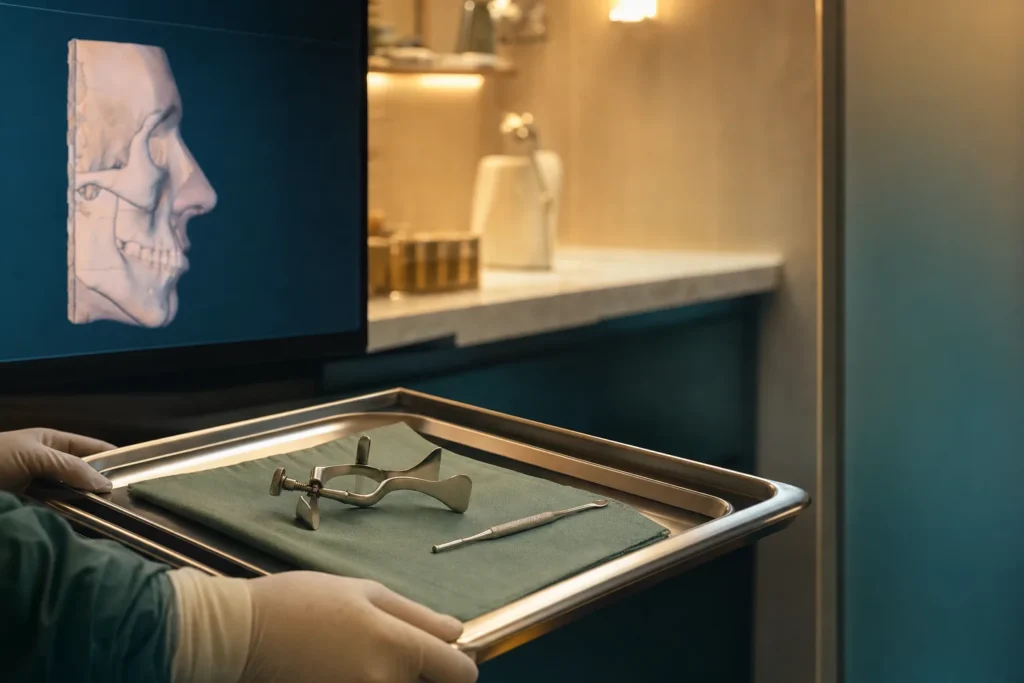
Septorhinoplasty
Septorhinoplasty is a single operation that does two jobs at once: it straightens the wall inside your nose so you can breathe better, and it reshapes the outside of your nose so it looks the way you want. This guide walks you through what really happens, in everyday language, so you can decide whether it is right for you and ask the right questions before you commit.
- Anaesthesia
- Usually general anaesthesia (you are asleep); occasionally local with sedation for limited work.
- Duration
- About 1 to 1.5 hours on average; complex or revision cases can take 2-3 hours.
- Recovery
- Back to desk work in 1-2 weeks; splint off at about 1 week; bruising fades in 2-3 weeks; most swelling settles by 3 months, final shape at ~1 year.
- Hospital stay
- Often day-case or one overnight stay; medical-travel patients usually stay 7-10 days locally.
Indicative hospital range, confirmed after your file is reviewed. You pay the hospital’s price — we add no markup.
What septorhinoplasty actually is
Your nose is divided down the middle by a thin wall called the septum. It is made of cartilage at the front (the bendy material you can feel in the tip of your nose) and bone further back, and it separates your two nostrils. When this wall is crooked, doctors call it a deviated septum, and it can block airflow on one or both sides.
Two different operations deal with the nose, and septorhinoplasty combines them:
- Septoplasty is a functional operation that straightens the septum so air can move freely. It does not usually change how the nose looks.
- Rhinoplasty (a "nose job") reshapes the outside of the nose - the bridge, the tip, the width - for appearance or to improve breathing.
Septorhinoplasty does both in one go: the surgeon straightens the inside wall and reshapes the visible part of the nose during the same surgery. People often search for it because they have a nose that both bothers them cosmetically and blocks up at night - and they would rather not have two separate operations and two separate recoveries.
Who is a good candidate (and who should wait or avoid it)
You may be a good candidate if you have both a breathing problem and a cosmetic concern about your nose. Common reasons people look into this surgery include a deviated septum that causes a stuffy nose, noisy breathing, repeated nosebleeds, facial pressure, snoring or disrupted sleep, alongside features they dislike such as a bump on the bridge, a drooping or wide tip, or a nose knocked off-centre by an old injury.
According to the Mayo Clinic and Cleveland Clinic, surgeons generally look for people who:
- have finished growing - this usually means the late teens, because operating on a still-growing nose can affect the result;
- are in good general health;
- do not smoke, or are willing to stop well before and after surgery (smoking slows healing and raises the risk of complications);
- have realistic expectations - a clear idea of what can change, not a wish for someone else's nose.
Who should be cautious or wait: people with uncontrolled medical conditions, bleeding disorders, or active sinus infections; anyone still growing; and people seeking surgery to please someone else rather than themselves. Surgeons also approach revision cases (fixing a previous nose operation) carefully, because scar tissue makes them more complex. An honest consultation is the place to sort out whether you fit.
Types and techniques
There are two main ways to reach the inside of the nose, and your surgeon will recommend one based on what needs doing.
- Closed (endonasal) technique: all the cuts are made inside the nostrils, so there are no visible external scars. It suits more limited reshaping and tends to involve less swelling.
- Open (external) technique: the surgeon adds a tiny cut across the columella - the small strip of skin between your nostrils - and lifts the skin to get a full view of the framework. This gives precise control for bigger changes or complex tips. The small scar usually fades to become barely noticeable.
Within these approaches, surgeons may shave down a bump, narrow or reposition the nasal bones, refine the tip cartilage, or use cartilage grafts (small pieces of your own cartilage, often borrowed from the septum itself or sometimes the ear) to rebuild support. The septoplasty part of the operation - straightening or trimming the crooked septum - is done through the same incisions. The right combination is decided for your particular nose, not from a menu.
How it is done, step by step
Anaesthesia. Septorhinoplasty is most often done under general anaesthesia, meaning you are fully asleep and feel nothing. Some limited procedures can be done under local anaesthetic with sedation. An anaesthetist monitors you throughout.
The steps, in plain terms:
- Once you are asleep, the surgeon makes the planned incisions - either entirely inside the nostrils (closed) or with the small extra cut on the columella (open).
- The skin is gently lifted off the bone-and-cartilage framework underneath.
- The crooked parts of the septum are straightened, trimmed or repositioned to open the airway.
- The outer shape is adjusted - smoothing a bump, refining the tip, narrowing the bridge - sometimes using cartilage grafts for support.
- The skin is laid back down and closed with fine stitches; inside the nose these are usually dissolvable and disappear over about six weeks.
- A small splint is taped to the outside of the nose to protect and hold the new shape, and soft internal supports or light packing may be placed.
How long it takes. Septoplasty alone is quick - around 30 to 45 minutes. Adding the reshaping makes septorhinoplasty longer, typically about 1 to 1.5 hours, and complex or revision work can run to two or three hours.
Recovery, step by step
Recovery is gradual, and knowing the milestones helps you plan time off and travel.
- First few days: Expect a blocked nose on both sides, as if you have a heavy cold, plus swelling and bruising around the eyes. You will breathe through your mouth for a while. Mild pain is usually managed with simple painkillers. Some blood-tinged fluid from the nose is normal.
- Around one week: The external splint and any internal supports or packing are removed at a clinic visit. Many people feel ready to return to desk work or school after 1 to 2 weeks, partly to lower infection risk while healing.
- Two to three weeks: Most visible bruising fades. The nose still feels congested - NHS guidance notes it can feel blocked for up to about six weeks, which is normal as the lining heals.
- One month: Light activity such as walking is fine early on, but avoid strenuous exercise, heavy lifting and contact sport for roughly a month, or as your surgeon advises.
- Three months and beyond: The bulk of the swelling has settled and breathing usually feels much improved.
Helpful habits: sleep with your head raised, do not blow your nose at first, sneeze with your mouth open, and use isotonic saline spray if recommended to keep the lining moist and speed healing.
Risks and possible complications
Septorhinoplasty is generally considered safe, but like any surgery it carries risks, and a good surgeon will discuss these with you. Reputable sources including the Cleveland Clinic and NHS list:
- Bleeding - some is normal; heavier bleeding is uncommon and can occur in the first hours or up to about ten days after surgery.
- Infection - uncommon, treated with antibiotics if it happens.
- Septal perforation - a small hole in the septum, which can cause whistling or crusting.
- Changes in the sense of smell - usually temporary, occasionally lasting.
- Numbness of the upper teeth, lip or nose tip, usually temporary.
- Changes in nose shape or a result you are not happy with, sometimes prompting revision surgery. For rhinoplasty in general, the Cleveland Clinic notes that around 15% of patients eventually have a revision.
- Risks linked to general anaesthesia, and very rare events such as toxic shock syndrome or a cerebrospinal fluid leak.
Tell your surgeon promptly if you have heavy fresh bleeding, a high temperature, or worsening pain after going home.
Results and how long they last
The breathing improvement is often noticed once the swelling settles, frequently within the first few weeks to months. The septum, once straightened, generally stays that way.
The cosmetic result takes longer to reveal itself. Swelling in the nose comes down slowly: roughly 90% of swelling is gone by about three months, but the last subtle changes - especially in the tip - can take up to a full year to finish settling. So the nose you see at one week is not the nose you will keep.
The structural reshaping of bone and cartilage is considered permanent; the Cleveland Clinic describes rhinoplasty results as lasting a lifetime. That said, normal ageing, weight changes and any future injury can still alter your nose over the years, just as they would for anyone.
Costs and what changes the price
Prices vary widely by country, surgeon and how much work is needed. In the United States, the American Society of Plastic Surgeons reports the surgeon's fee for rhinoplasty alone, before anaesthesia and facility charges, and once everything is added the total commonly lands in the low-to-mid five figures in US dollars; revision work costs more.
In Turkey, septorhinoplasty is typically offered to international patients in an indicative range of roughly EUR 2,500 to EUR 6,500. Many clinics bundle the surgeon's fee, anaesthesia, the hospital stay and follow-up into a single package, which can make budgeting simpler than paying line by line elsewhere. This is an indicative range, not a quote: the real figure varies by case, surgeon and clinic.
What pushes the price up or down:
- whether it is a first-time or a more complex revision procedure;
- open versus closed technique, and whether cartilage grafts are needed;
- the surgeon's experience and reputation;
- the hospital's accreditation and facilities;
- anaesthesia type, length of stay, and what is included (medication, splints, follow-up, sometimes hotel and transfers in travel packages).
Be wary of prices that look too good to be true - the cheapest option is not always the safest, and a needed revision later can cost far more than choosing well the first time.
Why people travel to Turkiye, and how to choose a safe clinic
Turkiye has become a major destination for nose surgery because experienced surgeons, modern hospitals and lower overall costs combine into well-organised packages for international patients. There are more than 40 hospitals in the country accredited by Joint Commission International (JCI), an independent body that assesses healthcare quality and patient safety to international standards.
To travel safely, verify rather than assume:
- Check the surgeon's credentials. Look for relevant specialist training in ear, nose and throat (otolaryngology) or plastic/facial plastic surgery, and a high volume of nose operations. Ask how many septorhinoplasties they perform a year.
- Confirm the hospital's accreditation directly on the JCI website, and ask for the exact hospital name and address where your surgery will take place.
- Ask about Turkish Ministry of Health licensing and Health Tourism Authorisation, which indicate the facility is approved to treat international patients.
- Insist on proper paperwork: a clear written quote, informed consent that spells out realistic outcomes and known risks, a pre-operative assessment plan, and a written aftercare and follow-up plan.
- Review before-and-after photos of the surgeon's own patients, and read independent reviews.
A trustworthy clinic welcomes these questions. If anyone pressures you to decide quickly or dodges your questions about credentials, treat that as a warning sign.
How to prepare and what to ask in your consultation
Good preparation makes for a smoother result. In the weeks before surgery you will usually be asked to stop smoking, avoid blood-thinning medicines and supplements unless your doctor says otherwise (such as aspirin and certain anti-inflammatories), arrange time off work, and organise help for the first days at home or in your hotel.
The consultation is your chance to interview the surgeon, not just be examined. Useful questions include:
- Are you specialist-trained for this surgery, and how many septorhinoplasties do you perform each year?
- Will my procedure be open or closed, and why?
- Will I need cartilage grafts, and where would the cartilage come from?
- What realistic change can I expect for my breathing and my appearance?
- What anaesthesia will be used, and where exactly will I be operated on?
- What are the main risks in my case, and your revision rate?
- What does the price include, and what happens if I need a revision?
- What is the aftercare plan, and who do I contact if something goes wrong after I fly home?
Bring photos of noses you like to illustrate your goals, and be honest about your medical history and medications.
Aftercare and travelling for treatment (including when it is safe to fly)
If you travel for surgery, plan to stay nearby long enough for the early healing and the splint-removal visit. For septorhinoplasty, clinics commonly suggest staying around 7 to 10 days locally, so the splint can come off and the surgeon can check you before you head home.
Flying. There is no single official rule, but surgeons generally advise not flying too soon. Many suggest waiting at least until after the splint is removed and the surgeon clears you - often around the one- to two-week mark, with longer waits for long-haul flights. The concern is that cabin pressure changes and the longer, drier, more crowded environment of flying can add to swelling, raise the small risk of bleeding, and increase infection exposure while the nose is still fragile. Always follow your own surgeon's specific advice.
Good aftercare habits apply wherever you are: keep your head elevated when resting, do not blow your nose at first, sneeze with your mouth open, use saline spray if advised, avoid strenuous activity for about a month, keep the nose out of strong sun, and attend every follow-up - in person or by video. Keep your discharge summary and emergency contact details with you, especially while travelling.
Frequently asked questions
What is the difference between septoplasty, rhinoplasty and septorhinoplasty?
Is septorhinoplasty painful?
How long does the surgery take?
How long is the recovery?
When can I fly after septorhinoplasty?
Will I have visible scars?
Are the results permanent?
What are the main risks?
How much does septorhinoplasty cost in Turkey?
How do I know a clinic in Turkey is safe?
How long should I stay in Turkey for the procedure?
Will septorhinoplasty fix my snoring or blocked nose?
This article is for general information only and is not medical advice. Always consult a qualified doctor about your individual case.
Considering this procedure?
Send us your photos and questions. A BergemHealth coordinator and a department-head specialist will review your case and reply with honest, personalised guidance — no obligation.
Free consultation