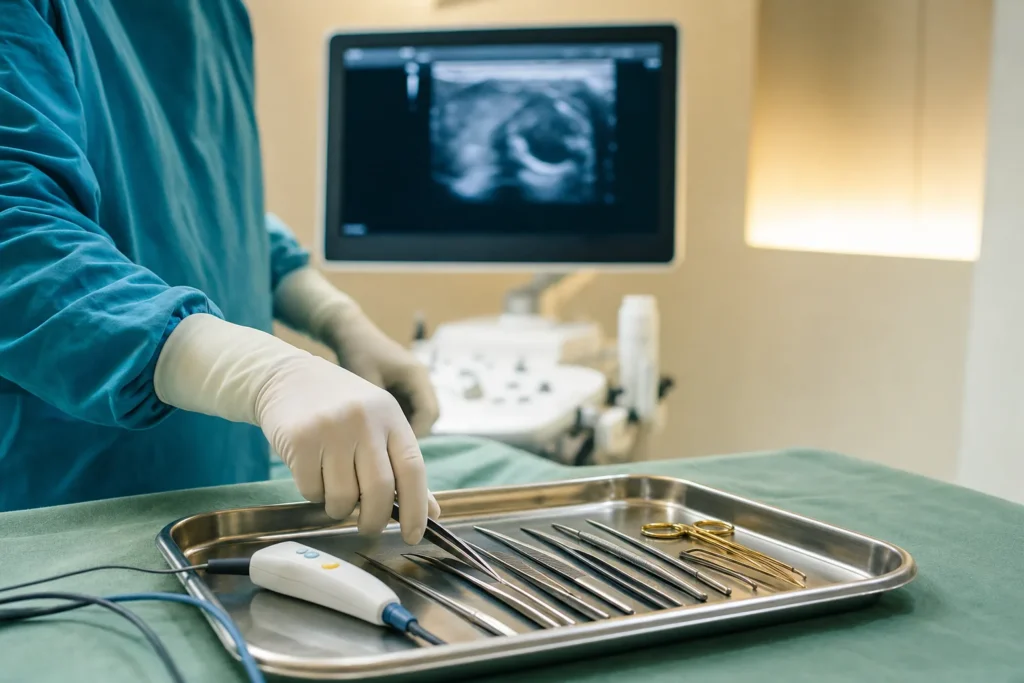
Thyroid & parathyroid surgery
Thyroid and parathyroid surgery covers a family of operations on two tiny but powerful glands in your neck. This guide explains, in everyday language, what these procedures involve, who genuinely needs them, what recovery feels like day by day, and how to choose a safe clinic and surgeon if you are considering treatment in Turkiye.
- Anaesthesia
- General anaesthesia (asleep); some focused parathyroid cases can use local or regional anaesthesia.
- Duration
- About 1-3 hours for thyroid surgery; roughly 1 hour for a focused parathyroid operation.
- Recovery
- Most people feel much better within 1-2 weeks; full recovery usually takes 2-6 weeks.
- Hospital stay
- Often same-day or one overnight; sometimes 1-2 nights after total thyroidectomy.
Indicative hospital range, confirmed after your file is reviewed. You pay the hospital’s price — we add no markup.
What thyroid and parathyroid surgery actually is
Your thyroid is a small, butterfly-shaped gland at the front of your neck, just below the Adam's apple. It makes hormones that act like the body's thermostat, controlling how fast you burn energy, your heart rate, your temperature and your mood. Thyroid surgery (a thyroidectomy) means removing all or part of this gland.
Tucked behind the thyroid are four parathyroid glands, each about the size of a grain of rice. Despite their name, they do a completely different job: they make parathyroid hormone (PTH), which keeps the amount of calcium in your blood steady. Parathyroid surgery (a parathyroidectomy) means removing one or more of these glands when they make too much hormone.
These two operations are grouped together because they happen in the same small space in the neck and are usually done by the same specialists, often ear-nose-throat (ENT) surgeons or endocrine surgeons. But they treat very different problems: thyroid surgery is usually about nodules, goitre, an overactive gland or cancer, while parathyroid surgery is almost always about high blood calcium caused by an overactive parathyroid gland.
Who is a good candidate (and who should think twice)
Doctors do not rush to operate on the thyroid. According to the American Thyroid Association, the main reasons for thyroid surgery are:
- A nodule (lump) that looks suspicious for thyroid cancer on a biopsy, or proven cancer.
- A goitre (an enlarged thyroid) that is pressing on the windpipe or food pipe, making it hard to breathe or swallow.
- Hyperthyroidism (an overactive thyroid, including Graves' disease) when medicines and radioactive iodine are not suitable or have not worked.
- A nodule that keeps producing too much hormone.
For the parathyroid, the usual reason is primary hyperparathyroidism - one or more glands making too much PTH, which pushes blood calcium too high. Surgery is typically recommended when high calcium causes kidney stones, bone thinning (osteoporosis), kidney problems, or symptoms such as tiredness, low mood, brain fog or bone pain. Cleveland Clinic notes that surgery is the only true cure for this condition.
Who should be cautious: small, harmless thyroid nodules often just need monitoring, not surgery. People with mild parathyroid disease and no symptoms may be watched rather than operated on. Anyone with significant heart or lung disease, uncontrolled bleeding disorders, or who cannot safely have general anaesthesia needs careful assessment first. Pregnancy usually means delaying non-urgent surgery. The right answer always depends on your individual scans, blood tests and overall health - not on a one-size-fits-all rule.
Types and techniques
Thyroid operations come in a few sizes:
- Lobectomy (hemithyroidectomy): removing one half (lobe) of the thyroid. The remaining half often keeps making enough hormone, though some people still need tablets.
- Total thyroidectomy: removing the whole gland. This is common for cancer and for Graves' disease, and always means lifelong thyroid hormone tablets afterwards.
- Isthmusectomy: removing just the small bridge of tissue connecting the two lobes.
- Neck dissection: for some cancers, nearby lymph nodes are also removed.
Parathyroid operations are usually one of two styles:
- Focused (minimally invasive) parathyroidectomy: when scans have already pinpointed the single overactive gland, the surgeon removes it through a small incision. Many surgeons check a quick blood hormone level during the operation (intraoperative PTH monitoring) to confirm the problem gland is gone before closing.
- Bilateral neck exploration: the surgeon checks all four glands, used when more than one gland may be involved or scans are unclear.
Access can be through a standard small neck incision placed in a natural skin crease, or, in selected centres, through minimally invasive video-assisted or scarless/remote-access techniques (for example through the mouth or under the arm) that hide the scar. Remote-access and robotic approaches are not right for everyone and are usually reserved for specific cases.
How it is done: anaesthesia, steps and timing
Most thyroid and parathyroid operations are done under general anaesthesia, meaning you are fully asleep and a breathing tube is placed. Some focused parathyroid operations can be done under local or regional anaesthesia in suitable patients.
Once you are asleep, the surgeon makes a small incision low in the front of the neck, gently moves aside the muscles, and reaches the gland. A key part of the operation is carefully protecting the recurrent laryngeal nerves, which control your vocal cords, and the parathyroid glands that sit behind the thyroid. Many surgeons use nerve monitoring to help find and protect these nerves. The gland (or part of it) is removed, any needed lymph nodes are sampled, and the incision is closed with dissolvable stitches and skin glue or tape.
In terms of time, Cleveland Clinic notes that removing the whole thyroid usually takes about one to three hours, while a focused parathyroid operation often takes around an hour. The exact time depends on the size of the gland, whether cancer or multiple glands are involved, and the technique used.
Recovery, step by step
Recovery is usually smoother than people expect for neck surgery. A rough timeline:
- First hours: you wake in recovery with a sore throat from the breathing tube and some neck stiffness. Pain is usually mild to moderate and controlled with simple painkillers.
- First night: many people go home the same day or stay one night so the team can watch for bleeding and check calcium levels after total thyroidectomy. MedlinePlus notes most patients are discharged within one to two days.
- Days 1-7: you can eat, drink, talk and walk around. Voice may feel tired or slightly hoarse. The British and US sources describe most people returning to light daily activities within days.
- Weeks 1-2: the skin glue or tape comes off, and many people return to desk work. Avoid heavy lifting and vigorous exercise for at least one to two weeks.
- Weeks 2-6: Cleveland Clinic puts full recovery at about two to three weeks for many people, while MedlinePlus cites up to four to six weeks for a complete return to normal. The scar fades gradually over 12-18 months.
After a total thyroidectomy you will start thyroid hormone tablets, and you may take calcium and vitamin D for a few weeks while the parathyroid glands recover. After a parathyroidectomy you may also take temporary calcium supplements.
Risks and possible complications
These are well-established, generally safe operations, but no surgery is risk-free. The main specific risks are:
- Voice changes (recurrent laryngeal nerve injury): temporary hoarseness happens in roughly 5-7% of cases; permanent voice change is uncommon, around 0.5% in figures cited by the American Thyroid Association. Injury to a smaller nearby nerve can affect singing or shouting.
- Low calcium (hypoparathyroidism): if the parathyroid glands are bruised or removed during total thyroidectomy, blood calcium can drop, causing tingling around the lips or in the fingers, and muscle cramps. This is often temporary; the American Thyroid Association cites a permanent rate of about 1-3%.
- Bleeding (neck haematoma): rare but important, because swelling in the neck can press on the airway. This is why patients are watched closely for the first hours.
- Infection: uncommon, under about 1%.
- General anaesthetic risks and a sore throat from the breathing tube.
For parathyroid surgery specifically, a less common issue is hungry bone syndrome, where bones rapidly take up calcium afterwards and blood calcium dips. Call your team for fever, increasing neck swelling, difficulty breathing or swallowing, or numbness and cramps.
Results and how long they last
Outcomes are generally very good. MedlinePlus describes the outlook after thyroid surgery as usually excellent. For benign goitres and overactive nodules, removing the gland reliably solves the original problem.
For parathyroid surgery, Cleveland Clinic reports a success rate of over 95% when performed by experienced surgeons, with recurrence in under 2%. Curing high calcium can protect against future kidney stones and bone loss and often improves energy and mood.
For thyroid cancer, surgery is usually the main treatment, sometimes followed by radioactive iodine and long-term blood tests (such as thyroglobulin) to watch for recurrence. The need for and timing of these depend on the cancer type and stage.
The trade-off after a total thyroidectomy is lifelong thyroid hormone replacement. This is a single daily tablet (levothyroxine) that replaces what the gland used to make; with the right dose, checked by blood tests, most people feel completely normal. After a lobectomy, you may or may not need tablets, depending on how the remaining half performs.
Costs: indicative ranges and what changes the price
Prices vary widely between countries and clinics. As a rough, indicative guide, thyroid or parathyroid surgery packages in Turkiye often fall in the region of EUR 2,500 to EUR 7,000. These figures are illustrative only - they are not a quote. The final price varies by case, surgeon and clinic.
What pushes the price up or down:
- Extent of surgery: a single-side lobectomy or focused parathyroidectomy is usually less than a total thyroidectomy with lymph node removal.
- Technique: minimally invasive, scarless or robotic approaches and intraoperative nerve and hormone monitoring can add cost.
- Diagnostics: scans, biopsies, blood tests and, for cancer, pathology on the removed tissue.
- Hospital grade and surgeon experience: internationally accredited hospitals and high-volume specialists may charge more.
- Hospital stay and extras: length of stay, anaesthesia, medicines, and, for international patients, translation, transfers and hotel nights.
- Follow-up: for cancer, radioactive iodine treatment is a separate, additional cost.
Always ask for a written, itemised quote that states exactly what is and is not included, so you can compare like with like.
Why people travel to Turkiye, and how to choose a safe clinic
Turkiye has become a major destination for medical travel because it combines internationally accredited hospitals, experienced specialists and prices that are often lower than in Western Europe, the UK or the Gulf - frequently without a long waiting list. The country has a large number of hospitals accredited by Joint Commission International (JCI), a global body that checks that a hospital meets strict international standards for patient safety and quality.
To choose safely, verify rather than assume:
- Hospital accreditation: confirm current JCI accreditation (with valid dates) on the official JCI list, and check the Turkish Ministry of Health tourism authorisation.
- Surgeon credentials: look for board certification in ENT or endocrine/general surgery and ask how many thyroid and parathyroid operations they perform each year. Evidence shows higher-volume surgeons tend to have fewer complications and better cure rates.
- Nerve monitoring and pathology: ask whether nerve monitoring is used and where tissue is analysed.
- Clear paperwork: you should receive the exact hospital name and address, an informed-consent document explaining realistic outcomes and risks, a pre-op plan, and a written aftercare and follow-up plan.
- Transparent pricing and a named point of contact for questions before and after surgery.
How to prepare and what to ask at your consultation
Good preparation makes surgery safer and recovery smoother. Before the operation you will usually have blood tests, neck imaging (ultrasound and, for parathyroid, a special scan), and sometimes a check of your vocal cords. You may be asked to stop certain blood-thinning medicines and to fast before surgery; follow your team's exact instructions.
Helpful questions to ask:
- What exactly are you removing, and why - a lobe, the whole thyroid, or one parathyroid gland?
- Will I need thyroid hormone tablets afterwards, and for how long?
- What is your personal complication rate, and how many of these operations do you do each year?
- Do you use nerve monitoring? For parathyroid, do you check hormone levels during surgery?
- How long will I stay in hospital, and how will my calcium be checked?
- What does the quote include, and what could cost extra?
- Who do I contact if there is a problem after I fly home, and how will follow-up work?
Bring a full list of your medicines and past medical history, and tell the team about any previous neck surgery, voice problems or anaesthetic reactions.
Aftercare and travelling for treatment
If you travel for surgery, plan to stay nearby for several days after the operation rather than flying straight home. Surgeons commonly advise remaining in the area for a short period so the team can watch for bleeding and check your calcium after total thyroidectomy.
When is it safe to fly? Advice varies, but many surgeons suggest waiting at least a few days to about one to two weeks after neck surgery, and only once you have been cleared. Make sure any drains are removed, you have your thyroid hormone and calcium tablets in hand, and you know the warning signs to watch for. Always follow the specific advice of your own surgeon, as the right timing depends on your operation and recovery. On the flight, keep moving - stand, stretch and walk the aisle every hour or two - to lower the small risk of blood clots.
Back home, look after the scar by keeping it clean and protected from strong sun, attend your blood tests to fine-tune hormone and calcium levels, and ease back into exercise as advised. Keep your overseas clinic's contact details and your operation notes, and make sure your local doctor knows what was done so your follow-up care is joined up.
Frequently asked questions
What is the difference between thyroid and parathyroid surgery?
Will I be able to talk normally after the operation?
Will I need to take medication for the rest of my life?
How long will I stay in hospital?
How big is the scar and will it show?
Is parathyroid surgery a permanent cure?
What are the warning signs of low calcium after surgery?
How soon can I fly home after surgery in Turkiye?
How much does thyroid or parathyroid surgery cost in Turkiye?
How do I know a Turkish clinic is safe?
Can thyroid surgery be avoided?
When can I go back to work and exercise?
This article is for general information only and is not medical advice. Always consult a qualified doctor about your individual case.
Considering this procedure?
Send us your photos and questions. A BergemHealth coordinator and a department-head specialist will review your case and reply with honest, personalised guidance — no obligation.
Free consultation