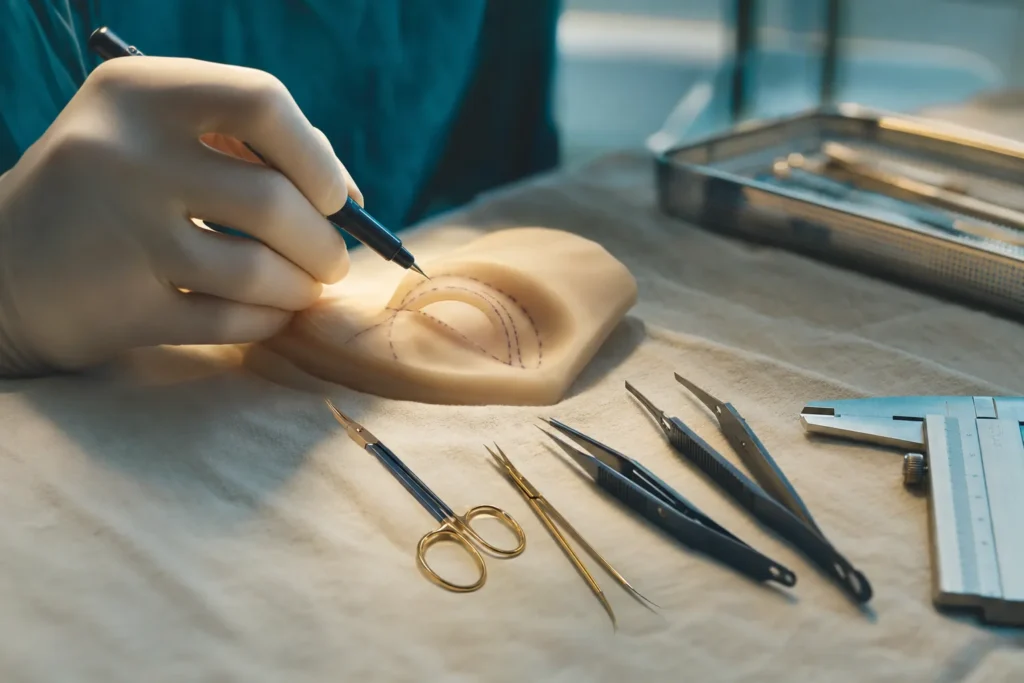
Blepharoplasty
Blepharoplasty, or eyelid surgery, reshapes the upper and/or lower eyelids by adjusting excess skin, muscle and fat. It is performed for cosmetic reasons and, when sagging upper-lid skin blocks vision, for functional ones. This guide explains what the operation can and cannot do, the main techniques, a realistic recovery timeline, the documented risks, and how to choose a qualified surgeon if you are considering treatment abroad, including in Turkiye.
- Anaesthesia
- Local anaesthesia with sedation, or general anaesthesia, depending on extent and surgeon preference.
- Duration
- Roughly 45 minutes to 1 hour for upper lids alone; about 2 hours when upper and lower lids are treated together.
- Recovery
- Most people feel comfortable in public after 10-14 days; full healing and scar maturation can take a few months.
- Hospital stay
- Usually a day-case (outpatient) procedure with no overnight stay.
What blepharoplasty is
Blepharoplasty is a surgical procedure to improve the appearance and, in some cases, the function of the eyelids. As the American Society of Plastic Surgeons (ASPS) defines it, eyelid surgery is performed to improve the appearance of the eyelids, and it can be done on the upper lids, the lower lids, or both at the same time.
With age, the thin skin of the eyelids stretches, the underlying muscle weakens, and small pockets of fat that cushion the eye can bulge forward through the supporting tissue. On the upper lid this produces loose, hooding skin and puffiness; on the lower lid it produces the puffy contours commonly called eye bags. Blepharoplasty addresses these changes by removing or repositioning excess skin and fat and, where needed, adjusting muscle.
It is important to understand the limits of the operation. Blepharoplasty targets the eyelid tissues themselves. It does not erase crow's feet (the fine lines at the outer eye corners), it does not remove dark circles under the eyes, and it does not lift sagging eyebrows. Cleveland Clinic states plainly that eyelid surgery does not eliminate dark circles or remove crow's feet or other facial wrinkles. Those concerns are caused by skin texture, pigmentation, muscle movement and brow position, and are treated by other methods such as skin resurfacing, fillers or a brow lift.
Who is a candidate
Good candidates are generally adults in good general health, with realistic expectations, who are bothered by specific, correctable eyelid changes. Cleveland Clinic notes that ideal candidates are healthy adults who do not have other eye conditions that would make surgery riskier.
Cosmetic indications include hooded or heavy upper lids, puffiness, and lower-lid bags or excess skin. Functional indications arise when loose upper-eyelid skin droops far enough to obstruct the upper field of vision. In the United Kingdom, for example, the NHS will generally only consider funding upper blepharoplasty for genuine functional reasons, supported by visual-field testing and clinical photographs that document the obstruction; purely cosmetic surgery is not funded.
Contraindications and cautions. Several conditions make surgery higher-risk or unsuitable, and you should disclose them at consultation. Cleveland Clinic highlights conditions to disclose, including pre-existing dry eyes, glaucoma, retinal detachment or other eye disease, and thyroid disorders, as well as cardiovascular disease and diabetes, which can increase risk. Smoking impairs healing. A careful preoperative eye examination is part of responsible assessment, and a tear-film (Schirmer) test may be used to screen for dry eye.
Types and techniques
Blepharoplasty is tailored to which lid is being treated and to the balance of skin, muscle and fat involved.
- Upper eyelid surgery (upper blepharoplasty). An incision is hidden within the natural upper-lid crease. A measured strip of excess skin, and sometimes a sliver of muscle and a small amount of fat, is removed, and the crease is reformed. A surgical review describes marking a curved line above the lid margin to plan the skin excision while preserving the muscle that opens the eye.
- Lower eyelid surgery (lower blepharoplasty). This mainly addresses fat that causes bags, with or without excess skin.
For the lower lid there are two principal approaches:
- Transconjunctival approach. The incision is made on the inside of the lower lid, leaving no external scar. The published literature describes it as well suited to younger patients with puffiness and fat bags but little excess skin, because it gives direct access to the lower fat compartments without a skin incision.
- Transcutaneous (subciliary) approach. A fine incision is placed just below the lash line, allowing the surgeon to remove or reposition fat and also trim excess skin. It is chosen when loose skin must be addressed as well as fat.
Modern practice often favours conserving fat where possible. Rather than aggressive removal, surgeons may reposition fat to smooth the transition between lid and cheek, because over-removal can leave a hollow appearance. Fine surface wrinkles, when they are the main concern, may be treated separately with laser or chemical peel rather than by cutting.
How it is performed
Blepharoplasty is usually a day-case procedure. Depending on the extent of surgery and the surgeon's preference, it is performed under local anaesthesia with sedation or under general anaesthesia.
After the eyelids are numbed and marked, the surgeon makes the planned incisions, in the upper-lid crease, just below the lower lashes, or inside the lower lid. Excess skin is trimmed, muscle is adjusted if needed, and fat is removed or repositioned to refine the contour. Incisions are then closed with fine sutures (none are visible with the transconjunctival route). Where loose upper-lid skin is being corrected, surgeons take care to leave enough skin so the eye can still close fully.
Duration. Cleveland Clinic reports that an upper blepharoplasty can typically be completed in about 45 minutes to one hour, and that treating both upper and lower lids takes roughly two hours. Because it is normally outpatient surgery, most patients go home the same day once they have recovered from anaesthesia.
Recovery timeline
Healing is gradual. Individual recovery varies, but the following stages are typical, drawing on ASPS and Cleveland Clinic guidance.
- First few days. Expect swelling, bruising, irritation, watering or dryness, and mild discomfort. These are commonly managed with prescribed medication, cold compresses and ointment. Keeping the head elevated, including during sleep, helps reduce swelling. Plan to stay home and limit activity.
- Around one week. Skin sutures, where used, are generally removed at about a week.
- 10-14 days. Most patients feel comfortable being seen in public, as bruising fades and swelling settles, according to both ASPS and Cleveland Clinic.
- Several weeks. Residual swelling continues to subside and you can progressively return to normal activity and exercise on your surgeon's advice. Strenuous activity is avoided early on.
- A few months. Final healing, including scar maturation and the settling of subtle swelling, can take several months. Diligent sun protection and tinted sunglasses are commonly recommended until healing is complete.
The transconjunctival route, which avoids an external skin incision, is often associated with relatively limited bruising and a quicker early recovery, though the same general principles of swelling and sun protection apply.
Risks and complications
Blepharoplasty is generally safe in appropriate hands, but it carries real risks that should be weighed against the benefits. ASPS lists the following possible complications:
- Bleeding from the incision lines, and infection
- Changes in skin sensation or numbness near the eyelashes
- Difficulty closing the eyes and resulting dryness
- Dry eyes
- Ectropion, an outward rolling of the lower eyelid
- Lid lag, a pulling down of the lower lid, which is often temporary
- Pain that may persist, sensitivity to bright light, and unfavourable scarring
- Possible need for revision surgery
- Temporary or even permanent change in vision, with a very rare chance of blindness
- Anaesthesia-related risks
The most feared complication is sight loss from bleeding behind the eye (retrobulbar haemorrhage). A peer-reviewed review estimates the incidence of vision loss from this cause at roughly 1 in 2,000 to 1 in 25,000 cases; it is a surgical emergency requiring rapid intervention to give any chance of recovery. The same literature notes that double vision (diplopia) after blepharoplasty is extremely rare and usually temporary, and that lower-lid malposition and ectropion are recognised concerns that careful technique aims to prevent. Risk can be increased by uncontrolled high blood pressure, blood-thinning medication, and surgery through previously scarred tissue.
Results and longevity
Blepharoplasty produces long-lasting results. ASPS states that the results of eyelid surgery will be long-lasting, while emphasising that you continue to age naturally afterwards. Cleveland Clinic offers a useful frame: upper-eyelid results can last anywhere from about five to seven years up to a lifetime, and lower-eyelid surgery rarely needs to be repeated.
Realistic expectations matter. The operation refreshes the eyelids, but it does not stop the broader ageing of the face, the brow, or the skin's surface. It will not change dark circles or crow's feet. ASPS also notes that although good results are expected, there is no guarantee, and that in some cases a single procedure may not achieve the optimal outcome, so a further operation could be needed. Scars from external incisions are placed in natural creases or below the lash line and typically fade over months, though they take time to mature. Ongoing sun protection helps preserve the result.
Costs: ranges, factors and a disclaimer
The cost of blepharoplasty depends heavily on what is being done, where, and by whom. As an indicative guide for self-funded cosmetic surgery, publicly reported private prices in the United Kingdom commonly fall in the region of roughly EUR 3,000-6,500 for upper or combined eyelid surgery, while publicly reported all-inclusive packages in Turkiye are frequently quoted from around EUR 1,800 for upper lids up to about EUR 3,000-3,500 for combined upper-and-lower surgery, sometimes bundling accommodation and transfers.
The main factors that move the price are:
- Whether one or both lids are treated, and whether skin, muscle and fat work is involved
- The technique used (for example, a transconjunctival lower-lid approach)
- Anaesthesia type and facility fees
- The surgeon's experience and credentials
- Pre-operative tests, follow-up, and any aftercare or accommodation in a package
Important: these figures are indicative ranges only, gathered from publicly available information, and are not a quote. The actual blepharoplasty cost varies by individual case, surgeon and clinic, and may change over time. A personalised assessment is the only way to obtain an accurate price, and the cheapest option is not necessarily the safest.
Why Turkiye, and choosing a qualified surgeon
Turkiye (Turkey) is a well-established destination for cosmetic surgery, including eyelid surgery, often chosen for its concentration of experienced surgeons and competitive package pricing. As with any destination, outcomes depend far more on the individual surgeon and facility than on the country, so verification matters.
When choosing a surgeon, whether at home or abroad, look for:
- Recognised board certification. Membership of bodies such as the European Board of Plastic, Reconstructive and Aesthetic Surgery (EBOPRAS), the International Society of Aesthetic Plastic Surgery (ISAPS), or the relevant national plastic-surgery society indicates accredited training and peer review.
- Specific experience in upper and lower blepharoplasty, including the technique relevant to you.
- An accredited, properly equipped facility with clear anaesthesia and emergency provision.
- A genuine pre-operative assessment, including an eye examination and dry-eye screening, rather than an offer based on photos alone.
- Transparent before-and-after expectations, a written plan, and clear arrangements for follow-up and managing any complications after you return home.
Be cautious of marketing that promises guaranteed results or quotes a firm price without examining you.
Preparing and what to ask at consultation
Good preparation improves both safety and the result. Your surgeon will take a full medical and ophthalmic history, examine your eyelids, brow position and tear function, and may order visual-field testing if there is a functional component. Because brow position influences the upper lids, an experienced surgeon checks whether a drooping brow, rather than the lid skin alone, is causing the heaviness; the literature stresses that brow ptosis should be addressed before or alongside blepharoplasty.
Before surgery you will typically be asked to stop smoking, to avoid medicines and supplements that increase bleeding (on medical advice), and to arrange a responsible adult to take you home and stay with you for the first day.
Useful questions to ask include:
- Am I a good candidate, and what specifically will surgery change, and not change?
- Which technique do you recommend for me, and why?
- What anaesthesia will be used, and is the facility accredited?
- What are the main risks in my case, and how often do you see them?
- When are stitches removed, and when can I resume normal activity and exercise?
- What does aftercare include, and how are complications handled if I travel home?
- What is the total cost, and what does it cover?
Aftercare, follow-up and travelling for surgery
After blepharoplasty, follow your surgeon's instructions closely: use cold compresses and any prescribed eye ointment or drops, keep the head elevated, avoid rubbing the eyes, protect the incisions from strain, and wear tinted sunglasses outdoors. Attend the early follow-up so sutures can be removed and healing checked, and report promptly any sudden severe pain, marked swelling, bleeding or change in vision, which require urgent assessment.
If you are travelling for surgery, build in enough time before flying home. Cabin pressure and dry cabin air can aggravate swelling, and many surgeons advise waiting before air travel. The right timing depends on your procedure and healing, so confirm it with your own surgeon, and in all cases wait until sutures are out and the wounds look stable. Plan for the early follow-up visit before departure, and agree in advance how any later concerns will be reviewed once you are home, ideally with a local doctor identified for support.
Frequently asked questions
What is the difference between upper and lower eyelid surgery?
Will blepharoplasty get rid of my dark circles and crow's feet?
How long does eyelid surgery take?
What anaesthesia is used?
When will I look presentable again?
What is the transconjunctival approach?
Is eyelid surgery covered by the NHS or insurance?
What are the most serious risks?
How long do the results last?
How much does blepharoplasty cost?
When is it safe to fly after eyelid surgery?
This article is for general information only and is not medical advice. Always consult a qualified doctor about your individual case.
Considering this procedure?
Send us your photos and questions. A BergemHealth coordinator and a department-head specialist will review your case and reply with honest, personalised guidance — no obligation.
Free consultation