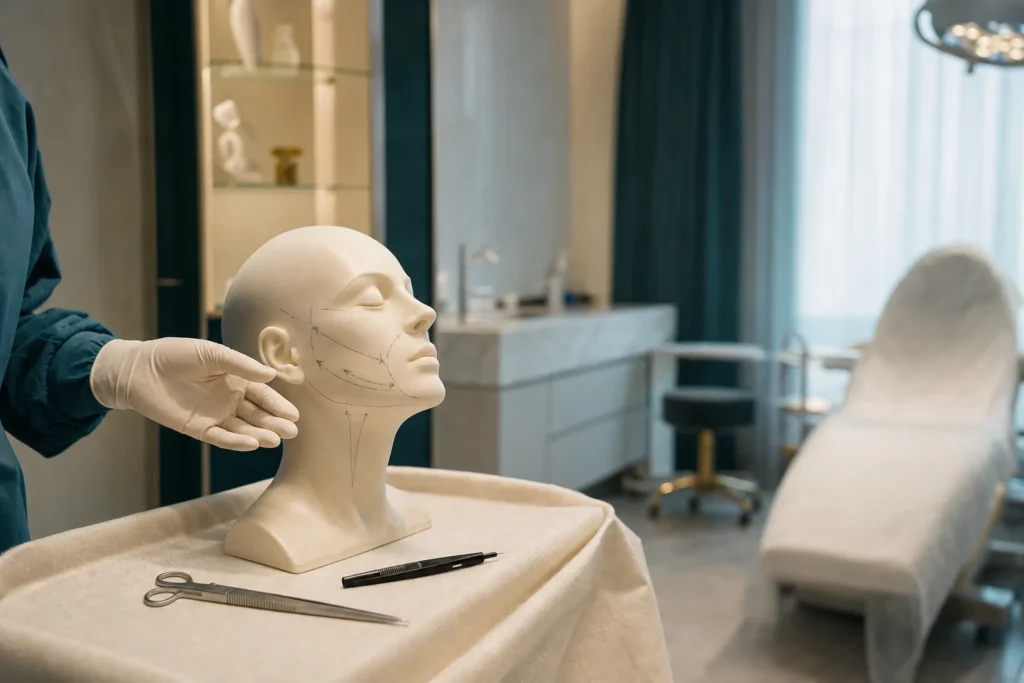
Face / neck lift
A face or neck lift is a surgical procedure that repositions and tightens the deeper soft tissues of the face and neck to soften the visible signs of ageing. It does not stop the ageing process or change the underlying quality of your skin. This guide explains the main techniques, who is suited to surgery, what recovery involves, the risks reported in the medical literature, and how to choose a qualified surgeon, including practical considerations if you are weighing up treatment abroad in countries such as Turkiye.
- Anaesthesia
- General anaesthesia or intravenous (IV) sedation, depending on the technique and extent of surgery.
- Duration
- Roughly 2 to 5 hours for a full face and neck lift; a brow lift alone typically takes 1 to 3 hours.
- Recovery
- Most bruising and swelling settles over about 2 to 3 weeks; many people return to non-strenuous work in 2 to 3 weeks (sooner for a mini-lift), with strenuous exercise avoided for at least 3 weeks and full settling over several months.
- Hospital stay
- Usually performed as a day case or with a single overnight stay; some procedures need no hospital admission, depending on the surgeon and facility.
What a face and neck lift is
A facelift, known medically as a rhytidectomy, is a surgical procedure that improves visible signs of ageing in the face and neck by repositioning or removing skin, fat and muscle. According to Cleveland Clinic, it works by lifting and tightening the deeper structures, not simply pulling the skin tighter.
Modern facelifts focus on a layer beneath the skin called the SMAS (the superficial musculoaponeurotic system) and, in the neck, the platysma muscle. The American Society of Plastic Surgeons (ASPS) explains that the deep-plane technique works below the SMAS and releases some of the supporting ligaments of the face.
It is important to be realistic about what surgery can and cannot do. A lift repositions sagging tissue and softens jowls, deep folds and neck banding, but Cleveland Clinic is clear that it cannot stop the ageing process, and it does not change the texture, sun damage, fine lines or pigmentation of the skin itself. Those concerns are usually addressed separately with skincare, resurfacing or other non-surgical treatments. Facelift remains one of the more commonly performed facial cosmetic procedures.
Who is a candidate (indications and contraindications)
Cleveland Clinic describes the ideal candidate as someone who is physically healthy, does not smoke, has realistic expectations, and still has some skin elasticity. Suitability depends far more on individual anatomy and health than on age alone.
You may be a candidate if you have one or more of the following:
- Sagging in the mid-face and cheeks
- Jowls along the jawline
- Loose skin and fat under the chin and neck
- Vertical neck bands or a poorly defined jaw-neck angle
- A heavy, hooded or low brow contributing to a tired appearance
Surgery may be less suitable, or carry higher risk, if you smoke, have poorly controlled high blood pressure, a bleeding tendency, or any medical condition that affects your body's ability to heal. The published literature is clear that smoking sharply raises the risk of wound-healing problems: a review of facelift complications reported that active smokers were roughly 12 times more likely than non-smokers to suffer skin death (skin slough). Many surgeons therefore ask patients to stop smoking well before surgery. Unrealistic expectations, body dysmorphic concerns and an inability to take adequate recovery time are also reasons to reconsider.
Types and techniques
There is no single facelift. The right approach depends on which areas are affected and on your individual anatomy. ASPS emphasises that the best technique is individualised rather than one-size-fits-all.
- SMAS facelift. A well-established technique in which the skin is lifted and the SMAS layer beneath it is tightened and repositioned, then excess skin is trimmed. It addresses jowls and the lower face well.
- Deep-plane facelift. ASPS describes this as going below the SMAS and releasing some of the supporting ligaments of the face, allowing the mid-face, cheek pads and jawline to be repositioned as a unit. A peer-reviewed review of facelift complications reports lower rates of skin necrosis with deep-plane than with subcutaneous techniques.
- Mini-lift. A more limited procedure with shorter incisions, suited to milder jowl and lower-face laxity. Recovery is generally quicker than a full lift.
- Neck lift (platysmaplasty). Cleveland Clinic describes this as tightening the platysma muscle, removing excess fat and trimming loose skin to restore the neck and jawline. It is often done together with a facelift, since the face and neck age together.
- Endoscopic brow lift. Through a few short incisions hidden in the scalp, a small camera (endoscope) lets the surgeon lift the brow and forehead with minimal scarring. It addresses forehead creases, frown lines and sagging, hooded brows.
These procedures are frequently combined. Brow and eyelid surgery (blepharoplasty) are commonly performed alongside a facelift so that the upper, mid and lower face are balanced.
How it is performed (anaesthesia, steps and duration)
A face or neck lift is performed under general anaesthesia or IV sedation, as Cleveland Clinic notes. Many lifts are carried out as a day case or with a single overnight stay, and some are performed in an accredited operating room without hospital admission, depending on the surgeon and facility.
The broad steps are similar across techniques:
- Anaesthesia is administered.
- Incisions are made. For a facelift these usually run near the sideburn, around the ear and into the hairline; a neck lift adds a small incision under the chin; an endoscopic brow lift uses a few short scalp incisions.
- The SMAS (and, in the neck, the platysma) is repositioned and tightened, fat is removed or repositioned, and ligaments may be released in a deep-plane approach.
- Excess skin is trimmed and incisions are closed with stitches, skin adhesive or, in some cases, dissolvable sutures. A small drain and a supportive dressing may be placed.
Operating time varies with the combination of procedures. A brow lift alone takes roughly 1 to 3 hours according to Cleveland Clinic; a full face and neck lift commonly takes several hours.
Recovery timeline
Recovery is gradual, and the figures below are typical ranges drawn from Cleveland Clinic and ASPS rather than guarantees. Your own timeline depends on the procedure and how your body heals.
- First few days. A supportive dressing and sometimes a drain are in place; these are usually removed within a few days. Swelling and bruising are most pronounced now. Keeping the head elevated helps; ASPS advises against applying ice to the neck after a neck lift, as it can compromise blood flow.
- Week 1. Stitches are often removed around a week. Comfort improves steadily.
- Weeks 2 to 3. Cleveland Clinic notes bruising and swelling generally last about two to three weeks. Most people return to non-strenuous work in this window after a full lift; a mini-lift may allow a return in roughly 5 to 7 days.
- From 3 weeks. Strenuous exercise is typically avoided for at least three weeks.
- Several months. The face feels back to normal over a few months, with minor residual swelling resolving gradually; Cleveland Clinic notes forehead healing after a brow lift can continue for up to about six months.
Incision scars are permanent, but are usually placed within the hairline and natural creases around the ear so they are well concealed over time.
Risks and complications
A face or neck lift is major surgery and carries genuine risks. The figures below come from a peer-reviewed review of facelift complications and from major clinics; they describe averages and do not predict your individual outcome.
- Bleeding under the skin (hematoma) is the most common significant complication. A review reported an expanding-hematoma incidence of about 1.8%. Reported risk factors include higher blood pressure, male sex, aspirin or NSAID use, and smoking. It can occur within the first 24 hours and occasionally needs a further procedure.
- Skin necrosis (skin slough) is reported in about 3.6% of subcutaneous facelifts versus under 1% with deep-plane technique, and is markedly more likely in smokers.
- Nerve injury. Temporary numbness is common. The great auricular (sensory) nerve is the most commonly injured, with a reported incidence as high as 7%. Motor-nerve injury is less common; permanent dysfunction of the frontal branch is reported at approximately 0.1%.
- Infection is uncommon, with a reported incidence well under 1% (about 0.89% in one large database review).
- Other risks include scarring, temporary or permanent hair loss near incisions, prolonged swelling, asymmetry, changes in sensation and, as with any surgery, deep vein thrombosis (DVT).
Cleveland Clinic notes serious complications such as nerve injury are rare, and that stopping smoking before surgery reduces healing complications.
Results and longevity
A well-performed face and neck lift can produce long-lasting results, but it does not freeze your appearance in time. Cleveland Clinic states facelift results usually last around seven to ten years, and that you will continue to age after surgery. You age naturally afterwards, just from a refreshed starting point.
Longevity depends on factors largely outside the operation itself: genetics, skin quality, sun exposure, weight changes, smoking and overall lifestyle. Because a lift repositions tissue rather than improving skin texture, many patients combine surgery with ongoing skin care, sun protection and, where appropriate, non-surgical treatments to maintain the result. Some choose a second, smaller procedure years later. Realistic expectations are central to satisfaction: the goal is a natural, rested look rather than a dramatic or unchanging one.
Costs (ranges, factors and disclaimer)
Cost varies widely by country, surgeon, technique and how many procedures are combined. The figures here are indicative ranges, not a quote, and your actual price depends on your individual case, surgeon and clinic.
In the United States, ASPS reports the average surgeon's fee for a facelift is $11,395. ASPS is explicit that this figure does not include anaesthesia, operating-room facilities or other related expenses, so the total is considerably higher once those are added.
Publicly reported, indicative pricing for a facelift in Turkiye commonly falls in the region of EUR 3,000 to EUR 6,000, often advertised as all-inclusive packages bundling surgery, anaesthesia, hospital stay and aftercare; deep-plane procedures tend to sit at the higher end. These are advertised package figures, not quotes, and a lower headline price should never be the only deciding factor.
Key factors that move the price include:
- Technique (mini-lift vs SMAS vs deep-plane) and number of areas treated
- Whether a neck lift, brow lift or eyelid surgery is combined
- Surgeon experience and accreditation
- Anaesthesia type, facility fees and length of stay
- Country and city
Always ask for an itemised breakdown so you understand exactly what is and is not included. The figures above are indicative and not a personal quote.
Why Turkiye, and choosing a qualified surgeon
Turkiye (Turkey) is a major destination for facial surgery, attracting international patients with experienced surgeons, modern private hospitals and prices often below those in much of Western Europe and North America. As with any country, quality varies between providers, and the most important decision is not where you go but who operates on you.
The qualification of the surgeon matters more than any marketing claim. Verify credentials independently rather than relying on a clinic website:
- Board certification in plastic, reconstructive and aesthetic surgery in their country. In Europe, look for the title FEBOPRAS (Fellow of the European Board of Plastic, Reconstructive and Aesthetic Surgery) and check the surgeon's name against the EBOPRAS records.
- ISAPS membership. The International Society of Aesthetic Plastic Surgery operates a public directory of members; confirm the surgeon appears as an active member.
- Confirm the surgeon, not a technician, will perform the operation, and ask about the accreditation of the facility.
- Ask to see consistent before-and-after photos and to speak to the surgeon directly before committing.
Patient-safety bodies such as the NHS advise weighing potential savings against potential risks when considering cosmetic surgery abroad, and stress thorough research on both surgeon and clinic. Pay particular attention to what aftercare is provided once you return home, as complications can arise after travel.
Preparing and what to ask at your consultation
Good preparation reduces risk and improves your experience. In the weeks before surgery you will typically be asked to stop smoking, avoid aspirin and certain anti-inflammatory drugs and supplements that increase bleeding, arrange time off and organise help at home for the first days.
Use the consultation to ask focused questions:
- Are you board-certified in plastic surgery, and are you a FEBOPRAS or ISAPS member I can verify?
- Which technique do you recommend for my anatomy, and why (SMAS, deep-plane, mini-lift)?
- Should a neck lift, brow lift or eyelid surgery be combined?
- What type of anaesthesia will be used, and where will I stay overnight?
- What are my specific risks, including for hematoma and nerve injury, and how are they managed?
- What does recovery look like week by week, and what aftercare is included?
- What is the total itemised cost, and what happens if a complication occurs?
Be honest about your medical history, medications and expectations. A reputable surgeon will sometimes advise against surgery or a particular technique, and that candour is a good sign.
Aftercare, follow-up and travelling for surgery
Aftercare is part of the treatment, not an afterthought. Follow your surgeon's instructions on dressings, wound care, sleeping with the head elevated, medication and activity restrictions. Attend all follow-up appointments so healing and any early problems can be checked. Report increasing pain, swelling on one side, fever or bleeding promptly, as a hematoma usually appears within the first 24 hours.
If you travel for surgery, plan the journey carefully. Both surgery and long flights can independently raise the risk of deep vein thrombosis (DVT), and this risk is generally highest in the early weeks after an operation. General guidance for facial procedures is to wait at least 7 to 10 days before flying and to delay long-haul travel longer, but you should fly only once your own surgeon has cleared you. Stay mobile during travel, walk regularly, stay hydrated and consider compression stockings as advised.
Before booking, confirm how long you should remain near the clinic after surgery, who will manage your aftercare once home, and how you would access care if a complication develops after you leave. A clear, written aftercare plan is one of the strongest signs of a responsible provider.
Frequently asked questions
What is the difference between a SMAS and a deep-plane facelift?
Will a facelift stop me from ageing?
Does a facelift improve the neck, or do I need a separate neck lift?
How long is recovery after a face and neck lift?
What is the most common complication of a facelift?
Will I have visible scars?
How much does a facelift cost?
How do I check that a surgeon abroad is qualified?
When is it safe to fly after a facelift?
Is an endoscopic brow lift very different from a facelift?
Can smoking affect my result?
This article is for general information only and is not medical advice. Always consult a qualified doctor about your individual case.
Considering this procedure?
Send us your photos and questions. A BergemHealth coordinator and a department-head specialist will review your case and reply with honest, personalised guidance — no obligation.
Free consultation