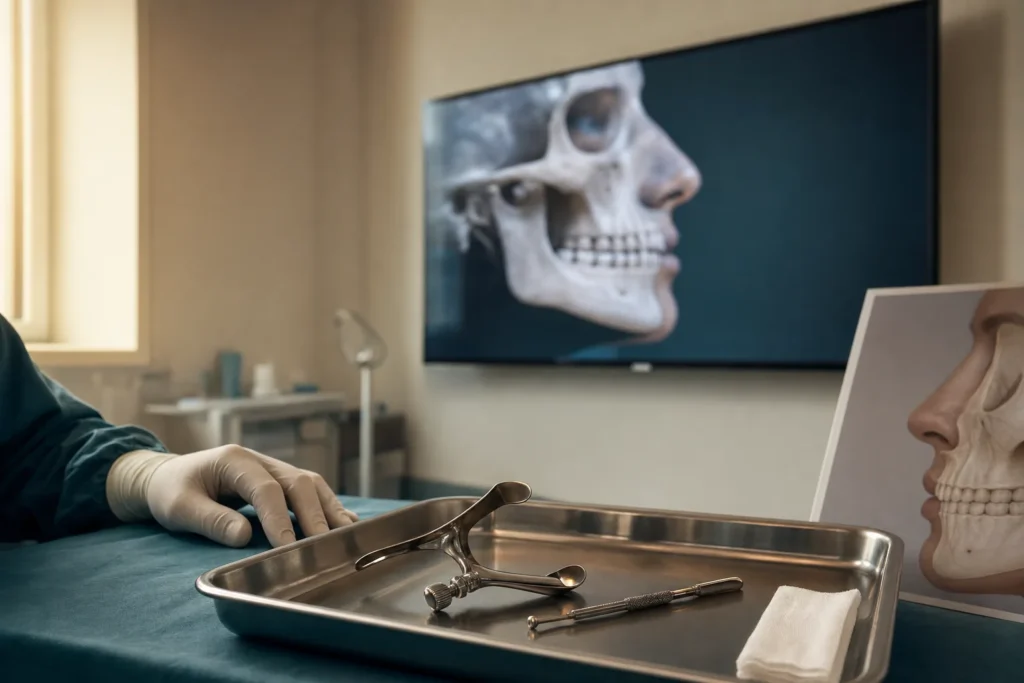
Rhinoplasty
Rhinoplasty, often called a nose job or nose reshaping, is surgery that changes the shape, size or proportions of the nose. It can be performed for cosmetic reasons, to improve facial balance, or for functional reasons, such as correcting a structural problem that affects breathing. This guide explains the main techniques, the typical recovery timeline, the risks, realistic results, indicative costs and how to choose a qualified surgeon, including considerations for patients travelling to Turkiye (Turkey) for treatment.
- Anaesthesia
- General anaesthesia, or local anaesthesia with intravenous sedation
- Duration
- About 1.5-3 hours
- Recovery
- External splint about 7 days; bruising/swelling settle over 2-3 weeks; final nasal shape refines up to ~12 months
- Hospital stay
- Day case or 1-2 nights, depending on the procedure and clinic
Minimum price, for reference only — the final cost is calculated individually after your records are reviewed. You pay the hospital’s price; our service is free for you.
What is rhinoplasty?
Rhinoplasty is surgery to reshape the nose. Sometimes called a nose job or nose reshaping, it can change the size of the nose, the width of the bridge, the shape of the tip or nostrils, or the angle between the nose and upper lip. Surgeons broadly divide rhinoplasty into two purposes.
- Cosmetic rhinoplasty changes the appearance of the nose to improve facial harmony and proportion.
- Functional rhinoplasty restores nasal form and function, for example after injury or to help breathing affected by a structural problem. When the internal wall between the nostrils (the septum) is straightened at the same time, the procedure is called a septorhinoplasty.
Because the nose is a central facial feature with both an aesthetic and a breathing role, even small structural changes can affect both how the nose looks and how it works. For this reason rhinoplasty is widely regarded as one of the more technically demanding facial procedures.
Who is a candidate for a nose job?
Guidance from major plastic surgery bodies describes a suitable candidate as someone who has finished facial growth, is in good general health, is a non-smoker, and has realistic expectations and personal motivation rather than pressure from others. Because the facial skeleton is still developing in adolescence, surgeons usually wait until growth is complete before performing cosmetic rhinoplasty.
You may be a candidate if you wish to change the appearance of your nose, or if you have a functional problem such as a deviated septum or breathing difficulty after trauma. Several factors can make surgery less advisable or require extra caution.
- Smoking, which impairs healing and increases complication risk.
- Unmanaged health conditions or anything that increases anaesthetic risk.
- Unrealistic expectations, or seeking surgery to satisfy someone else.
- Ongoing facial growth in younger teenagers.
A thorough consultation, including assessment of your nasal anatomy, skin and breathing, is needed to confirm whether surgery is appropriate for you.
Types and techniques: open, closed, ultrasonic and more
There is no single rhinoplasty operation. The surgeon selects an approach and techniques based on your anatomy and goals.
- Closed rhinoplasty uses incisions hidden inside the nostrils, leaving no visible external scar. It is often used for more limited reshaping.
- Open rhinoplasty adds a small incision across the columella (the strip of skin between the nostrils), lifting the skin for fuller visibility. It is often chosen for major reshaping or tip refinement; there is typically more tip swelling than with a closed approach.
- Septorhinoplasty combines reshaping of the nose with straightening of a deviated septum to address both appearance and breathing.
- Ultrasonic (piezo) rhinoplasty uses high-frequency ultrasonic instruments to cut and reshape nasal bone. Reviews of the published evidence report that, compared with conventional instruments, piezoelectric osteotomy is associated with reduced post-operative swelling (oedema) and bruising (ecchymosis) in the early days after surgery.
- Ethnic rhinoplasty is reshaping that aims to preserve the patient's ethnic identity and facial character rather than impose a single ideal.
- Tip plasty focuses on refining the nasal tip alone.
- Revision (secondary) rhinoplasty corrects or improves the result of a previous operation and is generally more complex than a first-time procedure.
How is rhinoplasty performed?
Rhinoplasty is carried out under general anaesthesia, or in some cases local anaesthesia combined with intravenous sedation. The choice depends on the extent of surgery and the surgeon's and anaesthetist's assessment.
In broad terms, the surgeon makes the incisions (inside the nostrils for a closed approach, or with an additional small external incision for an open approach), then gently lifts the skin to access the underlying bone and cartilage. The framework is reshaped, which may involve reducing or adding to bone and cartilage. Augmentation, where needed, can use cartilage grafts taken from elsewhere, such as the septum or ear. If the septum is deviated, it is straightened. The skin is then redraped and closed with fine stitches.
A typical operation takes about 1.5 to 3 hours, though complex or revision cases can take longer. Internal packing and an external splint are usually applied to support the new structure while it begins to heal.
Rhinoplasty recovery timeline: what to expect week by week
Recovery happens in stages. Individual healing varies, but the following timeline reflects guidance from the NHS and major plastic surgery sources.
- First days: internal packing, if used, is usually removed within the first day or two. You can expect swelling, some bruising around the eyes, and a blocked feeling, and you may struggle to breathe through the nose for about a week.
- Around 1 week: the external splint and any non-dissolvable stitches are typically removed at about 7 days. The nose will look swollen at this stage.
- 2-3 weeks: bruising, swelling and redness largely fade over the first two to three weeks. Many people take up to 2 weeks off work. Light, non-strenuous activity is usually resumed within this period.
- 3-6 weeks: swimming may be possible at around 3 weeks, and strenuous exercise is usually safe again at about 4 to 6 weeks. Avoid contact sports and anything that risks a knock to the nose until your surgeon advises.
- Months to ~1 year: most visible swelling settles over the first few months, but subtle swelling can persist and the final nasal contour may take up to a year to fully refine, with swelling sometimes worse in the mornings during the first year. The tip is often the last area to settle.
Your surgeon will give individual instructions, which commonly include keeping the head elevated, avoiding blowing the nose, protecting the nose from the sun, and being careful with glasses while the bones heal.
Risks and complications of rhinoplasty
Rhinoplasty is generally considered safe when performed by an appropriately trained surgeon, but like all surgery it carries risks. These should be explained to you in full before you give consent. Recognised risks include the following.
- Anaesthesia risks.
- Infection, and poor wound healing or scarring.
- Nosebleeds and, less commonly, heavy or excessive bleeding.
- Change in skin sensation, such as numbness or pain.
- Difficulty breathing through the nose.
- Change to the sense of smell.
- Skin discoloration and persistent swelling.
- An unsatisfactory appearance that may not meet expectations.
- Nasal septal perforation (a hole in the septum), which is rare. Further surgery may be needed to repair it, and in some cases it cannot be fully corrected.
- The possibility of needing revision surgery.
A published systematic review of more than 11,000 rhinoplasty cases reported reoperation rates of around 2.7% for primary open rhinoplasty and 1.6% for primary closed rhinoplasty, with the difference between the two approaches not statistically significant. Other sources give higher figures: Cleveland Clinic estimates that about 15% of people need a follow-up (revision) operation. Reported revision figures vary between studies depending on how revision is defined and how long patients are followed.
Results and longevity: how long does a nose job last?
Rhinoplasty changes the underlying structure of the nose, so its effects are considered permanent. The reshaped framework does not revert, although the nose, like the rest of the face, continues to age over a lifetime.
It is important to set realistic expectations. The visible result evolves as swelling resolves, and the final refined shape may not be apparent until up to a year after surgery. Not every result fully matches the goal: across the literature, a proportion of patients consider or undergo revision surgery. Reported revision rates vary widely: one large systematic review found reoperation rates of about 1.6-2.7% after primary surgery, while Cleveland Clinic estimates that about 15% of people need a follow-up (revision) operation; figures depend on how revision is defined and how long patients are followed. Discussing achievable outcomes for your specific anatomy with your surgeon, ideally with the help of photographs, is the most reliable way to align expectations. Reputable surgeons avoid guaranteeing a specific outcome.
How much does rhinoplasty cost?
Rhinoplasty cost varies widely by country, surgeon experience, the complexity of the procedure (for example primary versus revision, or whether functional work is included), and what the quoted price covers. Headline figures often exclude anaesthesia, operating-theatre facilities, implants or grafts, and follow-up care, so it is essential to compare like with like.
- In the United States, the American Society of Plastic Surgeons reports an average surgeon's fee of about $7,637, which explicitly does not include anaesthesia, facility costs or other related expenses.
- In the United Kingdom, the NHS indicates that private rhinoplasty typically costs around £4,000 to £7,000, plus the cost of consultations and follow-up care.
- In Turkiye, publicly reported package prices are generally lower, with indicative ranges commonly cited from around EUR 2,500 up to roughly EUR 8,000 or more for complex cases. These figures are indicative only.
Prices vary by case, surgeon and clinic, and the ranges above are indicative, not quotes. Lower prices in some countries largely reflect structural differences such as lower overheads and exchange rates rather than a difference in the surgery itself. Always confirm in writing exactly what a quote includes, and be cautious of prices that seem unusually low.
Rhinoplasty in Turkey: why patients travel and how to choose a surgeon
Turkiye has become a major destination for cosmetic surgery, including rhinoplasty, owing to a large number of experienced surgeons, established private hospitals and generally lower costs than Western Europe and North America. Travelling abroad for surgery can be a reasonable option, but the priority should always be safety and surgeon qualifications rather than price alone.
When choosing a surgeon, wherever they practise, verify their credentials and accreditation rather than relying on marketing:
- Confirm the surgeon is a registered specialist plastic surgeon in their country, and look for recognised credentials such as EBOPRAS fellowship (the European Board of Plastic, Reconstructive and Aesthetic Surgery, whose official list of fellows can be searched on its website) or membership of bodies such as ISAPS. In the UK, surgeons should hold GMC registration and may belong to BAAPS or BAPRAS.
- Check whether the hospital or clinic is accredited, for example by Joint Commission International (JCI), which signals audited safety systems.
- Ask how many of your specific procedure the surgeon performs, and review genuine before-and-after photographs of their own patients.
- Ask directly about their complication and revision rates, and how complications would be managed.
These are the kinds of experience, expertise and trust signals that responsible patients and search engines alike value, and they matter even more when distance is involved.
Preparing for surgery and what to ask in consultation
Good preparation improves both safety and satisfaction. Before surgery you will usually have a detailed consultation and assessment. Surgeons typically advise stopping smoking, avoiding certain medications and supplements that increase bleeding (on medical advice), arranging time off, and organising help and transport for the recovery period.
Use the consultation to ask focused questions, such as:
- Are you a registered specialist plastic surgeon, and what are your qualifications and accreditation?
- How many rhinoplasties, and how many of my type, do you perform each year?
- Which technique do you recommend for me, and why (open or closed, and whether functional work is needed)?
- What results are realistically achievable for my nose, and can I see examples?
- What are the specific risks in my case, and what are your complication and revision rates?
- What does the price include, and what happens if I need revision surgery?
- What does aftercare and follow-up involve, especially if I am travelling?
Be wary of any surgeon who guarantees a particular result or pressures you to decide quickly.
Aftercare, follow-up and travelling for surgery
Aftercare is a critical part of a good outcome. You will normally have at least one follow-up to remove the splint and any stitches at around a week, and further reviews as healing progresses over the following months. Following your surgeon's instructions on activity, nose care, sun protection and medication supports healing and reduces complication risk.
If you travel abroad for rhinoplasty, plan the logistics carefully.
- Stay long enough after surgery for initial review and splint or stitch removal before flying home; your surgeon will advise when it is safe to fly, as air travel too soon after surgery and anaesthesia can carry risks.
- Plan follow-up care for when you return home, and agree in advance with your surgeon or clinic how reviews and any complications will be handled remotely or in person.
- Keep all medical records, operative notes and contact details so a local doctor can help if a problem arises.
- Allow time for swelling and bruising before any major commitments, remembering the final shape can take up to a year.
A reputable provider or concierge will help coordinate the stay, follow-up and clear lines of communication so that aftercare does not stop at the airport.
This article is for general information only and is not medical advice. It does not replace an individual consultation, diagnosis or treatment recommendation from a qualified doctor. Always discuss your specific circumstances, risks and options with an appropriately registered surgeon before making any decision about surgery.
Frequently asked questions
Is rhinoplasty the same as a nose job?
What is the difference between open and closed rhinoplasty?
What is septorhinoplasty?
How long is rhinoplasty recovery?
Is rhinoplasty painful?
What are the main risks of rhinoplasty?
Are rhinoplasty results permanent?
How often is revision (a second) rhinoplasty needed?
How much does a nose job cost?
Why is rhinoplasty cheaper in Turkey, and is it safe?
When can I fly after rhinoplasty if I have surgery abroad?
Can rhinoplasty improve breathing?
Sources
- American Society of Plastic Surgeons — Rhinoplasty: Risks and Safety
- American Society of Plastic Surgeons — Rhinoplasty Recovery
- American Society of Plastic Surgeons — Rhinoplasty Cost
- NHS — Nose reshaping (rhinoplasty)
- Cleveland Clinic — Rhinoplasty (Nose Job): Surgery, Recovery, Before & After
- Mayo Clinic — Rhinoplasty
- Layliev et al. — Rhinoplasty Complications and Reoperations: Systematic Review (PMC5205520)
- PubMed — Piezoelectric or Conventional Osteotomy in Rhinoplasty? A Systematic Review and Meta-Analysis
- NCBI/PMC — Piezosurgery vs Conventional Osteotomies: Post-Operative Oedema and Ecchymosis (Systematic Review)
- EBOPRAS — European Board of Plastic, Reconstructive and Aesthetic Surgery (Fellows list)
This article is for general information only and is not medical advice. Always consult a qualified doctor about your individual case.
Specialists in Plastic & Aesthetic Surgery
Doctors of the department we work with directly. Which doctor takes your case is decided after the specialists have reviewed your records — your coordinator confirms it, not this page.


Considering this procedure?
Send us your photos and questions. A BergemHealth coordinator and a senior specialist will review your case and reply with honest, personalised guidance — no obligation.
Free consultation