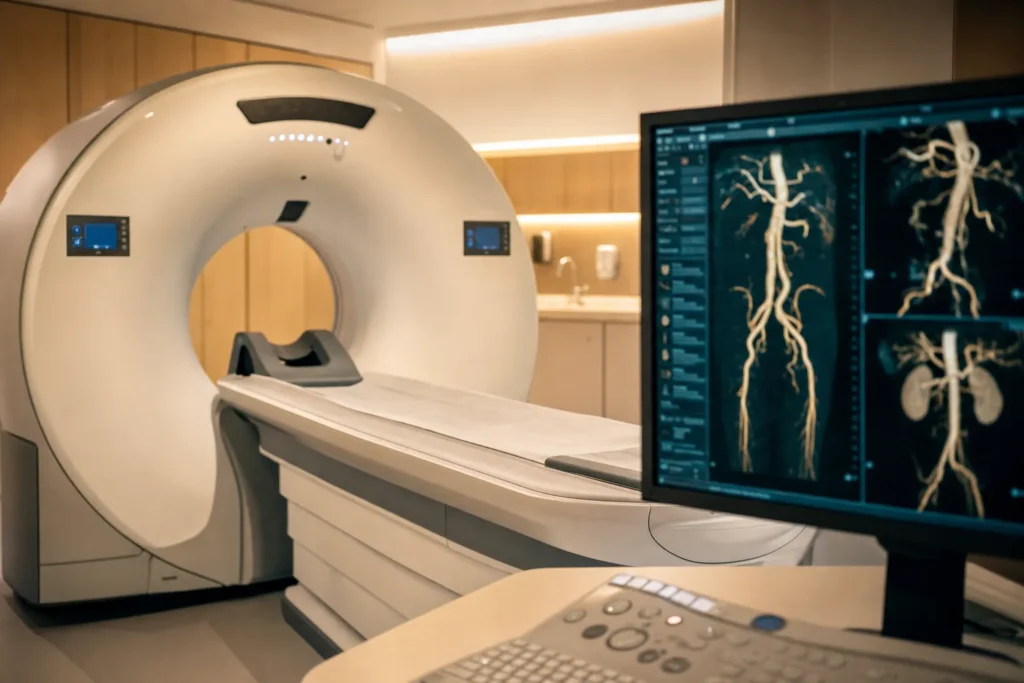
CT angiography
CT angiography, often shortened to CTA, is a quick scan that takes detailed pictures of your blood vessels using a CT machine and a special dye. It helps doctors find narrowings, blockages, bulges, and clots without surgery or a tube threaded into your arteries. This guide explains, in plain words, what the test involves, how it feels, what the results mean, and what to think about if you are considering having it done in Turkiye.
- Anaesthesia
- No anaesthesia or sedation; a small IV cannula is placed for the contrast dye
- Duration
- About 20-60 minutes in the room; the actual scan takes only 1-2 minutes
- Recovery
- Immediate; you can return to normal activities and are advised to drink plenty of fluids
- Hospital stay
- Outpatient; no overnight stay (around 30 minutes of observation if contrast is used)
Indicative hospital range, confirmed after your file is reviewed. You pay the hospital’s price — we add no markup.
What CT angiography is
CT angiography (CTA) is an imaging test that produces detailed pictures of your blood vessels. The name breaks down simply: CT stands for computed tomography, a scanner that takes many X-ray pictures from different angles, and angiography means imaging of blood vessels (an angio- is a vessel, -graphy means picturing it).
On an ordinary X-ray, blood vessels barely show up. So during a CTA, a healthcare professional injects a contrast dye (a liquid that shows up brightly on the scan) into a vein, usually in your arm. As the dye travels through your bloodstream, it makes your arteries and veins "light up" on the images. The scanner captures hundreds of thin, flat (2D) pictures, and a computer stitches them together into sharp 2D and 3D views of your vessels and the tissue around them.
Doctors order a CTA to look for problems such as narrowed or blocked arteries, aneurysms (a weak, bulging spot in a vessel wall), tears in a vessel, tangled or abnormal vessels, and blood clots. It is widely used because it is non-invasive: unlike traditional catheter angiography, no thin tube has to be threaded through your arteries, so it is faster and generally carries fewer risks.
Who is a good candidate (and who should be cautious)
Your doctor may suggest a CTA when there is a question about your blood vessels that other tests have not fully answered. Common reasons include:
- Chest pain where coronary artery disease (narrowing of the heart's own arteries) is possible but not certain.
- Suspected pulmonary embolism (a blood clot in the lungs).
- An aneurysm or a suspected aortic dissection (a tear in the wall of the body's main artery).
- Carotid artery disease (plaque buildup in the neck arteries that feed the brain) or assessment after a stroke or warning stroke.
- Peripheral artery disease (narrowed arteries in the legs or arms).
- Planning for surgery, stents, or valve procedures, and checking results afterwards.
CTA is not right for everyone. Tell your doctor and reconsider the contrast dye if you have severe kidney problems (the kidneys clear the dye, and weak kidneys may be strained by it), a history of a serious allergic reaction to iodine-based contrast, or if you are or might be pregnant (CT uses X-rays and is usually avoided in pregnancy unless truly necessary). Very large body size can be a limit because scanners have a weight and opening limit (often around 200 kg / about 450 lb). People with a very irregular or fast heartbeat may get blurry images on a heart CTA. None of these are absolute in every case, your medical team weighs the benefit of a clear diagnosis against the risk for you personally.
Types and techniques
A CTA can be aimed at almost any part of the body where blood vessels matter. The technique is broadly the same, but the focus and a few extra steps change depending on the target:
- Coronary CTA (CCTA) looks at the arteries supplying the heart. Because the heart is always moving, the scan is timed to your heartbeat using ECG (heart-tracing) stickers, and you may be given medicine to slow and steady your heart rate (see below).
- Head and neck CTA images the brain and carotid arteries, often after a stroke or to check for an aneurysm.
- Pulmonary CTA checks the lung arteries for clots.
- Aortic CTA looks at the body's main artery for bulges or tears.
- Peripheral CTA maps the arteries of the legs, arms, or kidneys.
Modern scanners with 64 or more detector rows produce the clearest pictures, especially for the fast-moving heart. Your radiologist may also create 3D reconstructions to view a vessel from any angle, which is helpful for surgical planning.
How it is done: anaesthesia, steps, and how long it takes
A CTA needs no general anaesthesia and no sedation. You stay awake the whole time. The only injection is the contrast dye through a small plastic tube (an IV cannula) placed in a vein in your hand or arm.
Here is the usual sequence:
- You change into a gown and remove jewellery, hairpins, glasses, and anything metal, which can blur the images.
- A nurse places the IV cannula. For a heart scan, ECG stickers go on your chest.
- You lie flat on a narrow table that slides into the doughnut-shaped scanner. Light lines may be projected onto your body to help with positioning.
- An automatic pump injects the contrast dye through the IV at a set speed. As it spreads, many people feel a brief wave of warmth, a flushing sensation, a metallic taste, or a passing urge to pass urine. These are normal and fade within a minute.
- The table moves slowly through the ring while the scanner makes buzzing and clicking sounds. You will be asked to hold your breath for a few seconds (often 5-15 seconds) so the pictures are sharp.
- When the images are done, the cannula is removed and a small plaster is applied.
The actual scanning takes only about 1-2 minutes, sometimes seconds. Counting check-in, positioning, the IV, and any heart-rate medicine, plan on roughly 20-60 minutes in the room.
For a coronary CTA, two extra medicines are common. A beta blocker (a tablet or injection) slows the heart so the pictures are crisper, and nitroglycerin (often a spray under the tongue) gently widens the coronary arteries so they show up better. You may be asked to avoid caffeine beforehand, since it can raise your heart rate.
Recovery, step by step
Recovery from a CTA is one of its biggest advantages, there usually isn't much to recover from. Because there is no incision and no sedation, most people walk out and carry on with their day.
- Right after the scan: If you received contrast dye, staff may ask you to wait around 30 minutes so they can make sure you have no delayed reaction to the dye.
- The rest of the day: You can eat, drive, and return to work or normal activities straight away. Drinking plenty of water helps your kidneys flush out the contrast dye.
- If you had heart-rate medicine: A beta blocker can leave you feeling a little light-headed when you stand, so get up slowly. Nitroglycerin can cause a short-lived headache that passes on its own.
- The cannula site: A small bruise where the IV was placed is common and fades within a few days.
There is no radiation left in your body after the scan, so you are not a risk to others, including children or pregnant people around you.
Risks and possible complications
CTA is considered a safe test for most people, and serious problems are uncommon. Still, it is worth understanding the main risks honestly.
- Reaction to the contrast dye. Most reactions are mild, such as itching, hives, flushing, or nausea. Moderate reactions (wheezing, a more severe rash, blood-pressure changes) are less common, and severe reactions (serious breathing difficulty, throat swelling, a big drop in blood pressure) are rare. Tell staff at once if you feel unwell. If you have reacted to contrast before, your doctor may give preventive medicine first.
- Effect on the kidneys. In people who already have significantly reduced kidney function, the dye can occasionally worsen it. That is why kidney function is often checked beforehand in at-risk patients (for example, those with kidney disease or diabetes).
- Radiation. A CTA uses X-rays. The dose from a single scan is small, but repeated scans over a lifetime can slightly add up. As a rough guide, a coronary CTA delivers an effective dose of roughly 8-9 millisieverts (mSv), and a chest CT around 6 mSv, compared with about 3 mSv of natural background radiation a year and about 0.1 mSv for a single chest X-ray. Doctors only order the scan when its benefit clearly outweighs this small risk.
- Dye leaking under the skin. Rarely, contrast can leak out of the vein at the injection site (called extravasation), causing temporary swelling or discomfort.
Tell your team beforehand about any allergies, kidney or thyroid problems, diabetes, asthma, heart conditions, the medicine metformin, and whether you could be pregnant or are breastfeeding.
Results and how long they last
A CTA is a diagnostic test, not a treatment, so its job is to give a clear picture, not to fix anything. A radiologist (a doctor specialised in reading scans) studies the images and writes a report for the doctor who sent you. In emergencies, such as chest pain in A&E, preliminary findings can be available very quickly; for routine scans, your doctor usually goes over the report with you at a follow-up appointment, often within days to a few weeks.
The images are a snapshot of your blood vessels at that moment, and they stay valid as long as your condition does not change. If you develop new symptoms, gain or lose significant weight, have a procedure, or start new treatment, your doctor may order another scan later to compare. There is no fixed "expiry date" on a CTA, your medical team decides if and when a repeat is useful.
Depending on what the scan shows, you might need no further action, a change in medication, lifestyle advice, or another test such as a stress test or a catheter procedure that can both confirm and treat a blockage.
Costs: indicative ranges and what changes the price
CT angiography is generally an affordable test, and prices in Turkiye are often lower than in Western Europe or North America. As a rough guide, a single CTA in a private Turkish hospital commonly falls in the region of EUR 150 to EUR 900, depending on the area scanned and the hospital.
Several things move the price within that range:
- Which body part is scanned and how many areas are covered (a single-region scan costs less than a whole-body vascular study).
- Whether it is a coronary CTA, which can involve extra heart-rate medicine, ECG gating, and more analysis.
- The scanner and protocol, and the amount of contrast dye used.
- The hospital's status (an internationally accredited private hospital may cost more than a basic clinic).
- Extras such as a consultation, blood tests for kidney function, and a written report in your language.
These figures are indicative only and not a quote. The actual price varies by case, by the doctor and clinic, and by what your scan includes. Always ask for a written, itemised quote that states exactly what is and is not covered before you commit.
Why people travel to Turkiye, and how to choose a safe clinic
Turkiye has become a major destination for medical care because it combines modern hospitals, experienced specialists, and competitive prices, often with short waiting times and English-speaking coordinators. Many large private hospitals there hold international accreditation, and the country is among the world leaders in the number of hospitals certified by Joint Commission International (JCI), a respected global standard for patient safety and quality.
A CTA is a low-risk test, but the value of the result depends on the quality of the equipment and, above all, the radiologist reading it. Before booking, it is sensible to verify:
- Hospital accreditation such as JCI, and a properly equipped radiology department with modern CT scanners (64-slice or higher for heart scans).
- The radiologist's qualifications and that the centre regularly performs CTA of the type you need.
- Clear, written pricing with no vague "package" gaps, and what happens if extra views or repeat scans are needed.
- How you will receive your results, ideally a full report in a language you read, plus the raw images on a disc or secure download so your home doctor can review them.
- Data protection and consent practices, and whether a local doctor reviews your medical history before the scan.
Be cautious of clinics that promise guaranteed findings, pressure you to decide quickly, or quote a price far below everyone else. A safe choice is transparent about its accreditation, its doctors, and its costs.
How to prepare and what to ask at your consultation
Good preparation makes a CTA smoother and the images clearer. Typical steps include:
- Fasting for a few hours beforehand if contrast is used, as your clinic instructs.
- Sharing your full medical history: allergies (especially to contrast or iodine), kidney or thyroid disease, diabetes, asthma, heart conditions, and all your medicines, including metformin.
- Telling them if you could be pregnant or are breastfeeding.
- For a heart scan, avoiding caffeine and certain medicines (your clinic will give a list, which may include some erectile-dysfunction drugs that interact with nitroglycerin).
- Wearing comfortable clothing and leaving metal items at home.
Helpful questions for your consultation:
- Why is a CTA the right test for me, and what are you hoping to find or rule out?
- Will contrast dye be used, and have my kidney function and allergies been checked?
- What is the radiation dose, and is there a non-X-ray alternative such as MRI angiography or ultrasound in my case?
- Who will read my scan, and when and how will I get the report and images?
- What is the all-in price, and what happens, and at what cost, if extra scans are needed?
- What might the next step be depending on the results?
Aftercare and travelling for treatment, including flying
Because a CTA is non-invasive and uses no sedation, aftercare is minimal. Drink plenty of fluids for the rest of the day to help clear the dye, watch the small cannula site for unusual swelling or redness, and report any delayed itching, rash, or breathing changes in the hours or days afterwards, as a small number of people have a delayed reaction to contrast.
For travellers, the practical question is usually when it is safe to fly. A CTA on its own does not require any waiting period before flying, there is no wound, no sedation, and no radiation left in your body, so flying the same day is generally fine for an otherwise well person. If you received a beta blocker for a heart scan, simply make sure any light-headedness has settled before you travel. Always follow the specific advice of the doctor who performed your scan.
The bigger planning point is the reason for the scan. A CTA often leads to a next step, more tests, a procedure, or a change in medication, so build in time to receive and discuss your results before flying home, and make sure you leave with a written report and a copy of your images. If the CTA is part of working up a more serious condition, ask your team whether any treatment that follows has its own travel or flying restrictions. Sharing your results with your doctor at home keeps your care joined up after you return.
Frequently asked questions
Is CT angiography painful?
How long does a CTA take?
What is the difference between a CTA and a regular angiogram?
Do I need anaesthesia or sedation?
Is the radiation from a CTA dangerous?
Can I have a CTA if I have kidney problems or diabetes?
What should I do to prepare?
How soon will I get my results?
Can I drive or fly after a CTA?
Is CTA safe while breastfeeding?
How much does CT angiography cost in Turkiye?
Will a CTA treat my blocked artery?
This article is for general information only and is not medical advice. Always consult a qualified doctor about your individual case.
Considering this procedure?
Send us your photos and questions. A BergemHealth coordinator and a department-head specialist will review your case and reply with honest, personalised guidance — no obligation.
Free consultation