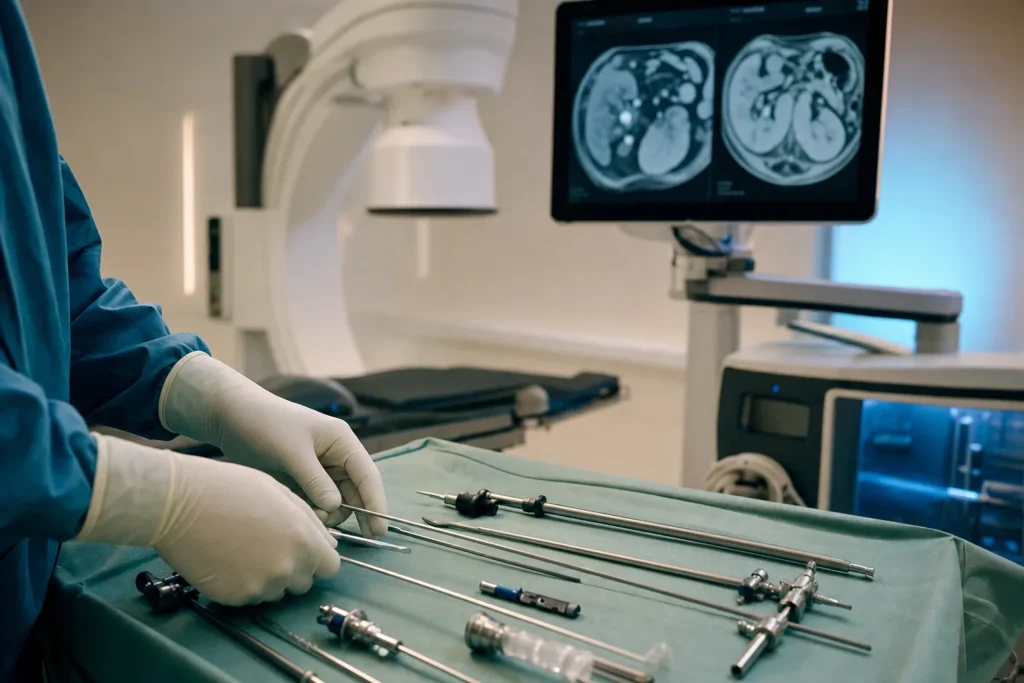
Kidney stones
Kidney stones are common, often very painful, and almost always treatable. This calm, plain-language guide explains what kidney stones are, why they form, the warning signs that need urgent attention, how doctors diagnose and treat them, and the practical steps you can take to lower the chance of another one. It is general information to help you have a better conversation with a qualified specialist, not a substitute for personal medical advice.
What kidney stones are
A kidney stone is a hard, pebble-like piece of material that forms inside a kidney. Your kidneys are two bean-shaped organs that clean your blood and make urine (pee). Urine carries away dissolved minerals and salts. When some of these substances become too concentrated, they can join together into tiny crystals, and over time those crystals can grow into a solid stone.
Stones can be as small as a grain of sand or, much less often, as large as a golf ball. Many small stones cause no trouble at all and pass out of the body in the urine without you ever noticing. Larger stones can get stuck as they travel down the ureter (the thin tube that connects each kidney to the bladder), and that is when the well-known severe pain usually begins.
Kidney stones are common. The NHS notes that more than 1 in 10 people are affected at some point, and they most often appear between the ages of about 30 and 60. The medical name for stone disease is nephrolithiasis (stones in the kidney) or urolithiasis (stones anywhere in the urinary tract). The good news is that, with the right care, kidney stones are highly treatable.
Types and subtypes of kidney stones
Not all kidney stones are made of the same material. Knowing the type matters, because it guides both treatment and how to prevent future stones. There are four main kinds.
- Calcium stones. These are by far the most common. Most are made of calcium oxalate, and some of calcium phosphate. Oxalate is a natural substance found in many foods and also made by the body. Having calcium stones does not usually mean you eat too much calcium.
- Uric acid stones. These form when urine is too acidic. They are more likely in people who eat a lot of animal protein, who lose too much fluid, who have gout, or who have certain other health conditions.
- Struvite stones. These are linked to long-lasting urinary tract infections (UTIs). They can grow quickly and become large, sometimes filling much of the kidney in a branched shape known as a staghorn stone, which usually needs surgery.
- Cystine stones. These are rare and run in families. They occur in people with an inherited condition called cystinuria, in which the kidneys leak too much of a substance called cystine into the urine.
A laboratory can analyse a stone once it has passed or been removed to tell you exactly which type you have. This single test is one of the most useful steps in preventing further stones.
Causes and risk factors
At its simplest, a stone forms when your urine contains more crystal-forming substances, such as calcium, oxalate and uric acid, than the fluid in your urine can dilute. At the same time, urine may lack substances that normally stop crystals from sticking together. The result is the slow build-up of a stone.
Several things make this more likely:
- Not drinking enough fluid. This is one of the biggest and most changeable risk factors. Less fluid means more concentrated urine.
- Diet. A diet very high in salt, animal protein or sugar can raise the risk, as can very high doses of vitamin C supplements.
- Family or personal history. If a close relative has had stones, or if you have had one before, your risk is higher.
- Certain medical conditions. These include gout, an overactive parathyroid gland (hyperparathyroidism), repeated urinary infections, inflammatory bowel disease, obesity, diabetes and some inherited disorders such as cystinuria.
- Some medicines. Long-term use of certain diuretics ("water tablets"), some antacids, certain anti-seizure drugs and some other medicines can play a part.
Men develop kidney stones somewhat more often than women. According to the U.S. National Institute of Diabetes and Digestive and Kidney Diseases (NIDDK), about 11 out of every 100 men and 6 out of every 100 women have a kidney stone at least once in their lives. Knowing your personal risk factors helps your doctor tailor a prevention plan.
Signs and symptoms, and when to see a doctor
A small stone sitting quietly in the kidney often causes no symptoms. Problems usually start when a stone moves into the ureter and blocks the flow of urine. Typical symptoms include:
- Severe pain in the side and back, below the ribs, that can spread to the lower belly and groin
- Pain that comes in waves and changes in intensity, sometimes called renal colic
- Pain or a burning feeling when you pass urine
- Pink, red or brown urine (blood in the urine)
- Cloudy or foul-smelling urine
- A frequent or urgent need to pass urine, often only small amounts
- Feeling sick (nausea) or being sick (vomiting)
The pain can be intense, but pain by itself is not usually dangerous. What matters is recognising the signs that need prompt medical attention.
Seek urgent medical care, or go to an emergency department, if you have:
- Pain so severe that you cannot get comfortable or sit still
- Pain together with a fever and chills, which can signal a serious infection
- Difficulty passing any urine
- Blood in your urine
- Severe nausea and vomiting
A fever with stone pain is the combination doctors worry about most, because a blocked, infected kidney is a medical emergency that needs treatment quickly.
Screening and early detection
There is no routine screening test for kidney stones for the general public, in the way there is for some other conditions. Most stones are found only when they cause symptoms or are spotted by chance on a scan done for another reason.
However, people who have already had a stone, or who have a strong family history or a known risk condition, can take a more proactive approach. After a first stone, many specialists recommend a set of tests, including blood tests and a 24-hour urine collection (where you collect all your urine over a full day so the laboratory can measure the substances in it). This is not screening in the usual sense, but it is a form of early detection that helps identify why stones are forming and how to prevent the next one.
If you are in a higher-risk group, the most useful early step is simply to talk to a doctor about your personal risk and what monitoring, if any, makes sense for you. Recurrence is common, so paying attention after a first stone is worthwhile.
How kidney stones are diagnosed
Diagnosis usually combines your symptoms, a physical examination and a few tests. Your doctor will ask about your pain, your diet, your fluid intake, any past stones and your family history.
Common tests include:
- Urine tests (urinalysis). These check for blood, crystals and signs of infection in your urine.
- Blood tests. These measure kidney function and levels of calcium, uric acid and other substances that can contribute to stones.
- Imaging. A CT scan (a detailed type of X-ray) is often the most accurate way to confirm a stone and show its exact size and location. An ultrasound (which uses sound waves and no radiation) is frequently used, especially for children and during pregnancy. A plain X-ray of the abdomen (sometimes called a KUB) may also be used, though not all stones show up on a plain X-ray.
- Stone analysis. If you pass a stone, you may be asked to catch it (for example, by straining your urine) so it can be analysed in the laboratory to find out exactly what it is made of.
There is no formal staging system for kidney stones as there is for cancer. Instead, doctors focus on the stone's size, location, type and whether it is blocking urine flow or causing infection. These details directly shape the treatment plan.
Treatment options
Treatment depends mainly on the size and position of the stone, the type of stone, how much pain it is causing and whether there is a blockage or infection. Care is often shared by a team that can include a urologist (a surgeon who treats the urinary system), a kidney doctor (nephrologist), radiologists, nurses and dietitians.
Letting a small stone pass on its own. Many small stones, especially those under about 4 to 6 millimetres, pass naturally in the urine within days to a few weeks. The Cleveland Clinic notes that the large majority of small stones pass without surgery. Management at home usually involves drinking plenty of fluid and using pain relief. Doctors sometimes prescribe a medicine called an alpha-blocker (such as tamsulosin) to relax the ureter and help the stone pass more easily. Anti-sickness medicines can help with nausea.
Procedures to break up or remove a stone. If a stone is too large to pass, is causing a blockage or infection, or simply will not move, several minimally invasive options exist:
- Shock wave lithotripsy (SWL/ESWL). A machine sends focused shock waves through the skin to break the stone into tiny fragments that can then pass in the urine. There is no cut, and it is usually done as a day procedure. More than one session is sometimes needed.
- Ureteroscopy. A very thin telescope is passed up through the urethra and bladder to reach the stone. The stone is broken up, often with a laser, and the pieces are removed. A small temporary tube called a stent is sometimes left in the ureter for a short time to keep it open and help healing.
- Percutaneous nephrolithotomy (PCNL). For large stones, including staghorn stones, the surgeon makes a small cut in the back and passes an instrument directly into the kidney to break up and remove the stone. This is the usual choice for the biggest stones.
Open or keyhole surgery. Traditional open surgery is now rarely needed and is reserved for unusual or complex situations.
Supportive and preventive care. Treating an infection with antibiotics, controlling pain, and starting a prevention plan are all part of good care. No medicine simply dissolves most existing stones, though medicines can help dissolve some uric acid stones and, importantly, can lower the chance of new ones forming.
Outlook: what to expect
For most people, the outlook after a kidney stone is good. The pain of passing a stone or having it treated is temporary, and modern, minimally invasive procedures are effective and widely available. The kidneys usually recover well once a blockage is relieved.
The main long-term issue is not the single stone but the tendency to form more. Recurrence is common: the National Kidney Foundation and NHS both note that around half of people who have had a kidney stone will form another within several years if no preventive steps are taken. The encouraging news is that this risk can often be reduced substantially with simple changes and, where needed, medicines.
Stones that are left untreated and keep blocking or infecting a kidney can, over time, damage kidney function, so they should not be ignored. But with timely treatment and good follow-up, serious complications are uncommon. These are general patterns seen in groups of people and are not a prediction for any individual; your own outlook depends on your stone type, your health and how closely you can follow a prevention plan. A qualified specialist can give you advice tailored to your situation.
Living with kidney stones and follow-up
Because stones tend to come back, living well with stone disease is mostly about prevention and staying alert to early signs. After your stone has been treated, your team may suggest a follow-up plan that can include:
- Stone analysis, if a stone was caught or removed, to identify the exact type
- Blood and 24-hour urine tests to understand why stones are forming in you specifically
- A personalised drinking and eating plan, often the single most powerful tool you have
- Occasional imaging, if you have a known stone still in place or a high risk of recurrence
Day to day, the most important habit is drinking enough fluid to keep your urine pale and plentiful. Many people benefit from keeping a water bottle nearby and spreading their drinking across the whole day, including the evening. It helps to learn your own early warning signs, such as a familiar twinge in the side, so you can seek advice promptly. If you have been given a stent after a procedure, your team will tell you when it will be removed and what sensations are normal in the meantime. Keep your follow-up appointments, even when you feel completely well, because prevention works best when it is steady and long-term.
Planning treatment abroad: what affects cost and how to prepare your records
If you are considering treatment for kidney stones in another country, it helps to understand what drives the overall cost so you can ask clear questions and get an accurate, personalised estimate. We do not list prices here because every case is different; instead, here are the factors that matter most.
- The type of procedure. Letting a small stone pass with medicine, shock wave lithotripsy, ureteroscopy with laser, and percutaneous surgery (PCNL) are very different in complexity and therefore in cost.
- The size, number and location of stones. A single small stone is simpler than multiple stones or a large staghorn stone, which may need more than one session.
- Tests and imaging such as CT scans, urine and blood tests, and stone analysis.
- Hospital time and anaesthesia, which depend on the procedure chosen.
- Extras such as a stent, its later removal, follow-up visits, medicines, and any treatment of infection.
- Travel and stay, including flights, accommodation, interpreting and local transport.
To get a reliable estimate, prepare your records in advance. Gather any recent scan images and reports (a CT or ultrasound on a disc or shared file is very valuable), your blood and urine test results, a list of your medicines and allergies, the results of any previous stone analysis, and a short written summary of your symptoms and history. Clear records let a specialist plan accurately and avoid repeating tests. The best next step is to request a free consultation for a personalised estimate based on your own situation, rather than relying on general figures.
Why Turkiye, and how to choose a good centre
Turkiye (Turkey) has become a well-known destination for medical care, including urology, with many modern hospitals, experienced specialists and established services for international patients. Turkey is among the countries with a large number of hospitals accredited by Joint Commission International (JCI), an independent body that assesses healthcare quality and patient safety to international standards.
Choosing a centre carefully matters more than choosing a country. Sensible things to verify include:
- Accreditation and licensing. Look for recognised accreditation such as JCI, and confirm the hospital and surgeons are properly licensed.
- A genuine urology team. Stone care is best delivered by a urologist working with a wider team, and the centre should offer the full range of treatments, from lithotripsy to ureteroscopy and PCNL, so the right option can be matched to your stone.
- Equipment and experience. Ask how often they perform the specific procedure you may need.
- Clear communication. Check that you can get information in a language you understand, with a written treatment plan and an itemised estimate.
- Follow-up arrangements. Ask what happens after you return home, including stent removal if relevant and how results will be shared with your local doctor.
Be cautious of any provider that promises guaranteed results or uses pressure to make you decide quickly. Good care is transparent, unhurried and tailored to you. We can help you compare suitable JCI-accredited hospitals and arrange a free consultation so you can make an informed choice.
Prevention and self-care
Prevention is where you have the most influence, and it can make a real difference, especially if you have had a stone before. The advice below is general; your specialist may adjust it once they know your stone type and test results.
- Drink plenty of fluid. This is the single most effective step for most stone types. NIDDK suggests aiming for roughly six to eight glasses of fluid a day for most people, enough to keep your urine pale, unless you have been told to limit fluids for another health reason. Water is ideal.
- Watch your salt. A high-salt diet raises the calcium in your urine, so cutting back on added salt and processed foods can help.
- Moderate animal protein. Large amounts of meat, poultry, fish and eggs can increase the risk of some stones.
- Get the right amount of calcium from food. Most people should not cut out dietary calcium, because adequate calcium in meals can actually help. Calcium supplements, however, should only be taken on medical advice.
- Be mindful of high-oxalate foods such as spinach, nuts and rhubarb if you form calcium oxalate stones, balancing them with calcium-containing foods rather than avoiding calcium.
- Keep a healthy weight and manage conditions such as gout or diabetes with your doctor.
Some people are prescribed preventive medicines, chosen according to their stone type, such as thiazide diuretics for some calcium stones, potassium citrate to make urine less acidic, or allopurinol for uric acid stones. If your stones keep coming back despite these steps, ask your doctor about more detailed testing and a referral to a specialist clinic. Steady, long-term habits, rather than short bursts of effort, are what keep stones away.
Frequently asked questions
How do I know if I have a kidney stone?
Are kidney stones dangerous?
How long does it take to pass a kidney stone?
Will I need surgery?
What is shock wave lithotripsy (ESWL)?
Can kidney stones come back?
What can I do at home to prevent kidney stones?
Should I cut out calcium to avoid stones?
How are kidney stones diagnosed?
Why might I get treatment in Turkiye, and how do I choose a hospital?
Does anything affect the cost of kidney stone treatment?
This article is for general information only and is not medical advice. Always consult a qualified doctor about your individual case.
Considering this procedure?
Send us your photos and questions. A BergemHealth coordinator and a department-head specialist will review your case and reply with honest, personalised guidance — no obligation.
Free consultation