Hearing loss & cochlear implants
If hearing has become harder for you or someone you love, you are far from alone, and there is a lot that can help. This guide explains hearing loss in everyday words and looks closely at one option for severe loss: the cochlear implant, a small electronic device that can open up the world of sound when ordinary hearing aids are no longer enough.
What hearing loss and cochlear implants are
Hearing loss simply means you cannot hear as well as someone with typical hearing. The World Health Organization describes typical hearing as a threshold of about 20 decibels (a way of measuring how soft a sound can be while you still notice it) in both ears. When your threshold is higher than that, sounds need to be louder before you catch them, and softer or higher-pitched sounds may slip past entirely.
Hearing loss ranges from mild to profound. Many people manage mild-to-moderate loss with hearing aids, which make sounds louder. But when loss is severe or profound and hearing aids no longer give enough clarity, a different tool may help: the cochlear implant.
A cochlear implant is a small electronic device that does something a hearing aid cannot. Instead of just amplifying sound, it bypasses the damaged parts of the inner ear and sends signals directly to the hearing nerve. The brain learns to read those signals as sound. Hearing through an implant is not identical to natural hearing, and it takes practice, but for many people it restores the ability to follow conversation and reconnect with the people around them.
This is a common situation: the WHO estimates that more than 430 million people worldwide currently need rehabilitation for hearing loss, and over a quarter of people older than 60 live with disabling hearing loss. You are in a very large group, and the path forward is well-travelled.
Types and subtypes of hearing loss
Doctors usually sort hearing loss into a few main types. Knowing which type you have matters, because it points to different treatments.
- Sensorineural hearing loss. This happens when the inner ear (the cochlea) or the hearing nerve is damaged. The cochlea is a snail-shaped, fluid-filled structure lined with tiny hair cells that turn sound vibrations into nerve signals. When those hair cells are worn out or damaged, the loss is usually permanent. This is the most common type in adults and the type that cochlear implants are designed for.
- Conductive hearing loss. Here sound cannot pass properly through the outer or middle ear, often because of earwax build-up, fluid behind the eardrum, or a hole in the eardrum. The good news is that this type can often be treated or reversed with medicine or surgery.
- Mixed hearing loss. A combination of the two above, where both the conducting parts and the inner ear are involved.
Loss can affect one ear (unilateral) or both ears (bilateral), and it can come on gradually over years or suddenly over hours or days. Sudden hearing loss should be treated as urgent, as you will read below.
Causes and risk factors
Hearing loss has many possible causes, and they vary across a person's life. According to the WHO and MedlinePlus, common ones include:
- Ageing. Age-related hearing loss (called presbycusis) is the most common reason older adults lose hearing, as the inner ear's hair cells gradually wear down.
- Noise. Long-term exposure to loud noise at work or through personal music players, and one-off very loud blasts, can permanently damage the inner ear.
- Genetics and family history. Some hearing loss is inherited.
- Infections and illness. Chronic ear infections, fluid build-up, meningitis (an infection of the membranes around the brain), and certain childhood infections can all harm hearing. In newborns, factors before or around birth, such as low birth weight or severe jaundice, can play a role.
- Medicines that can harm hearing (called ototoxic medicines), including some antibiotics and chemotherapy drugs.
- Earwax build-up and physical injury to the ear or head.
Importantly, the WHO estimates that nearly 60% of hearing loss in children comes from causes that could be prevented, for example through vaccination and safe-listening habits. Not every cause is preventable, but many are.
Signs, symptoms, and when to see a doctor
Hearing loss often creeps in so slowly that the people around you notice before you do. Common signs include:
- Asking others to repeat themselves often.
- Turning the television or phone volume up higher than others find comfortable.
- Struggling to follow conversation in noisy places like restaurants.
- Feeling that people are mumbling.
- Difficulty hearing on the phone or hearing higher-pitched voices, such as children's.
- Ringing or buzzing in the ears (tinnitus), or a sense of being cut off from conversations and feeling tired after social events.
It is sensible to arrange a hearing check if any of these sound familiar. Seek medical help promptly if hearing loss comes on suddenly, especially in one ear, or if it is accompanied by ear pain, discharge, dizziness, or ringing. Sudden hearing loss can sometimes be treated if seen quickly, so do not wait. Hearing problems left unaddressed tend to make communication harder over time, and addressing them earlier generally makes support easier to put in place.
Screening and early detection
For hearing, early detection is a real strength of modern healthcare. In many countries, newborn hearing screening is routine, so that babies with hearing loss can be identified and supported in the first weeks of life, which helps language development.
For adults, there is no single universal screening programme in the way there is for some other conditions, but hearing checks are widely available and quick. A good first step is simply to ask your doctor or an audiologist (a hearing specialist) for a hearing test, sometimes called audiometry. Because age-related loss is so common, many clinicians suggest that older adults have their hearing checked periodically, and certainly if they or their family notice any of the signs above. If you work around loud noise, regular workplace hearing checks are especially valuable.
The key message is reassuring: a hearing test is painless, fast, and the gateway to everything else. You cannot decide on the right treatment until you know exactly what kind and degree of loss you have.
How hearing loss is diagnosed
Diagnosis is a step-by-step process carried out by hearing and ear specialists. It usually includes:
- History and ear examination. The clinician asks about your symptoms and looks inside your ears to check for earwax, fluid, or eardrum problems.
- Audiometry (a hearing test). You listen to tones at different pitches and volumes through headphones and signal when you hear them. This maps the softest sounds you can detect, your hearing threshold, for each ear.
- Speech testing. You repeat words to measure how clearly you understand speech, not just whether you detect sound. A common measure is the percentage of single-syllable words you can correctly identify.
- Tympanometry and other tests to check how the eardrum and middle ear are working.
If severe or profound sensorineural loss is found and hearing aids are not giving enough benefit, the team may discuss a cochlear implant. Candidacy is assessed carefully. As an example, the Cleveland Clinic notes that speech-understanding scores at or below a defined level in the ear to be implanted are part of contemporary candidacy guidelines, and that criteria have broadened over time, including for older adults. Imaging scans (such as CT or MRI) are usually done before implant surgery to map the inner ear's anatomy.
Treatment options
There is a spectrum of help, and the right choice depends on the type and degree of loss. Care is best delivered by a multidisciplinary team, typically an ear surgeon (an otolaryngologist or neurotologist), an audiologist, and a speech-language pathologist, who work together from assessment through long-term follow-up.
For conductive loss, treatment may simply mean removing earwax, treating an infection, or surgery to repair the eardrum or middle ear.
For sensorineural loss, the mainstay is hearing aids, which amplify sound and suit a wide range of mild-to-severe loss. Assistive listening devices, captioning, and communication strategies add further support.
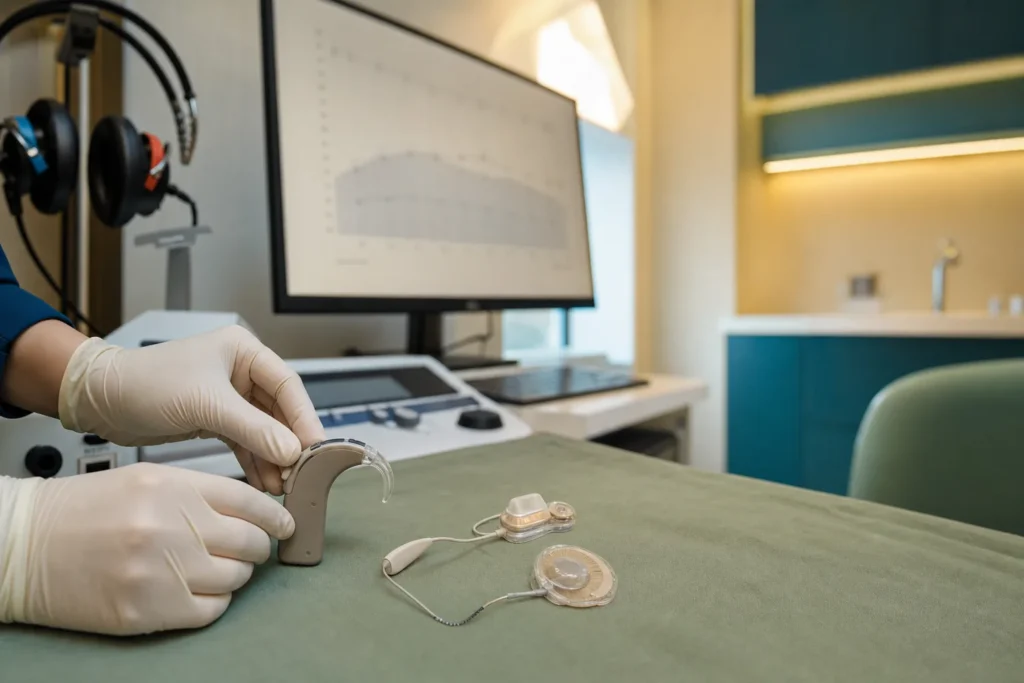
Cochlear implants come in when loss is severe-to-profound and hearing aids no longer provide enough clarity. The device has an external part worn behind the ear (a microphone, a speech processor that organises sound, and a transmitter) and an internal part placed under the skin during surgery (a receiver and a thin electrode array that is gently inserted into the cochlea). The surgery is performed under general anaesthesia. After the wound has healed, usually a few weeks later, the external processor is fitted and switched on, a session often called activation. From there, an audiologist fine-tunes the device over several appointments in a process called mapping or programming, adjusting it to your ears and comfort. Rehabilitation with a speech-language pathologist, sometimes called auditory training, helps your brain learn to interpret the new signals.
Outlook: what to expect
It helps to set honest, hopeful expectations. A cochlear implant does not recreate perfectly natural hearing, and the sound can seem unusual at first. But the NIDCD (the U.S. National Institute on Deafness and Other Communication Disorders) explains that the brain gradually learns to make sense of the signals, and that with time and practice many people gain a great deal, from awareness of everyday sounds to understanding speech, sometimes even on the telephone.
Outcomes vary from person to person and depend on factors such as how long the hearing loss has been present, the cause, and the effort put into rehabilitation. In children, early implantation can support language development, and the NIDCD notes that children implanted young can develop language skills at a rate comparable to children with typical hearing. These are general, population-level observations, not a prediction for any single person, and your own team is the right source for what you personally can expect.
Cochlear implant surgery is widely regarded as safe, and serious complications are uncommon. The technology is well established: as of December 2019 the NIDCD reported that roughly 736,900 implants had been placed worldwide.
Living with a cochlear implant and follow-up
An implant is a long-term partnership, not a one-off fix. In the first weeks and months after activation, you will attend regular appointments so the audiologist can fine-tune the programming as your brain adjusts. Practising actively, by listening to audiobooks, talking with patient family members, and following any auditory-training exercises, makes a real difference to how much benefit you gain.
Day to day, the external processor is removed at night and when bathing or swimming (unless you have a waterproof accessory), and it uses batteries that need charging or replacing. You will learn simple care routines and how to troubleshoot. Most everyday activities, work, and exercise are possible. There are a few practical points to know, such as letting healthcare staff know you have an implant before certain scans like MRI, and your team will give you a device card and guidance.
Support does not stop at the clinic door. Patient groups, sign-language and lip-reading classes, and workplace accommodations can all help. The WHO emphasises that rehabilitation and support enable people with hearing loss to take full part in education, work, and community life.
Planning treatment abroad: what affects cost and how to prepare your records
If you are considering having a cochlear implant abroad, it helps to understand what actually shapes the overall cost so you can ask the right questions and compare like with like. We do not publish prices here because every case is different; instead, here are the main factors that influence the total:
- One ear or both. A bilateral (both ears) implant naturally involves more than a unilateral (one ear) procedure.
- The device itself. Different manufacturers and processor models vary, and the choice is a clinical decision made with your surgeon and audiologist.
- Pre-operative testing such as audiology assessments and imaging scans (CT or MRI).
- Surgery and hospital care, including the surgical team, anaesthesia, and any inpatient stay.
- Activation, mapping sessions, and rehabilitation, which are an essential part of the journey and continue after surgery.
- Travel and accommodation for you and a companion, and the length of stay needed for follow-up appointments.
To prepare, gather your recent audiograms (hearing-test results), any speech-test scores, prior ear-surgery notes, a list of your medicines, and any imaging you already have. Clear, complete records help the team give you accurate guidance. For a personalised estimate tailored to your hearing, your goals, and the device options, the most reliable step is to request a free consultation so a specialist can review your case.
Why Turkiye, and how to choose a good centre
Turkiye has become a well-known destination for medical care, including ear, nose, and throat surgery, with a number of hospitals that hold international accreditation. The most widely recognised mark is JCI accreditation (Joint Commission International), an independent standard for quality and patient safety. JCI looks at how care is delivered across a hospital, including how teams communicate, document care, manage medication, and handle high-risk situations.
Whatever country you choose, a few practical checks protect you:
- Verify accreditation directly. Look the hospital up in the official JCI directory and confirm it is the same legal entity and address where your surgery will actually take place.
- Check the team. A cochlear implant programme should include an experienced implant surgeon, audiologists, and speech-language pathologists working together, not just an operating theatre.
- Ask for a written care pathway: the pre-operative tests, the surgery-day plan, post-operative monitoring, discharge criteria, and the schedule of activation and mapping appointments.
- Clarify aftercare. Ask who is responsible for follow-up, how mapping will continue once you return home, and how urgent problems are handled at a distance.
- Ask about emergency readiness, including intensive-care access and on-call cover.
A reputable centre will welcome these questions and answer them clearly. A medical-tourism concierge can help coordinate records, appointments, and logistics, but the clinical decisions always rest with you and the specialist team.
Prevention and self-care
While not all hearing loss can be prevented, a lot of it can, and good self-care protects the hearing you have. Helpful steps, drawn from WHO guidance, include:
- Protect against loud noise. Use ear protection around machinery or at loud events, keep personal music at safe volumes, and take listening breaks.
- Look after ear health. Treat ear infections promptly, keep up with recommended vaccinations (some infections that harm hearing are preventable), and avoid pushing objects into the ear canal.
- Use medicines wisely. If you are prescribed a medicine known to affect hearing, ask your doctor about monitoring.
- Get checked. Have your hearing tested if you notice any change, and attend newborn and childhood hearing checks where offered.
If you already use an implant or hearing aid, self-care also means keeping the device clean and charged, attending follow-up appointments, and practising listening so your brain gets the most from it. Small, consistent habits add up to better hearing health for years to come.
Frequently asked questions
What is the difference between a hearing aid and a cochlear implant?
Who is a candidate for a cochlear implant?
Does a cochlear implant restore normal hearing?
Is cochlear implant surgery safe?
What happens during and after the surgery?
How long does it take to hear well after activation?
Can both ears be implanted?
Is hearing loss preventable?
How do I prepare my records for treatment abroad?
How do I choose a good hospital in Turkiye?
This article is for general information only and is not medical advice. Always consult a qualified doctor about your individual case.
Considering this procedure?
Send us your photos and questions. A BergemHealth coordinator and a department-head specialist will review your case and reply with honest, personalised guidance — no obligation.
Free consultation