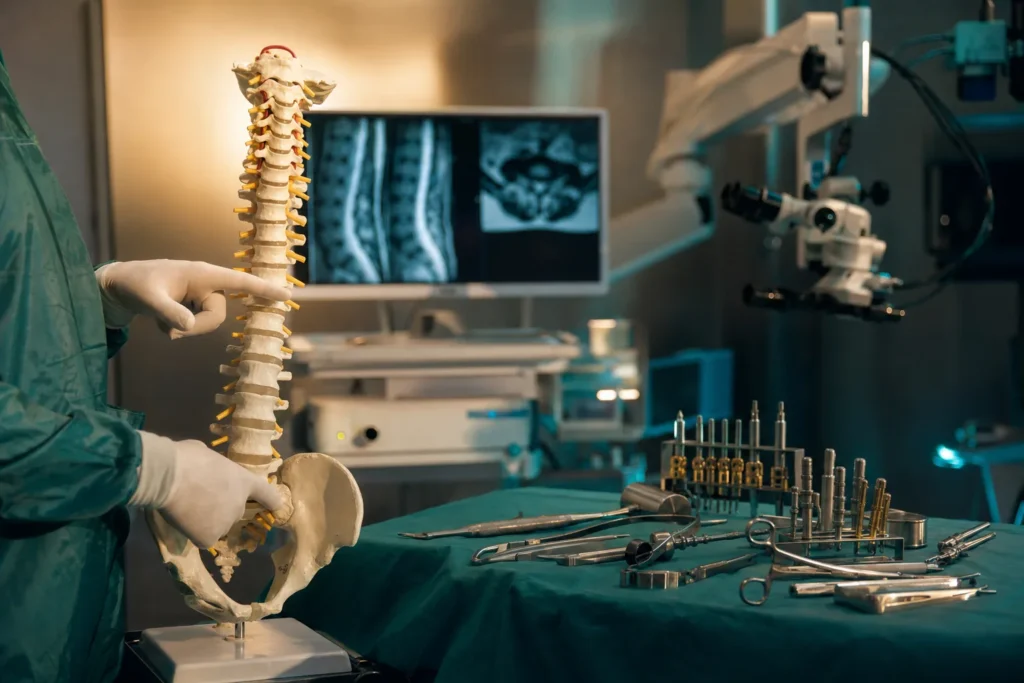
Herniated disc
A herniated disc is one of the most common causes of back, neck and leg pain, and the good news is that most cases settle without surgery. This guide explains in plain language what a herniated disc is, who needs treatment, how surgery works when it is needed, what recovery feels like, and what to check before travelling to Turkiye for care.
- Anaesthesia
- Usually general anaesthesia for microdiscectomy; some endoscopic procedures use spinal or local anaesthesia with sedation
- Duration
- Roughly 1 to 2 hours for a single-level microdiscectomy or discectomy
- Recovery
- Light activity within days; desk work in about 2 weeks; physical jobs and full activity over 6 to 12 weeks
- Hospital stay
- Often same-day or one overnight stay for a straightforward disc operation
Minimum price, for reference only — the final cost is calculated individually after your records are reviewed. You pay the hospital’s price; our service is free for you.
What a herniated disc is
Your spine is a stack of bones called vertebrae. Between each bone sits a small cushion, a disc, that works like a shock absorber and lets your back bend and twist. Each disc has a tough outer ring and a soft, jelly-like centre.
A herniated disc happens when that soft centre pushes through a tear or weak spot in the outer ring. You may also hear it called a slipped, prolapsed, bulging or ruptured disc. Nothing literally slips out of place; the wording just describes the soft material bulging where it should not.
The problem is usually not the bulge itself but what it presses on. The displaced material can push against a nearby nerve or the spinal cord, and that pressure (plus inflammation around it) is what causes pain, tingling, numbness or weakness. According to the Cleveland Clinic, more than 3 million people in the United States have a herniated disc each year, so this is a very common condition rather than a rare one.
Discs in the lower back (the lumbar spine) are affected most often, followed by the neck (the cervical spine). A herniated disc in the upper or mid back is uncommon.
Who is a good candidate (and who should wait or avoid surgery)
It helps to separate two questions: who is a candidate for treatment, and who is a candidate for surgery. Most people with a herniated disc never need an operation at all.
Typical symptoms that lead people to seek help:
- Pain that radiates from the lower back into the buttock and down one leg, often called sciatica.
- Neck pain that travels into the shoulder, arm, hand or fingers.
- Tingling, pins and needles, or numbness in a leg, foot, arm or hand.
- Muscle weakness, such as a foot that feels heavy or an arm that tires quickly.
Surgery is usually only considered when:
- Several weeks of non-surgical treatment have not helped and pain still limits daily life.
- There is progressive weakness or worsening numbness, suggesting nerve function is declining.
- An MRI clearly shows a herniation that matches the symptoms.
Who should avoid or postpone elective surgery: people whose pain is improving on its own, people with very mild symptoms, and those whose scan findings do not match their pain. Active infection, poorly controlled diabetes, smoking and significant heart or lung disease all raise surgical risk and may need to be managed first. Your surgeon will weigh these carefully.
One genuine emergency: the NHS advises calling emergency services if you develop numbness around the genitals or buttocks (the "saddle" area), cannot pass or control urine, or lose bowel control. These can signal cauda equina syndrome, where nerves at the base of the spine are severely compressed. It is rare, but it needs surgery within hours, not weeks.
Types and techniques
Treatment ranges from doing very little to several kinds of operation. Knowing the names helps you follow a consultation.
Non-surgical care is the starting point for almost everyone: staying gently active, pain relievers, anti-inflammatory medicine, occasionally muscle relaxants, physiotherapy, and sometimes a steroid injection around the irritated nerve (an epidural steroid injection) to calm inflammation.
Microdiscectomy is the most common surgery for a lumbar herniated disc. The surgeon removes only the small piece of disc pressing on the nerve, working through a small incision with a microscope or magnifying loupes. The aim is to relieve leg pain (sciatica) rather than to remove the whole disc.
Endoscopic discectomy is an even less invasive version using a thin tube and camera through a very small opening. Spine-Health notes it can sometimes be done under local anaesthesia and may involve a shorter operating time.
Laminotomy or laminectomy means removing a small part (or, less often, more) of the bony arch over the nerve to create space and relieve pressure.
Cervical (neck) procedures include anterior cervical discectomy and fusion (ACDF), where the disc is removed from the front of the neck and the two bones are joined, and artificial disc replacement, where the disc is replaced with a movable implant in suitable cases.
Spinal fusion permanently joins two vertebrae and is used when the spine also needs stabilising, not for a simple disc bulge.
How treatment is done, step by step
For the common case of a single-level lumbar microdiscectomy, here is roughly what to expect.
Anaesthesia. Most microdiscectomies are done under general anaesthesia, so you are fully asleep. Some endoscopic procedures can be performed under spinal or local anaesthesia with sedation, where the lower body is numbed but you stay awake.
The operation. You lie face down. The surgeon makes a small incision in the lower back, gently moves muscle aside, and uses a microscope to see the nerve and the herniated fragment. They remove the piece of disc pressing on the nerve and check that the nerve now has room. The skin is closed with stitches or surgical glue.
How long it takes. A single-level microdiscectomy or discectomy usually takes about one to two hours, though preparation, anaesthesia and waking up add time around it.
Hospital stay. Many disc operations are done as day surgery or with a single overnight stay. Larger procedures such as fusion may need a longer admission.
Spine-Health reports that people often feel leg-pain relief almost immediately after a microdiscectomy, although numbness or weakness can take longer to fade because the nerve itself needs time to recover.
Recovery, step by step
Recovery is gradual, and respecting the early limits protects the result.
First few days. Some soreness at the incision is normal. You will be encouraged to get up and walk short distances soon after surgery, because gentle movement helps healing and lowers the risk of blood clots. Walking little and often is the main exercise at this stage.
Weeks 1 to 2. Walking distance increases day by day. Many people doing desk-based work return in around two weeks, sometimes sooner, depending on comfort and how far they must travel or sit.
Weeks 2 to 6. Physiotherapy typically begins in this window to rebuild core and back strength. The common rule is to avoid heavy lifting, bending and twisting for about six weeks while the area heals.
Weeks 6 to 12 and beyond. Most people return to fuller activity, including physical jobs, over six to twelve weeks. Reports suggest full recovery can take up to about three months, and any residual nerve numbness may continue improving for several months more.
Throughout recovery, follow your own surgeon's instructions, which always override general timelines.
Risks and possible complications
Spine surgery is generally safe in experienced hands, but no operation is risk-free. It is worth understanding the possibilities so you can ask informed questions.
- Incomplete pain relief or symptoms that persist, particularly long-standing numbness or weakness that may not fully return.
- Recurrent herniation, where disc material herniates again at the same level, sometimes needing further surgery.
- Infection at the wound or, rarely, deeper.
- Bleeding or a collection of blood pressing on nerves.
- Dural tear, a small leak of the fluid surrounding the nerves, which is usually repaired during the operation.
- Nerve injury, which is uncommon but can cause weakness or numbness.
- Blood clots in the legs (deep vein thrombosis), which is why early walking and movement matter.
- Anaesthesia-related risks, which your anaesthetist will discuss.
Call your medical team if you notice spreading redness, fever, wound discharge, increasing weakness, or any loss of bladder or bowel control after surgery.
Results and how long they last
The most reassuring fact is that most herniated discs improve without surgery. Both the Cleveland Clinic and the American Association of Neurological Surgeons state that around 9 out of 10 people get better with non-surgical care, often within about four to six weeks.
When surgery is needed, microdiscectomy has a good track record for relieving leg pain. Spine-Health describes relatively high success rates, especially for sciatica, and notes that surgery can give greater symptom improvement than non-surgical care over the first couple of years in suitable patients.
Results are usually long-lasting, but surgery treats the current herniation rather than freezing the spine in time. Discs naturally age, and another disc can herniate later, so the same level can occasionally herniate again. Keeping a healthy weight, staying active, building core strength, lifting carefully and not smoking all help protect your back over the long term. There are no guarantees, and individual outcomes vary.
Costs and what changes the price
In Turkiye, indicative prices for herniated disc surgery commonly fall in the region of EUR 2,000 to EUR 7,000, depending on the procedure. Less invasive operations such as an endoscopic or microdiscectomy tend to sit at the lower end, while operations that include stabilising hardware or fusion cost more.
What moves the price:
- The technique used (endoscopic, microdiscectomy, laminectomy, fusion or artificial disc).
- Whether one level or several levels are treated.
- The implants or hardware needed, if any.
- The hospital, its accreditation and the surgeon's experience.
- Type of anaesthesia, length of hospital stay and post-operative physiotherapy.
- Pre-operative imaging and tests, and any package extras such as airport transfers, accommodation and a translator.
These figures are indicative ranges only. They vary by case, surgeon and clinic and are not a quote. Always ask for a written, itemised estimate that states exactly what is and is not included, and what would happen (and cost) if a complication required extra care.
Why people travel to Turkiye, and how to choose a safe clinic and surgeon
Turkiye has become a well-known destination for spine and orthopaedic care because it combines modern private hospitals, experienced surgeons and prices that are often lower than in Western Europe, the UK or North America. Many hospitals are set up for international patients with English-speaking staff and all-inclusive packages. Lower cost alone, though, should never be the deciding factor for spine surgery.
What to verify before you commit:
- Hospital accreditation. Look for international accreditation such as JCI (Joint Commission International), alongside the hospital's Turkish Ministry of Health licensing.
- Surgeon credentials. Confirm the surgeon is a board-certified neurosurgeon or orthopaedic spine surgeon, and ask how many of your specific procedure they perform each year.
- A clear diagnosis. A reputable clinic will review your MRI and symptoms before recommending surgery, and will be honest if non-surgical treatment is the better first step.
- Transparent, written pricing with a named contact, plus a clear plan for complications and follow-up.
- Realistic claims. Be cautious of any clinic promising guaranteed cures or pressuring you to decide quickly. Read independent reviews and ask to speak with the surgeon directly before travelling.
How to prepare and what to ask at your consultation
Good preparation makes surgery safer and recovery smoother.
Before you travel or operate:
- Gather your recent MRI scan, reports and a list of your medicines and allergies.
- Tell the team about blood thinners, diabetes, heart or lung conditions and any past surgery.
- If you smoke, stopping (even temporarily) helps healing and lowers complication risk.
- Arrange help at home for the first week or two, and plan how you will get to and from the airport without heavy lifting.
Questions worth asking:
- Is surgery truly necessary now, or should I try more non-surgical treatment first?
- Exactly which procedure are you recommending, and why?
- What are the realistic chances it will relieve my pain, and what may not improve?
- What are the main risks for someone with my health, and how often do they happen here?
- How long is the hospital stay, and when can I safely sit for long periods and fly home?
- What does the price include, and what happens if there is a complication?
- Who manages my follow-up once I return home?
Aftercare and travelling for treatment (including when it is safe to fly)
Travelling abroad for spine surgery adds one extra factor: the journey home. Sitting still for hours after an operation raises the risk of blood clots, so flying home too soon is not advisable.
General guidance on flying. Surgeons commonly advise waiting before flying after spine surgery, and the first four to six weeks after surgery carry the highest blood-clot risk because of the combination of recent surgery and prolonged sitting. Short flights may be possible earlier for a straightforward, well-healed microdiscectomy, but only your own surgeon can clear you based on your wound healing, pain control, mobility and nerve recovery. Plan to stay in Turkiye for the recovery period your surgeon recommends rather than booking a tight return.
To reduce clot risk on the flight: stay well hydrated, get up and walk when you can, do gentle ankle and leg movements in your seat, and consider compression stockings if advised.
Aftercare basics: keep the wound clean and dry, watch for signs of infection (spreading redness, fever, discharge), take medicines as prescribed, start physiotherapy when instructed, and avoid heavy lifting, bending and twisting during the early healing window. Make sure you leave with written instructions, a point of contact at the clinic, and a clear plan for follow-up with a doctor at home.
Frequently asked questions
What is the difference between a herniated, slipped and bulging disc?
Will my herniated disc heal without surgery?
What are the warning signs that need emergency care?
How long does microdiscectomy surgery take?
What type of anaesthesia is used?
How soon can I return to work after disc surgery?
When is it safe to fly home after surgery in Turkiye?
How much does herniated disc surgery cost in Turkiye?
Can a herniated disc come back after surgery?
What are the main risks of the operation?
How do I choose a safe clinic and surgeon in Turkiye?
Do I really need an MRI before surgery?
Sources
- Cleveland Clinic - Herniated Disk (Bulging Disk): Symptoms & Treatment
- Mayo Clinic - Herniated disk: Diagnosis and treatment
- Mayo Clinic - Herniated disk: Symptoms and causes
- NHS - Slipped disc
- American Association of Neurological Surgeons (AANS) - Herniated Disc
- Spine-Health - Microdiscectomy (Microdecompression) Spine Surgery
- Hospital for Special Surgery (HSS) - Microdiscectomy Surgery
- Joint Commission International (JCI) - Accreditation
This article is for general information only and is not medical advice. Always consult a qualified doctor about your individual case.
Specialists in Orthopaedics
Doctors of the department we work with directly. Which doctor takes your case is decided after the specialists have reviewed your records — your coordinator confirms it, not this page.



Considering this procedure?
Send us your photos and questions. A BergemHealth coordinator and a senior specialist will review your case and reply with honest, personalised guidance — no obligation.
Free consultation