Paediatric cardiology
If a doctor has mentioned your child's heart, or you have just heard the words "congenital heart disease", it is natural to feel frightened. This guide explains, in plain language, what paediatric cardiology covers, how heart problems in children are found and treated today, and what the journey often looks like. The reassuring reality is that medicine has changed enormously: most children born with a heart condition now grow up to live full lives. Knowing what to expect can make the road ahead feel a great deal more manageable.
What paediatric cardiology is
Paediatric cardiology is the branch of medicine that looks after the hearts of babies, children and teenagers. The doctors who work in it are called paediatric cardiologists, and they spend their careers understanding how a child's heart grows, beats and pumps blood, and what to do when something is not working as it should.
Most of their work centres on congenital heart disease. "Congenital" simply means "present at birth". As the NHS puts it, congenital heart disease is when a baby is born with a heart defect, such as a hole in the heart, that can affect the way blood flows around the body. The Cleveland Clinic describes it as "an issue with your heart's structure that's present at birth". These are problems with how the heart was built while the baby was developing in the womb, usually during the first few months of pregnancy.
This is the most common type of birth difference. The U.S. Centers for Disease Control and Prevention (CDC) reports that heart defects affect nearly 1% of births each year, which works out at about 40,000 babies a year in the United States. Many of these are mild and may never cause trouble; some need careful treatment. Paediatric cardiologists also see children with heart rhythm problems, heart muscle conditions and infections that affect the heart, but congenital heart disease is the heart of the speciality and the main focus of this guide.
One important point to hold on to from the start: as the Cleveland Clinic notes, about 90% of children born with a heart condition now survive into adulthood, compared with only about 10% decades ago. That is a measure of how far care has come.
Types and subtypes of heart conditions in children
There are many different types of congenital heart disease, and the names can sound overwhelming at first. Doctors group them in two helpful ways.
The first way is by how they affect oxygen in the blood. Acyanotic conditions usually keep oxygen levels in the blood near normal. Cyanotic conditions lower the oxygen level, which can make the skin and lips look blue or grey (this is called cyanosis). Knowing which group a condition belongs to helps the team plan care.
The second way is by what part of the heart is involved. Common examples, using the plain descriptions given by the CDC and MedlinePlus, include:
- Holes in the heart (septal defects). A hole in the wall between the two upper chambers is an atrial septal defect (ASD); a hole between the two lower chambers is a ventricular septal defect (VSD), the most common defect of all. An atrioventricular septal defect affects the valves and walls between upper and lower chambers.
- Patent ductus arteriosus (PDA), where a blood vessel that should close soon after birth stays open.
- Narrowed vessels or valves, such as coarctation of the aorta (part of the body's main artery is narrower than usual), or narrowing (stenosis) of the aortic or pulmonary valve.
- More complex (often cyanotic) conditions. Tetralogy of Fallot is a combination of four defects that limits oxygen in the blood pumped to the body. In transposition of the great arteries the heart's two main arteries are switched in position. Hypoplastic left heart syndrome means the left side of the heart is severely underdeveloped. Others include pulmonary atresia and tricuspid atresia (a heart valve that did not form), total anomalous pulmonary venous return (the lung veins join the heart abnormally), truncus arteriosus (a single vessel leaves the heart instead of two) and single ventricle conditions, where only one pumping chamber works properly.
The CDC notes that about 1 in 4 babies born with a heart defect has a critical heart defect, meaning one that usually needs surgery or a catheter procedure within the first year of life. The rest range from very mild to moderate.
Causes and risk factors
One of the first questions parents ask is "why did this happen?" The honest and important answer is that, in most cases, no one knows, and it is almost never caused by anything a parent did. The British Heart Foundation states plainly that in most cases we do not know why the heart has not developed normally, and the NHS agrees that often there is no clear reason.
That said, researchers have identified some factors that can make a congenital heart condition more likely. According to the NHS, Mayo Clinic, Cleveland Clinic and MedlinePlus, these include:
- Genetic factors. Sometimes a changed gene is passed from a parent, and heart defects are more common in children with certain chromosome conditions, such as Down syndrome.
- Conditions or infections during pregnancy. Diabetes that is present before pregnancy or develops early in it, and infections such as rubella (German measles) caught during pregnancy, can increase the risk.
- Things the baby is exposed to. Drinking alcohol or smoking in pregnancy, exposure to second-hand smoke, and certain medicines (for example some treatments for high blood pressure, cholesterol or severe acne) have been linked to higher risk.
- Other factors such as living with obesity in pregnancy, or a metabolic condition called phenylketonuria.
It is worth repeating: many babies with none of these factors are born with heart conditions, and many babies exposed to a risk factor have perfectly healthy hearts. A diagnosis is not a verdict on a parent.
Signs, symptoms and when to see a doctor
Symptoms depend entirely on the type of condition and how much it affects blood flow. Some children have no symptoms at all and the condition is found by chance. The Cleveland Clinic and MedlinePlus point out that one thing congenital heart defects generally do not cause is pain.
In babies, signs that the heart may be working too hard can include:
- A blue or grey tinge to the skin, lips or nails (cyanosis)
- Fast or laboured breathing, or getting breathless
- Tiredness, sleepiness, or sweating, especially during feeds
- Difficulty feeding or poor weight gain
- A weak pulse or poor circulation
- A heart murmur, an extra whooshing sound a doctor hears through a stethoscope
In older children, milder conditions may show up as getting out of breath or very tired during exercise, swelling, fainting, or a racing or irregular heartbeat (palpitations). The NHS notes that sometimes symptoms do not appear until the teenage or adult years.
A heart murmur on its own is very common in healthy children and is often harmless (an "innocent" murmur), so try not to assume the worst if a doctor mentions one. When to seek help: if your baby looks blue or grey, is breathing fast or struggling to breathe, is very floppy or unusually sleepy, or is feeding poorly, contact a doctor promptly; if a child suddenly turns blue, collapses or stops breathing, this is an emergency and you should call your local emergency number at once.
Screening and early detection
Good news for parents: there are well-established ways to find many heart conditions early, sometimes before a baby is even born.
During pregnancy. Many heart conditions can be spotted at the routine mid-pregnancy ultrasound scan (often around 18 to 22 weeks). If something looks unusual, you may be offered a more detailed scan of the baby's heart called a fetal echocardiogram, performed by a specialist. Finding a condition early means a plan can be in place for a safe delivery and immediate care.
After birth. The CDC describes pulse oximetry screening, a simple, painless bedside test in which a soft sensor on a newborn's hand or foot estimates the amount of oxygen in the blood. A low reading can flag a critical heart defect that needs urgent attention. Many maternity units now offer this routinely, and it has become an important safety net for catching conditions that might otherwise be missed in the first days of life. Newborn babies are also given a physical examination that includes listening to the heart.
It is important to understand that no screening test catches everything. Some conditions, especially milder ones, are not found until later, when a murmur is heard at a check-up or symptoms appear during childhood. That is one reason ongoing routine child health checks matter.
How heart conditions are diagnosed
If a heart condition is suspected, a paediatric cardiologist will use a combination of tests to understand exactly what is happening. None of the common tests is painful, and most are quick. Drawing on the NHS, Cleveland Clinic and MedlinePlus, the main ones are:
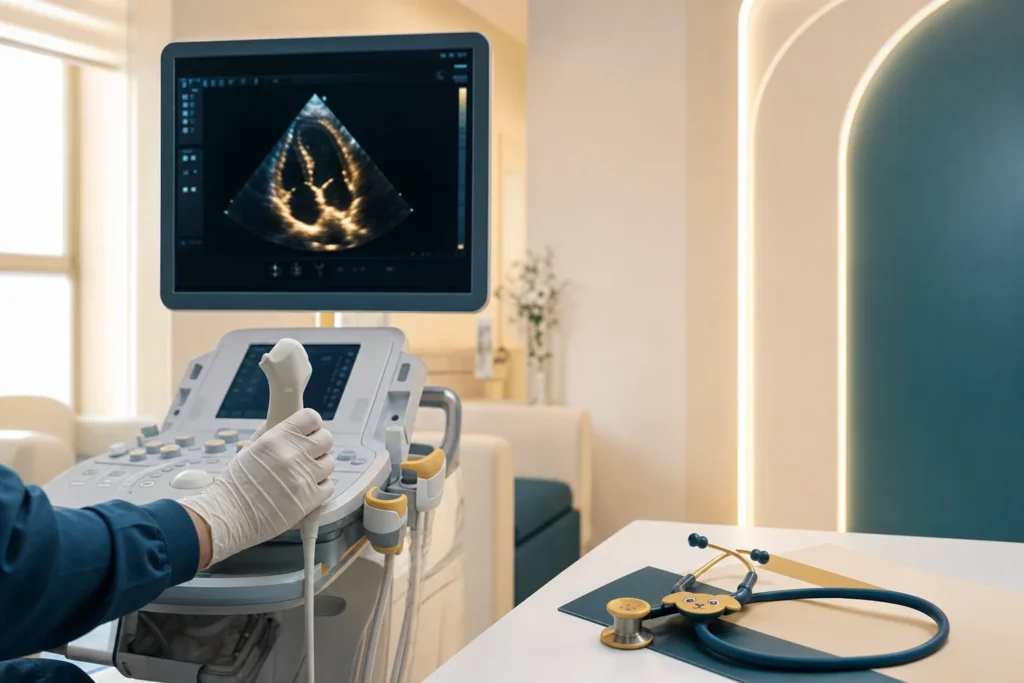
- Echocardiogram ("echo"). An ultrasound scan of the heart, the single most useful test. Using sound waves and a small probe on the chest, it produces moving pictures of the heart's chambers, walls, valves and blood flow. It is safe, painless and uses no radiation.
- Pulse oximetry. The painless oxygen-level check described above.
- Electrocardiogram (ECG). Small stickers on the skin record the heart's electrical activity and rhythm.
- Chest X-ray. Shows the size and shape of the heart and the lungs.
- Cardiac MRI. A detailed scan that gives a fuller three-dimensional picture, often used for more complex conditions.
- Cardiac catheterisation. A very thin, flexible tube is gently guided through a blood vessel up to the heart to take precise measurements and pictures; sometimes the problem can be treated during the same procedure.
- Blood tests, including genetic tests, where a chromosome or gene condition may be involved.
For complex conditions, doctors may describe the diagnosis in stages or use specialised terms; do not hesitate to ask the team to draw a simple diagram of your child's heart. Many families find that seeing the picture makes the explanation far easier to follow.
Treatment options
Treatment is tailored to the exact condition, and it is helpful to know that not every child needs an operation. As the NHS and British Heart Foundation explain, some conditions, such as small holes in the heart, often need no treatment at all and may close on their own, requiring only regular check-ups. Others are best treated, and today there is a wide and increasingly gentle range of options.
Medicines. The NHS lists several that may be used: digoxin to strengthen the heartbeat, diuretics (water tablets) to reduce fluid build-up, ACE inhibitors to improve blood flow, and anti-arrhythmic medicines to help control an irregular heartbeat. In some newborns a medicine called prostaglandin is used to keep a vital vessel open until treatment can be given.
Catheter (keyhole) procedures. Many defects can now be repaired without open surgery. Through a thin tube passed via a blood vessel, the cardiologist can, for example, close certain holes with a small device or widen a narrowed valve or vessel with a tiny balloon. Recovery from these procedures is usually quicker than from open surgery.
Surgery. When an operation is needed, this may be keyhole surgery or open-heart surgery to repair holes, reroute or widen vessels, or repair or replace valves. Some complex conditions are corrected in a planned series of operations over the early years of life.
Transplant. In rare and severe cases, a heart, or heart and lung, transplant may be considered.
Throughout, your child is cared for by a multidisciplinary team: paediatric cardiologists, cardiac surgeons, specialist nurses, anaesthetists, intensive-care doctors, and often dietitians, physiotherapists and psychologists, all working together. Supportive care, such as help with feeding and growth, is part of the picture, not an afterthought.
Outlook: what to expect
The outlook for children with heart conditions has improved dramatically over the past few decades, and this is one of the genuine success stories of modern medicine. The Cleveland Clinic reports that about 90% of children with congenital heart disease now survive into adulthood, compared with only around 10% decades ago, and NHS specialist heart centres also give a figure of over 90%. The CDC notes that more than 2 million people in the United States are now living with a heart defect.
These are population-level figures, not a prediction for any one child. The outlook for an individual depends heavily on the specific condition, how severe it is, whether other health issues are present, and how it responds to treatment. A child with a small hole that closes by itself has a very different path from a child with a complex single-ventricle condition. Only your child's own specialist team, who know the full details, can talk you through what is realistic for your family, and it is completely reasonable to ask them directly.
An honest point that the CDC makes carefully: many people with heart defects are not "cured" even after a successful repair. The heart may work very well, but it has been changed, and lifelong attention keeps it that way. For most families this means living a full and active life with some sensible follow-up, rather than living under a cloud.
Living with a heart condition and follow-up
For most children, a heart condition becomes one part of an otherwise ordinary childhood rather than the whole of it. Many can play, learn and take part in activities like their friends, sometimes with a few individual adjustments their cardiologist will advise on.
Ongoing check-ups. Even after a successful repair, regular reviews with a cardiologist are important. As MedlinePlus stresses, lifelong follow-up is essential, because the team can spot and manage any changes early. These visits usually involve a chat, an examination, and tests such as an echo or ECG.
Everyday care. Good dental care matters, because mouth infections can occasionally affect the heart; your team will tell you whether your child needs any special precautions. Keeping vaccinations up to date, supporting healthy growth and feeding, and knowing which symptoms to watch for are all part of looking after a child with a heart condition.
Growing up. As children become teenagers and then adults, their care is handed over to adult congenital heart disease (ACHD) services. This planned "transition" helps young people gradually take charge of their own health. The emotional side matters too: it is normal for children and parents to feel worried at times, and many centres offer psychological support, which is a sign of good care rather than a cause for concern.
Planning treatment abroad: what affects cost and how to prepare your records
Some families choose to arrange their child's heart care in another country, whether for access to a particular specialist team, shorter waiting times, or other personal reasons. Because every child's heart is different, there is no single "price" for paediatric cardiac care, and you should be cautious of any figure quoted before your child has been properly assessed. Instead, it helps to understand the factors that shape the cost of care.
- The exact diagnosis and its complexity. A straightforward catheter procedure is very different from a staged series of open-heart operations.
- The type of treatment. Monitoring, medicines, a catheter procedure or surgery each carry different needs.
- Hospital and intensive-care time required, which depends on the procedure and how your child recovers.
- The team and tests involved, including anaesthesia, imaging and laboratory work.
- Travel and accommodation for the child and accompanying family, and length of stay in the country.
How to prepare your child's records. Gather copies of all echocardiogram and other scan images and reports, ECGs, any cardiac MRI or catheterisation reports, operation notes from previous procedures, a list of current medicines with doses, growth charts, and any genetic test results. Recent images are especially valuable. Having these ready lets a specialist give you accurate advice and a personalised plan. Rather than relying on a generic price, the sensible step is to request a personalised estimate through a free consultation, where the team can review your child's records first.
Why Turkiye, and how to choose a good centre
Turkiye (Turkey) has become a well-known destination for medical care, including paediatric heart care, with a number of large hospitals that treat international families. If you are considering care here, the most useful thing you can do is judge a centre on objective signs of quality rather than on marketing claims. Here is what to look for and verify for yourself:
- Accreditation. Ask whether the hospital holds recognised international accreditation, such as Joint Commission International (JCI), and whether it meets national standards. Accreditation is an independent check on safety and quality of care.
- A dedicated paediatric cardiac team. Children are not small adults; their hearts need specialists. Confirm that there are paediatric cardiologists and paediatric cardiac surgeons, a paediatric intensive care unit, and paediatric anaesthetists.
- Experience with your child's specific condition. It is entirely reasonable to ask how often the centre treats the particular defect your child has.
- Clear communication. Check that you can understand the team, that interpreters are available if needed, and that you will receive full written reports.
- Follow-up arrangements. Ask how care will be coordinated with doctors back home once you return, so your child's follow-up is not interrupted.
A trustworthy centre or concierge will welcome these questions and answer them openly. Be wary of anyone who promises a "cure", guarantees an outcome, or claims to be simply "the best"; careful, honest teams describe realistic expectations instead.
Prevention, self-care and getting a second opinion
Because the cause of most congenital heart conditions is unknown, they usually cannot be prevented, and parents should not blame themselves. There are, however, sensible steps that may lower the risk and support a healthy pregnancy, drawn from the NHS, Mayo Clinic and CDC: avoiding alcohol and smoking (including second-hand smoke) during pregnancy, keeping diabetes well controlled before and during pregnancy, checking with a doctor before taking any medicine while pregnant, and making sure you are protected against rubella before pregnancy. Good general antenatal care also helps conditions be found early.
Self-care for the whole family. Looking after a child with a heart condition is a marathon, not a sprint. Lean on your specialist team, write down your questions before appointments, and accept support from family, patient groups and charities. Caring for your own wellbeing is part of caring for your child.
Second opinions. Seeking a second opinion is a normal and accepted part of medical care, not a sign of distrust. If a major procedure has been recommended, or if a diagnosis is complex, asking another qualified paediatric cardiologist to review the same scans and records can give you confidence and clarity. A good team will support you in doing this. Whatever path you choose, the single most valuable thing you can do is to keep your child under the care of a qualified paediatric cardiology specialist.
Frequently asked questions
What does a paediatric cardiologist do?
How common is congenital heart disease?
Did I cause my child's heart condition?
What are the warning signs in a baby?
Can a heart condition be found before birth?
Is the main test, an echocardiogram, safe and painful?
Will my child definitely need surgery?
What is the outlook for children with heart conditions today?
Why does my child still need check-ups after a successful repair?
When does care move to adult services?
How should I prepare to get an opinion or treatment abroad?
What should I check before choosing a hospital in Turkiye?
Sources
- NHS — Congenital heart disease
- NHS — Congenital heart disease: Treatment
- Mayo Clinic — Congenital heart defects in children
- Cleveland Clinic — Congenital Heart Disease
- MedlinePlus — Congenital Heart Defects
- CDC — About Congenital Heart Defects
- CDC — Specific Congenital Heart Defects
- British Heart Foundation — Congenital heart disease
This article is for general information only and is not medical advice. Always consult a qualified doctor about your individual case.
Specialists in Paediatrics
Doctors of the department we work with directly. Which doctor takes your case is decided after the specialists have reviewed your records — your coordinator confirms it, not this page.



Considering this procedure?
Send us your photos and questions. A BergemHealth coordinator and a senior specialist will review your case and reply with honest, personalised guidance — no obligation.
Free consultation