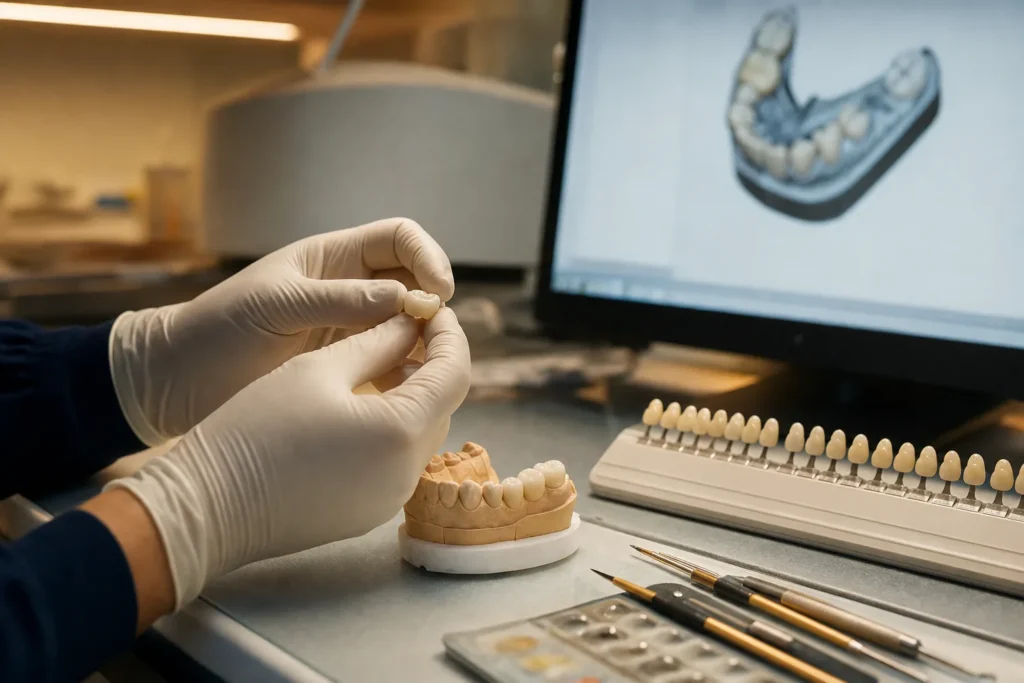
Zirconia crowns
A zirconia crown is a tooth-shaped cap, made from a tough white ceramic, that covers a damaged or weak tooth to restore its shape, strength and appearance. This guide explains in everyday language what zirconia crowns are, who they suit, how they are made and fitted, what recovery feels like, the risks to know about, how long they tend to last, and what they typically cost, including why many people choose to have the work done in Turkiye and how to pick a safe clinic.
- Anaesthesia
- Local anaesthetic (the tooth and gum are numbed); sedation occasionally on request
- Duration
- About 30-60 minutes per tooth to prepare; fitting is a shorter second visit
- Recovery
- No real downtime; mild sensitivity for a few days, easing within a week or two
- Hospital stay
- None; treated as an outpatient over two dental visits
Minimum price, for reference only — the final cost is calculated individually after your records are reviewed. You pay the hospital’s price; our service is free for you.
What a zirconia crown is
A dental crown is a cap shaped like a tooth that fits over the whole visible part of a tooth, a bit like a snug helmet. Once it is cemented in place, it becomes the new chewing and biting surface, restoring a tooth that is broken down, heavily filled, root-treated or simply worn.
A zirconia crown is one made from zirconium dioxide, usually shortened to zirconia. This is a white ceramic engineered from the metal zirconium. Do not confuse it with cubic zirconia, the sparkly diamond substitute used in jewellery; dental zirconia is a different, medical-grade material chosen for its strength and its tooth-like colour.
What makes zirconia popular is that it is unusually tough for a ceramic. The Cleveland Clinic notes that zirconia crowns are very durable and can take heavier biting forces than other ceramic crowns, while also being gentle on the natural teeth they bite against. Because it is white all the way through, a zirconia crown does not show the dark metal line at the gum that older metal-backed crowns sometimes reveal over time.
In short, a zirconia crown is a way to rebuild a single tooth (or several) so it looks natural and stands up to everyday chewing, without using any metal.
Who is a good candidate
Crowns are a workhorse of dentistry, and a dentist may suggest one when a filling alone will not do the job. Typical reasons include:
- A tooth that is badly decayed or broken, where too little healthy tooth is left to hold a filling.
- A tooth that has had root canal treatment, which can leave it brittle and in need of protection.
- A cracked or worn-down tooth that needs reinforcing.
- A large old filling that keeps failing.
- Covering a dental implant, or anchoring a bridge that replaces a missing tooth.
- Improving the look of a discoloured or misshapen tooth when a thinner veneer is not enough.
Zirconia in particular suits people who bite hard or grind their teeth, and back teeth (molars) that take a lot of force, because of its strength.
It is not the right choice for everyone, though. A crown is best avoided, or delayed, if there is active gum disease or untreated infection that needs sorting first, or if there is simply not enough sound tooth left to support a crown (other options such as an implant may then be discussed). Children's baby teeth are usually managed differently. People with a very heavy grinding habit may need a protective night guard so the crown, and the teeth it bites against, last longer. As with any dental treatment, your own dentist should examine you, often with an X-ray, before deciding a crown is right for you.
Types and techniques
Crowns can be made from several materials, including metal, gold alloys, resin, porcelain fused to metal (PFM) and all-ceramic options. Zirconia sits in the all-ceramic family. Within zirconia itself there are two main styles, and the difference matters:
- Monolithic (full-zirconia) crowns. Carved from a single solid block of zirconia. They are the strongest option and resist chipping well, which makes them a good fit for back teeth and for people who grind. The trade-off is that solid zirconia can look slightly more uniform and less naturally translucent than a real tooth, though modern multi-layer zirconia blanks have narrowed this gap considerably.
- Layered zirconia crowns. A strong zirconia core is covered with a thin layer of cosmetic porcelain. This gives the technician fine control over colour, translucency and the way light passes through the crown, so it can look extremely lifelike. The downside is that the outer porcelain is more fragile than the core and can chip over time, so layered crowns are usually reserved for front teeth, where appearance matters most and biting forces are lower.
You may also hear about same-day or CAD/CAM crowns, where the tooth is scanned digitally and the crown is milled by machine on site, sometimes in a single appointment. Two related materials often come up in the same conversation: e.max (lithium disilicate), a glass-ceramic prized for front-tooth beauty, and traditional porcelain-fused-to-metal. Your dentist will recommend a material and technique based on which tooth is being treated and how it looks against your other teeth.
How it is done, step by step
Getting a traditional crown usually takes two visits, often a week or two apart. Here is what each stage involves.
Anaesthesia. The work is done under local anaesthetic, meaning the tooth and the gum around it are numbed with an injection so you do not feel pain. You stay awake. Sedation can sometimes be arranged for very anxious patients, but it is not routine for a crown.
Visit one, preparing the tooth. After numbing, the dentist removes any decay and reshapes the tooth, filing it down so the crown will fit over it like a cap. They then take a precise mould, either with a soft impression putty or a digital scanner, so the crown can be made to match your bite and neighbouring teeth. A shade is chosen to match your other teeth. A temporary crown is fitted to protect the tooth while the permanent one is made in a dental laboratory. Preparing one tooth typically takes around 30 to 60 minutes.
Visit two, fitting the crown. Once the zirconia crown is ready, the temporary is removed and the dentist checks that the new crown fits, sits comfortably and matches in colour. When everyone is happy, it is bonded in place with dental cement. The cement sets within minutes, your bite is checked and any excess is cleaned away. This appointment is shorter than the first.
With same-day digital systems, scanning, milling and fitting can sometimes be completed in a single longer appointment of roughly two to four hours.
Recovery, step by step
A crown is not surgery, so there is no real downtime. Most people go back to normal activities the same day. Still, knowing what to expect over the first couple of weeks helps.
- First few hours. If you have had local anaesthetic, your lip, cheek and tongue may stay numb for an hour or two. Avoid chewing on that side until feeling returns so you do not bite your cheek, and skip very hot drinks while numb.
- First few days. Mild tooth sensitivity, especially to cold, and a little gum tenderness are common and normal. Sensitivity often peaks in the first day or two and then settles. Over-the-counter pain relief is usually enough if you need anything at all.
- While you have a temporary crown. If your final crown is being made elsewhere, treat the temporary gently: avoid hard, crunchy or sticky foods (toffee, chewing gum, hard nuts) that could pull it off, and floss carefully by sliding the floss out sideways rather than snapping it up.
- First couple of weeks after the permanent crown. Any lingering sensitivity should fade. Your bite may feel slightly different at first as you get used to the new surface.
Contact your dentist if you get sharp or increasing pain, if your bite feels high or uneven, if the crown feels loose, or if sensitivity does not improve, as these can usually be adjusted easily.
Risks and possible complications
Crowns are a very well-established treatment and serious problems are uncommon, but no dental work is completely risk-free. Things to be aware of include:
- Sensitivity. The treated tooth may be sensitive to hot, cold or pressure for a while, particularly soon after fitting.
- Irreversible tooth reduction. To make room for a crown, healthy tooth has to be filed down, and that cannot be undone. This is part of why a crown is recommended only when a more conservative option will not work.
- Chipping or fracture. Solid zirconia rarely chips, but the cosmetic porcelain on layered crowns can chip over time, especially in people who grind their teeth.
- A loose or lost crown. Cement can wash out or the fit can loosen, in which case the crown may need re-cementing or replacing. Avoid sticky and very hard foods that pull at crowns.
- Decay or gum problems at the edge. The natural tooth beneath the crown can still decay where the crown meets the gum if plaque is allowed to build up, so good brushing and flossing remain essential.
- Nerve irritation. Occasionally the tooth's nerve becomes inflamed after being prepared, and a small number of teeth later need root canal treatment.
Report anything that does not settle to your dentist; most of these issues are straightforward to put right when caught early.
Results and how long they last
A well-made, well-fitted crown should look and feel like a natural tooth and let you eat normally. The final colour and shape are visible as soon as the permanent crown is bonded, and any minor sensitivity usually settles within a couple of weeks.
On longevity, general guidance from sources such as the Cleveland Clinic is that crowns typically last between about 5 and 15 years, and many last considerably longer, sometimes well beyond 20 to 30 years, with good care. Zirconia's strength gives it a good track record on back teeth in particular.
How long your crown lasts depends less on the material alone and more on how you look after it. The biggest factors are day-to-day oral hygiene, regular dental check-ups, whether you grind your teeth (a night guard helps), and habits like chewing ice or using teeth to open packaging. A crown does not get cavities itself, but the living tooth underneath still can, so the gum line is where most failures begin.
Costs and what changes the price
Prices vary widely by country, clinic and case, so treat the figures below as indicative ranges, not a quote. The final price depends on your specific case, the dentist, the clinic and the materials used.
As a rough guide, a single zirconia crown commonly costs in the region of 120 to 350 EUR per tooth in Turkiye, with many clinics quoting around 130 to 200 EUR. Full-mouth packages of, say, 20 crowns are often bundled at a few thousand euros. For comparison, the same crown frequently costs the equivalent of several hundred to well over a thousand euros in the UK, wider Europe or the United States. These are illustrative market figures from medical-tourism listings rather than a price we are promising.
What moves the price up or down:
- Number of crowns and whether a package discount applies.
- Type of zirconia (solid versus layered, or premium multi-layer aesthetic blocks).
- Front versus back teeth, since front-tooth work demands more cosmetic finishing.
- Extra treatment needed first, such as fillings, root canals, a post, or an implant to build on.
- The dentist's and laboratory's experience and the clinic's facilities and accreditation.
- What is included, for example consultation, scans, temporary crowns, and (for travellers) hotel and transfers.
Always ask for an itemised, written estimate after an examination, and check what happens about repairs or replacement if something goes wrong.
Why people travel to Turkiye, and choosing a safe clinic
Turkiye has become a major destination for dental work because prices are substantially lower than in much of Western Europe and North America, while many clinics offer modern equipment, English-speaking coordinators and travel packages that bundle treatment with a hotel stay. For multi-crown cases the savings can be large enough to cover the trip.
Lower cost only makes sense alongside safety, so it is worth doing your homework. Sensible checks include:
- Health-tourism authorisation. Clinics treating international patients in Turkiye are expected to hold an International Health Tourism Authorisation Certificate from the Turkish Ministry of Health. Licensed facilities appear in the Ministry's records.
- Accreditation. Look for independent quality accreditation such as JCI (Joint Commission International), which you can confirm on the JCI website rather than relying on a clinic's word.
- The dentist's credentials. Ask for the treating dentist's full name, university and graduation year, and check membership of the Turkish Dental Association. Turkish dental qualifications can be cross-checked through the national higher-education records.
- Evidence, not just photos. Ask to see the materials and laboratory used, the warranty or guarantee on the crowns, and genuine before-and-after cases and reviews.
- A clear written plan and quote based on your X-rays or scans, with the total cost and what is included spelled out.
A reputable clinic will welcome these questions. A good medical-tourism coordinator can help arrange and verify much of this, but the final responsibility for checking is yours.
How to prepare and what to ask at your consultation
A little preparation makes treatment smoother, especially if you are travelling. Before you go:
- Gather any recent X-rays or dental records and a list of your medicines and medical conditions.
- Tell the clinic if you grind your teeth, have allergies, or take blood thinners.
- Sort out any urgent problems like infection or gum disease, as these may need treating first.
Useful questions to ask at the consultation:
- Why is a crown recommended for me, and what are my alternatives?
- Will it be monolithic or layered zirconia, and why is that best for this tooth?
- How many visits will I need, and how many days should I stay if I am travelling?
- Who exactly will treat me, and what are their qualifications?
- What is the total written cost, and what does it include?
- What guarantee comes with the crown, and what happens if it chips, loosens or fails after I go home?
- How will follow-up care work once I am back in my own country?
It is reasonable to ask all of this and to take your time deciding. A trustworthy clinic will answer clearly and put the plan in writing.
Aftercare and travelling for treatment
Looking after a crown is mostly looking after your mouth. Brush twice a day, floss daily around the crown, keep up regular check-ups, and avoid using your teeth as tools or chewing very hard things like ice. If you grind your teeth, wear the night guard your dentist provides. With this routine, a crown does not need any special products.
For travellers, plan the timing carefully. A traditional crown needs two visits, with the laboratory work in between, so clinics commonly suggest a stay of roughly 5 to 7 days (or two short trips) to allow the crown to be made and fitted. Confirm the schedule before you book flights, and build in a buffer day in case the bite needs adjusting.
On flying, a permanently cemented crown is generally considered safe to fly with almost immediately, because the bonding cement sets within minutes. A cautious approach is to wait about 24 to 48 hours, which also lets early sensitivity settle. Flying with a temporary crown is best avoided where possible, since it is less secure. Cold cabin air can briefly worsen a sensitive tooth, so a scarf over the lower face can help. If you have pain, a high-feeling bite or a loose crown, get it checked before you fly. Finally, agree a follow-up plan with a local dentist for routine care once you are home, and keep your clinic's contact details and any warranty paperwork handy.
Frequently asked questions
Are zirconia crowns better than porcelain or metal crowns?
Do zirconia crowns look natural?
Does getting a crown hurt?
How long do zirconia crowns last?
How many visits and how long does treatment take?
How much does a zirconia crown cost in Turkiye?
Is it safe to fly after getting a crown?
Will my tooth be filed down for a crown?
Can a zirconia crown chip or break?
How do I care for a zirconia crown?
How do I check that a Turkish dental clinic is safe and qualified?
Sources
- Cleveland Clinic, Dental Crowns: overview, materials, lifespan and care
- WebMD, Dental Crowns: types of materials, procedure and complications
- Healthline, Dental Crown Prep: traditional and same-day procedures
- PMC / NCBI, Dental tourism and the risk of barotrauma and barodontalgia (flying after dental work)
- Joint Commission International (JCI), accredited organisations directory
- Republic of Turkiye Ministry of Health, Health Tourism (HealthTurkiye)
- Turkish Dental Association (Turk Dishekimleri Birligi)
- Flymedi, Zirconium Crowns in Turkey, indicative prices and treatment timeline
This article is for general information only and is not medical advice. Always consult a qualified doctor about your individual case.
Specialists in Dentistry
Doctors of the department we work with directly. Which doctor takes your case is decided after the specialists have reviewed your records — your coordinator confirms it, not this page.


Considering this procedure?
Send us your photos and questions. A BergemHealth coordinator and a senior specialist will review your case and reply with honest, personalised guidance — no obligation.
Free consultation