Hepatocellular carcinoma (HCC)
Hepatocellular carcinoma, often shortened to HCC, is the most common type of cancer that starts in the liver. If you or someone you love has just heard this name, it can feel overwhelming. This guide explains, in everyday language, what HCC is, why it happens, how doctors find and treat it, and what to think about if you are considering care abroad. Our aim is to help you feel informed and calm, not frightened, so you can ask good questions and make decisions that are right for you.
What hepatocellular carcinoma is
The liver is a large organ in the upper right side of your abdomen (tummy). It does hundreds of quiet but vital jobs: it filters your blood, helps you digest food, stores energy, and makes proteins that keep you healthy. Most of the liver tucks up under your right rib cage, which is one reason small problems there can go unnoticed for a while.
Hepatocellular carcinoma (HCC) is a cancer that begins in the main working cells of the liver, called hepatocytes. "Hepato" means liver, "cellular" means cells, and "carcinoma" means a cancer that starts in the lining or working cells of an organ. So the name simply describes a cancer of the liver's own cells.
HCC is the most common form of primary liver cancer — cancer that actually starts in the liver, rather than cancer that began somewhere else and spread there. According to the Cleveland Clinic, HCC accounts for roughly 85% to 90% of all primary liver cancers. It is described as an aggressive (fast-growing) cancer, and it is most common in people who already have long-standing liver disease such as cirrhosis (scarring of the liver). HCC tends to be diagnosed more often in men and most often after age 60.
It helps to know that liver cancer is not one single thing. The behaviour and treatment of HCC depend a great deal on how healthy the rest of your liver is, not just on the tumour itself. That is why your care team will look at the whole picture of your liver, not only the cancer.
Types and subtypes
When people say "liver cancer," they may be talking about several different conditions. Sorting them out matters, because treatment differs.
- Hepatocellular carcinoma (HCC) — the focus of this guide and the most common primary liver cancer. It arises from hepatocytes, the liver's main cells.
- Intrahepatic cholangiocarcinoma — a less common primary liver cancer that starts in the small bile ducts inside the liver. It is a separate disease from HCC and is treated differently.
- Secondary (metastatic) liver cancer — cancer that started in another organ, such as the bowel or breast, and travelled to the liver. As Cancer Research UK explains, this is not primary liver cancer and is managed according to where it began.
Doctors sometimes describe particular patterns of HCC seen under the microscope. One example is fibrolamellar carcinoma, a rare subtype that tends to affect younger people who usually do not have underlying liver disease. Your pathology report (the laboratory analysis of tumour tissue) may mention features like this, and your specialist can explain what any specific wording means for you.
Causes and risk factors
HCC usually develops on a background of long-term liver injury and inflammation. Over many years, repeated damage can lead to cirrhosis (permanent scarring), and cirrhosis greatly raises the risk of liver cancer. The Cleveland Clinic notes that about 80% of HCC cases occur in people who already have cirrhosis. Having a risk factor does not mean you will get HCC — many people with these conditions never do — but knowing your risks helps you and your doctor stay watchful.
The American Cancer Society and Mayo Clinic list the main risk factors:
- Chronic hepatitis B or hepatitis C — long-lasting viral infections of the liver. Worldwide, these are the most common cause of liver cancer.
- Cirrhosis from any cause — scarring of the liver from years of damage.
- Heavy, long-term alcohol use — a leading cause of cirrhosis.
- Metabolic dysfunction-associated steatotic liver disease (MASLD), previously called non-alcoholic fatty liver disease — a build-up of fat in the liver linked to excess weight, type 2 diabetes, and metabolic syndrome.
- Obesity and type 2 diabetes — both raise risk, partly through fatty liver disease.
- Aflatoxins — harmful substances made by certain moulds that can grow on poorly stored grains and nuts in some parts of the world.
- Inherited conditions such as hereditary hemochromatosis (too much iron stored in the body) and Wilson disease (too much copper).
- Smoking, and long-term use of anabolic steroids.
HCC is also more common in men than in women.
Signs and symptoms (and when to see a doctor)
In its early stages, HCC often causes no symptoms at all. This is partly because the liver sits mostly under the ribs, so a small tumour cannot be felt, and partly because the liver can keep working even when part of it is affected. Symptoms tend to appear as a tumour grows or as liver function declines.
Possible signs, drawn from the Cleveland Clinic and Cancer Research UK, include:
- A feeling of fullness, a lump, or discomfort under the ribs on the right side
- Unexplained weight loss and loss of appetite
- Feeling sick (nausea) or being sick (vomiting)
- A swollen or painful abdomen
- Jaundice — yellowing of the skin or the whites of the eyes
- Itchy skin, or feeling unusually tired or weak
Many of these symptoms have ordinary, non-cancer causes. But the Cleveland Clinic advises seeing a doctor if symptoms last longer than about two weeks. If you already have a known liver condition such as cirrhosis or chronic hepatitis and you suddenly feel much worse, contact your doctor promptly. Seek urgent care for severe abdominal pain, vomiting blood, black tarry stools, or new confusion — these need quick assessment.
Screening and early detection
There is currently no routine liver cancer screening for people at average risk. As the American Cancer Society puts it, there are no widely recommended screening tests for liver cancer in people at average risk. So this is not a cancer the general public is screened for, unlike, say, bowel or breast cancer.
However, for people at high risk, regular monitoring — called surveillance — is recommended, because finding HCC early gives the most treatment choices. People considered high risk include those with cirrhosis (from any cause), chronic hepatitis B, or hereditary hemochromatosis. For these groups, the American Cancer Society describes testing about every 6 months, usually with:
- An ultrasound scan of the liver (a painless scan using sound waves), and
- A blood test for alpha-fetoprotein (AFP), a protein that can be raised when liver cancer is present.
It is worth knowing that AFP is not a perfect test on its own. Many people with early liver cancer have normal AFP levels, and some people with chronic liver disease but no cancer have high AFP. That is why ultrasound and AFP are used together, and why surveillance is repeated regularly rather than relied on as a single snapshot. If you have a liver condition, ask your doctor whether you should be on a surveillance programme.
How it is diagnosed
Diagnosing HCC usually starts when something prompts a closer look — a surveillance ultrasound, a symptom, or an abnormal blood test. From there, the steps typically include:
- Blood tests — including AFP and tests of how well the liver is working (liver function tests), plus checks for hepatitis B and C.
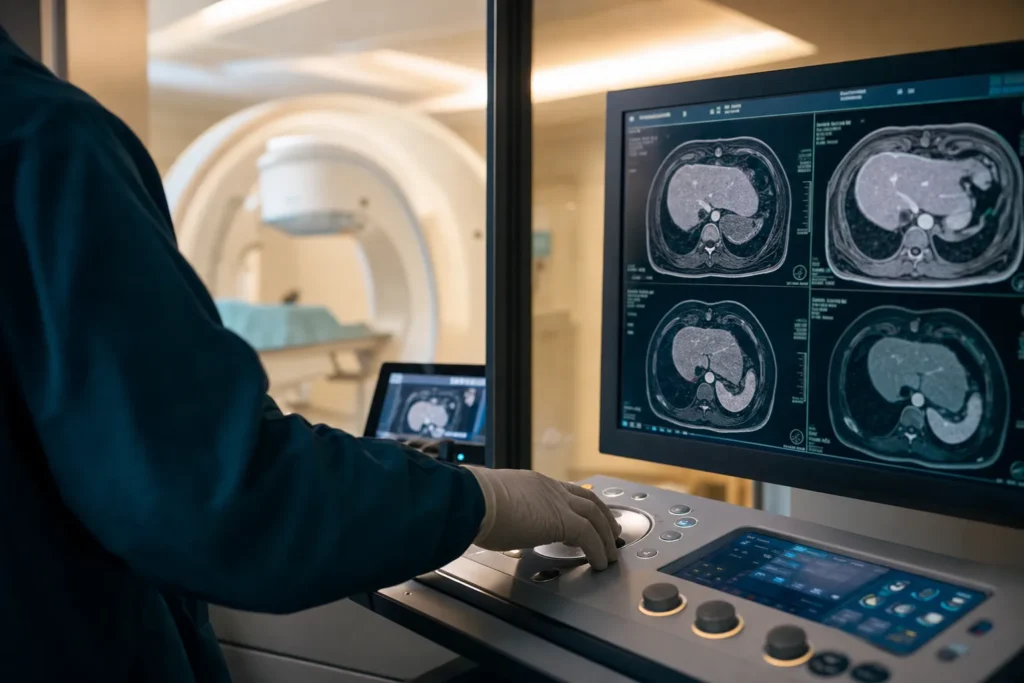
- Imaging scans — a CT scan or MRI with contrast dye gives a detailed picture of the liver. HCC often has a recognisable pattern on these scans. In fact, the Cleveland Clinic notes that doctors can sometimes diagnose HCC from the typical appearance on MRI or CT without needing a biopsy. Many centres use a standardised reporting system called LI-RADS to describe how likely a liver spot is to be HCC.
- Biopsy — taking a tiny tissue sample to examine under a microscope. This is used when the scans are not clear-cut.
If HCC is confirmed, the team works out the stage — how large the tumour is, whether there is more than one, whether it has grown into blood vessels or spread, and crucially how well the rest of the liver is working and how well you feel day to day. For HCC, the most widely used system is the Barcelona Clinic Liver Cancer (BCLC) staging, which the National Cancer Institute notes is the most accepted staging system for HCC. Staging guides treatment, because it captures both the cancer and the health of your liver together.
Treatment options
HCC treatment is highly individual. The right plan depends on the size and number of tumours, whether the cancer has spread, how well your liver is functioning, and your overall health. ESMO and other guidelines stress that decisions should be made by a multidisciplinary team — a group that may include a liver specialist (hepatologist), a liver surgeon, an oncologist (cancer doctor), an interventional radiologist, a transplant team, a radiologist, a pathologist, and specialist nurses. Bringing these experts together helps match the treatment to your situation.
Treatments fall into a few broad groups. The following are drawn from the National Cancer Institute and Cleveland Clinic.
Treatments aimed at cure (often for earlier-stage disease):
- Surgery to remove part of the liver (partial hepatectomy) — possible when the tumour can be removed and enough healthy liver remains. The liver has a remarkable ability to regrow.
- Liver transplant — replacing the diseased liver with a healthy donor liver. This can treat both the cancer and the underlying liver disease in carefully selected people.
- Ablation — destroying small tumours with heat (radiofrequency or microwave), cold (cryoablation), or alcohol injection, usually guided by imaging through the skin.
Treatments that target the tumour through its blood supply or with focused radiation:
- Transarterial chemoembolisation (TACE) and transarterial embolisation (TAE) — blocking the artery feeding the tumour, sometimes delivering chemotherapy directly to it.
- Radioembolisation (TARE) — delivering tiny radioactive beads to the tumour through its blood vessels.
- Stereotactic body radiation therapy (SBRT) — precisely focused radiation.
Whole-body (systemic) treatments for more advanced disease:
- Immunotherapy — medicines that help your immune system attack cancer, such as atezolizumab, durvalumab, nivolumab, and pembrolizumab, often used in combinations.
- Targeted therapy — medicines that interfere with how cancer grows, such as bevacizumab, lenvatinib, sorafenib, cabozantinib, regorafenib, and ramucirumab.
Supportive (palliative) care — care focused on relieving symptoms and maintaining quality of life — is valuable at any stage and can be given alongside other treatments.
Outlook: what to expect
Talking about outlook is delicate, and it is important to be honest without being frightening. Survival statistics describe large groups of people; they cannot predict what will happen for any one person.
The American Cancer Society reports 5-year relative survival figures for liver cancer based on US (SEER) data, grouped by how far the cancer had spread when first found: localized 37% (cancer still confined to the liver), regional 13% (spread to nearby structures or lymph nodes), distant 3% (spread to distant parts of the body), and 22% for all stages combined. The Cleveland Clinic similarly cites an overall five-year survival rate of around 21%.
Several caveats matter enormously here. The American Cancer Society stresses that these numbers apply only to the stage when the cancer was first diagnosed, that they cannot predict any individual's outcome, and that people diagnosed today may do better than older statistics suggest because treatments keep improving. The figures also do not capture your age, overall health, how well your liver works, or how your particular cancer responds to treatment. Notably, people whose tumours can be surgically removed, or who receive a liver transplant, often do considerably better than the overall averages. The most useful guide to your own situation is an honest conversation with your specialist.
Living with HCC and follow-up
Living with HCC often means living with two conditions at once: the cancer and the underlying liver disease. Looking after your liver is part of looking after yourself. That can include avoiding alcohol, keeping hepatitis under control with treatment, managing weight and diabetes, and being careful with medicines that the liver processes — always check with your doctor or pharmacist before starting anything new, including herbal and over-the-counter products.
After treatment, you will have follow-up appointments with scans (such as CT or MRI) and blood tests, including AFP, on a schedule your team sets. The aim is to spot any return of the cancer early, when more options may be available, and to keep an eye on your liver. HCC can come back, so regular follow-up is a normal and important part of care, not a sign that something is wrong.
Emotional wellbeing matters just as much as the physical side. Anxiety, low mood, and fatigue are common and understandable. Many people find help in talking to a counsellor, joining a support group, or leaning on family and friends. Practical support — with nutrition, energy levels, and pain — is available too. Ask your team what services they offer, and do not hesitate to say when you are struggling.
Planning treatment abroad: what affects cost and how to prepare your records
Some people choose to seek liver cancer care abroad, in places such as Turkiye, where specialist hospitals offer the full range of HCC treatments. Costs vary widely from person to person, and no honest provider can quote a meaningful figure before reviewing your case. Rather than focusing on a headline number, it helps to understand what drives the cost so you can request a clear, personalised estimate.
Factors that typically affect the cost of HCC care include:
- The treatment plan itself — surgery, ablation, TACE/TARE, transplant, radiation, immunotherapy, or targeted drugs each carry very different costs, and many people need a combination.
- The stage of the cancer and the health of your liver, which determine how complex care will be.
- Diagnostic work-up — scans, blood tests, and sometimes a biopsy or repeat imaging.
- Length of hospital stay and the level of post-treatment monitoring needed.
- Medicines, especially long courses of immunotherapy or targeted therapy.
- Travel, accommodation, interpreting, and follow-up for you and anyone travelling with you.
To get an accurate estimate and avoid delays, gather your medical records before you reach out: recent imaging (CT or MRI scans, ideally on disc or in DICOM format), pathology and biopsy reports, blood test results including AFP and liver function tests, your hepatitis status, a list of current medicines, and a short summary from your current doctor. With these, a hospital's team can review your case and prepare a tailored plan. We are happy to help you organise these documents and arrange a free consultation so you can request a personalised estimate before committing to anything.
Why Turkiye, and how to choose a good centre
Turkiye has become a well-known destination for medical care, including complex liver treatment, with hospitals that handle the full HCC pathway — diagnosis, surgery, ablation, embolisation, radiation, transplant programmes, and systemic therapy. The most important thing, wherever you go, is to choose a centre carefully and verify what you are told.
When evaluating a hospital for HCC care, consider checking:
- Accreditation — look for internationally recognised quality accreditation (for example, Joint Commission International) alongside national health-ministry licensing.
- A genuine multidisciplinary liver team — HCC care should involve hepatologists, liver surgeons, oncologists, interventional radiologists, and, where relevant, a transplant team working together, as ESMO recommends.
- Experience with your specific treatment — ask how often the centre performs the procedure you may need.
- Clear communication — a written treatment plan, transparent explanation of costs, interpreting support, and a named contact.
- Continuity of care — how follow-up will work after you return home, and how your records will be shared with your local doctors.
Be cautious of any provider that guarantees a cure, promises a specific outcome, or pressures you to decide quickly. Reputable teams give realistic information and welcome your questions. A concierge service like ours can help you compare accredited centres, arrange a second opinion, and coordinate the practical side — while leaving the medical decisions where they belong, with you and the specialists.
Prevention, clinical trials, and second opinions
Although not every case can be prevented, a large share of HCC is linked to causes that can be reduced. The Mayo Clinic and Cleveland Clinic highlight steps that lower risk:
- Get vaccinated against hepatitis B, and get tested and treated for hepatitis B or C if you may be at risk. Treating these infections lowers the chance of cirrhosis and cancer.
- Limit or avoid alcohol to protect the liver from scarring.
- Keep a healthy weight and manage diabetes to reduce fatty liver disease.
- Don't smoke.
- If you have a liver condition, join a surveillance programme so any cancer can be found early.
If you have been diagnosed with HCC, two things are worth knowing. First, clinical trials — carefully run studies of new treatments — may be an option, and your specialist or organisations such as the National Cancer Institute and Cancer Research UK can help you find them. Second, you are entitled to a second opinion. HCC decisions are complex and depend on fine details of your liver health, so it is completely reasonable to ask another specialist to review your case. A good doctor will never be offended by this; getting it right matters more than getting it fast. Above all, stay connected to a qualified liver specialist who knows your whole story.
Frequently asked questions
Is hepatocellular carcinoma the same as liver cancer?
What are the first signs of HCC?
Who is at higher risk of HCC?
Is there a screening test for liver cancer?
How is HCC diagnosed?
Can HCC be cured?
What treatments are available for advanced HCC?
What do survival statistics for liver cancer mean?
How can I lower my risk of HCC?
What records should I prepare before seeking treatment abroad?
How do I choose a good hospital for HCC in Turkiye?
Should I get a second opinion?
This article is for general information only and is not medical advice. Always consult a qualified doctor about your individual case.
Considering this procedure?
Send us your photos and questions. A BergemHealth coordinator and a department-head specialist will review your case and reply with honest, personalised guidance — no obligation.
Free consultation