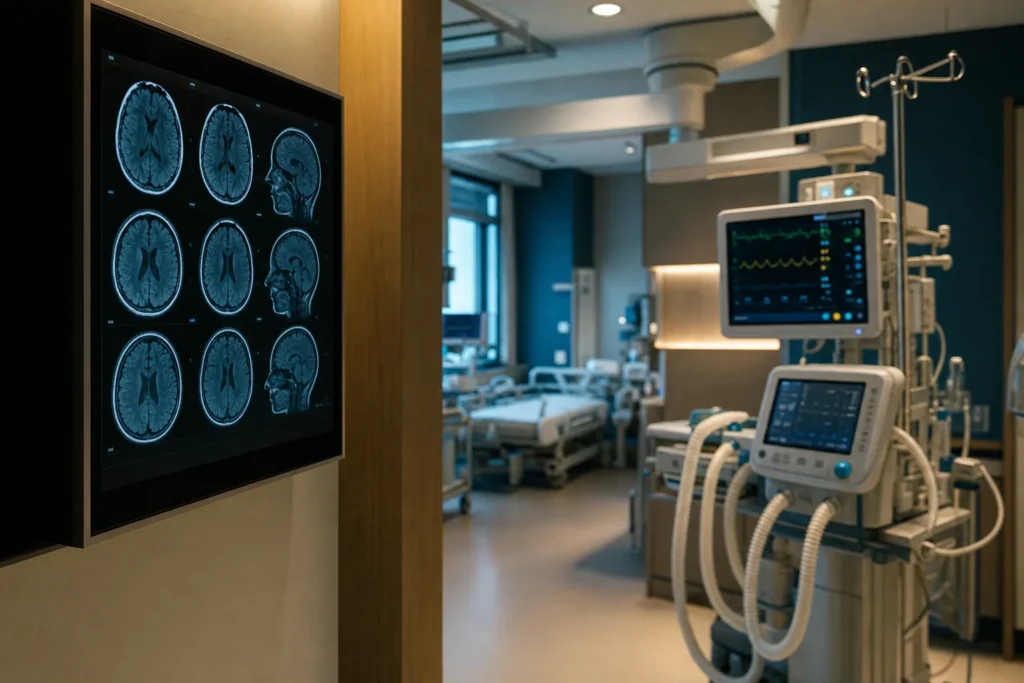
Severe traumatic brain injury
A severe traumatic brain injury is a frightening event for everyone involved, and looking for clear, honest information is a natural first step. This guide explains, in plain language, what a severe TBI is, how doctors assess and treat it, what recovery can look like over time, and how families weighing care or rehabilitation abroad can prepare. It is written to inform, not to alarm, and it is not a substitute for advice from a qualified specialist who knows the individual person.
What a severe traumatic brain injury is
A traumatic brain injury (TBI) happens when an outside force damages the brain and changes how it works. The force might be a blow, bump or jolt to the head, a violent back-and-forth movement, or an object that pierces the skull. A TBI is called severe when that damage is serious enough to cause a long loss of consciousness or a deep reduction in awareness.
Doctors usually grade how serious a brain injury is using the Glasgow Coma Scale (GCS), a simple bedside check of how well a person opens their eyes, speaks, and moves. Scores run from 3 (least responsive) to 15 (fully awake). A score of 13 to 15 is generally called mild, 9 to 12 moderate, and 3 to 8 severe. A score of 8 or below usually means the person is in a coma (a state of deep unconsciousness from which they cannot be woken).
It helps to know that the brain can be harmed in two stages. The primary injury is the damage caused at the moment of impact. The secondary injury is further harm that can develop over the following hours and days, for example from swelling, bleeding, or a lack of oxygen. Much of modern emergency and intensive care for severe TBI is aimed at limiting that secondary injury, because it is the part doctors can most influence.
Types and patterns of brain injury
Severe TBI is not a single thing. The brain can be hurt in different ways, and a person may have more than one pattern at once.
- Closed head injury. The skull is not broken open, but the brain is shaken, bounced or twisted inside it. This is the most common pattern.
- Penetrating (open) injury. Something breaks through the skull and enters brain tissue, such as a bullet, a sharp object, or fragments of bone.
Within these, doctors describe several specific injuries:
- Contusion. A bruise on the brain itself, where small blood vessels have been damaged.
- Diffuse axonal injury. Widespread stretching and tearing of nerve fibres that occurs when the brain rapidly rotates or accelerates. It can be a cause of prolonged unconsciousness.
- Haematoma. A collection of blood that forms inside or around the brain. Common types include an epidural haematoma (between the skull and the brain's outer covering), a subdural haematoma (beneath that covering), and an intracerebral haematoma (within the brain tissue). A growing haematoma can press on the brain and needs urgent attention.
Because the skull is a rigid box, any swelling or bleeding raises the pressure inside it. This is called raised intracranial pressure, and reducing it is a central goal of treatment.
Causes and risk factors
Severe TBI is usually the result of a sudden, high-energy event. The most common causes reported by health authorities include:
- Falls — the leading cause in older adults (roughly age 65 and over).
- Road traffic crashes — a common cause among teenagers and younger adults.
- Violence and assaults, including gunshot wounds.
- Being struck by or against an object, including some sports and recreation injuries.
- Blast injuries from explosions, which can affect military personnel.
- Abuse in young children, which is a recognised cause in those under four.
Some factors raise the chance of a serious injury or a harder recovery. Men have TBIs more often than women and tend to have more severe ones. Very young children and older adults are more vulnerable, and older adults face the highest risk of hospitalisation and death. Using alcohol or drugs, not wearing a seatbelt or helmet, and conditions that affect balance or blood clotting can also increase risk. None of these guarantees an injury, and many severe TBIs happen to people with no risk factors at all.
Signs and symptoms, and when to get help
The signs of a severe brain injury can appear straight away or in the hours afterward. They affect the body, thinking, the senses, and behaviour.
- Reduced consciousness — being very drowsy, confused, or unable to be woken; loss of consciousness, sometimes for a long time.
- A headache that keeps getting worse or will not go away.
- Repeated vomiting or persistent nausea.
- Seizures or fits.
- Weakness, numbness, or loss of coordination in the arms or legs.
- Slurred speech or difficulty speaking and understanding.
- One or both pupils enlarged (dilated), or problems with vision or hearing, including double vision.
- Clear fluid or blood coming from the ears or nose, or bruising behind the ears.
- Increasing confusion, restlessness or agitation, or unusual behaviour.
A severe head injury is a medical emergency. Call emergency services (such as 999 or 112) without delay if someone cannot stay awake or be roused, has a seizure, has weakness or numbness, has clear fluid or bleeding from the ears or nose, or has any of the warning signs above after a head injury. While waiting for help, keep the person still, do not move them unnecessarily (the neck may also be injured), and do not give food or drink.
Screening and early detection
There is no routine screening test for traumatic brain injury, because a TBI is an event rather than a disease that develops silently over time. You cannot scan for a severe TBI before it happens; instead, the focus is on prevention and on recognising the injury quickly once it occurs.
What does matter for early detection is acting fast after a head injury. The longer raised pressure, bleeding, or low oxygen go untreated, the more secondary injury can build up. That is why anyone with a serious head injury should be assessed urgently in an emergency department, even if they seem to recover at first, and why hospital staff repeat the Glasgow Coma Scale and pupil checks at intervals: a falling score can be the earliest sign that something is changing and that treatment needs to be stepped up.
How a severe TBI is diagnosed
Diagnosis begins the moment paramedics or emergency staff reach the person. Several tools are used together.
- Clinical assessment. Doctors check the airway, breathing and circulation first, then examine the nervous system. The Glasgow Coma Scale measures eye opening, verbal response and movement, and is repeated regularly to track any change.
- Pupil checks. The size of the pupils and how they react to light give a quick bedside clue to how the brain is coping.
- CT scan (computed tomography). This is usually the first imaging test. It builds a detailed picture of the head and shows bleeding, bruising, swelling, and fractures, helping the team decide whether surgery is needed urgently.
- MRI scan. Magnetic resonance imaging can show subtler damage, such as diffuse axonal injury, and may be used once the person is more stable.
- Intracranial pressure (ICP) monitoring. In severe cases, a small probe may be placed inside the skull to measure pressure directly and guide treatment.
Plain X-rays of the head are no longer used to assess the brain, as they add little. Later in recovery, neuropsychological testing may be used to map thinking, memory and attention so rehabilitation can be tailored to the individual.
Treatment options
Care for a severe TBI is delivered by a multidisciplinary team and usually moves through emergency stabilisation, intensive care, sometimes surgery, and then rehabilitation. The team can include emergency doctors, neurosurgeons, intensive care (critical care) specialists, neurologists, nurses, and a range of therapists.
Emergency and intensive care. The first goals are to keep enough oxygen and blood reaching the brain, control blood pressure, and prevent secondary injury. This may involve placing a breathing tube and using a ventilator, careful fluid management, and continuous monitoring. To lower raised pressure inside the skull, doctors may use measures such as positioning, sedation, and osmotic medicines (for example mannitol or hypertonic saline) that draw fluid out of the brain.
Medicines. Beyond pressure-lowering drugs, treatment may include anti-seizure medicines to reduce the risk of fits in the early period, pain relief, sedation, and medicines to prevent blood clots. Later, some people are prescribed medicines for mood, attention or other ongoing symptoms.
Surgery. When imaging shows a problem that is pressing on the brain, a neurosurgeon may operate to remove a haematoma (blood clot), repair a skull fracture, or relieve pressure. One procedure, a decompressive craniectomy, involves temporarily removing part of the skull to give a swollen brain room to expand. International guidelines (such as those from the Brain Trauma Foundation) help neurosurgeons decide when surgery is likely to help.
Supportive and rehabilitation care. Recovery is supported by a therapy team that may include physiotherapists, occupational therapists, speech and language therapists, neuropsychologists, dietitians, and respiratory therapists. Rehabilitation can begin early, even while a person is still in intensive care, and continues for as long as it is helpful.
Outlook: what to expect over time
Outcomes after a severe TBI vary widely from one person to another, and the honest position taken by medical authorities is that the early picture is uncertain. In the first month or two after a severe injury, specialists can usually only estimate how long recovery may take and what it might look like. The information below describes population-level patterns and is not a prediction for any individual person; only the treating team, who know the specific injury, can offer personal guidance.
Many people pass through recognised stages as awareness returns: coma, then a vegetative state (also called unresponsive wakefulness, where the eyes open and sleep-wake cycles return but there is no purposeful response), then a minimally conscious state (inconsistent but real signs of awareness), and then a confused state with problems of attention and memory, before clearer thinking returns. Not everyone goes through every stage, and the pace differs greatly.
Published figures from rehabilitation research give a sense of the range. Of people who are still in a vegetative state one month after a traumatic brain injury, a substantial proportion regain consciousness over the following year; reported figures vary, with one widely cited estimate being around half and others higher. Generally, the sooner a person shows signs of awareness, such as following simple commands within the first months, the better the longer-term outlook tends to be. At the same time, severe TBI can be a lifelong condition for some, with effects that continue to need support. The brain has a real capacity to relearn skills, and even people with serious injuries can make meaningful progress.
Living with the effects and follow-up
After the acute phase, life with a brain injury is often a gradual process rather than a single recovery point. The effects depend on which parts of the brain were injured, and may include:
- Physical changes — weakness, balance and coordination problems, fatigue, headaches, or changes in vision, hearing or sleep.
- Thinking and memory — difficulty with attention, memory, planning, word-finding, or processing information quickly.
- Emotion and behaviour — irritability, low mood, anxiety, impulsivity, or changes in personality that families notice.
Follow-up care is important and usually ongoing. It can involve a specialist brain injury or rehabilitation clinic, the family doctor, and continued therapy. Practical support, adjustments at home, returning to work or study in stages, and help for family members and carers all play a part. Support organisations for people affected by brain injury can be a valuable source of information and connection. Because some complications, such as seizures, can appear later, knowing what to watch for and keeping in touch with the care team matters.
Planning treatment or rehabilitation abroad: what affects cost and how to prepare records
Some families consider treatment or, more often, structured rehabilitation abroad. Severe TBI care is highly individual, so there is no single price, and it is sensible to ask for a personalised estimate rather than relying on general figures. The main factors that influence cost include:
- The stage and severity of the injury and the level of care needed (for example intensive care versus inpatient rehabilitation).
- Whether neurosurgery or ICP monitoring is required, and how long any hospital or intensive care stay lasts.
- The type, intensity and length of the rehabilitation programme and the mix of therapies involved.
- Imaging, laboratory tests, medicines, and consultations with different specialists.
- Accommodation for accompanying family, interpreting services, and transfers.
To prepare, gather a complete copy of the medical records: hospital discharge summaries, operation notes, all imaging (CT and MRI scans, ideally the actual image files as well as the reports), the GCS history, a current medicines list, and recent therapy or neuropsychology assessments. Having translated, well-organised records lets a centre give an accurate opinion and estimate. The best next step is a free consultation, where a coordinator can review the records, explain options, and arrange a tailored, written estimate before any commitment.
Why Turkiye, and how to choose a good centre
Turkiye (Turkey) has become a well-known destination for international medical care, including neurosurgery, intensive care and rehabilitation, supported by many hospitals that hold international accreditation and offer dedicated services for overseas patients. Choosing carefully matters more than reputation alone, especially for something as complex as severe TBI.
When assessing any centre, it is reasonable to verify the following:
- Accreditation. Look for recognised quality marks such as Joint Commission International (JCI) accreditation, which reflects international standards for patient safety and care.
- The right specialist team. Confirm that there are board-certified neurosurgeons, intensive care (critical care) specialists, and a full rehabilitation team, and ask about their experience with brain injury specifically.
- Facilities. Check for a proper neuro-intensive care unit, modern imaging, and a dedicated neurorehabilitation programme.
- Continuity and communication. Ask how the team will coordinate with the doctors back home, share records and scans, and plan for ongoing rehabilitation after discharge.
- Clear, honest information. A trustworthy centre will give realistic, individualised explanations and a written estimate, and will avoid promises of guaranteed outcomes.
Be cautious of any provider that promises a cure or a specific recovery, or claims to be the single best option. Severe TBI care is about careful, evidence-based treatment and patient rehabilitation, not guarantees.
Prevention and reducing future risk
While not every brain injury can be avoided, several well-established steps lower the risk, and they also help protect against a second injury during recovery:
- Wear seatbelts in vehicles and use correctly fitted child car seats.
- Wear a helmet for cycling, motorcycling, skiing, climbing, contact sports and similar activities.
- Never drive under the influence of alcohol or drugs, and avoid riding with anyone who is.
- Reduce fall risks at home, especially for older adults: improve lighting, remove trip hazards, install grab rails and stair rails, and stay active to maintain strength and balance.
- Store firearms safely, unloaded and locked away from ammunition.
- Manage health conditions and medicines that affect balance, vision or alertness, and have eyesight checked regularly.
For anyone who has already had a severe TBI, following the rehabilitation plan, attending follow-up appointments, getting enough rest, and avoiding further head impacts are all part of giving the brain the best chance to heal. If you are unsure about any symptom or decision, speak with a qualified specialist who can advise on the individual situation.
Frequently asked questions
What is the difference between mild, moderate and severe TBI?
What does a Glasgow Coma Scale score of 8 mean?
Can someone fully recover from a severe traumatic brain injury?
How long does recovery take?
What is the difference between a coma, a vegetative state and a minimally conscious state?
When does someone with a head injury need surgery?
What does rehabilitation after a severe TBI involve?
Is there a screening test for traumatic brain injury?
How is a severe TBI diagnosed?
What should I prepare before seeking treatment or rehabilitation abroad?
How do I choose a safe hospital in Turkiye for brain injury care?
Can a severe TBI cause problems that appear later?
This article is for general information only and is not medical advice. Always consult a qualified doctor about your individual case.
Considering this procedure?
Send us your photos and questions. A BergemHealth coordinator and a department-head specialist will review your case and reply with honest, personalised guidance — no obligation.
Free consultation