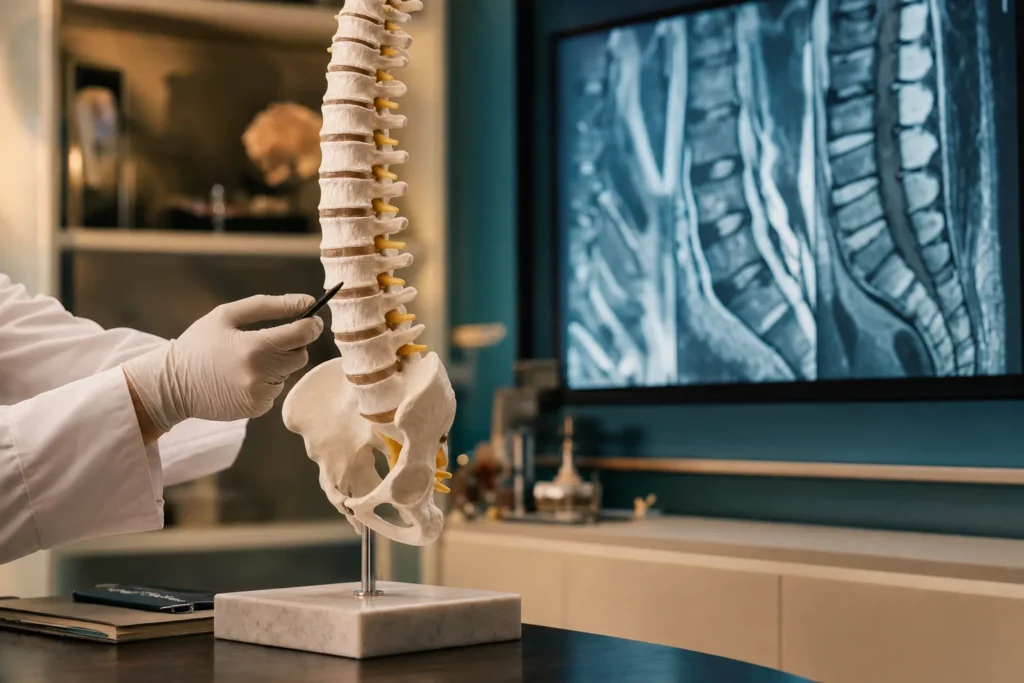
Disc herniation (spine)
A disc herniation, often called a "slipped disc," is one of the most common causes of back, neck, leg or arm pain. The good news is that most people get better with simple, non-surgical care. This guide explains in plain language what a herniated disc is, why it happens, how doctors diagnose and treat it, and what to think about if you are considering surgery abroad.
What disc herniation is
Your spine is a stack of bones called vertebrae. Between each pair of bones sits a small, round cushion called an intervertebral disc. Each disc has a tough outer ring (doctors call it the annulus fibrosus) and a soft, jelly-like centre (the nucleus pulposus). These discs act like shock absorbers, letting you bend, twist and move comfortably.
A disc herniation happens when part of that soft centre pushes out through a tear or weak spot in the tough outer ring. You may also hear it called a slipped disc, prolapsed disc, or ruptured disc. The disc does not actually "slip" out of place; rather, a small fragment of the inner material bulges or escapes outward.
By itself, a bulging disc may cause no trouble at all. In fact, many people have a herniated disc and never feel a thing. Problems usually begin only when the escaped material presses on or irritates a nearby spinal nerve. That pressure is what produces the pain, numbness, tingling or weakness that brings most people to a doctor.
Disc herniation is common. In the United States, more than three million people experience a herniated disc each year, according to Cleveland Clinic. It is one of the most frequent reasons adults seek help for back or neck pain, and for most of them the story ends well.
Types and where they happen
Discs can herniate anywhere along the spine, but they appear far more often in two areas:
- Lower back (lumbar spine). This is the most common location. A herniated disc here can press on nerves that travel down into the buttock and leg, causing the well-known leg pain called sciatica.
- Neck (cervical spine). The second most common location. A herniated disc here can press on nerves heading into the shoulder, arm and hand.
- Mid-back (thoracic spine). Herniation here is rare because this part of the spine moves less and is supported by the rib cage.
Doctors also describe how far the inner material has travelled. A disc may be bulging (the outer ring stretches but stays intact), protruded (the inner material pushes against the outer ring), extruded (material breaks through the ring), or sequestered (a fragment separates and moves into the spinal canal). These terms simply describe the shape and stage; they do not always match how much pain you feel. A small herniation in a sensitive spot can hurt more than a large one elsewhere.
Causes and risk factors
In most cases there is no single dramatic injury. The usual cause is gradual wear and tear that comes with age. Over the years, discs lose some of their water content, becoming less flexible and more prone to tearing, even during ordinary movements such as bending to pick something up. Doctors call this natural process disc degeneration.
Sometimes a herniation follows a specific strain, such as lifting a heavy object using the back rather than the legs, or twisting forcefully while lifting. A fall or accident can also play a part, though this usually affects a disc that was already weakened.
According to Mayo Clinic, Cleveland Clinic and MedlinePlus, the things that raise your risk include:
- Age, with herniation most common between about 30 and 50 years.
- Excess body weight, which puts extra load on the lower back.
- Work that strains the spine, such as repeated lifting, pulling, bending or twisting, or jobs involving long-term whole-body vibration (for example, driving trucks).
- Long periods of sitting and a sedentary lifestyle.
- Smoking, which reduces the oxygen and nutrients reaching the disc and weakens its tissue.
- Family history, as a tendency to herniation can run in families.
Knowing your risk factors is useful, but it is not a verdict. Many people with several risk factors never develop symptoms, and some changes (such as stopping smoking, staying active and lifting carefully) are within your control.
Signs, symptoms and when to see a doctor
Symptoms depend on where the disc has herniated and which nerve, if any, is being irritated. Common signs include:
- Pain that radiates. With a lumbar (lower back) herniation, pain often shoots from the buttock down the back of one leg, sometimes past the knee and into the foot, this is sciatica. With a cervical (neck) herniation, pain may travel into the shoulder, arm or hand.
- Numbness or tingling in the area served by the affected nerve, such as part of a leg, foot, arm or hand.
- Muscle weakness in the affected limb, which may make you stumble or struggle to grip or lift things.
- Back or neck pain that may worsen with certain movements, coughing or sneezing.
It is worth knowing what is reassuring as well. Pain on one side of the body, that comes and goes, and that eases with rest or gentle movement, is typical of a herniated disc and usually improves over weeks.
See a doctor if pain is severe, does not start to settle after a few weeks, keeps you from your usual activities, or is joined by numbness or weakness. The NHS also advises seeing a doctor if back pain comes with a high temperature, unexplained weight loss, or pain that is clearly worse at night.
Seek emergency care straight away (in the UK, call 999 or go to A&E) if you notice any of these red flag signs, which can point to a rare but serious condition called cauda equina syndrome, described below:
- Numbness or tingling around the genitals, buttocks or inner thighs (sometimes called "saddle" numbness).
- Loss of control of your bladder or bowels, or being unable to pass urine.
- Numbness, severe weakness or paralysis affecting both legs.
Screening and early detection
There is no routine screening test for disc herniation, and no benefit in scanning people who have no symptoms. This is an important point: studies show that many people without any back trouble have disc bulges on a scan that cause them no problems at all. Imaging a healthy back can lead to worry and unnecessary treatment for findings that were never going to matter.
Because of this, doctors and guideline bodies recommend imaging only when symptoms are persistent, severe, or accompanied by warning signs. The most useful form of "early detection" for you is simply paying attention to your body: noticing radiating pain, numbness or weakness early, and seeing a clinician rather than pushing through it. Acting promptly on the red-flag emergency symptoms listed above is the one situation where speed genuinely matters.
How it is diagnosed
Most herniated discs are diagnosed from your history and a physical examination, without any need for immediate scans.
During the examination, the clinician will ask where the pain travels and what makes it better or worse, then check your reflexes, muscle strength and sensation to work out which nerve may be affected. A common test for lumbar herniation is the straight leg raise, in which you lie down and the doctor gently lifts your straightened leg; if this reproduces your leg pain, it suggests nerve irritation.
If symptoms are severe, are not improving, or surgery is being considered, imaging may be used:
- MRI (magnetic resonance imaging) is the most useful test. It shows the discs, nerves and soft tissues clearly and confirms whether a herniation is pressing on a nerve. The American Association of Neurological Surgeons notes that MRI is typically arranged after symptoms have persisted for around six weeks, unless red-flag signs are present.
- CT scan gives a detailed view of the bones and can be combined with a dye (a myelogram) to outline the nerves.
- X-rays do not show discs directly but can rule out other causes of pain, such as fractures or alignment problems.
- Nerve studies (EMG and nerve conduction tests) can help pinpoint which nerve is affected when the picture is unclear.
Crucially, doctors match the scan to your symptoms. Treatment is guided by how you feel and what the examination shows, not by the image alone.
Treatment options
The most reassuring fact about disc herniation is that the great majority of people recover without surgery. According to Cleveland Clinic and the American Association of Neurological Surgeons, roughly 9 out of 10 people improve with conservative (non-surgical) care, often within weeks. Many herniations even shrink on their own over time as the body reabsorbs the escaped material.
Non-surgical care is almost always the starting point and usually includes:
- Staying gently active. Long bed rest is no longer advised. Keeping moving with gentle activity such as walking helps recovery; a short rest of a day or two is fine when pain is at its worst.
- Pain relief. Over-the-counter anti-inflammatory medicines (such as ibuprofen) or paracetamol/acetaminophen, used as directed, help many people stay mobile. Stronger medicines, such as a short course of muscle relaxants, may be prescribed; opioid painkillers, if used at all, are only for short periods because of the risk of dependence.
- Physiotherapy. A physiotherapist can teach exercises and movements that ease pressure on the nerve, build supporting muscles and reduce the chance of recurrence.
- Heat or cold, which can soothe muscle spasm and discomfort.
- Epidural steroid injections. If pain is persistent, an injection of anti-inflammatory steroid medicine near the affected nerve can reduce inflammation and pain for some people.
Surgery is considered only for a minority, typically when severe pain has not settled despite weeks of proper conservative care, when there is progressive muscle weakness, or in an emergency such as cauda equina syndrome. Common procedures, which are part of the field of neurosurgery and spinal surgery, include:
- Microdiscectomy / discectomy: removal of the herniated fragment that is pressing on the nerve, often through a small incision using a microscope. This is the most common operation for a herniated disc.
- Laminotomy or laminectomy: removing a small part of the bony arch of the vertebra to give the nerve more room.
- Artificial disc replacement or spinal fusion: used in selected cases, for example when a disc is badly worn or the spine needs stabilising.
Care is best delivered by a multidisciplinary team, which may include a spinal surgeon or neurosurgeon, a physiotherapist, a pain specialist and a rehabilitation team, so that the plan fits your particular situation.
Outlook and what to expect
For most people, the outlook is good. Mayo Clinic and MedlinePlus note that symptoms commonly ease within about four to six weeks, and most people improve within a month or so with non-surgical care. Some episodes settle even faster, while others take longer, and a minority have symptoms that come back from time to time.
When surgery is needed for a herniated disc, results for relieving leg or arm pain are generally favourable in carefully selected patients, particularly with microdiscectomy. As with any operation, outcomes vary from person to person and depend on factors such as how long the nerve has been compressed, your general health, and how closely rehabilitation is followed. No operation can guarantee a particular result, and your surgeon should explain the likely benefits and the risks in your specific case.
It is normal to feel anxious when pain radiates down a limb, but try to hold on to the bigger picture: disc herniation is common, it is well understood, and most people return to their usual lives. These figures describe groups of people studied over time, not a prediction for any one individual, so your own recovery should be discussed with a clinician who knows your situation.
Living with it and follow-up
Recovering from a herniated disc, with or without surgery, is partly an active process. Most people benefit from:
- Keeping moving within comfortable limits, and gradually building back to normal activity rather than avoiding movement out of fear.
- Following a physiotherapy programme, including core and back-strengthening exercises, which can reduce the risk of further episodes.
- Adjusting daily habits, such as how you sit, lift and set up your workspace, to take strain off the spine.
- Pacing activity, breaking up long periods of sitting and avoiding sudden heavy lifting while you heal.
Follow-up depends on your treatment. After conservative care, you may simply check in if symptoms do not improve or return. After an injection or surgery, your team will arrange reviews to track your recovery and guide your return to work, driving and exercise. Tell your clinician promptly if pain worsens, weakness develops, or any red-flag symptom appears. It is also normal for mood to dip during a painful spell; mentioning this to your care team is worthwhile, as good pain control and reassurance are part of recovery.
Planning treatment abroad: what affects cost and how to prepare
If your symptoms point towards a procedure, and you are considering having it in Turkiye, it helps to understand what shapes the overall cost so you can plan realistically. We do not list fixed prices here, because the right plan, and therefore the cost, depends on your individual situation. The main factors include:
- The procedure itself, for example a single-level microdiscectomy versus a more involved operation such as fusion or artificial disc replacement.
- Which part of the spine is treated, and how many levels are involved.
- The diagnostic work needed, such as an up-to-date MRI, blood tests and a specialist assessment.
- Hospital stay and aftercare, including physiotherapy and follow-up reviews.
- Your general health, which can affect the type of anaesthesia and the level of monitoring required.
- Travel and accommodation for you and anyone accompanying you, and the length of stay your team recommends before flying home.
To prepare, gather your medical records in advance: recent imaging (MRI or CT scans, ideally the original files on disc, not just the report), a summary of your symptoms and how long you have had them, a list of treatments already tried, your current medicines, and details of any other health conditions. Sharing these allows a specialist to review your case properly and give you a personalised plan. The clearest way to understand likely costs for your situation is to request a personalised estimate through a free consultation, after a specialist has reviewed your records.
Why Turkiye, and how to choose a good centre
Turkiye has become a well-established destination for international patients seeking spinal and neurosurgical care, supported by modern hospitals and internationally trained specialists. Many leading Turkish hospitals hold accreditation from Joint Commission International (JCI), a widely recognised international standard for healthcare quality and patient safety; Turkiye is among the countries with a large number of JCI-accredited institutions.
Rather than choosing on price or marketing alone, it is sensible to verify a few practical things before committing:
- Accreditation, such as current JCI accreditation of the hospital.
- The surgeon's qualifications and experience, specifically in spinal and disc surgery, and how often they perform the procedure you need.
- A genuine multidisciplinary team, including physiotherapy and rehabilitation, not just an operating surgeon.
- Clear, written information on the proposed procedure, its risks and benefits, and what your recovery and follow-up will involve.
- A proper review of your records and imaging before any plan is confirmed, and a willingness to recommend non-surgical care if that is more appropriate for you.
- Aftercare arrangements, including how the team will support you once you return home and who to contact with questions.
A trustworthy centre will be transparent, will not pressure you, and will be honest if surgery is not the best option in your case.
Prevention and self-care
You cannot stop your discs from ageing, but several everyday habits can lower your risk of a herniation or a recurrence, and are recommended by Mayo Clinic and the NHS:
- Stay active. Regular exercise that builds core and back strength helps support and stabilise the spine.
- Lift carefully. Bend at the hips and knees rather than the back, keep loads close to your body, and avoid twisting while lifting heavy objects.
- Mind your posture. Sit and stand with good support, and break up long periods of sitting with movement.
- Keep to a healthy weight, to reduce the load carried by your lower back.
- Do not smoke. Smoking weakens disc tissue by reducing its blood and nutrient supply, so stopping protects your spine as well as the rest of your body.
If you already have back or neck trouble, gentle, consistent self-care, staying active, doing your physiotherapy exercises and pacing yourself, is usually more helpful than either complete rest or pushing through pain. If anything is unclear, a qualified specialist can tailor advice to you.
Frequently asked questions
Is a slipped disc the same as a herniated disc?
Will my herniated disc heal without surgery?
How long does a herniated disc take to get better?
When should I worry and get emergency help?
What is sciatica, and is it the same as a herniated disc?
Do I need an MRI scan?
Should I rest in bed until the pain goes away?
What kind of surgery is used for a herniated disc?
Can a herniated disc come back after treatment?
Can I prevent a herniated disc?
How are costs for spine treatment in Turkiye worked out?
Sources
- NHS — Slipped disc
- Cleveland Clinic — Herniated Disk
- Cleveland Clinic — Cauda Equina Syndrome
- Mayo Clinic — Herniated disk
- Mayo Clinic Press — Herniated disks explained
- MedlinePlus — Herniated Disk
- American Association of Neurological Surgeons — Herniated Disc
- Joint Commission International — Accredited Organizations
This article is for general information only and is not medical advice. Always consult a qualified doctor about your individual case.
Specialists in Neurosurgery
Doctors of the department we work with directly. Which doctor takes your case is decided after the specialists have reviewed your records — your coordinator confirms it, not this page.




Considering this procedure?
Send us your photos and questions. A BergemHealth coordinator and a senior specialist will review your case and reply with honest, personalised guidance — no obligation.
Free consultation