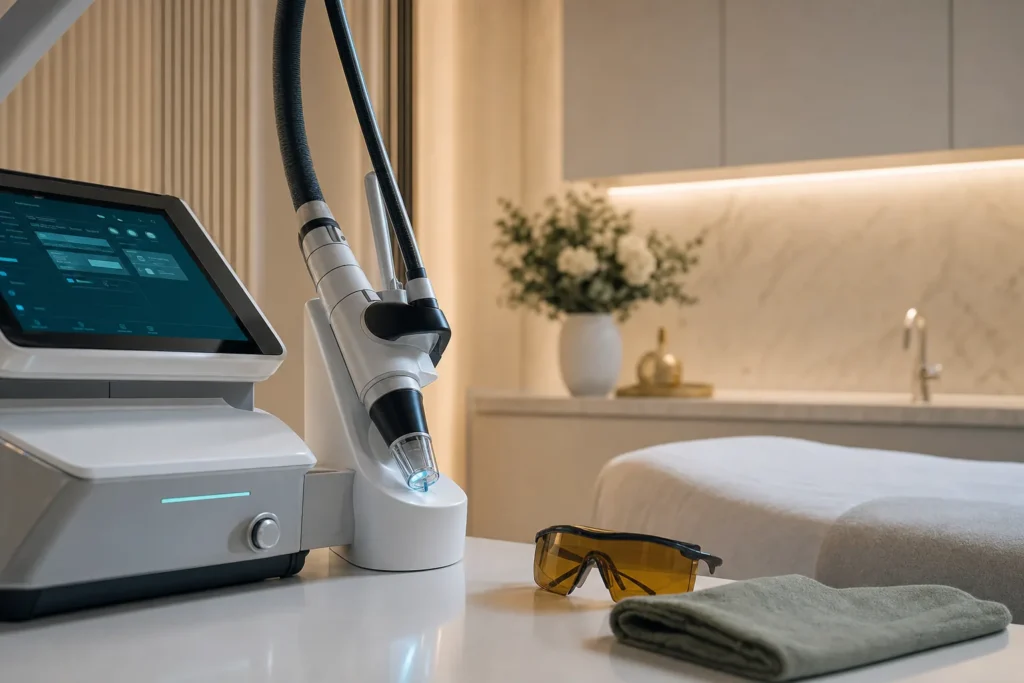
Laser CO2 / Fraxel
Laser skin resurfacing uses focused light to remove or heat damaged skin and stimulate new collagen, softening lines, scars, pigmentation and texture. This guide explains the difference between ablative fractional CO2 and non-ablative fractional (Fraxel) lasers, how fractional treatment works, how many sessions to expect, the very different downtime each involves, and how skin type affects safety, so international patients can weigh their options calmly and ask the right questions.
- Anaesthesia
- Topical numbing cream for lighter non-ablative sessions; local anaesthesia with sedation for deeper or partial-face ablative treatment; general anaesthesia may be used for full-face ablative CO2 resurfacing.
- Duration
- Roughly 30-45 minutes for a partial-face treatment and about 1.5-2 hours for full-face ablative resurfacing; non-ablative Fraxel sessions are often shorter.
- Recovery
- Non-ablative (Fraxel) typically involves a few days of redness and flaking; ablative fractional CO2 usually needs up to about two weeks of visible healing, with pinkness fading over 2-3 months and occasionally up to a year.
- Hospital stay
- Usually an outpatient (day-case) procedure with no overnight hospital stay.
Minimum price, for reference only — the final cost is calculated individually after your records are reviewed. You pay the hospital’s price; our service is free for you.
What laser skin resurfacing is
Laser skin resurfacing (also called a laser peel or laser vaporisation) is a cosmetic procedure that uses concentrated beams of light to improve the surface and tone of the skin. According to the American Society of Plastic Surgeons, the laser removes the outer layer of skin while heating the deeper layer (the dermis) to stimulate new collagen growth, so that the skin that heals tends to look smoother and firmer.
There are two broad families of laser resurfacing devices. Ablative lasers, such as the carbon dioxide (CO2) laser and the erbium laser, vaporise thin layers of skin. Non-ablative lasers, including non-ablative fractional devices marketed under names such as Fraxel, heat the deeper skin to prompt collagen remodelling while largely leaving the outer surface intact. Cleveland Clinic notes that CO2 systems have been used for years and now deliver light very precisely.
Fraxel is a brand that covers more than one device: some Fraxel platforms are non-ablative, while a fractional ablative CO2 system can also carry a Fraxel name. The practical distinction is whether a treatment is ablative (more downtime, often stronger results in one session) or non-ablative (less downtime, usually needing a course of sessions).
Who is a candidate
The American Society of Plastic Surgeons lists common reasons people consider this procedure: fine lines and wrinkles around the eyes, forehead or mouth; acne or chickenpox scars; aged or sun-damaged skin and liver (age) spots; uneven or discoloured skin; skin that has not responded after a facelift; certain birthmarks; warts; and enlarged oil glands on the nose. Non-ablative fractional lasers are also widely used for skin texture and milder pigmentation.
Good candidates are generally in good overall health, are non-smokers or willing to stop, and have realistic expectations. According to ASPS, you may not be a good candidate if you have active acne, very dark skin, or deep wrinkles or excessive (sagging) skin that resurfacing alone cannot correct. ASPS also notes that patients with darker skin tones have a greater risk of healing with darker pigmentation (hyperpigmentation).
Some factors call for caution: a history of keloid or hypertrophic scarring, poor wound healing, a tendency to cold sores (which can be reactivated), recent isotretinoin use, and active infection in the treatment area. The peer-reviewed literature highlights poor wound healing, keloids and hypertrophic scarring as reasons to avoid aggressive resurfacing. Anyone considering treatment should discuss medical history, medications and previous skin reactions with the treating clinician, who can advise whether resurfacing, a different laser, or a non-laser option is most appropriate.
Types and techniques
It helps to think along two axes: ablative versus non-ablative, and fully resurfacing versus fractional.
- Ablative CO2 laser: Vaporises the outer skin and heats the dermis. It is typically the most powerful option for deeper wrinkles, photodamage and scars, with the longest recovery. Cleveland Clinic gives a recovery time of up to two weeks for CO2 resurfacing.
- Ablative erbium laser: Designed for superficial to moderately deep lines. Cleveland Clinic gives a recovery time of one full week for erbium resurfacing, generally shorter than CO2.
- Fractional CO2 (ablative fractional): Delivers narrow columns of laser light deep into the skin while leaving the surrounding skin intact, which speeds healing compared with fully ablative treatment. Cleveland Clinic gives a recovery time of one full week for fractional resurfacing. The peer-reviewed literature cautions that deeper or more aggressive treatment carries a greater risk of complicated healing and scarring.
- Non-ablative fractional (Fraxel): Heats microscopic columns in the dermis without removing the surface. Downtime is usually only a few days, but a course of sessions is generally needed to build a comparable result.
How fractional treatment works: instead of treating the entire surface at once, a fractional laser treats only a fraction of the skin in a grid of tiny columns, leaving healthy untreated skin in between. Cleveland Clinic explains that fractionated CO2 resurfacing drills numerous narrow columns deep into the skin while the surrounding skin remains untreated and intact, which is why fractional devices generally have shorter recovery than older fully ablative resurfacing.
How it is performed
Laser resurfacing is usually done on an outpatient basis, so most patients go home the same day. Anaesthesia depends on the device and the area treated. Cleveland Clinic notes that local anaesthesia combined with orally or intravenously administered sedatives is common, and general anaesthesia may be used when the entire face is treated; lighter non-ablative sessions are often managed with topical numbing cream alone.
A typical sequence is: the skin is cleansed; numbing or anaesthesia is applied; protective eyewear is worn; and the laser is passed over the treatment area. For ablative CO2, Cleveland Clinic gives a duration of about 30 to 45 minutes for a partial-face treatment and around 1.5 to 2 hours for a full face. After ablative treatment, a dressing may be applied early on, after which the area is cleansed several times a day and kept moist, following the clinic's instructions.
Number of sessions: a deeper ablative CO2 treatment is frequently performed as a single session, with touch-ups as needed over time. Non-ablative fractional (Fraxel-type) treatment is generally given as a course of several sessions spaced a few weeks apart, because each session is gentler. Your clinician sets the exact plan based on your skin and goals.
Recovery timeline
Recovery differs sharply between the two families, which is one of the most important points for travellers to plan around.
Ablative CO2 / fractional CO2:
- Days 1 to 2: The skin can feel and look like a sunburn, with redness, swelling, and sometimes itching or stinging. ASPS advises elevating the head with an extra pillow at night and using an ice pack during the first day or two to ease swelling and discomfort.
- Around five days to a week: ASPS notes the skin typically becomes dry and begins to peel about five days to a week after treatment, revealing pink new skin.
- Healing window: ASPS gives an overall healing window of up to two weeks for CO2 and one full week for erbium; Cleveland Clinic likewise gives up to two weeks for CO2.
- Colour fading: ASPS notes the new skin is pink and gradually lightens over about two to three months, and that it may take up to a year for the pinkness to go away. ASPS adds that redness tends to last longer in blondes and redheads.
Non-ablative fractional (Fraxel): downtime is usually limited to a few days of redness and flaking that many people find manageable, but results build gradually across the planned course of sessions rather than appearing all at once.
Throughout recovery, daily sunscreen is essential, crusts should not be picked, and makeup is generally introduced only once the skin has healed, following your clinician's guidance.
Risks and complications
Laser resurfacing is generally well tolerated when performed appropriately, but it is a medical procedure with real risks. ASPS, Cleveland Clinic and the peer-reviewed literature describe possible complications including:
- Milia (small white bumps) and acne flares, described in the literature as minor side effects that usually resolve.
- Pigment changes: hyperpigmentation (darkening), especially in darker skin tones, and more rarely hypopigmentation (lightening). A peer-reviewed review notes that delayed-onset permanent hypopigmentation seen in up to roughly 19% of cases with previous-generation CO2 lasers is now very uncommon with fractional resurfacing, though it remains possible with excessive treatment.
- Infection: bacterial infection, and reactivation of the herpes simplex (cold sore) virus; the literature notes prophylactic antibiotics and antivirals are standard.
- Prolonged redness and swelling.
- Scarring: uncommon but possible. One review of fractional CO2 resurfacing cites a 3.8% incidence of scarring documented by Manuskiatti, with every case in that series resulting from infection; the review adds that the neck and chest are more susceptible to scarring than the face, and that the lower eyelid can be vulnerable if too much energy or density is used.
The same literature stresses that careful patient selection, appropriate laser settings (avoiding excessive fluence, density or multiple passes), and prophylactic antibiotics and antivirals are central to preventing complications. Patients with a history of keloids or poor wound healing are at higher risk and should raise this before treatment.
Results and longevity
With ablative treatment, some improvement is visible once the initial healing is complete, and the skin can continue to improve over the following months as collagen remodels. Results can last several years, but laser resurfacing does not stop the ageing process: new lines and sun damage can develop over time, which is why some people choose maintenance or repeat treatments later.
Non-ablative fractional treatment tends to produce subtler, gradual improvement that accumulates over a course of sessions and with ongoing collagen remodelling in the months afterwards. It generally offers a gentler change than a single strong ablative session.
Realistic expectations matter. Resurfacing can soften fine lines, improve texture, fade some pigmentation and improve the appearance of scars, but it cannot remove deep folds, tighten significantly sagging skin, or fully clear all scars or pigmentation. Sun protection after treatment is a major factor in how long results last, since further sun damage undermines the benefit.
Costs: ranges, factors and disclaimer
Prices vary widely by country, device, the size of the area treated, the number of sessions, and the experience of the provider. The figures below are indicative ranges only and not a quote; the actual cost depends on your individual case, surgeon and clinic.
In higher-cost markets such as the United States, publicly reported pricing for full-face fractional CO2 laser treatment is often in the region of several thousand dollars per treatment, while a single non-ablative Fraxel session is commonly quoted lower, with several sessions usually recommended for a full course. Because non-ablative treatment is planned as a course, the total cost can approach or exceed that of a single ablative session.
For Turkiye, publicly reported indicative figures for fractional CO2 resurfacing are frequently quoted from roughly a few hundred euros per session up into the low four figures for a full-face treatment, which is why many international patients consider it. As a rough working range for this guide, we use an indicative EUR 300 at the lower end (a single, smaller non-ablative or fractional session) up to about EUR 5,000 for more extensive ablative work or a multi-session course in higher-cost markets. Your laser resurfacing cost should always be confirmed in writing for your specific plan.
When comparing quotes, check what is included: consultation, the laser session(s), anaesthesia, post-treatment medication (such as antivirals), aftercare products, and follow-up. The cheapest headline price is rarely a fair comparison if it excludes these. Laser resurfacing for cosmetic reasons is generally not covered by insurance.
Why Turkiye, and choosing a qualified provider
Turkiye is a well-established medical-tourism destination, and many patients are drawn by competitive pricing and modern laser platforms. As with any country, quality varies between providers, so the most important decisions are about who treats you and how, not just price.
Look for a clinician with documented training and experience specifically in laser surgery. ASPS and Cleveland Clinic both emphasise choosing a provider with demonstrated laser experience. For aesthetic and reconstructive credentials, recognised markers include board certification and membership of respected bodies such as the European Board of Plastic, Reconstructive and Aesthetic Surgery (EBOPRAS) and the International Society of Aesthetic Plastic Surgery (ISAPS); experienced board-certified dermatologists also commonly perform laser resurfacing.
Things to verify before committing:
- The clinician's qualifications, board certification and laser-specific experience.
- Which device will be used and whether it is ablative or non-ablative, and why it suits your skin.
- Experience treating your specific skin type (see the next section).
- The facility's accreditation, hygiene standards and complication protocols.
- A clear written plan, costs, aftercare, and arrangements for follow-up once you return home.
Preparing and what to ask at consultation
Preparation usually starts weeks before treatment. Cleveland Clinic advises avoiding tanning or heavy sun exposure and using a broad-spectrum sunscreen daily for four weeks before treatment, because tanned or recently sun-exposed skin raises the risk of pigment problems. Your clinician may also advise stopping smoking, pausing certain skincare products or medications, and starting antiviral medication if you are prone to cold sores. For people at higher risk of post-inflammatory hyperpigmentation, published guidance notes that pre- and post-treatment with bleaching agents such as hydroquinone has been shown to reduce that risk.
Useful questions to ask at consultation include:
- Am I a good candidate for ablative or non-ablative treatment, and why?
- How many sessions will I likely need, and how far apart?
- What downtime should I plan for, and when can I fly and return to work?
- Given my skin type, what is my risk of pigment changes, and how will you reduce it?
- What are the realistic results, and what will this not fix?
- What is the plan if a complication occurs after I travel home?
Aftercare, follow-up and travelling for treatment
Good aftercare strongly influences both safety and results. ASPS and Cleveland Clinic guidance typically includes: cleansing the treated area several times a day as instructed, keeping the skin moist, not picking crusts, sleeping with the head elevated early on, and applying broad-spectrum sunscreen every day. Stronger active skincare, such as retinoids and glycolic acid, is usually reintroduced only after the skin has healed, on your clinician's advice.
Skin-type considerations: Fitzpatrick skin type matters. Published guidance (StatPearls) notes the risk of post-procedure hyperpigmentation or hypopigmentation is higher in Fitzpatrick skin types IV through VI, because melanin absorbs more laser energy. That guidance suggests lower treatment densities for darker skin, considering longer-wavelength lasers, and pre- and post-treatment measures such as bleaching agents and epidermal cooling. Choosing a provider experienced with skin of colour is sensible, since appropriate settings reduce the risk of pigment problems.
Travelling for treatment and flying: resurfacing is usually a day-case procedure, so no hospital stay is normally required. However, healing is visible and the skin is fragile, so plan your trip around the downtime: a few days for non-ablative fractional, or roughly one to two weeks of visible healing for ablative CO2. Flying itself is generally not the limiting factor, but you should not travel while skin is raw, oozing or at risk of infection. Confirm with your clinician when it is safe to fly home, attend a final check, and arrange remote follow-up for the months of redness that can follow.
Frequently asked questions
What is the difference between CO2 laser and Fraxel?
How does a fractional laser work?
How many sessions will I need?
How much downtime does each type involve?
Does laser resurfacing hurt?
What can laser resurfacing treat?
Is it safe for darker skin tones?
What are the main risks?
How long do the results last?
How much does laser resurfacing cost?
When can I fly after treatment?
Will insurance cover it?
Sources
- American Society of Plastic Surgeons - Laser Skin Resurfacing
- American Society of Plastic Surgeons - Laser Skin Resurfacing Recovery
- American Society of Plastic Surgeons - Laser Skin Resurfacing Candidates
- Cleveland Clinic - Laser Skin Resurfacing
- Cleveland Clinic - Carbon Dioxide (CO2) Laser Resurfacing
- Mayo Clinic - Laser resurfacing
- Fractional CO2 Laser Resurfacing Complications (review, NIH/PMC)
- Post-inflammatory hyperpigmentation after CO2 laser: prevention and risk factors (NIH/PMC)
- Laser Fitzpatrick Skin Type Recommendations - StatPearls (NCBI)
This article is for general information only and is not medical advice. Always consult a qualified doctor about your individual case.
Specialists in Plastic & Aesthetic Surgery
Doctors of the department we work with directly. Which doctor takes your case is decided after the specialists have reviewed your records — your coordinator confirms it, not this page.


Considering this procedure?
Send us your photos and questions. A BergemHealth coordinator and a senior specialist will review your case and reply with honest, personalised guidance — no obligation.
Free consultation