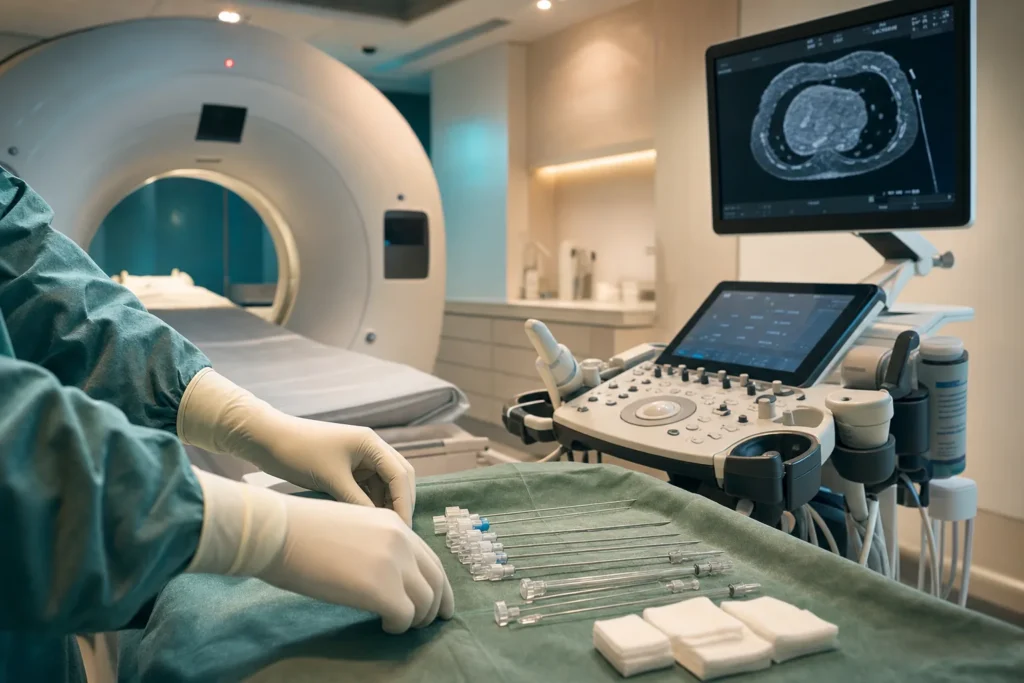
Image-guided biopsy
An image-guided biopsy lets a doctor take a tiny tissue sample from deep inside your body without surgery, using a live scan to steer a thin needle to exactly the right spot. This guide explains in plain words how it works, what the day feels like, the risks, how accurate it is, and what it tends to cost if you travel to Turkiye (Turkey) for it.
- Anaesthesia
- Usually local anaesthetic (the area is numbed); light sedation sometimes added. General anaesthesia is rare and mainly for children.
- Duration
- The needle part typically takes about 15-30 minutes; you may be in the room up to an hour, and a lung or liver biopsy can take around an hour with setup.
- Recovery
- Most people return to light activities the same or next day; avoid strenuous exercise and heavy lifting for about 48 hours (up to a week after a liver biopsy).
- Hospital stay
- Almost always a same-day (outpatient) procedure. Lung and liver biopsies usually include a few hours of monitoring before you go home.
Indicative hospital range, confirmed after your file is reviewed. You pay the hospital’s price — we add no markup.
What it is
A biopsy is when a doctor takes a small sample of tissue or cells from your body so a specialist can examine it under a microscope. An image-guided biopsy is a way of doing this without open surgery: instead of making a large cut, the doctor passes a thin needle through the skin to the exact spot that needs sampling, watching a live medical scan the whole time to steer the needle precisely.
The word for going through the skin with a needle is percutaneous ("through the skin"). Because the doctor can see both the needle and the target on a screen as they work, the needle can reach things that are deep inside the body, such as a lump in the liver, lung, kidney, breast, thyroid, lymph node, or bone, while avoiding nearby blood vessels and organs.
The doctor who usually performs it is an interventional radiologist, a specialist trained both in reading scans and in carrying out minimally invasive procedures guided by those scans. The sample they collect goes to a pathologist, a doctor who studies tissue, to find out whether a lump is harmless (benign) or cancerous (malignant), to identify an infection, or to understand a disease so the right treatment can be chosen.
Compared with a surgical biopsy, an image-guided needle biopsy is less invasive, leaves little or no scar, and usually lets you go home the same day, while giving results that are about as reliable as a sample taken in the operating room.
Who is a good candidate
Your doctor may suggest an image-guided biopsy when a scan or examination finds something that needs a tissue diagnosis rather than just a picture. Common reasons (the kind people search as "biopsy for a lump" or "do I need a biopsy") include:
- A lump, nodule, or mass seen on ultrasound, mammogram, CT, MRI, or PET that needs to be identified.
- An abnormal area in an organ such as the liver, lung, kidney, thyroid, prostate, or pancreas.
- A swollen or suspicious lymph node.
- Working out the exact type of a known cancer, or checking whether it has changed or spread.
- Diagnosing some infections, inflammation, or organ diseases (for example chronic liver disease).
It is a strong choice for people who want to avoid an operation, who have a target a needle can safely reach, and who can briefly pause blood-thinning medicines if needed.
Who should be cautious or avoid it. An image-guided biopsy may not be suitable, or may need extra planning, if you:
- Have a bleeding disorder or take blood thinners (such as warfarin, aspirin, clopidogrel, or newer anticoagulants) that cannot be safely paused.
- Cannot lie still in the required position, or cannot hold your breath when asked (important for lung and liver biopsies).
- Are pregnant, especially where the scan would use radiation (CT or X-ray) rather than ultrasound or MRI.
- Have a target that is too small, too risky to reach, or hidden behind bone, bowel, or major vessels, in which case a surgical biopsy or repeat scan may be safer.
- Have an active infection over the planned needle path.
Your care team weighs these factors for your specific case. Always tell them about every medicine and supplement you take and any allergies, particularly to contrast dye or local anaesthetic.
Types and techniques
Two things vary in an image-guided biopsy: the kind of needle used, and the kind of scan used to guide it.
Types of needle
- Fine-needle aspiration (FNA). A very thin needle, finer than the one used to draw blood (often 25 or 27 gauge for the thyroid), with a syringe to draw out fluid and loose clusters of cells. It is the gentlest option and is common for thyroid nodules and lymph nodes.
- Core needle biopsy. A slightly thicker, spring-loaded needle that removes one or more small cylinders ("cores") of solid tissue, often about 2 mm across. Because it keeps the tissue structure intact, it gives the pathologist more to work with than FNA and is widely used for breast, liver, lung, kidney, and bone.
- Vacuum-assisted biopsy (VAB). A device that uses gentle suction to pull more tissue into the needle through a single insertion, often used for the breast.
Types of image guidance
- Ultrasound. Uses sound waves, shows the needle moving in real time, has no radiation, and is excellent for the breast, thyroid, lymph nodes, and liver.
- CT (computed tomography). Cross-sectional X-ray images, ideal for deep or hard-to-see targets such as the lung, certain abdominal masses, and bone.
- MRI. Uses magnets and radio waves, no radiation, used for some breast lesions and other targets best seen on MRI.
- Mammography with stereotactic guidance. A specialised breast X-ray that locates a target using images from two angles, especially useful for tiny calcium specks (calcifications) in the breast.
- Fluoroscopy. Live X-ray, sometimes used to guide the needle to bone or other structures.
Your team chooses the combination that gives the clearest view with the least risk for your particular target.
How it is done
On the day, you change into a gown and lie on the scan table in the position that gives the best view of the target. You are usually awake the whole time.
Anaesthesia. The skin and the path the needle will take are numbed with a local anaesthetic injection. You may feel a small pinch and a brief stinging or burning as it goes in; after that the area should be numb. For longer or deeper procedures, the team can add light sedation through a drip to help you relax. General anaesthesia (being put fully to sleep) is rarely needed and is mostly used for children.
The steps.
- The skin is cleaned with antiseptic and covered with a sterile drape.
- The local anaesthetic is injected.
- For a core biopsy, the doctor may make a tiny nick in the skin so the needle can pass through easily.
- Watching the live scan, the doctor advances the needle to the target and takes one or more samples. With a core or vacuum needle you may hear a quick click and feel pushing or pressure, not sharp pain.
- In some biopsies (for example the breast), a tiny metal marker is left at the site so the spot can be found again on future scans. It is harmless and not visible from outside.
- The needle comes out, firm pressure is applied to stop any bleeding, and a small dressing or bandage is placed. Stitches are usually not needed.
How long it takes. The needle part often takes only about 15-30 minutes, though you may be in the room up to an hour with positioning and imaging. A thyroid FNA is usually done in under 30 minutes; a liver biopsy is about 30 minutes; a CT-guided lung biopsy commonly takes around an hour. Afterwards, lung and liver biopsies include a period of monitoring before you leave.
Recovery, step by step
Recovery from an image-guided biopsy is usually quick and gentle. Here is roughly how it unfolds.
- First hours (recovery room). You rest while staff check your pulse, blood pressure, and the biopsy site. After a lung biopsy you are typically watched for several hours and may have a chest X-ray to confirm the lung is fine. After a liver biopsy you usually lie down, often on your side, for up to about four hours.
- Going home. Most people go home the same day. If you had sedation, arrange for someone to take you home, and do not drive for the rest of that day (after a liver biopsy, avoid driving or operating machinery for at least 12 hours).
- First 24-48 hours. You can usually return to light daily activities the same or next day. Avoid strenuous exercise, running, and heavy lifting for about 48 hours. You may see mild bruising or feel tenderness at the site; the bandage can often come off after about a day, and you can usually shower normally.
- After a liver biopsy. Take it easier: avoid intense activity and heavy lifting for about a week.
- Mild discomfort. Some soreness is normal and usually settles with simple pain relief such as paracetamol (acetaminophen). Ask your team before taking anti-inflammatory painkillers like ibuprofen, as they can increase bleeding.
Call your clinic or seek urgent care if you have heavy or increasing bleeding, a fever, spreading redness or pus at the site, or worsening pain. After a lung biopsy specifically, seek emergency care for new shortness of breath, sharp chest or shoulder pain, a rapid pulse, or coughing up blood, as these can signal a collapsed lung.
Risks and possible complications
An image-guided needle biopsy is considered a minimally invasive procedure with a low complication rate, but no medical procedure is completely risk-free. Most problems are mild and settle on their own.
- Bleeding and bruising. The most common effects. A little bruising at the site is normal; significant bleeding is uncommon. After a liver biopsy, internal bleeding can occur but is rare.
- Infection. Any time the skin is broken there is a small infection risk; the chance of an infection serious enough to need antibiotics is reported as less than 1 in 1,000.
- Pain or soreness. Usually mild and short-lived.
- Collapsed lung (pneumothorax). A specific risk of lung biopsy, where air leaks into the space around the lung. It is watched for with monitoring and a chest X-ray; many cases are small and settle, while some need a thin tube to drain the air.
- Injury to nearby structures. Rarely, a nearby organ, blood vessel, or (in the lung) an air embolism can be affected; image guidance is used precisely to avoid this.
- Allergic reaction. Uncommon, mainly to contrast dye if it is used.
- A non-diagnostic or false-negative result. Occasionally the needle does not capture enough tissue, or just misses the target, so the sample cannot give a clear answer. This means the biopsy may need to be repeated; it does not usually mean harm. False-negative core biopsies are rare.
One large registry of biopsies found mild complications were more common with CT guidance than ultrasound, while the overall rate of serious problems was very low. A skilled team and good imaging keep these risks small.
Results and how long they last
The "result" of a biopsy is the pathologist's report on the tissue, not a treatment, so unlike a cosmetic procedure there is nothing that wears off over time. What matters is when you get the answer and what it means.
How long results take. A straightforward report is often ready within a few days to about a week. Liver biopsy results are usually available to your doctor within about a week, and breast biopsy results commonly within roughly 7-10 days. Some cases take longer, a few weeks or more, when extra laboratory tests are needed, such as special stains or genetic (molecular) tests to guide cancer treatment. If you are travelling, ask in advance how and when your results will be sent to you and to your doctor at home.
What the result tells you. The report says whether the tissue is benign or malignant and, if it is cancer, often the exact type and features that shape treatment. A clear, accurate diagnosis is the lasting value of the biopsy: it lets your team plan the next steps with confidence, whether that is reassurance and routine follow-up, or treatment such as surgery, medication, or radiotherapy. Needle biopsy results are about as accurate as those from a surgical sample; FNA of the thyroid, for example, is reported to be roughly 95% accurate.
Because a small minority of biopsies are inconclusive, a normal result is sometimes confirmed with follow-up imaging or a repeat sample, and your doctor will advise whether that is needed.
Costs
Prices for an image-guided biopsy vary widely depending on the country, the hospital, the organ involved, the type of needle and scan used, and how much laboratory work the samples need. The figures below are indicative ranges only and are not a quote: the real cost varies by case, doctor, and clinic.
As a rough guide, a single image-guided needle biopsy in Turkiye often falls somewhere in the region of EUR 300-2,500. A simpler ultrasound-guided thyroid or lymph-node FNA sits toward the lower end, while a CT-guided lung, deep abdominal, or bone biopsy, or one needing sedation and extended monitoring, sits higher. The pathology (laboratory analysis) is sometimes priced separately, and specialised molecular or genetic tests add to the total.
What changes the price:
- Which organ is biopsied and how complex the target is to reach.
- The imaging used (ultrasound is generally less costly than CT or MRI guidance).
- Needle type (FNA vs core vs vacuum-assisted).
- Whether sedation, an anaesthetist, and a hospital observation bed are needed.
- The number of samples and any extra pathology tests, special stains, or genetic profiling.
- Hospital category and the surgeon's or radiologist's experience.
- For international patients: any package that bundles scans, the procedure, pathology, interpreter, and transfers.
Always ask for a written, itemised estimate that states clearly what is and is not included, and whether pathology and any repeat sampling are covered.
Why people travel to Turkiye and how to choose a safe clinic
Turkiye has become a well-known destination for medical care because it combines modern, well-equipped private hospitals with prices that are often lower than in Western Europe and North America, short waiting times, and experienced staff used to international patients. For a diagnostic step like a biopsy, travellers often value getting the scan, the procedure, and the pathology arranged quickly in one place.
Choosing carefully matters far more than chasing the lowest price. Use the checklist below before you book.
- Hospital accreditation. Look for an internationally recognised standard such as JCI (Joint Commission International), which assesses patient safety and quality every three years, alongside Turkiye's national health-ministry licensing.
- The right specialist. An image-guided biopsy should be done by a qualified, board-certified interventional radiologist (or an equivalent specialist for that organ). Ask about their training, certification, and how many of these biopsies they perform.
- Proper equipment. Confirm the clinic uses appropriate, modern imaging (ultrasound, CT, or MRI) for your target and has an on-site or partnered accredited pathology laboratory.
- Pathology quality. The diagnosis is only as good as the lab. Ask whether the pathology lab is accredited and whether you can obtain your slides or a second opinion.
- Clear, written information. A trustworthy clinic gives an itemised quote, a consent form you understand, and clear answers, without pressure or promises of a guaranteed result.
- Reviews and records. Check independent patient reviews, and make sure you will receive your full medical records and reports in a language you and your home doctor can use.
Be wary of any clinic that guarantees outcomes, rushes you, or will not name the doctor who will perform the procedure.
How to prepare and what to ask
Good preparation makes the day smoother and the result more reliable. Your exact instructions depend on the organ and the type of guidance, so follow the clinic's advice over any general tips.
Typical preparation:
- Share a full list of your medicines and supplements. You may be asked to stop blood thinners or aspirin for a set number of days beforehand, but never stop a prescribed medicine without your doctor's instruction.
- Mention allergies, especially to contrast dye or anaesthetic, and any bleeding tendency, pregnancy, or kidney problems.
- You may be asked not to eat or drink for several hours (often about 8) before the procedure, particularly if sedation is planned.
- You may need recent blood tests that check how well your blood clots.
- Wear comfortable clothes, and if you will have sedation, arrange for someone to take you home and stay with you.
Questions worth asking at your consultation:
- Which organ are you sampling, and which type of needle and which scan will you use, and why?
- Who exactly will perform the biopsy, and what are their qualifications?
- Will I have local anaesthetic only, or sedation as well?
- What are the specific risks for my biopsy, and how will you watch for them afterwards?
- How long will I stay, and when can I travel or fly home?
- When and how will I get my results, and in what language?
- What happens if the sample is inconclusive, and is a repeat included in the price?
- What is the full, itemised cost, including pathology and any extra tests?
Aftercare and travelling for treatment
If you travel to Turkiye for an image-guided biopsy, plan the trip around safe recovery rather than the procedure alone.
Right after the biopsy. Follow the site-care instructions: keep the dressing dry as advised, and watch for the warning signs listed earlier (heavy bleeding, fever, spreading redness, or, after a lung biopsy, breathlessness or chest pain). Take only the painkillers your team approves, and rest for the first day or two.
When it is safe to fly. This is the single most important travel question, and the answer depends on the biopsy. For most simple needle biopsies, short-haul flying within a day or two is often fine, but you should always confirm with the doctor who performed it. After a lung biopsy, flying needs particular caution, because changes in cabin pressure can affect any air that has leaked around the lung; the radiology guidance is to consult your radiologist before booking or taking a flight soon after a lung biopsy. After a liver biopsy, give yourself the recommended week of easier activity before a long journey.
Plan your stay. Build in enough days so you are reviewed after the procedure and, ideally, have a check before you fly. Keep a buffer in case you need a repeat sample or a short period of extra monitoring.
Take your records home. Collect copies of your scans, the procedure note, and the pathology report, and make sure they are shared with your doctor at home so your follow-up and any treatment are properly joined up. Arrange in advance how the lab will send results if they are not ready before you leave.
This article is general information and not medical advice. Your own doctor and the team carrying out the biopsy should guide every decision for your particular situation.
Frequently asked questions
Is an image-guided biopsy painful?
Will I be awake during the procedure?
How long does it take and will I stay overnight?
How accurate is a needle biopsy compared with surgery?
What are the main risks?
When will I get my results?
How soon can I fly after an image-guided biopsy?
Do I need to stop my medications beforehand?
What is the difference between fine-needle aspiration and a core needle biopsy?
What does an image-guided biopsy cost in Turkey?
Why is a tiny marker sometimes left at the biopsy site?
What happens if the result is inconclusive?
This article is for general information only and is not medical advice. Always consult a qualified doctor about your individual case.
Considering this procedure?
Send us your photos and questions. A BergemHealth coordinator and a department-head specialist will review your case and reply with honest, personalised guidance — no obligation.
Free consultation