Bladder cancer
If you have been told you might have bladder cancer, or you have noticed blood in your urine and are trying to understand what it could mean, this guide is here to help. We explain, in plain language, what bladder cancer is, how doctors find and treat it, what the outlook tends to look like, and how to prepare if you are considering treatment in Turkiye. None of this replaces advice from a qualified specialist who can examine you and look at your own test results, but it should help you ask better questions and feel more in control.
What bladder cancer is
The bladder is a hollow, muscular organ low in your abdomen (belly). Its job is simple: it stores the urine (pee) that your kidneys make until you are ready to empty it. The inside of the bladder is lined with a special layer of cells called the urothelium (sometimes called transitional epithelium). Underneath that lining sit a thin layer of connective tissue, then a thick muscle layer, and finally a layer of fat on the outside.
Bladder cancer happens when cells in the bladder, almost always cells in that inner lining, begin to grow and divide in an uncontrolled way and form a lump called a tumour. Over time, if it is not treated, a tumour can grow deeper, from the lining into the connective tissue and then into the muscle, and in some cases spread beyond the bladder.
One of the most useful things to understand early on is the difference between two broad groups. Non-muscle-invasive bladder cancer stays in the inner lining or the thin connective-tissue layer and has not reached the main muscle. This is the most common situation at diagnosis and is often very treatable. Muscle-invasive bladder cancer has grown into the muscle layer; it needs more intensive treatment and is watched more closely because it has a greater chance of spreading. Knowing which group your cancer falls into shapes nearly every decision that follows.
Types and subtypes
Bladder cancers are grouped by the kind of cell they start in. This matters because different types can behave differently and may respond to different treatments.
- Urothelial carcinoma (also called transitional cell carcinoma) is by far the most common type, making up roughly 90% of cases. It begins in the urothelium, the lining of the bladder. The same type of lining runs through the rest of the urinary tract, so this cancer can occasionally also appear in the tubes that carry urine (the ureters and urethra) or the kidney's collecting system.
- Squamous cell carcinoma accounts for around 3% to 5% of cases. It tends to develop after long-term irritation or infection of the bladder. Worldwide it is more common where a parasitic infection called schistosomiasis is widespread, though that is extremely rare in Europe.
- Adenocarcinoma is rare, about 1% to 2% of cases, and starts in the gland-type cells that can make mucus.
- Small cell carcinoma is uncommon (under 1% of cases). It starts in nerve-like (neuroendocrine) cells and usually needs chemotherapy as part of treatment.
Doctors also describe how aggressive the cells look under the microscope, called the grade. Low-grade cells look fairly close to normal and tend to grow slowly. High-grade cells look more abnormal and are more likely to grow and spread. A special situation worth knowing about is carcinoma in situ (CIS), a flat, high-grade cancer that stays within the lining but is taken seriously because it can progress.
Causes and risk factors
A risk factor is something that raises the chance of a disease, not a guarantee that it will happen. Many people with bladder cancer have one or more of these, and some have none. Understanding them can also help you and your family reduce risk.
- Smoking is the single biggest cause. Cancer Research UK estimates that around half of bladder cancers are linked to smoking, and smokers can have up to four times the risk of people who have never smoked. Harmful chemicals from tobacco are filtered into the urine and sit against the bladder lining.
- Workplace chemical exposure, especially to a group of chemicals called aromatic amines once widely used in the dye, rubber, textile, leather and paint industries. The cancer often appears many years, sometimes 30 to 40 years or more, after the exposure.
- Age and sex. Bladder cancer becomes much more common with age; the average age at diagnosis is around 73, and it is uncommon under 40. It is also several times more common in men than in women.
- Past cancer treatment, such as radiotherapy aimed at the pelvis (for example for prostate cancer) or certain chemotherapy drugs.
- Long-term bladder irritation, including repeated urinary infections, bladder stones, or long-term use of a urinary catheter.
- Family history. Having a close relative with bladder cancer slightly raises risk, partly because families may share habits such as smoking.
Because smoking and chemical exposures are involved in so many cases, bladder cancer is, to a meaningful degree, a preventable disease.
Signs and symptoms, and when to see a doctor
The most common and important symptom is blood in the urine (doctors call this haematuria). It may turn the urine bright pink, red or dark brown, or it may be detected only on a urine test. It is often painless, and it may come and go, which can be falsely reassuring. Even a single episode is worth getting checked.
Other possible symptoms include:
- Needing to pass urine more often than usual, or a sudden urgent need to go.
- Pain, burning or stinging when passing urine.
- Repeated urinary tract infections.
Symptoms that may appear with more advanced disease include lower back or pelvic pain, bone pain, tiredness, loss of appetite and unexplained weight loss.
It is genuinely important to remember that these symptoms are far more often caused by something else entirely, such as a urinary infection, an enlarged prostate or kidney stones. They do not mean you have cancer. But the only way to know is to be checked, so see a doctor promptly if you notice blood in your urine, even once and even if it is painless, or if other urinary symptoms do not settle. Finding any cancer early generally makes it easier to treat. In women in particular, blood in the urine is sometimes mistaken for a gynaecological issue, so it is worth being clear with your doctor about what you have noticed.
Screening and early detection
Screening means testing people who feel completely well to catch a disease before it causes symptoms. For some cancers there are organised national screening programmes. For bladder cancer, there is currently no routine screening programme for the general public. The available tests are not accurate enough, in people at average risk, to do more good than harm if used on everyone.
Because of this, the most powerful tool for early detection is simply acting on symptoms, above all getting blood in the urine checked quickly rather than waiting to see if it returns.
In some specific situations, a doctor may recommend closer monitoring. For example, people who have already been treated for bladder cancer are watched carefully for it coming back, and people with a known high-risk chemical exposure at work may be offered urine checks. If you think you fall into a higher-risk group because of your work history or other reasons, raise it with your doctor so the right monitoring can be considered for you.
How it is diagnosed
If bladder cancer is suspected, doctors use a combination of tests, both to confirm the diagnosis and to work out how far it has spread.
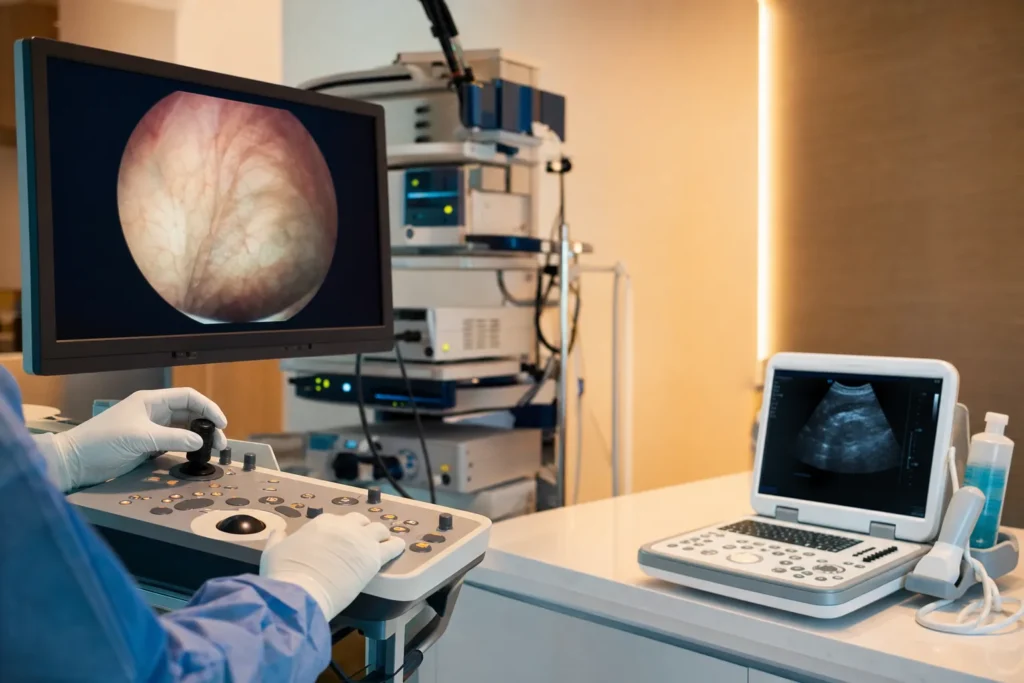
- Cystoscopy is the key test. A thin, flexible tube with a tiny camera is passed gently through the urethra so the specialist can look directly at the bladder lining. It is usually done with local anaesthetic gel to numb the area. This is the main way to see and confirm a tumour.
- Urine tests. A urinalysis checks for infection and blood, and urine cytology examines a urine sample under the microscope to look for cancer cells.
- Imaging scans such as a CT urogram (a CT scan that shows the urinary tract using a special dye) or MRI help show the size of a tumour and whether it has spread to lymph nodes or beyond. A chest scan or bone scan may be added if there is concern about spread.
- TURBT (transurethral resection of bladder tumour) is both a test and a treatment. Under anaesthetic, the surgeon removes the visible tumour through the urethra using an instrument passed into the bladder, and the tissue is sent to a laboratory. This tells the team the exact type and grade, and crucially whether the cancer has reached the muscle.
The results are combined into a stage, often described with the TNM system: T for how deeply the tumour has grown into the bladder wall, N for whether nearby lymph nodes are involved, and M for whether it has spread to distant parts of the body. Staging guides the whole treatment plan.
Treatment options
Treatment is chosen by a multidisciplinary team, typically a urologist (surgeon for the urinary system), an oncologist (cancer doctor), a radiologist, a pathologist, and specialist nurses, who plan care together. The right approach depends on whether the cancer is non-muscle-invasive or muscle-invasive, its grade, your general health and your own preferences. The descriptions below explain common options; your team will tailor them to you.
For non-muscle-invasive cancer, the foundation is TURBT to remove the tumour through the urethra (no cut on the abdomen). To lower the chance of it coming back or progressing, the surgeon may then put medicine directly into the bladder through a catheter, called intravesical therapy. This can be intravesical chemotherapy (for example mitomycin or gemcitabine) or BCG, a type of immunotherapy that prompts the body's own immune system to attack remaining cancer cells.
For muscle-invasive cancer, common options include:
- Radical cystectomy, surgery to remove the whole bladder, sometimes with nearby lymph nodes and organs. The surgeon then creates a new way for urine to leave the body, called a urinary diversion, such as a urostomy (a stoma on the abdomen with a bag), a continent pouch, or a new bladder made from a piece of bowel (a neobladder). A partial cystectomy, removing only part of the bladder, is possible in selected cases.
- Chemotherapy using cisplatin-based drug combinations is often given before surgery (neoadjuvant) to shrink the cancer and improve results, and sometimes afterwards.
- Bladder-preserving treatment, often called trimodal therapy, combines TURBT with radiotherapy and chemotherapy to try to treat the cancer while keeping the bladder, an option for suitable people.
For advanced or recurrent disease, newer systemic treatments are used, including immunotherapy with checkpoint-inhibitor drugs (such as atezolizumab, nivolumab or pembrolizumab) and targeted therapies (such as erdafitinib, enfortumab vedotin and sacituzumab govitecan) chosen according to the cancer's features. Supportive (palliative) care to control symptoms and protect quality of life is an important part of treatment at any stage, not just at the end.
Outlook: what to expect
Outlook varies a great deal from person to person, and statistics describe large groups, not individuals. They cannot predict what will happen to any one person, because they do not capture your specific cancer, your age, your overall health or how you respond to treatment. With that firmly in mind, population-level figures can give a general sense of the picture.
The American Cancer Society reports five-year relative survival rates for bladder cancer in the United States (people diagnosed 2015 to 2021). A relative survival rate compares people with the cancer to people in the general population. For cancer that has not spread outside the bladder lining (in situ) the figure is about 98%, and for cancer still confined to the bladder (localized) about 73%. When the cancer has reached nearby structures or lymph nodes (regional) it is about 41%, and when it has spread to distant parts of the body (distant) about 9%. Across all stages combined it is about 79%.
Two practical points help make sense of these numbers. First, the great majority of bladder cancers are found while still non-invasive or localized, which is the more treatable end of the range, and finding it early is one reason to act on symptoms quickly. Second, these figures reflect treatments from past years, and care continues to improve. Your own specialist is the right person to discuss what the outlook means in your particular situation.
Living with it and follow-up
Bladder cancer, especially the non-muscle-invasive type, has a notable tendency to come back, so careful follow-up is a normal and expected part of care rather than a sign that something is wrong. After treatment you will usually have regular check-ups, often including repeat cystoscopies on a schedule that becomes less frequent over time if all stays clear, along with urine tests and sometimes scans. Keeping these appointments is one of the most useful things you can do, because anything that returns is easier to treat when caught early.
If you have had your bladder removed and a urinary diversion created, life does adjust, but most people adapt well with time and support. A specialist stoma or continence nurse can teach you how to manage a urostomy bag or a neobladder, and these skills usually become routine. It is normal for this to take some getting used to emotionally as well as physically.
Day to day, stopping smoking is one of the most valuable steps, as it lowers the risk of recurrence and benefits overall health; your team can help you access support to quit. Staying hydrated, eating a balanced diet, gentle activity and looking after your mental wellbeing all help. Many people find peer support groups and counselling genuinely valuable, and reporting any new symptoms promptly is always the right thing to do.
Planning treatment abroad: what affects cost and how to prepare your records
If you are considering treatment in another country such as Turkiye, it helps to understand what shapes the overall cost so you can ask for an accurate, personalised estimate rather than relying on a single headline figure. We do not list prices here, because a realistic figure can only be given once a specialist has reviewed your records.
The main factors that influence cost include:
- The type and stage of the cancer, and therefore the treatment plan, for example a TURBT with bladder instillations versus major surgery to remove the bladder with a urinary diversion.
- Whether you need systemic treatment such as chemotherapy, immunotherapy or targeted therapy, which are priced by drug and number of cycles.
- The length of hospital stay and level of care, including any time in intensive care after major surgery.
- Diagnostic tests needed before treatment, such as scans, cystoscopy and laboratory work.
- Follow-up appointments, and travel and accommodation for you and a companion.
To prepare, gather your medical records in one place: pathology (biopsy and TURBT) reports, imaging scans and their written reports (ideally on a CD or in digital form), a list of your medicines, and a summary from your current doctor. Having these translated and ready allows a specialist team to review your case properly and give you a tailored plan and estimate. The clearest way forward is to request a free consultation so your situation can be assessed individually before you commit to anything.
Why Turkiye, and how to choose a good centre
Turkiye has become a well-established destination for medical care, with many large hospitals offering urology and oncology services, experienced surgeons, and modern equipment, often with international patient departments that arrange interpreters, transfers and accommodation. For people travelling from Europe, the Gulf, the wider region and beyond, the combination of accessible travel and comprehensive care can be appealing. The aim of this section is not to make promises, but to help you choose wisely.
When comparing centres, it is sensible to verify:
- Accreditation. Look for hospitals with recognised quality accreditation (for example international accreditation such as JCI) and proper national licensing.
- A genuine multidisciplinary team. Good bladder cancer care involves urologists, medical and radiation oncologists, pathologists, radiologists and specialist nurses working together, not a single doctor in isolation.
- Experience with your specific treatment, whether that is TURBT and intravesical therapy, radical cystectomy with the urinary diversion you are considering, or chemoradiotherapy.
- Clear communication. A written treatment plan, transparent information about what is and is not included, and access to interpreters and your reports in a language you understand.
- Continuity of care. Ask how follow-up will be handled after you return home, and how your local doctor will receive your records.
Take your time, ask questions, and consider getting more than one opinion. A reputable centre will welcome that.
Prevention, second opinions and clinical trials
While not every case can be prevented, several steps genuinely lower risk. The most important is to not smoke, or to stop if you do; because smoking is linked to around half of cases, quitting is the single biggest thing most people can do, and it also reduces the chance of cancer returning. Follow safety rules and protective measures if you work with chemicals such as those in the dye, rubber, paint or textile industries. Treating bladder infections promptly and staying well hydrated also support bladder health.
Two further options are worth knowing about. A second opinion is a normal and reasonable thing to seek, especially before major surgery; reviewing your case with another qualified specialist can confirm the plan or offer alternatives, and good doctors are not offended by the request. Clinical trials are research studies testing new treatments or new ways of using existing ones. They are not a last resort; for some people they offer access to promising approaches with careful monitoring. Ask your cancer team whether any trials might be suitable for you, and weigh the possible benefits and risks together with them.
Above all, work closely with a qualified specialist who knows your individual situation. The information here is a starting point for understanding and good questions, not a substitute for that personal medical advice.
Frequently asked questions
Is blood in my urine always a sign of bladder cancer?
What is the difference between non-muscle-invasive and muscle-invasive bladder cancer?
How is bladder cancer diagnosed?
Is there a screening test for bladder cancer?
Does smoking really cause bladder cancer?
What treatments are used for bladder cancer?
Will I be able to pass urine normally after my bladder is removed?
What is the outlook for someone with bladder cancer?
Why does bladder cancer need long-term follow-up?
How do I prepare my records to get a treatment estimate from a hospital abroad?
Can bladder cancer be prevented?
This article is for general information only and is not medical advice. Always consult a qualified doctor about your individual case.
Considering this procedure?
Send us your photos and questions. A BergemHealth coordinator and a department-head specialist will review your case and reply with honest, personalised guidance — no obligation.
Free consultation