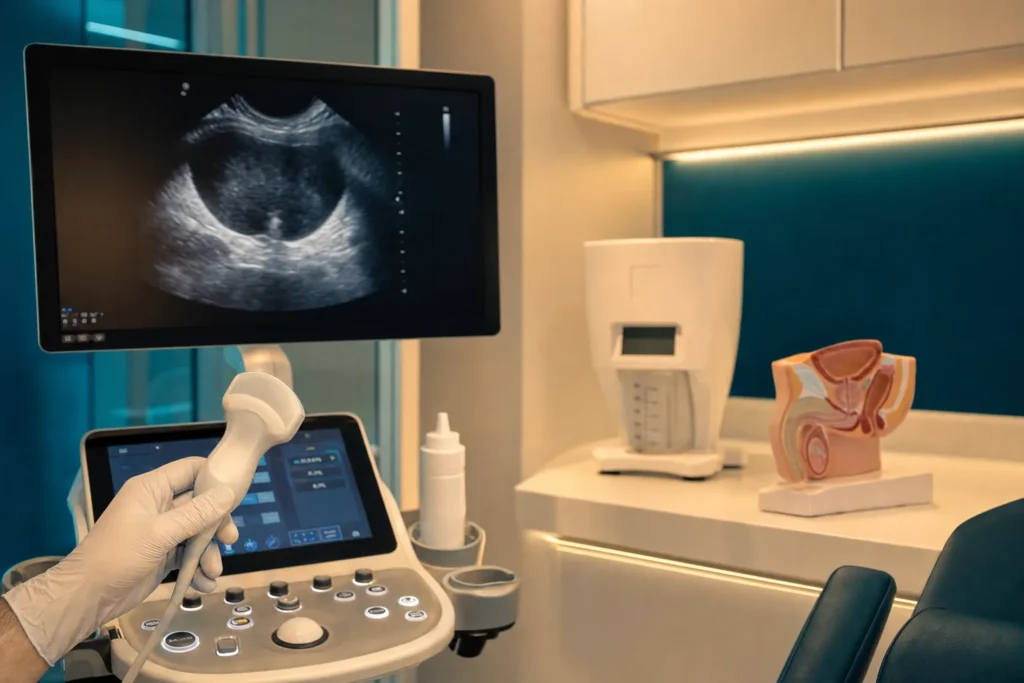
BPH (enlarged prostate)
An enlarged prostate (the medical name is benign prostatic hyperplasia, or BPH) is one of the most common reasons men over 50 notice changes in how they pee. The word "benign" means it is not cancer. This guide explains in plain language what BPH is, why it happens, how doctors check for it, and the full range of treatments, from simple daily habits to medicines and modern keyhole procedures, so you can have an informed, unhurried conversation with a specialist.
What BPH (enlarged prostate) is
The prostate is a small gland, normally about the size of a walnut, that sits just below the bladder in men. It wraps around the urethra, the tube that carries urine (pee) from the bladder out through the penis. The prostate's main job is to help make some of the fluid in semen.
Benign prostatic hyperplasia (BPH) simply means the prostate has grown larger than it used to be. "Benign" means it is not cancer. "Hyperplasia" means an increase in the number of cells. As the gland grows, it can press on the urethra and squeeze it, a bit like standing on a garden hose. That squeezing is what causes the urinary changes many men notice as they get older.
It is important to be reassured on one point: BPH is not prostate cancer, and having BPH does not increase your risk of getting prostate cancer. They are two separate conditions that can each happen on their own, and sometimes happen to be present at the same time, but one does not turn into the other. BPH is also very common and, in most men, not dangerous, though the symptoms can be a real nuisance and are worth treating.
Doctors sometimes group the urinary changes BPH causes under the umbrella term lower urinary tract symptoms (often shortened to LUTS), because not every man with these symptoms has the same underlying cause.
Types and patterns of BPH
BPH is one specific condition rather than a family of different diseases, so it does not have "subtypes" in the way cancers do. But it does show up in different patterns, and understanding them helps explain why treatments differ from one man to the next.
Doctors often describe the obstruction (the blockage of urine flow) as having two parts:
- The static part. This is the physical bulk of the enlarged gland pressing on the urethra. A bigger gland tends to push harder.
- The dynamic part. This is the tension in the small muscles within the prostate and bladder neck. Even a modestly enlarged prostate can cause symptoms if these muscles are tight.
This is why two men with similar-sized prostates can have very different symptoms, and why the size of the prostate does not reliably predict how bad the symptoms are. Some men with large glands have few complaints, while others with only slight enlargement struggle.
Symptoms are usually sorted into two groups, which guides treatment:
- Voiding (emptying) symptoms: a weak or slow stream, difficulty starting, straining, a stop-start flow, and dribbling at the end.
- Storage (filling) symptoms: needing to pee often, sudden urges, and getting up at night to pee (called nocturia).
Causes and risk factors
The honest answer is that researchers do not know the single cause of BPH. The leading explanation is that it is linked to the natural changes in hormone levels that come with ageing. As men get older, the balance of hormones shifts, and a hormone called dihydrotestosterone (DHT), made from testosterone, is thought to encourage the prostate to keep growing slowly over many years.
One telling clue is that men who lost the function of their testicles early in life do not develop BPH, which points to a role for the male hormones the testicles produce.
The main risk factors are:
- Age. This is the biggest factor. BPH rarely causes symptoms before 40, but it becomes increasingly common with each decade afterward.
- Family history. Having a father or brother with an enlarged prostate raises your chances.
- General health conditions. Some studies link a higher risk to type 2 diabetes, heart and blood-vessel disease, obesity, and erectile difficulties.
- Being physically inactive. Regular activity appears to be associated with a lower risk.
None of these guarantee you will develop bothersome symptoms, and none of them are your fault. They simply help explain why BPH is so widespread among older men.
Signs, symptoms, and when to see a doctor
BPH symptoms usually creep in slowly over months or years, so it is easy to dismiss them as "just getting older." Not everyone with an enlarged prostate has symptoms at all. When symptoms do appear, common ones include:
- A weak, slow, or interrupted urine stream
- Difficulty starting to pee, or having to strain
- A feeling that the bladder has not fully emptied
- Dribbling at the end of urination
- Needing to pee more often, especially at night
- A sudden, hard-to-postpone urge to pee
It is sensible to see a doctor (a GP or family doctor is a good first stop) if these symptoms are bothering you, affecting your sleep, or changing your daily routine. Getting checked is worthwhile because the same symptoms can occasionally come from other conditions, and the doctor can rule those out.
Seek urgent medical help if you suddenly cannot pee at all and your lower belly is uncomfortable and swollen, this is called acute urinary retention and needs prompt treatment. Also seek prompt care if you have blood in your urine, pain or burning when peeing, or symptoms alongside fever and chills, as these can point to an infection or another problem that needs attention. These warning signs are uncommon, but knowing them means you can act calmly and quickly if they happen.
Screening and early detection
There is no routine population screening programme for BPH itself. Because it is not cancer and is generally not life-threatening, there is no need for healthy men to be screened for it. Instead, BPH usually comes to light when a man notices urinary symptoms and mentions them to his doctor, or when a prostate is found to be enlarged during a routine examination.
This is an important place to clear up a common source of worry. The PSA blood test (PSA stands for prostate-specific antigen) is sometimes used as part of assessing prostate health, but it is not a test "for BPH." PSA can be raised by an enlarged prostate, by infection, or by prostate cancer, so a higher number does not by itself tell you which is the cause. Decisions about PSA testing for prostate cancer are a separate conversation, and they involve weighing the benefits and downsides with your doctor.
The practical takeaway: there is nothing you need to do to "catch BPH early." The right step is simply to speak to a doctor when symptoms appear, rather than waiting until they become severe. Early conversation usually means simpler treatment.
How BPH is diagnosed
Diagnosing BPH is usually straightforward and rarely uncomfortable. Doctors build the picture from your story plus a few simple tests, and only add more detailed tests if needed.
Talking through your symptoms. Your doctor will ask about your urinary habits and how much they bother you. Many use a short questionnaire called the International Prostate Symptom Score (IPSS), seven questions that produce a score from 0 to 35. Broadly, a score of 0 to 7 is considered mild, 8 to 19 moderate, and 20 to 35 severe. This score helps track whether things change over time and guides treatment choices.
Physical examination. This often includes a digital rectal exam (DRE), in which the doctor gently feels the prostate through the wall of the rectum using a gloved finger. It takes only a few seconds and lets the doctor estimate the gland's size and texture.
Simple tests may include:
- Urine test (urinalysis) to look for infection or blood.
- PSA blood test, considered in the context described above.
- Blood tests of kidney function, if there is concern the bladder is not emptying well.
More detailed tests, often arranged by a urologist (a specialist in the urinary system), can include:
- Uroflowmetry, which measures how fast you pee into a special device.
- Post-void residual, a quick ultrasound scan that measures how much urine is left in the bladder after you pee.
- Ultrasound of the prostate, bladder, or kidneys.
- Cystoscopy, where a thin, flexible camera is passed into the urethra to look directly at the bladder and prostate.
- Urodynamic studies, more detailed bladder-pressure tests used in selected cases.
BPH does not have cancer-style "stages." Instead, doctors describe it by symptom severity (the score above), prostate size, and whether complications such as poor emptying are present.
Treatment options
There is a wide and growing menu of treatments for BPH, and the right choice depends on how much your symptoms bother you, the size of your prostate, your general health, and your own preferences. Care is often guided by a multidisciplinary team, which may include a urologist, a specialist nurse, an anaesthetist for procedures, and sometimes an interventional radiologist for certain techniques. Treatment usually steps up gradually, starting with the gentlest options.
1. Watchful waiting and lifestyle measures. If symptoms are mild and not very bothersome, no immediate treatment may be needed beyond regular review. Helpful habits include cutting down on alcohol and caffeine, not drinking large amounts of fluid in the evening, taking your time to empty the bladder fully, and staying physically active.
2. Medicines. Several types are used, sometimes in combination:
- Alpha blockers (such as tamsulosin, alfuzosin, doxazosin, or silodosin) relax the muscle in the prostate and bladder neck, easing the flow. They often work within days. A common side effect is changes in ejaculation (less or no semen released, which is harmless), and they can cause dizziness on standing.
- 5-alpha reductase inhibitors (finasteride or dutasteride) gradually shrink the prostate by lowering DHT. They suit men with larger glands but take several months to reach full effect.
- Combination therapy (an alpha blocker plus a 5-alpha reductase inhibitor) can work better than either alone for some men.
- PDE5 inhibitors (such as daily tadalafil) can ease urinary symptoms and are useful for men who also have erectile difficulties.
- Medicines for an overactive bladder (such as anticholinergics or mirabegron) may be added when storage symptoms like urgency dominate.
3. Minimally invasive (keyhole) procedures. These newer options aim to relieve the blockage with less impact than traditional surgery, and several are designed to preserve normal ejaculation:
- Prostatic urethral lift (UroLift) places small implants that hold the enlarged tissue aside, without cutting or removing it.
- Water vapour therapy (Rezum) uses bursts of steam to shrink excess prostate tissue over the following weeks.
- Aquablation uses a robotically guided, high-pressure jet of water to remove tissue.
- Prostate artery embolisation, performed by an interventional radiologist, blocks some of the blood supply to shrink the gland; it is used in selected situations.
4. Surgery. For larger glands or symptoms that do not respond to other measures:
- Transurethral resection of the prostate (TURP) is the long-established standard, removing the inner part of the prostate through the urethra with no external cuts.
- Laser procedures, including holmium laser enucleation (HoLEP), can treat even very large prostates and often involve less bleeding and a shorter catheter time.
- Simple (open or keyhole) prostatectomy may be used for very large glands.
Supportive care such as bladder training, pelvic floor exercises, absorbent products, or a temporary catheter can help manage symptoms at any stage.
Outlook: what to expect
The overall outlook for men with BPH is reassuring. Authoritative sources describe the outlook as very good: BPH is not a cancer and is generally not life-threatening, and the great majority of men get meaningful relief from symptoms with treatment.
It helps to set realistic expectations. BPH is a long-term condition rather than something that is "cured" once and forgotten. Medicines control symptoms while you take them, and even after a procedure the prostate can slowly grow again over many years. National health information notes that around 1 in 10 men who have surgery may need a further procedure within about 20 years, which is a reminder that follow-up matters, not a cause for alarm.
Left completely untreated, bothersome BPH can occasionally lead to complications such as repeated urinary infections, bladder stones, blood in the urine, an inability to pee (acute retention), or, rarely, strain on the kidneys. The encouraging point is that these are largely preventable: they are exactly what timely treatment and regular review are designed to avoid. For most men, BPH is something you manage comfortably for years rather than something that takes over your life.
Living with BPH and follow-up
Most men live full, active lives with BPH. The aim of care is to keep symptoms low enough that they do not interfere with sleep, work, travel, or social life.
Day-to-day, the same habits that help mild symptoms are worth keeping up: moderating caffeine and alcohol, spacing out fluids so you are not drinking large amounts late in the evening, and giving yourself enough time in the bathroom to empty fully. If you take medicines, taking them consistently makes a real difference, and it is worth telling any doctor about them, since some cold and allergy remedies (decongestants and certain antihistamines) can temporarily worsen urinary symptoms.
Follow-up is usually simple. Many men have a yearly review where the doctor checks symptoms (often repeating the IPSS questionnaire), reviews medicines, and makes sure the bladder is emptying well. After a procedure, you will typically have a short period of recovery and a check-up to confirm things are working as intended. Between visits, it is fine, and encouraged, to get in touch sooner if symptoms change, if a medicine causes side effects, or if any of the urgent warning signs described earlier appear.
BPH can also have an emotional side. Frequent night-time trips and the worry of being caught short can be wearing. You are not alone in this; it is one of the most common conditions in older men, and talking openly with your doctor about how it affects your quality of life is part of getting the right treatment.
Planning treatment abroad: what affects cost and how to prepare your records
If you are considering having a BPH procedure abroad, for example in Turkiye, it helps to understand what shapes the overall cost and how to prepare so your care goes smoothly. We do not list prices here because the right plan, and therefore the cost, is genuinely individual; the sensible approach is to request a personalised estimate after a specialist has reviewed your case.
What affects the cost of BPH treatment typically includes:
- Which treatment is chosen. Medicines, a keyhole procedure such as UroLift or Rezum, a laser enucleation, or a TURP each involve different equipment, theatre time, and staffing.
- The size of your prostate and your general health, which influence the technique and the anaesthetic plan.
- Pre-treatment tests such as scans, flow tests, and blood work.
- Hospital and aftercare needs, including any overnight stay, catheter management, and follow-up checks.
- Practical travel factors, such as length of stay, interpreting, and transfers, when arranged as part of a package.
How to prepare your records. Gather any recent prostate-related tests (IPSS questionnaire, PSA results, ultrasound or flow studies), a list of your current medicines and allergies, and a brief summary of your medical history from your own doctor. Clear records let a specialist give you accurate advice and a meaningful estimate without unnecessary repeat tests. A free consultation is the right moment to share these and ask exactly what your plan would involve.
Why Turkiye, and how to choose a good centre
Turkiye has become a well-known destination for international medical care, with a large number of hospitals that hold international accreditation and dedicated international-patient services. For a common, well-established condition like BPH, this can mean access to experienced urology teams and the full range of modern treatments. That said, the most important thing is not the country but choosing a good, properly accredited centre and a qualified specialist.
Here is what to verify, wherever you go:
- Accreditation. Look for recognised international accreditation such as Joint Commission International (JCI), which signals that a hospital meets defined standards for patient safety and quality of care. You can confirm a hospital's status through the accrediting body's own directory.
- The specialist's qualifications. Confirm that your surgeon is a trained, licensed urologist with specific experience in the BPH procedure you are considering.
- The range of treatments offered. A centre that offers several options (medicines, keyhole procedures, laser, and TURP) is more likely to recommend what genuinely suits you rather than the one technique it happens to have.
- Clear, written information. You should receive a plain explanation of the proposed treatment, its benefits, its risks and side effects, and the aftercare plan, before you commit.
- Communication and aftercare. Check that you can communicate in a language you understand and that there is a clear plan for follow-up once you return home.
Be cautious of any promise of a guaranteed result or claims that one clinic is simply "the best." Good care is about a careful match between your needs and a qualified team, and a trustworthy centre will be happy to answer questions and share its credentials.
Prevention and self-care
There is no proven way to guarantee you will never develop BPH, because the main driver is the natural process of ageing, which no one can stop. But there are sensible, evidence-aligned steps that support your urinary health and may help.
- Stay physically active. Regular activity is associated with a lower risk of BPH and is good for your heart and overall health too.
- Look after your general health. Keeping a healthy weight and managing conditions such as type 2 diabetes and heart disease may help, since these are linked to a higher risk.
- Adjust daily habits if you notice symptoms. Cutting back on caffeine and alcohol, especially in the evening, and not drinking a lot of fluid right before bed can ease night-time trips.
- Empty your bladder fully and take your time, rather than rushing.
- Check your medicines. Some over-the-counter decongestants and antihistamines can temporarily worsen urinary symptoms; ask a pharmacist or doctor if you are unsure.
Above all, the single most useful step is simply to talk to a doctor when symptoms first start to bother you. BPH is common, well understood, and very treatable, and getting advice early usually means simpler treatment and a better quality of life.
Frequently asked questions
Is an enlarged prostate (BPH) the same as prostate cancer?
Does BPH mean I will eventually need surgery?
How common is an enlarged prostate?
What are the first signs of BPH?
When should I see a doctor urgently?
Do BPH medicines have side effects?
Will BPH treatment affect my sex life?
Can lifestyle changes really help an enlarged prostate?
What is the IPSS, and why did my doctor give me a questionnaire?
Is BPH dangerous if I just leave it?
How do I prepare my records for a consultation about treatment abroad?
This article is for general information only and is not medical advice. Always consult a qualified doctor about your individual case.
Considering this procedure?
Send us your photos and questions. A BergemHealth coordinator and a department-head specialist will review your case and reply with honest, personalised guidance — no obligation.
Free consultation