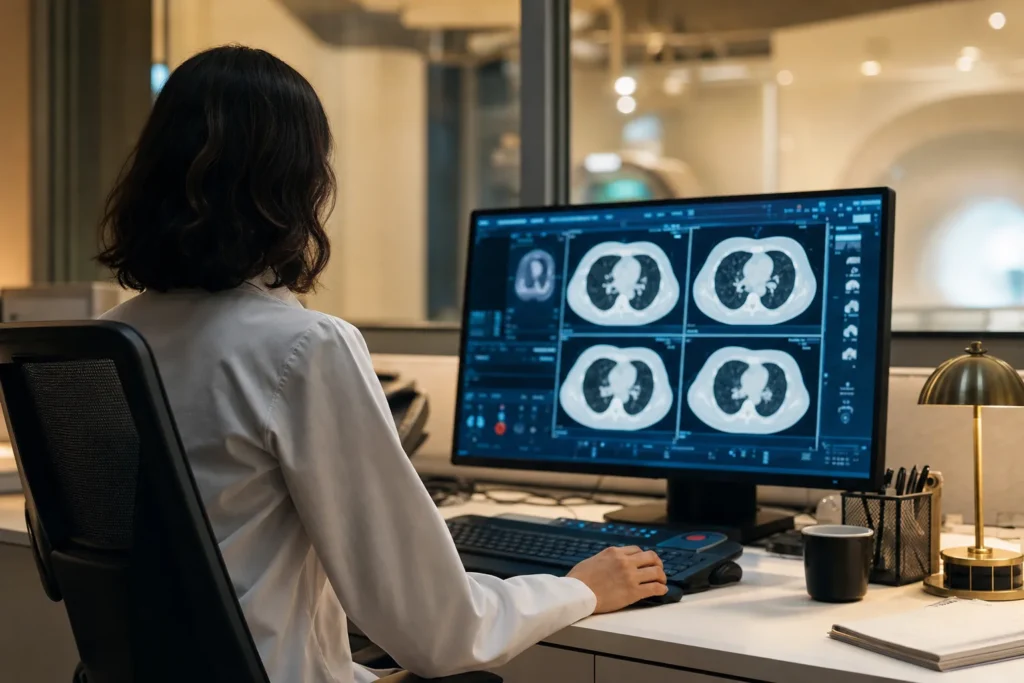
Lung cancer
A lung cancer diagnosis raises many urgent questions. This guide explains the two main types, how doctors stage and test the disease, the treatment options available today, and what to consider if you are exploring care abroad, including in Turkiye, drawing on established cancer authorities. It is for general information and is not a substitute for advice from a qualified oncologist.
What lung cancer is
Lung cancer is a disease in which cells in the lungs grow and divide in an uncontrolled way, forming a tumour. The lungs are the spongy organs in the chest that bring oxygen into the body and remove carbon dioxide. Cancer can begin in the cells lining the airways or the tiny air sacs (alveoli), and over time it may spread to lymph nodes and other parts of the body.
Doctors divide lung cancer into two broad groups that behave differently and are treated differently: non-small cell lung cancer (NSCLC) and small cell lung cancer (SCLC). According to the American Cancer Society, NSCLC accounts for roughly 80% to 85% of all lung cancers, while SCLC makes up about 10% to 15%. Knowing which type you have is the foundation of every treatment decision, which is why accurate diagnosis and laboratory analysis of the tumour come first.
Lung cancer is one of the most studied cancers in the world, and the options for diagnosis and treatment have changed substantially over the past decade. Understanding the basics can help you ask better questions and take part in decisions with your medical team.
Types and subtypes
The first and most important distinction is between non-small cell and small cell disease, because they grow at different speeds and respond to different treatments.
Non-small cell lung cancer (NSCLC) is the larger group and includes three main subtypes:
- Adenocarcinoma begins in the cells that line the alveoli and produce substances such as mucus. It is the most common form overall and is the type most often seen in people who have never smoked.
- Squamous cell carcinoma forms in the flat cells that line the airways and is typically located more centrally in the lung. It is often associated with a history of smoking.
- Large cell carcinoma can appear in any part of the lung and tends to grow and spread more quickly. Less common variants include large cell neuroendocrine, adenosquamous and sarcomatoid carcinomas.
Small cell lung cancer (SCLC), sometimes called oat cell cancer, is a fast-growing cancer that often spreads early. A less common form, combined small cell carcinoma, shows features of both small cell and non-small cell disease. Because of these differences, the same words "lung cancer" can describe diseases that call for very different plans. NSCLC and SCLC are not interchangeable, and a precise pathology report is essential to guide care.
Risk factors and causes
The single largest cause of lung cancer is tobacco smoking. The American Cancer Society reports that about 80% of lung cancer deaths are thought to result from smoking, and the risk applies to cigarettes, cigars and pipes. Stopping smoking at any age can lower risk over time, which is why cessation support is part of good care.
However, lung cancer also occurs in people who have never smoked, so the disease should never be dismissed on the basis of smoking history alone. Other recognised risk factors include:
- Secondhand (passive) smoke, described by the American Cancer Society as the third most common cause of lung cancer in the United States.
- Radon, a naturally occurring radioactive gas, which the American Cancer Society describes as the second-leading cause overall and the leading cause among people who do not smoke.
- Asbestos and other workplace carcinogens such as arsenic, cadmium, chromium and nickel compounds, silica, uranium and diesel exhaust.
- Air pollution and previous radiation therapy to the chest.
- A personal or family history of lung cancer.
Having a risk factor does not mean a person will develop lung cancer, and many people with the disease have few or none of these factors. Risk is best understood as a combination of influences rather than a single cause. A doctor can help you understand your own situation.
Signs, symptoms and when to see a doctor
Lung cancer often causes no symptoms in its earliest stages, which is part of why screening matters for higher-risk people. When symptoms do appear, the American Cancer Society lists common ones such as a cough that does not go away or gets worse, coughing up blood or rust-coloured sputum, chest discomfort, shortness of breath, hoarseness, fatigue, loss of appetite, unexplained weight loss, and repeated infections such as bronchitis or pneumonia.
If the cancer has spread, it can cause additional symptoms such as bone pain, neurological changes (headache, weakness, dizziness or seizures), jaundice, or swollen lymph nodes in the neck or above the collarbone. Tumours in certain locations can press on nearby structures, causing superior vena cava syndrome (swelling of the face and arms) or Horner syndrome (a drooping eyelid and small pupil on one side). Some lung tumours also produce hormone-like substances or trigger immune reactions that cause paraneoplastic syndromes, with endocrine or neurological effects.
When to see a doctor: contact a healthcare professional if you have any of these symptoms, especially if they last more than a couple of weeks. Most of these symptoms have causes other than cancer, but prompt evaluation allows accurate diagnosis and earlier treatment if it is needed.
Screening and early detection
For people at higher risk, lung cancer can sometimes be found before symptoms appear. The recommended screening test is a low-dose CT (LDCT) scan, which uses a small amount of radiation to create detailed images of the lungs.
The American Cancer Society recommends yearly LDCT screening for people who meet all of the following: aged 50 to 80 years, and current smokers or former smokers with at least a 20 pack-year history (one pack-year equals smoking one pack a day for one year). Screening is not recommended for people with serious health problems that would limit life expectancy or who would be unable or unwilling to have treatment if cancer were found.
Screening has potential benefits, including finding cancer earlier when it may be easier to treat, but it also has limits and possible harms, such as radiation exposure, false-positive results that lead to further tests, and findings unrelated to lung cancer. Anyone considering screening should discuss the benefits and limits with their doctor first. For people who do not meet the screening criteria, there is no routine screening, so paying attention to symptoms remains important.
Diagnosis and staging
Diagnosing lung cancer usually involves several steps. Imaging may include a chest X-ray, a CT scan for detailed cross-sectional images, a PET/CT scan to help assess whether cancer has spread, and an MRI to check the brain or spinal cord. In some cases, a sample of coughed-up sputum is examined for cancer cells.
A firm diagnosis requires a biopsy, where a sample of tissue is examined under a microscope. Methods include needle biopsy through the chest wall, bronchoscopy to reach tumours in the airways, endobronchial ultrasound (EBUS) and mediastinoscopy to sample lymph nodes between the lungs, and thoracentesis to test fluid around the lung. A liquid biopsy, a blood test that looks for tumour DNA, may be used in some situations, for example when tissue is difficult to obtain.
Once cancer is confirmed, doctors assign a stage. NSCLC uses the TNM system, which combines tumour size (T), lymph node involvement (N) and distant spread or metastasis (M) into stages from 0 (in situ) through I to IV. Understanding lung cancer stages helps guide whether treatment aims to cure the disease or to control it and relieve symptoms. SCLC is often described in two practical categories: limited stage (confined to one side of the chest and nearby lymph nodes) and extensive stage (spread more widely), although the TNM system can also be applied.
Treatment options
Lung cancer treatment is tailored to the type, stage, biomarker results and the person's overall health. A defining feature of modern care is the multidisciplinary tumour board, in which surgeons, medical and radiation oncologists, pulmonologists, radiologists, pathologists and specialist nurses review each case together. The NHS notes that treatment is managed by a team of specialists who work together to plan care.
Surgery may offer the chance of cure for earlier-stage NSCLC. Options range from wedge resection (removing a small piece of lung) to lobectomy (removing a lobe), sleeve resection, or pneumonectomy (removing a whole lung).
Radiotherapy uses targeted radiation to destroy cancer cells. Stereotactic body radiotherapy delivers precise high doses and may be an option when surgery is not suitable; radiotherapy is also used to relieve symptoms.
Chemotherapy often uses platinum-based combinations (such as cisplatin or carboplatin with another agent) given in cycles. It plays a central role in SCLC, which frequently responds to chemotherapy and radiation, at least initially.
Targeted therapy may be used when a tumour carries a specific genetic change. Tyrosine kinase inhibitors can target EGFR mutations and ALK rearrangements, and other drugs address alterations such as ROS1, BRAF, KRAS G12C, MET, RET, NTRK and HER2. These options are most relevant in NSCLC, particularly adenocarcinoma.
Immunotherapy with checkpoint inhibitors that target the PD-1/PD-L1 pathway helps the immune system recognise cancer. PD-L1 testing on the tumour can help predict who may benefit, and immunotherapy is used in NSCLC and in SCLC (in extensive-stage disease and, after chemoradiation, in some limited-stage disease). In SCLC, prophylactic cranial irradiation may also be considered to reduce the risk of spread to the brain. The right combination is decided by your oncology team based on your individual case.
Prognosis and survival
Survival statistics describe groups of people, not individuals, and are not a prediction for any single person. The figures below come from American Cancer Society analyses of United States SEER data and are population-level, stage-dependent estimates. They cannot predict what will happen to any one person, because outcomes depend on many factors including the exact subtype, biomarker results, overall health, and how the cancer responds to treatment. Because they reflect people diagnosed in earlier years, they may not capture the effect of newer therapies.
For NSCLC (cases diagnosed 2015 to 2021), the American Cancer Society reports a 5-year relative survival of about 67% for localized disease, 40% for regional disease, and 12% for distant disease, with an all-stages figure of about 32%.
For SCLC (cases diagnosed 2012 to 2018), the American Cancer Society reports a 5-year relative survival of about 34% for localized disease, 20% for regional disease, and 4% for distant disease, with an all-stages figure of about 9%.
These numbers point to the importance of early diagnosis, but they are averages from the past and not a forecast for any individual. The most reliable picture of your own situation comes from a qualified oncologist who knows your full medical details and can discuss what the evidence means for you.
Supportive and follow-up care
Care for lung cancer extends well beyond the cancer-directed treatments. Supportive (palliative) care focuses on relieving symptoms such as breathlessness, cough, pain and fatigue, and on supporting emotional wellbeing. It can be provided alongside treatment aimed at controlling the cancer, not only at the end of life, and the NHS describes it as a way to help manage symptoms and maintain quality of life.
After treatment, follow-up care typically includes regular appointments, imaging and other tests to watch for signs of recurrence and to manage any lasting effects of treatment. Smoking cessation support, pulmonary rehabilitation, nutrition advice and psychological support can all play a part.
It is reasonable to ask your team who to contact between appointments, what symptoms should prompt an urgent call, and what survivorship or rehabilitation services are available. Good supportive care can make a meaningful difference to daily life throughout and after treatment.
Planning treatment abroad: what affects cost and how to prepare records
If you are considering treatment in another country, planning ahead can make the journey smoother. Rather than focusing on a single price, it helps to understand the factors that affect the overall complexity and cost of care:
- The type and stage of cancer and whether the plan involves surgery, radiotherapy, chemotherapy, targeted therapy or immunotherapy, often in combination.
- The biomarker and pathology tests required, since these guide treatment selection and may need to be repeated or confirmed.
- The length of stay, number of treatment cycles, follow-up imaging, and any need for rehabilitation.
- Accommodation, travel, interpreter services and support for a companion.
To prepare, gather your medical records in advance: pathology and biopsy reports, biomarker and molecular test results, imaging files (CT, PET, MRI) on disc or in digital form, a list of medications, and a written summary from your current doctors. Having these ready allows a treating team to review your case efficiently and give realistic advice. Because every plan is individual, the most accurate guidance comes from a personalised assessment by a qualified oncology team. You can request a case review through a consultation with our team, who can help coordinate records and second-opinion arrangements.
Turkiye and choosing a cancer centre
Turkiye has become a destination for international patients seeking lung cancer treatment, with a number of hospitals that hold international accreditation and offer the full range of modern cancer services. The priority, however, is not the country itself but the quality and coordination of the specific centre and team.
When evaluating any cancer centre, in Turkiye or elsewhere, it is worth verifying:
- Whether the hospital holds recognised accreditation, such as Joint Commission International (JCI), which indicates adherence to international safety and quality standards.
- Whether your case will be reviewed by a genuine multidisciplinary tumour board rather than a single doctor.
- The availability of comprehensive services in one place, including thoracic surgery, medical and radiation oncology, modern imaging, molecular pathology and biomarker testing.
- The team's experience with your specific type and stage of lung cancer, and clear communication in a language you understand.
A reputable concierge can help you compare accredited centres, arrange the tumour board review of your records, and coordinate logistics, while leaving clinical decisions to qualified oncologists. Be cautious of any provider that promises a guaranteed cure or uses superlative claims; trustworthy centres focus on evidence and individualised planning.
Clinical trials and second opinions
Lung cancer research is moving quickly, and clinical trials may offer access to newer treatments that are not yet standard. Trials are carefully regulated studies; eligibility depends on factors such as tumour type, biomarkers, stage and previous treatment. Ask your oncologist whether a relevant trial might be appropriate and what it would involve.
A second opinion is a normal and reasonable step, especially for complex decisions or when treatments differ between centres. It can help confirm the diagnosis, clarify staging and biomarker results, and ensure you have considered all options. Many patients find that a second opinion increases their confidence, whether or not it changes the plan.
Whatever path you choose, decisions about lung cancer are best made together with a qualified oncologist and multidisciplinary team who can weigh the evidence against your individual circumstances. This guide is for general information and education and is not a substitute for personalised medical advice.
Frequently asked questions
What is the difference between NSCLC and SCLC?
What are the common lung cancer symptoms?
Can people who never smoked get lung cancer?
What are the stages of lung cancer?
Why is biomarker testing (EGFR, ALK, PD-L1) important?
Is lung cancer screening available, and who should have it?
What treatments are used for lung cancer?
What do lung cancer survival statistics mean for me?
How do I prepare my records for treatment abroad?
What should I check when choosing a cancer centre in Turkiye?
Should I consider a clinical trial or a second opinion?
Sources
- National Cancer Institute - Non-Small Cell Lung Cancer Treatment (PDQ)
- National Cancer Institute - Small Cell Lung Cancer Treatment (PDQ)
- American Cancer Society - What Is Lung Cancer?
- American Cancer Society - Lung Cancer Risk Factors
- American Cancer Society - Signs and Symptoms of Lung Cancer
- American Cancer Society - Can Lung Cancer Be Found Early? (Screening)
- American Cancer Society - How Is Lung Cancer Diagnosed?
- American Cancer Society - Lung Cancer Survival Rates
- American Cancer Society - Targeted Drug Therapy for NSCLC
- NHS - Lung Cancer Treatment
- Cancer Research UK - About Lung Cancer
- World Health Organization - Lung Cancer Fact Sheet
This article is for general information only and is not medical advice. Always consult a qualified doctor about your individual case.
Specialists in Oncology
Doctors of the department we work with directly. Which doctor takes your case is decided after the specialists have reviewed your records — your coordinator confirms it, not this page.




Considering this procedure?
Send us your photos and questions. A BergemHealth coordinator and a senior specialist will review your case and reply with honest, personalised guidance — no obligation.
Free consultation