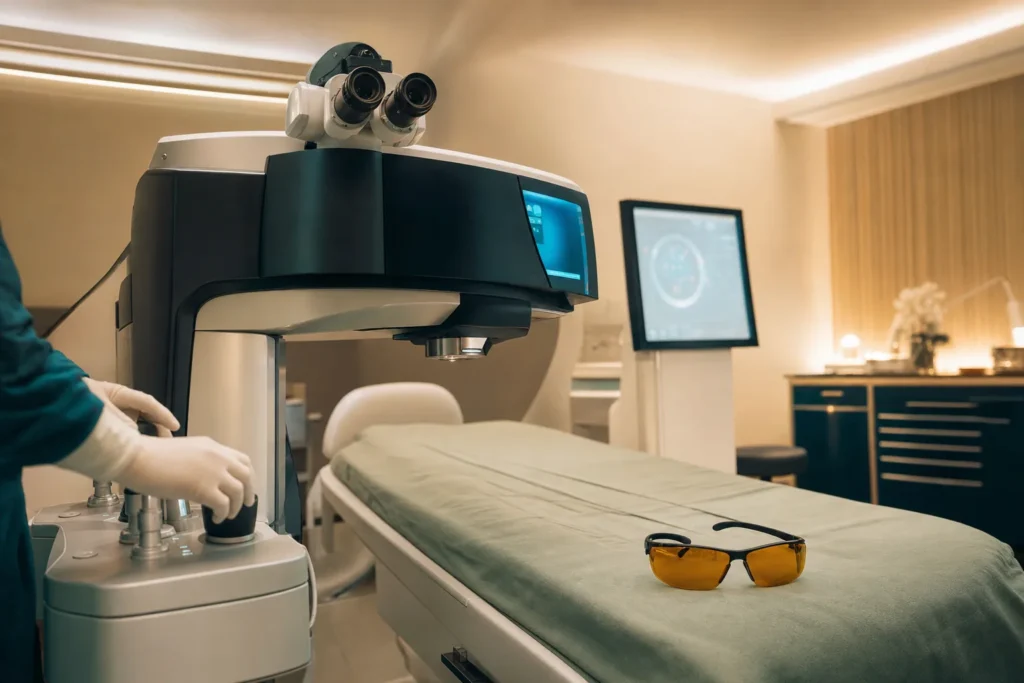
Femto-LASIK & SMILE
If you have spent years reaching for glasses on the bedside table or fiddling with contact lenses, laser eye surgery can feel almost like science fiction: a few minutes lying under a laser, and many people wake up the next morning seeing clearly. Femto-LASIK and SMILE are two of the most common modern techniques for fixing nearsightedness, farsightedness and astigmatism. This guide explains, in everyday language, what each procedure actually does, who they suit, what recovery is really like, the risks worth knowing, and what it costs, including why so many people travel to Turkiye for treatment.
- Anaesthesia
- Numbing eye drops only (topical anaesthetic); you stay awake, a mild sedative is sometimes offered.
- Duration
- About 10 to 15 minutes per eye; the laser itself works for under a minute per eye.
- Recovery
- Back to most normal activities in 1 to 2 days; vision settles over days to a few weeks.
- Hospital stay
- Day case, no overnight stay; you go home the same day and rest.
What it is
Femto-LASIK and SMILE are both types of laser refractive surgery. "Refractive" simply means the surgery changes how your eye bends (refracts) light. Most blurry vision happens because the eye does not focus light precisely on the retina, the light-sensitive layer at the back of the eye that sends pictures to your brain. By gently reshaping the clear front window of the eye, the cornea, a laser can correct that focus, so you depend less on glasses or contact lenses, and often not at all.
Both procedures treat the same everyday vision problems: myopia (nearsightedness, where distant things look blurry), hyperopia (farsightedness, where close-up things are harder to focus), and astigmatism (where the cornea is shaped more like a rugby ball than a football, blurring vision at all distances). There is an important difference: LASIK can treat all three, while SMILE is approved for nearsightedness and astigmatism but not farsightedness.
Femto-LASIK is the modern, all-laser version of LASIK. The surgeon uses a very fast laser called a femtosecond laser to lift a thin hinged layer of cornea (a "flap"), then a second laser reshapes the tissue underneath, and the flap is laid back down. SMILE (small incision lenticule extraction) takes a different route: instead of a flap, the laser carves a tiny lens-shaped disc of tissue inside the cornea, which the surgeon slips out through a small cut. Neither operation can fix presbyopia, the age-related need for reading glasses that most people notice in their mid-forties.
Who is a good candidate
Laser eye surgery suits many people, but not everyone, and a careful screening exists precisely to find out which group you are in. In general, a good candidate is an adult whose eyesight has stopped changing, whose corneas are healthy and thick enough, and who has realistic expectations.
You are more likely to be suitable if you:
- Are at least 18, and ideally over 21, when most people's vision has settled
- Have had the same glasses or contact lens prescription for at least a year
- Have corneas that measurements show are thick and regularly shaped
- Are in good general eye health, with no serious dry eye, infection or disease
- Understand that the goal is to reduce dependence on glasses, not to guarantee perfect vision forever
Surgery may not be right for you if you have:
- A prescription that is still changing, or hormonal changes from pregnancy or breastfeeding that can shift vision (most surgeons ask you to wait)
- Significant dry eye disease, which laser surgery can make worse
- Keratoconus (a cone-shaped, thinning cornea) or other corneal disease, advanced glaucoma, or cataracts that already blur vision
- An autoimmune or immune-weakening condition, such as rheumatoid arthritis, lupus or a suppressed immune system, which can slow healing and raise infection risk
- Poorly controlled diabetes, a history of certain eye infections such as herpes of the eye, or very large pupils, which can increase glare and halos at night
If your corneas are on the thin side, your surgeon may suggest PRK, a surface laser technique that removes no flap and no lenticule, as a safer alternative. The honest answer for some people is that contact lenses or glasses remain the better choice, and a trustworthy clinic will tell you so.
Types & techniques
It helps to think of three closely related procedures on a menu, with the surgeon recommending the one that fits your eyes.
Femto-LASIK. Two lasers are used. A femtosecond laser creates the corneal flap (older LASIK used a fine oscillating blade called a microkeratome; the all-laser flap is now common). An excimer laser then reshapes the tissue underneath. Because the flap is replaced and seals itself, vision usually clears quickly, often within a day. This is the technique behind most "next-day vision" stories.
SMILE (ReLEx SMILE). Only one laser is used, the femtosecond laser, and there is no flap. The laser shapes a thin disc of tissue (the lenticule) inside the cornea, and the surgeon removes it through a small cut, usually less than 4 millimetres. Because the outer surface is disturbed far less, SMILE tends to be gentler on the cornea's surface nerves, which may mean less long-term dry eye. It can be a good option for nearsighted people with active lifestyles or contact sports, since there is no flap that could be dislodged.
PRK (surface laser). The oldest of the three and still widely used. The surgeon removes the thin surface skin of the cornea (the epithelium), reshapes the surface with an excimer laser, and lets the skin grow back over about a week. PRK avoids both a flap and a lenticule, so it is often chosen for thinner or irregular corneas or for people prone to dry eye, at the cost of a slower, more uncomfortable early recovery.
How it is done
Laser eye surgery is an outpatient day procedure, meaning you arrive, have the surgery and go home the same day. There is no general anaesthetic and you are awake throughout.
Anaesthesia. The only anaesthetic is numbing eye drops placed on the surface of the eye. Some clinics offer a mild sedative tablet to help you relax, but you will be able to follow simple instructions, such as looking at a target light.
The steps, in plain terms:
- Your eye is numbed with drops, and a small holder gently keeps the eyelids open so you cannot blink.
- In Femto-LASIK, a suction ring steadies the eye while the femtosecond laser creates the flap. You may feel firm pressure, like a finger pressing on your eyelid, and your vision may dim for a few seconds. In SMILE, the same laser shapes the lenticule inside the cornea.
- You focus on a target light. In LASIK, the surgeon lifts the flap and the excimer laser reshapes the cornea for a short time; you may hear clicking and notice a faint smell. In SMILE, the surgeon removes the lenticule through the tiny incision.
- The flap is smoothed back into place (no stitches are needed; it seals itself in a couple of minutes), or the small SMILE incision is left to heal on its own.
How long it takes. Plan for the actual surgery to take roughly 10 to 15 minutes per eye, though the laser itself works for well under a minute. Both eyes are usually treated on the same day. With check-in, drops and final checks, you are typically at the clinic for a couple of hours.
Recovery, step by step
One of the appeals of Femto-LASIK and SMILE is how quickly most people get back to normal life. Recovery is gradual, though, and your eyes need looking after.
First few hours. Your eyes may feel scratchy, watery, gritty or burning, and bright light can be uncomfortable. Vision is often hazy. The best thing you can do is go home, keep your eyes closed and rest or nap. You will be given lubricating and often antibiotic and anti-inflammatory drops to use on a schedule.
First day or two. Many Femto-LASIK patients notice clearer vision the next morning; SMILE vision can take a little longer to sharpen. You will usually have a follow-up check within a day or two so the surgeon can confirm healing. A clear plastic shield is often worn while sleeping for a few nights so you cannot rub the eye.
First weeks. Vision may fluctuate during the day and dryness is common; these symptoms usually fade within about a month. Avoid rubbing your eyes, getting water, soap or shampoo directly in them, and skip eye makeup, swimming, saunas and dusty environments for the period your surgeon advises (often one to two weeks or more).
What to avoid early on:
- Rubbing or pressing on the eyes
- Swimming pools, hot tubs and contact sports until cleared
- Eye makeup until your surgeon says it is safe
- Driving until your vision is sharp enough and your surgeon agrees
Full, stable vision can take several weeks to settle, and your surgeon will usually want to see you again at set intervals to confirm everything has healed well.
Risks & possible complications
Laser eye surgery has a strong safety record and most people are happy with the result, but it is real surgery and no operation is risk-free. Being clear-eyed about the possibilities helps you make a calm decision and spot problems early.
Common and usually temporary:
- Dry eyes, sometimes for weeks or months, needing regular lubricating drops. SMILE tends to cause less dry eye than LASIK because the surface is disturbed less.
- Glare, halos and starbursts around lights, especially when driving at night; these usually ease over days to a few weeks.
- Hazy or fluctuating vision, light sensitivity, and small painless red patches on the white of the eye that clear on their own.
Less common but more serious:
- Under-correction or over-correction, where you still need a weak prescription or a touch-up procedure.
- Flap complications (specific to LASIK, not SMILE), such as the flap wrinkling or shifting.
- Infection or inflammation of the cornea, which is uncommon and usually treatable if caught early.
- Corneal ectasia, a rare weakening and bulging of the cornea that can develop later, which is one reason careful pre-surgery screening matters so much.
Rare: a loss of best-corrected vision (worse than your vision was even with glasses beforehand). Permanent serious vision loss is very rare. Contact your surgeon promptly if you have increasing pain, worsening vision or signs of infection rather than waiting for a scheduled appointment.
Results & how long they last
The headline figure surgeons often quote is encouraging: roughly 9 out of 10 people who have LASIK end up with vision between 20/20 and 20/40 without glasses or contacts. (20/20 is standard "normal" vision; 20/40 is usually good enough to, for example, pass a driving eye test in many places.) SMILE shows similar strong results for suitable nearsighted patients, with most achieving good unaided vision.
For most people, the correction is long-lasting. The reshaping of the cornea is permanent, so the nearsightedness, farsightedness or astigmatism you had treated does not simply "grow back." What can change is the eye itself over the years. A small number of people experience some regression, a partial drift back toward needing a mild prescription, and a touch-up procedure (an "enhancement") is sometimes possible.
One honest limitation applies to everyone: laser surgery does not stop normal ageing. Most people in their mid-forties and beyond will still need reading glasses for close work as presbyopia sets in, even after a perfect distance correction. And like everyone else, you can still develop cataracts later in life. Realistic expectations, set during your consultation, are the key to being satisfied with the outcome.
Costs
Price is one of the biggest reasons people research treatment abroad, so it is worth understanding both the ranges and what moves them. As a rough guide, in the UK, US or Western Europe, laser eye surgery for both eyes often costs the equivalent of around 4,000 to 6,000 euros, while in Turkiye complete packages commonly fall in a lower band.
Indicative ranges in Turkiye (both eyes, often as a package):
- Femto-LASIK: roughly 1,300 to 2,200 euros
- SMILE (ReLEx SMILE): roughly 2,200 to 3,500 euros, typically more than LASIK
SMILE tends to cost more partly because the technology carries a per-eye licence fee paid to the equipment maker, and because it requires specific training and machines.
What changes the price:
- The technique chosen (surface PRK, Femto-LASIK or SMILE)
- The surgeon's experience and the clinic's reputation and equipment generation
- How complex your case is, for example a high prescription or astigmatism
- Whether the quote is all-inclusive (pre-op tests, the surgery, follow-up visits, and sometimes hotel and airport transfers) or just the operation
These figures are indicative only. Costs vary by case, surgeon and clinic, and the numbers here are not a quote. Always ask for a written, itemised price that states exactly what is and is not included, and beware of unusually cheap headline prices that may exclude essential tests or follow-up care.
Why people travel to Turkiye & how to choose a safe clinic
Turkiye has become a major destination for eye surgery because it combines lower prices with a large number of well-equipped private hospitals and busy, experienced surgeons. Many clinics offer convenient packages that bundle the consultation, tests, surgery, follow-up and even accommodation and transfers. Lower cost, however, should never mean lower standards, and the responsibility to check credentials sits with you.
What to verify before you commit:
- Accreditation. Look for hospitals accredited by Joint Commission International (JCI), a globally recognised standard for patient safety and quality. Turkiye has many JCI-accredited facilities.
- The surgeon, not just the clinic. Confirm that an ophthalmologist (a medical eye doctor and surgeon), not a technician, performs your operation. Ask about their qualifications, how many laser procedures they do, and any fellowship training.
- Proper screening. A safe clinic insists on detailed corneal scans and measurements before agreeing to operate, and is willing to say no if you are not a good candidate. Be wary of anyone who guarantees you will not need glasses.
- The facts in writing. Get the exact hospital name and address in writing before paying a deposit, and confirm that is where you will actually be treated. Ask what happens, and who pays, if you need a touch-up or have a complication.
- Aftercare and contact. Make sure you know who to call after you fly home, and that the clinic will share your records with your eye doctor at home.
Independent guidance, such as that from the Royal College of Ophthalmologists, stresses choosing a properly qualified, registered surgeon and having realistic expectations, advice that applies just as much abroad as at home.
How to prepare & what to ask in your consultation
Good preparation makes the day smoother and the result more predictable. The consultation is also your chance to decide whether you trust the clinic.
Before your assessment:
- Stop wearing contact lenses for the period the clinic specifies before measurements, often around one to two weeks for soft lenses and longer for hard lenses, because lenses temporarily change the cornea's shape.
- Bring your glasses, your prescription history, and a list of medicines, allergies and any health conditions.
- Avoid eye makeup, perfume and creams around the eyes on assessment and surgery days.
- Arrange for someone to take you home, as you should not drive immediately afterwards.
Questions worth asking:
- Am I genuinely a good candidate, and which technique do you recommend for me and why?
- Who exactly will perform my surgery, and what are their qualifications and experience?
- What results are realistic for my prescription, and what is the chance I will still need glasses for some tasks?
- What are the specific risks in my case, and how often do your patients need a touch-up?
- What does the price include, and what would a complication or enhancement cost?
- What aftercare and follow-up do you provide, especially once I am back home?
Take your time, and do not feel pressured to book on the day of a consultation. A reputable clinic will respect a considered decision.
Aftercare & travelling for treatment
If you travel for surgery, the journey home is part of the recovery, so plan it around your eyes rather than the cheapest flight.
When it is safe to fly. Cabin pressure does not damage the cornea, but the dry cabin air can make early dryness and discomfort harder to manage. Many surgeons are comfortable with patients flying within a day or two of laser surgery, while others prefer you wait up to a week; crucially, most advise flying only after your first follow-up appointment confirms the eye is healing well. Always follow your own surgeon's specific advice and build a buffer of a few days into your trip rather than flying out the same day.
To make the flight home easier:
- Carry plenty of preservative-free lubricating drops in your hand luggage and use them generously
- Drink water to stay hydrated and avoid alcohol
- Wear sunglasses in the airport and on the plane, and resist rubbing your eyes
- Keep your protective shield and prescribed drops with you, not in checked baggage
Once you are home, keep using your drops exactly as instructed, attend any local follow-up, and stick to the restrictions on swimming, makeup, dusty work and contact sports until you are cleared. Know the warning signs that mean you should seek care quickly: increasing pain, worsening vision, intense redness or discharge. Before you leave the clinic abroad, make sure you have a written summary of what was done and a reliable way to reach the surgical team, so that distance never gets in the way of safe aftercare.
Frequently asked questions
What is the difference between Femto-LASIK and SMILE?
Does laser eye surgery hurt?
How quickly will I see clearly?
Am I too old or too young for laser eye surgery?
Will I still need glasses afterwards?
Who should not have LASIK or SMILE?
How long does the procedure take and do I stay overnight?
What are the main risks?
How much does laser eye surgery cost in Turkiye?
Is it safe to have eye surgery in Turkiye?
How soon can I fly after laser eye surgery?
What is PRK, and when is it used instead?
This article is for general information only and is not medical advice. Always consult a qualified doctor about your individual case.
Considering this procedure?
Send us your photos and questions. A BergemHealth coordinator and a department-head specialist will review your case and reply with honest, personalised guidance — no obligation.
Free consultation