Tumour embolisation
Tumour embolisation is a keyhole, image-guided treatment that blocks the blood supply feeding a tumour, so it shrinks or stops growing. This guide explains the main types in plain language, what the day is really like, recovery, risks, results, indicative costs, and how to choose a safe clinic if you are considering treatment in Turkiye.
- Anaesthesia
- Usually local anaesthetic at the entry point plus light or moderate sedation; general anaesthesia is occasional (and standard for children).
- Duration
- Most procedures take about 1 to 2 hours; TACE is often completed within roughly 90 minutes.
- Recovery
- Back to most daily activities within about a week; tiredness and reduced appetite can last 2 weeks or more.
- Hospital stay
- Often one night for monitoring; many liver cases stay 1 to 2 days, some bland embolisations are day cases.
Indicative hospital range, confirmed after your file is reviewed. You pay the hospital’s price — we add no markup.
What tumour embolisation is
Tumour embolisation (also spelled embolization) is a minimally invasive treatment, which simply means it is done through a tiny puncture rather than a large surgical cut. A doctor called an interventional radiologist threads a thin tube through your blood vessels to the artery feeding a tumour, then deliberately blocks that artery. Because a tumour relies on a steady blood supply for the oxygen and nutrients it needs to grow, cutting off that supply makes the tumour shrink or die.
The clever part is selectivity. Many tumours, especially in the liver, draw most of their blood from one main artery, while the surrounding healthy tissue gets its blood from somewhere else. In the liver, for example, tumours feed mostly from the hepatic artery, while healthy liver tissue is supplied mainly by a separate vessel called the portal vein. This difference lets the doctor starve the tumour while sparing much of the normal organ.
The material used to block the vessel is called an embolic agent. It can be tiny beads (microspheres), a gel, a special glue, or small metal coils. Sometimes the agent is plain (just blocking the vessel), and sometimes it carries a payload of chemotherapy or radiation directly to the tumour. Embolisation does not usually aim to cure cancer on its own; more often it controls a tumour, relieves symptoms, shrinks a tumour before surgery, or buys time, for example while someone waits for a liver transplant.
Who is a good candidate (and who should avoid it)
Tumour embolisation is most often used for liver tumours, including primary liver cancer (hepatocellular carcinoma) and cancers that have spread to the liver from elsewhere, such as bowel cancer, breast cancer, and neuroendocrine tumours. It is commonly chosen when a tumour is too large or too widespread for it to be cut out or destroyed with heat (ablation), but the cancer has not spread all over the body.
It is also used beyond the liver. Doctors may embolise tumours in the kidney, and before surgery on highly vascular tumours, such as kidney-cancer deposits in bone, to reduce bleeding during the operation. Embolisation can also calm a tumour that is bleeding or causing pain.
You are more likely to be a good candidate if your liver and kidneys are working reasonably well and your general health is fair. Embolisation may not be suitable, or needs extra caution, if you have:
- Cancer that has spread widely beyond the target organ.
- Poor liver function or advanced cirrhosis, severe liver disease such as hepatic encephalopathy (confusion from liver failure), or a blocked main liver vein (portal vein thrombosis).
- A blocked bile duct.
- Significant kidney disease, because the contrast dye and blocked vessels add strain.
- A bleeding or blood-clotting disorder.
- A serious allergy to the iodine-based contrast dye.
The right choice is always individual. A multidisciplinary team (cancer specialists, surgeons, and the interventional radiologist) reviews your scans and blood tests before recommending it.
Types and techniques
There are three main families of tumour embolisation, plus some variations.
Bland embolisation (TAE, trans-arterial embolisation). The simplest form: tiny beads or a gel are used to plug the artery feeding the tumour, cutting off its blood supply with no added drug or radiation.
Chemoembolisation (TACE, trans-arterial chemoembolisation). This combines two effects. Chemotherapy is delivered straight into the tumour's artery, then the vessel is blocked. Blocking the vessel keeps the drug concentrated inside the tumour for longer and limits how much circulates around the rest of your body. A modern version uses drug-eluting beads (DEB-TACE), where the beads are coated with chemotherapy and release it slowly over time. Common chemotherapy drugs used include doxorubicin and cisplatin.
Radioembolisation (SIRT or TARE, selective internal radiation therapy / trans-arterial radioembolisation). Here the microspheres carry a tiny dose of radiation, usually from a substance called yttrium-90. The beads lodge in the small vessels in and around the tumour and deliver radiation over several days. The radiation only travels a few millimetres, so it concentrates on the tumour while sparing nearby tissue.
Doctors choose between these based on the tumour type, its size and number, your liver function, and the goal of treatment. The access route is also a choice: the catheter is usually inserted in the artery at the groin (femoral artery) or sometimes at the wrist.
How it is done: anaesthesia, steps, and timing
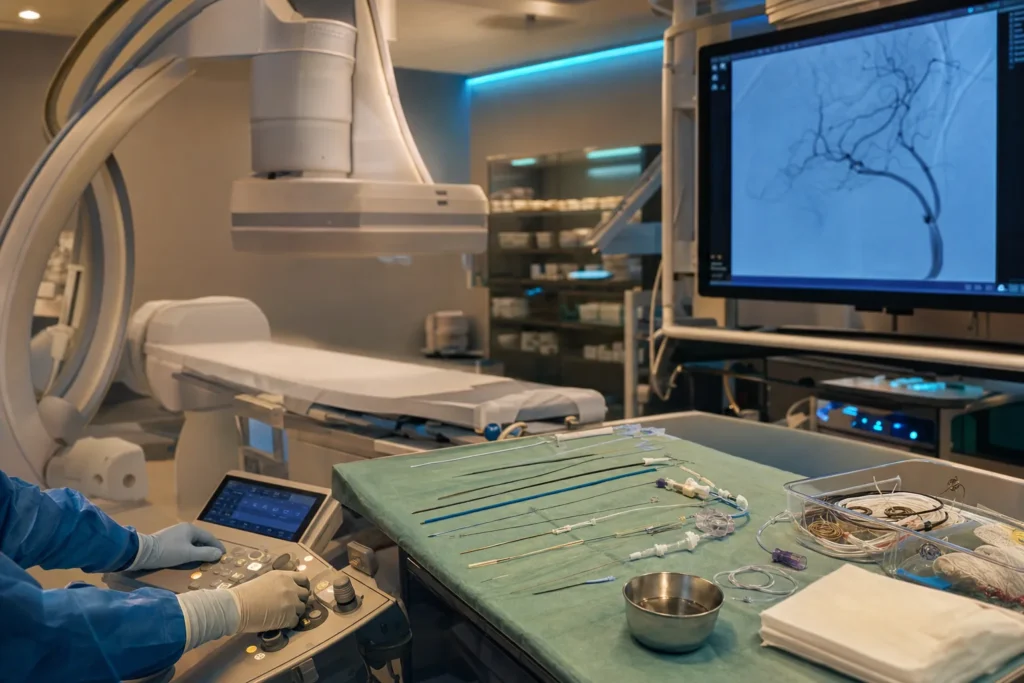
Embolisation is done in an angiography suite, a room with live X-ray imaging called fluoroscopy that lets the doctor watch the catheter move through your vessels in real time.
Anaesthesia. Most adults stay awake but relaxed. You usually get a local anaesthetic to numb the small entry point, plus light or moderate sedation to keep you calm and comfortable, without a breathing tube. Some cases use general anaesthesia, and children are usually given general anaesthesia. You will be connected to monitors tracking your heart rate, blood pressure, and oxygen.
The typical steps are:
- The skin over the artery (groin or wrist) is numbed, and a small puncture is made. No large cut and usually no stitches.
- A thin tube (catheter), about the width of a pencil lead, is guided through the artery toward the organ.
- Contrast dye is injected so the blood vessels show up clearly on X-ray, creating a map of the tumour's blood supply.
- The catheter is steered into the artery feeding the tumour.
- The embolic agent (plain beads, chemotherapy plus beads, or radioactive beads) is released. The doctor confirms the blood flow has stopped.
- The catheter is removed and a bandage or small closure device is applied to the entry point.
How long it takes. Most procedures last about 1 to 2 hours. TACE is often completed within roughly 90 minutes, and the embolisation step itself may take around an hour. Radioembolisation usually involves two visits: a planning angiogram first (to map vessels, block any that lead to the wrong place, and run a test scan), then the actual bead delivery one to two weeks later.
Recovery, step by step
First few hours. You rest in a recovery area while staff watch the entry point and your vital signs. If the groin artery was used, you typically lie flat for several hours so the puncture seals. If the wrist was used, you can usually sit up sooner. Expect to spend roughly 2 to 6 hours under observation.
Overnight. Many people stay one night so pain, nausea, and fever can be managed with medication. Liver cases commonly stay 1 to 2 days; some bland embolisations are done as day cases.
The first week at home. A common, expected reaction is post-embolisation syndrome: a flu-like mix of pain over the treated area, nausea, and a low-grade fever. It often starts within a day or two, can appear 3 to 5 days later, and usually settles within one to two weeks. Painkillers and anti-sickness medicine help. Drink plenty of fluids and rest.
Activity. Most people return to normal daily activities within about a week. Avoid heavy lifting and strenuous exercise for several days. If the groin was used, take it easy on stairs at first; if the wrist was used, avoid repetitive hand movements and heavy gripping.
Longer recovery. Tiredness and reduced appetite can linger for two weeks or more, and after radioembolisation tiredness can last up to about six weeks. These usually fade gradually.
Risks and possible complications
Embolisation is generally well tolerated, but no procedure is risk-free. Knowing the possibilities helps you spot problems early.
Common and expected. Post-embolisation syndrome (pain, nausea, low fever, tiredness) affects most people and is usually short-lived. Bruising at the puncture site is common.
Less common.
- Bleeding or a bruise (haematoma) at the entry point.
- Infection, including, rarely, a liver abscess or sepsis.
- Allergic reaction to the contrast dye.
- Kidney strain from the dye, more likely if your kidneys are already weak.
- Temporary worsening of liver function.
- Non-target embolisation, where beads travel to the wrong place. After radioembolisation this can occasionally irritate the stomach or gut, the gallbladder, or, very rarely, the lungs.
Serious but uncommon. Major complications are reported in roughly 1 in 20 procedures, and rarely the procedure can lead to liver failure; one widely cited patient resource notes that around 1 in 100 procedures may result in death, usually from liver failure in people with already-fragile livers. These figures vary with the type of embolisation and how well the liver is working beforehand. Your own risk depends on your specific situation, which your team should explain clearly.
Results and how long they last
Embolisation is mainly a control treatment rather than a cure. The goal is to shrink or stabilise the tumour, ease symptoms, and protect quality of life, and in some cases to make later surgery or a transplant possible.
For chemoembolisation of liver tumours, published patient information indicates that tumour growth is stopped in roughly two-thirds of treated cases, and that the benefit lasts on average about 10 to 14 months before another treatment may be needed. Technical success (the doctor successfully blocking the target vessel) is high, often well above 90%.
Crucially, the effect is not permanent. Tumours can regrow, or new ones can appear, which is why embolisation is often repeated over months or years and combined with other treatments. After radioembolisation, the radiation fades within about two weeks, while the now-inert beads stay harmlessly in the liver. You will have follow-up scans (often a CT around 2 to 3 months later) and regular blood tests to track how the tumour and your liver are responding.
Costs: indicative ranges and what changes the price
Prices vary a great deal between countries, hospitals, and individual cases. As a rough, indicative guide, a single tumour-embolisation session in Turkiye commonly falls in the region of EUR 5,000 to EUR 15,000. Simpler bland embolisation tends to sit toward the lower end; chemoembolisation in the middle; and radioembolisation with yttrium-90 toward the higher end, because the radioactive microspheres and planning angiogram add cost.
These numbers are an illustration only and not a quote. The real figure depends on your case, the treating doctor, and the clinic, including:
- Type of embolisation (bland vs chemoembolisation vs radioembolisation).
- Number of sessions needed; many people require more than one.
- The materials used (standard beads, drug-eluting beads, or radioactive microspheres).
- Imaging and tests before and after, such as CT and angiography.
- Hospital stay length and level of monitoring.
- Hospital prestige, the team's experience, and whether the price is a bundled package.
For medical travel, ask whether the quote is all-inclusive or itemised, and what happens (and what it costs) if you need extra sessions, a longer stay, or treatment of a complication. Always get a written, itemised estimate before you commit.
Why people travel to Turkiye, and how to choose a safe clinic
Turkiye has become a popular destination for image-guided cancer treatments because it offers modern hospitals, experienced interventional radiology teams, and prices that can be substantially lower than in many Western European countries, often with international patient departments and English-speaking coordinators. Lower cost should never be the only factor, though; for a procedure that works on your liver and blood vessels, safety and expertise matter most.
Before you book, verify the following:
- Hospital accreditation. Look for international accreditation such as Joint Commission International (JCI). You can check a hospital's status directly on the JCI website rather than taking the clinic's word for it.
- The doctor's credentials. Confirm the interventional radiologist is properly board-certified and specifically trained in tumour embolisation. Ask how many of your specific procedure they perform each year.
- A genuine team approach. A reputable centre discusses your case in a multidisciplinary tumour board, not just a single salesperson.
- Transparency on outcomes and risks. Ask to see current certificates and ask about their complication rates. Be wary of any clinic that promises a cure or guarantees results, as no honest provider can.
- Clear written plan. An itemised estimate, a named treating doctor, and a plan for follow-up and complications.
- Aftercare and records. Make sure you will receive full medical records and imaging to hand to your doctors back home.
How to prepare and what to ask at your consultation
Tests beforehand. Expect scans (CT or MRI) and blood tests to check your blood counts, clotting, and how well your liver and kidneys are working. For radioembolisation there is an extra planning angiogram and a test scan to see where the beads will travel.
Medication and fasting. Tell the team about all your medicines and allergies. You may be asked to stop blood thinners or anti-inflammatory painkillers (such as aspirin or other NSAIDs) for several days beforehand, but only on medical advice. You will usually fast for around 4 to 8 hours before sedation, though small sips of water may be allowed up to a couple of hours before.
Good questions to ask:
- Which type of embolisation do you recommend for me, and why?
- What is the goal: shrink the tumour, control it, relieve symptoms, or bridge to surgery or transplant?
- How many sessions am I likely to need?
- What are my specific risks given my liver and kidney function?
- What sedation or anaesthesia will I have?
- How long will I stay in hospital, and who looks after me afterwards?
- What side effects are normal, and which ones mean I should seek urgent help?
- How and when will we check whether it worked?
- What is included in the price, and what happens if I need more treatment?
Aftercare and travelling for treatment (including when it is safe to fly)
Immediate aftercare. Keep the puncture site clean and dry as instructed, take painkillers and anti-sickness medicine as prescribed, and drink plenty of fluids to support your kidneys. After radioembolisation you may be given anti-ulcer medication for several weeks, and a few simple radiation-safety steps for about a week, such as washing your hands carefully and limiting close, prolonged contact with young children and pregnant women. The radiation fades within roughly two weeks.
Warning signs to act on. Contact your medical team promptly if you have a high or persistent fever, severe or worsening pain, redness or discharge at the puncture site, yellowing of the skin or eyes, confusion, or breathing problems.
When it is safe to fly. There is no single fixed rule, and you should get personal clearance from your interventional radiologist before booking flights home. As a general guide, many doctors suggest waiting at least several days to about a week after embolisation, sometimes longer, so the puncture is well healed and post-embolisation symptoms have settled. The main concerns are the entry-point wound, dehydration, and the risk of blood clots (deep vein thrombosis) on longer flights. To reduce that risk, move and stretch regularly, drink water, wear loose clothing, and choose an aisle seat so you can walk about.
Planning your trip. Allow time for the planning visit if you are having radioembolisation, build in a buffer in case you need an extra night or a delayed flight, arrange a companion if you can, and make sure your follow-up scans and blood tests are organised with a doctor at home before you travel.
Frequently asked questions
What is tumour embolisation in simple terms?
What is the difference between TAE, TACE, and SIRT?
Will it cure my cancer?
Does it hurt, and what anaesthesia is used?
How long does the procedure take?
How long will I be in hospital?
What is post-embolisation syndrome?
How soon can I fly after tumour embolisation?
How long do the results last?
What are the main risks?
How much does tumour embolisation cost in Turkiye?
Who should not have this procedure?
This article is for general information only and is not medical advice. Always consult a qualified doctor about your individual case.
Considering this procedure?
Send us your photos and questions. A BergemHealth coordinator and a department-head specialist will review your case and reply with honest, personalised guidance — no obligation.
Free consultation