Psoriasis
Psoriasis is a common, long-term skin condition that causes raised, scaly patches. It is not contagious and it is not your fault. While there is no cure, today's treatments can calm the skin, ease discomfort, and help many people reach long periods with little or no visible disease. This guide explains, in plain language, what psoriasis is, why it happens, and the full range of ways it can be managed.
What psoriasis is
Psoriasis is a long-term (chronic) condition in which the skin makes new cells far too quickly. In healthy skin, cells take roughly a month to grow, rise to the surface, and gently shed. In psoriasis, that process speeds up to just a few days. Because the skin cannot shed the cells fast enough, they pile up on the surface and form thick, scaly patches.
At its root, psoriasis is driven by the immune system. The immune system is the body's defence network. In psoriasis it becomes overactive and behaves as if there were an injury or infection to fight when there is none. This triggers inflammation (swelling and redness) and the rapid skin growth. Doctors call this kind of condition immune-mediated or autoimmune.
Two points often bring relief when people first hear them. First, psoriasis is not contagious — you cannot catch it from someone else or pass it on through touch. Second, it is not caused by poor hygiene or anything you did wrong. Psoriasis is common: it affects more than 3 in every 100 people, and it can begin at any age, though it often first appears in younger and middle-aged adults.
Patches most often appear on the elbows, knees, scalp, and lower back, but they can show up anywhere. On lighter skin tones the patches usually look pink or red with silvery-white scale; on darker skin tones they may look grey, purple, or darker brown, which can sometimes make psoriasis harder to recognise.
Types and subtypes
Psoriasis comes in several forms. A person may have one type, or more than one over time.
- Plaque psoriasis is by far the most common, accounting for around 80 to 90 percent of cases. It causes raised patches (plaques) covered with silvery-white scale, often on the elbows, knees, scalp, and lower back.
- Guttate psoriasis causes many small, drop-shaped spots, often on the trunk, arms, and legs. It frequently appears after a throat infection (such as strep throat), especially in children and young adults, and sometimes clears on its own.
- Inverse (flexural) psoriasis appears in skin folds — under the breasts, in the armpits, or around the groin. The patches are smooth and shiny rather than scaly, because rubbing and moisture wear the scale away.
- Pustular psoriasis causes small, white, pus-filled bumps on red skin. The pus is not an infection. Some forms are limited to the hands and feet; a widespread (generalised) form can make a person feel unwell and needs urgent medical care.
- Erythrodermic psoriasis is a rare, severe form in which redness and shedding cover most of the body. It can affect temperature control and fluid balance and is a medical emergency.
- Nail psoriasis causes tiny dents (pitting), discolouration, thickening, or the nail lifting from its bed. It can affect fingernails and toenails.
- Scalp psoriasis causes scaly, sometimes itchy patches on the scalp; it can extend to the hairline, forehead, and behind the ears.
Separately, some people develop psoriatic arthritis, a related condition affecting the joints, which is covered later in this guide.
Causes and risk factors
The exact cause of psoriasis is not fully understood, but two things work together: genes and the immune system. Psoriasis tends to run in families, so inheriting certain genes makes a person more likely to develop it. Those genes affect how the immune system behaves, leading to the inflammation and rapid skin growth that cause the patches.
Having the genetic tendency does not mean psoriasis will definitely appear. Often something acts as a trigger — an event that sets off the first flare or makes an existing one worse. Common triggers include:
- Infections, especially throat infections (a known trigger for guttate psoriasis).
- Skin injury such as a cut, scrape, sunburn, or even a vaccination site — new patches can appear where the skin was damaged (known as the Koebner response).
- Stress, which many people notice worsens their skin.
- Certain medicines, including some used for blood pressure (beta-blockers), the mood stabiliser lithium, and some antimalarial drugs. Never stop a prescribed medicine without talking to your doctor.
- Smoking and heavy alcohol use.
- Cold, dry weather, and sometimes hormonal changes.
Risk factors that make psoriasis more likely or harder to control include a family history of the condition, smoking, obesity, and high levels of stress. Identifying your personal triggers — which differ from person to person — is a useful part of long-term management.
Signs and symptoms, and when to see a doctor
The most familiar sign of psoriasis is a patch of thickened skin with scale. Common symptoms include:
- Raised patches of skin, often with silvery-white, grey, or darker scale depending on your skin tone.
- Dry, cracked skin that may itch, feel sore, or sometimes bleed.
- Itching or a burning sensation in or around the patches.
- Nail changes such as pitting (small dents), thickening, or the nail separating from its bed.
- Stiff or swollen joints, which can signal psoriatic arthritis.
Symptoms typically come and go. Periods when the skin flares up can be followed by quieter periods (remission) lasting months or longer.
See a doctor if you think you have psoriasis for the first time, if your current treatment is not helping, or if the condition is affecting your sleep, mood, or daily life. Importantly, see a doctor promptly if you develop joint pain, stiffness, or swelling, as treating psoriatic arthritis early can help protect the joints.
Seek emergency care if your skin rapidly turns very red over a large area, or develops widespread pus-filled bumps, particularly if you also feel feverish, shivery, or unwell. These can be signs of severe forms (erythrodermic or generalised pustular psoriasis) that need urgent treatment.
Screening and early detection
There is no routine screening test for psoriasis in the way there is, for example, for some cancers. Psoriasis is usually noticed by the person or spotted by a doctor during an examination of the skin, scalp, and nails.
What does matter is early recognition and watching for related problems. Because psoriasis is linked to inflammation throughout the body, doctors may check for, or ask you to watch for, conditions that are more common in people with psoriasis. These include psoriatic arthritis (joint pain and swelling — roughly 1 in 3 people with psoriasis may develop it), as well as raised risks of heart disease, type 2 diabetes, high blood pressure, high cholesterol, and depression or anxiety.
For this reason, many clinicians treat a psoriasis review as a chance to check blood pressure, weight, and general health, and to ask about mood and joints. Telling your doctor early about any new joint stiffness, eye redness, or low mood helps these problems be caught and managed sooner.
How psoriasis is diagnosed
In most cases, psoriasis is diagnosed simply by looking at the skin, scalp, and nails. The appearance, the typical locations, and the pattern of the scale are often enough for a doctor — usually a GP or a dermatologist (a doctor who specialises in skin) — to make the diagnosis.
Sometimes psoriasis can look like other skin conditions, such as eczema or fungal infections. When the diagnosis is unclear, the doctor may take a small skin biopsy: a tiny sample of skin is removed under local anaesthetic and examined under a microscope. This can confirm psoriasis and rule out other causes.
Unlike many conditions, psoriasis severity is not measured by a single number. Doctors assess how much of the body is affected, how thick and inflamed the patches are, where they are (the scalp, face, hands, feet, and genitals can be especially troublesome), and — crucially — how much the condition affects your quality of life. If joint symptoms are present, you may be referred to a rheumatologist (a joint specialist), who may use blood tests and imaging such as X-rays, ultrasound, or MRI scans to look for psoriatic arthritis. There is no single blood test that diagnoses psoriasis itself.
Treatment options
There is no cure for psoriasis, but a wide and steadily improving range of treatments can control it well. Treatment is usually built up in steps, starting with the gentlest effective options and moving to stronger ones if needed. The right plan depends on the type and severity, the areas involved, your general health, and your preferences. Care is often shared between your GP, a dermatologist, and — for joint disease — a rheumatologist, working as a team.
Topical treatments (applied to the skin) are the usual first step for mild to moderate psoriasis:
- Emollients (moisturisers) soften scale, reduce itch, and protect the skin; they are the foundation of care.
- Vitamin D-based creams and ointments slow the rapid skin growth.
- Topical corticosteroids (steroid creams) reduce inflammation and itch; they are used under medical guidance because long-term overuse can thin the skin.
- Coal tar and dithranol preparations help reduce scale and inflammation.
- Calcineurin inhibitors are useful for delicate areas such as the face and skin folds.
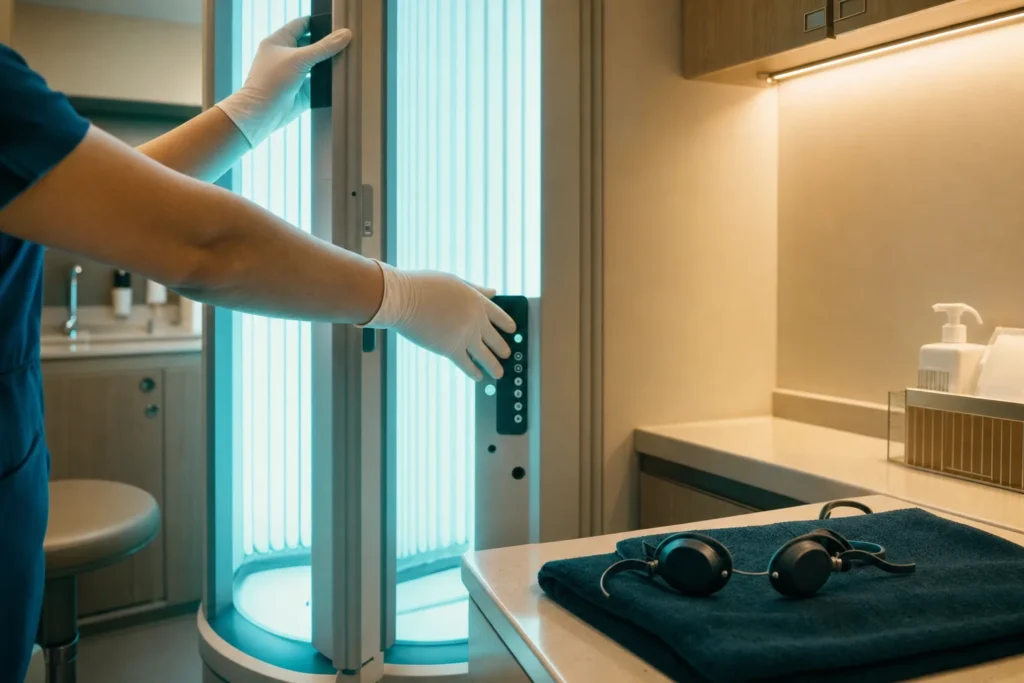
Phototherapy (light therapy) uses controlled doses of ultraviolet light, given in a clinic, to slow skin cell growth. UVB is common; PUVA combines a light-sensitising medicine (psoralen) with UVA light. It is supervised carefully to manage the dose.
Systemic treatments (whole-body medicines) are used for moderate to severe psoriasis or when other treatments have not worked. Traditional tablets include methotrexate, ciclosporin, and acitretin; these need regular blood tests and monitoring because they can affect the liver, kidneys, or other organs. Newer biologic medicines are given by injection or drip and target only the specific overactive parts of the immune system (such as the signalling proteins TNF, IL-17, or IL-23) involved in psoriasis. Because they are precise, they can be very effective. Before starting a biologic, doctors usually do blood tests and screen for infections such as tuberculosis. Some people are also offered targeted tablets such as apremilast.
Alongside medical treatment, supportive care matters: managing itch and dry skin, addressing stress, supporting mental wellbeing, and treating linked conditions such as joint disease all form part of good care.
Outlook and what to expect
Psoriasis is a long-term condition, so for most people it does not simply disappear forever. However, the outlook for symptom control is encouraging. Psoriasis typically follows a pattern of flares and remissions — times when the skin is more active alternating with quieter periods that can last months or even years.
With today's treatments, many people achieve clear or nearly clear skin and a good quality of life. Some children with guttate psoriasis see it settle on its own. The likelihood and degree of improvement vary from person to person, and finding the most effective treatment can take some trial and adjustment. This is normal and not a sign of failure.
It is also worth knowing that psoriasis is more than skin deep. Because it involves body-wide inflammation, it is associated with higher risks of psoriatic arthritis, heart and blood-vessel disease, type 2 diabetes, and mood conditions such as depression and anxiety. The good news is that these risks can be reduced — by treating the psoriasis, by healthy lifestyle steps, and by regular check-ups. None of this predicts what will happen to any one individual; it simply explains why ongoing care is valuable.
Living with psoriasis and follow-up
Living well with psoriasis is very achievable, and small daily habits make a real difference. Using moisturiser regularly, treating the skin gently, and avoiding scratching all help. Learning your personal triggers — and reducing them where you can — gives you more control. For many people that means not smoking, keeping alcohol within sensible limits, maintaining a healthy weight, and finding ways to manage stress.
The emotional side of psoriasis is important and often underestimated. Visible patches, itch, and the unpredictability of flares can affect confidence, sleep, relationships, and mood. You are not alone in this, and support — from your care team, from counselling, or from patient organisations — is part of proper treatment, not an optional extra. Tell your doctor if your skin is affecting your mental health.
Follow-up is usually ongoing. Regular reviews let your team check how treatments are working, watch for side effects (especially with systemic medicines that require blood tests), and screen for related conditions such as joint disease and heart risk factors. Bring up new joint pain, eye problems, or low mood at these visits. Treatment plans are meant to evolve over time as your skin and your life change.
Psoriatic arthritis: the joint connection
Around 1 in 3 people with psoriasis develop psoriatic arthritis, a related condition in which the same immune-driven inflammation affects the joints. It often appears years after the skin symptoms, but it can occasionally come first or even occur without obvious skin disease.
Typical signs are pain, stiffness, and swelling in one or more joints — for example the fingers, toes, knees, or lower back. Stiffness is often worse after rest, such as first thing in the morning, and may ease with movement. A whole finger or toe can swell up (called dactylitis, or a sausage digit), and nail changes are common. Many people also feel tired.
Why this matters: untreated joint inflammation can, over time, damage the joints. Spotting it early and starting treatment helps protect them. So if you have psoriasis and notice persistent joint pain, stiffness, or swelling, tell your doctor. Diagnosis usually involves a referral to a rheumatologist, who may use blood tests and imaging (X-ray, ultrasound, or MRI). Treatments overlap with those for skin psoriasis and include anti-inflammatory painkillers, disease-modifying medicines (DMARDs), biologics, plus physiotherapy to keep joints moving.
Planning treatment abroad: what affects cost and how to prepare your records
Psoriasis is generally a condition managed over the long term rather than fixed by a single operation, so people who travel for care are often seeking specialist dermatology assessment, advanced phototherapy, or access to systemic and biologic treatments under expert supervision. Because every plan is individual, costs vary, and we do not list prices here; instead, it helps to understand what drives them so you can request a personalised estimate.
Factors that affect the cost of psoriasis care include:
- The type and severity of your psoriasis and how much of the body is involved.
- The treatment approach chosen — topical regimens, courses of phototherapy, traditional systemic tablets, or biologic medicines (which differ widely in price).
- Tests and monitoring, such as skin biopsy, blood tests, infection screening before biologics, and follow-up reviews.
- Length and number of visits, since some treatments need repeated sessions or ongoing supervision.
- Any related care, such as assessment for psoriatic arthritis.
To prepare, gather your medical records before you travel: a list of treatments you have already tried and how well they worked, current medicines and allergies, any recent blood test or biopsy results, and clear photographs of your skin at its current state. A short summary letter from your usual doctor is very helpful. With these in hand, a specialist centre can give you an informed, personalised plan and a clear estimate. We are happy to help arrange a free, no-obligation consultation to discuss your situation.
Choosing care in Turkiye and what to verify
Turkiye (Turkey) has become a well-known destination for international patients seeking dermatology care, with modern hospitals, English-speaking coordinators, and experienced specialists. As with anywhere, the key is to choose carefully and to focus on quality and safety rather than on price alone.
When evaluating a centre for psoriasis treatment, it is sensible to verify the following:
- Accreditation: look for internationally recognised hospital accreditation such as JCI (Joint Commission International), which signals adherence to recognised patient-safety and quality standards. Turkiye has a number of JCI-accredited hospitals.
- Specialist credentials: confirm you will be seen by a qualified, board-certified dermatologist, with access to a rheumatologist if joint disease is a concern.
- Multidisciplinary care: good psoriasis care often involves a team — dermatology, sometimes rheumatology, plus nursing and psychological support.
- Range of treatments: check that the centre offers the options you may need, including phototherapy and access to systemic and biologic medicines with proper monitoring.
- Clear communication and follow-up: ask how your care will be coordinated, how follow-up and any future prescriptions will be handled once you return home, and whether records and reports are provided in a language your home doctor can use.
Ask questions freely, request a written plan, and make sure you understand who to contact if you have problems after treatment. A reputable centre will welcome this. We can help you compare accredited options and arrange consultations so you can make an informed choice.
Self-care, prevention of flares, and second opinions
While psoriasis itself cannot currently be prevented, you can do a great deal to reduce flares and feel better day to day. Helpful self-care steps include:
- Moisturise often to keep skin supple and reduce scale and itch, especially after bathing.
- Treat the skin gently — avoid harsh soaps, scratching, and picking at scale, which can trigger new patches.
- Know and manage your triggers, whether that is stress, certain medicines, infections, or cold dry weather.
- Look after your general health: not smoking, limiting alcohol, staying active, and keeping to a healthy weight can all help the skin and lower the linked risks to your heart and joints.
- Use treatments as prescribed and keep your follow-up appointments — consistency is often what makes treatment work.
- Care for your mental wellbeing and reach out for support; this is a legitimate and important part of managing psoriasis.
Finally, you are always entitled to a second opinion. If your psoriasis is not improving, if you are unsure about a recommended treatment, or if you simply want reassurance before making a decision, seeing another qualified dermatologist is reasonable and common. A good doctor will support your wish to be fully informed. The aim of all of this is the same: clearer, more comfortable skin and a life that is not dominated by the condition.
Frequently asked questions
Is psoriasis contagious?
Can psoriasis be cured?
What causes psoriasis?
What does psoriasis look like?
How is psoriasis diagnosed?
What are the main treatments for psoriasis?
What are biologics, and are they safe?
Will I get psoriatic arthritis?
Can diet, stress, or lifestyle affect psoriasis?
When should I seek emergency care?
Why might someone travel to Turkiye for psoriasis care?
This article is for general information only and is not medical advice. Always consult a qualified doctor about your individual case.
Considering this procedure?
Send us your photos and questions. A BergemHealth coordinator and a department-head specialist will review your case and reply with honest, personalised guidance — no obligation.
Free consultation