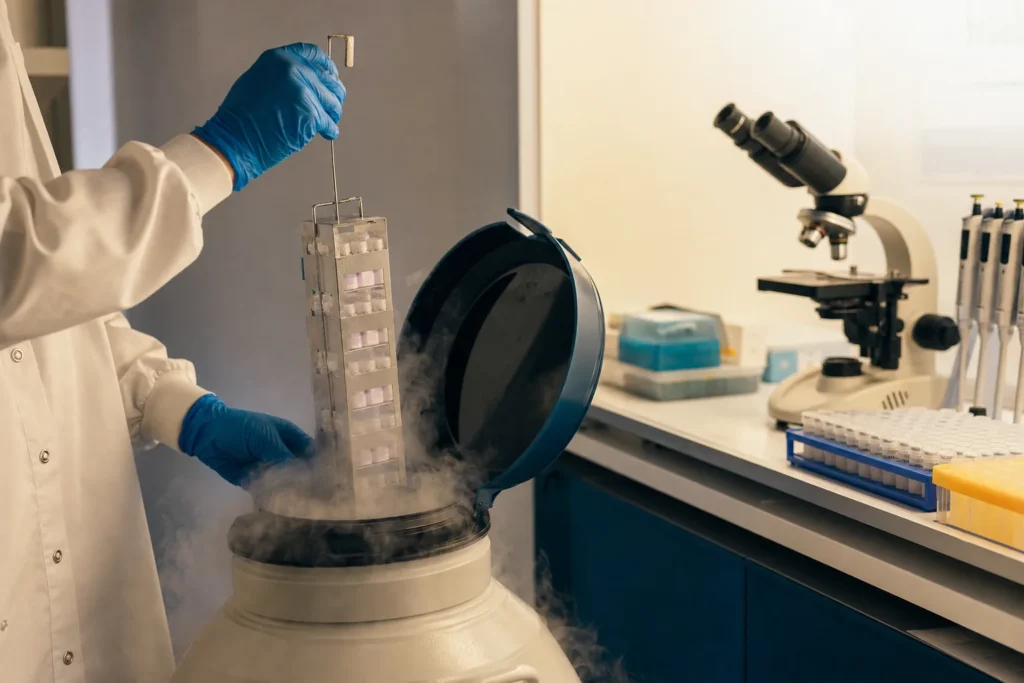
Egg & sperm freezing
Egg and sperm freezing let you store healthy reproductive cells now and use them to try for a baby years later. This friendly, plain-language guide explains how each procedure works, who it helps, the real success rates, the risks, indicative costs, and exactly what to check if you are considering treatment in Turkiye.
- Anaesthesia
- Egg retrieval: light sedation or short general anaesthesia. Sperm collection: none.
- Duration
- Egg retrieval about 20-30 minutes (within a 2-3 week cycle); sperm collection a few minutes per sample.
- Recovery
- Most women resume normal activity within 1-2 days after egg retrieval; sperm collection needs no recovery.
- Hospital stay
- Day case (outpatient) for both; no overnight stay needed.
What egg and sperm freezing actually are
Egg freezing and sperm freezing are ways to press pause on your fertility. The idea is simple: collect healthy eggs or sperm while they are at their best, freeze them so they stop ageing, and store them safely until you are ready to try for a baby, sometimes many years later.
The medical name for egg freezing is oocyte cryopreservation (an oocyte is an egg cell; cryopreservation means preserving something by freezing). Sperm freezing is also called sperm banking or sperm cryopreservation. Both fall under the umbrella of fertility preservation.
Modern freezing uses a fast-freeze method called vitrification. Instead of cooling cells slowly (which lets damaging ice crystals form), vitrification cools them so quickly that the liquid inside turns glass-like rather than icy. A protective solution called a cryoprotectant is added first to shield the cells. The frozen eggs or sperm are then kept in tanks of liquid nitrogen at around -196 degrees Celsius (about -321 degrees Fahrenheit), a temperature so cold that all biological activity essentially stops. At that point, time no longer ages the cells.
One key difference between the two: freezing sperm is quick and simple, while freezing eggs involves a two-to-three-week cycle of medication and a minor procedure. We explain both below.
Who is a good candidate, and who should think twice
People freeze eggs or sperm for two broad reasons: a medical reason (a treatment or condition that may harm fertility) or a planned, elective reason (wanting to keep options open for the future).
Common reasons to freeze eggs:
- Before cancer treatment such as chemotherapy or radiotherapy, which can damage the ovaries.
- A medical condition or surgery that may reduce ovarian reserve (the number of eggs left), or a family history of early menopause.
- Wanting to delay motherhood for personal, relationship, or career reasons, knowing egg quality and quantity decline with age.
- Before gender-affirming hormone treatment for trans men.
Common reasons to freeze sperm:
- Before cancer treatment, a vasectomy, or surgery that may affect fertility (for example testicular surgery).
- A very low or falling sperm count, so a good sample is stored as a backup.
- Work or travel that takes you away from a partner during fertility treatment, including military deployment.
- Before gender-affirming treatment for trans women.
Who should think twice or get extra advice: The American Society for Reproductive Medicine (ASRM) is clear that freezing eggs does not guarantee a future baby, and that the most reliable, lowest-cost route to a family is usually to conceive naturally at a relatively younger age. Egg freezing in your late 30s or 40s yields fewer and lower-quality eggs, so the odds are lower. Anyone with active infection, certain medical conditions that make ovarian stimulation unsafe, or who cannot commit to the monitoring schedule should discuss timing carefully with a fertility specialist.
Importantly, freezing eggs or sperm is only the first half of the story. Using them later still requires in vitro fertilisation (IVF) or another assisted-conception step, which has its own success rates and costs.
Types and techniques
Egg freezing almost always uses vitrification today. Older slow-freezing methods exist but give poorer survival rates after thawing, so vitrification has become the standard.
You may also hear about embryo freezing as an alternative. Here the eggs are fertilised with sperm before freezing, creating embryos. Embryos tend to survive thawing very reliably and give a clearer picture of likely success, but they commit you to a specific sperm source now. Freezing unfertilised eggs keeps your future choices open, including who the sperm comes from. Your clinic will help you weigh these trade-offs.
Sperm freezing is usually straightforward. The sample is mixed with a cryoprotectant, divided into several small vials, frozen in liquid-nitrogen vapour and then stored. Splitting one sample across several vials means you can run several future treatments without using everything at once.
When a usual semen sample is not possible (for example after certain cancers or in men with no sperm in the ejaculate), sperm can sometimes be retrieved surgically directly from the testicle with techniques such as TESE (testicular sperm extraction) and then frozen. These surgical options are discussed individually.
How the frozen cells are used later also varies. Thawed sperm can be used for intrauterine insemination (IUI, placing sperm into the womb), or with IVF. Thawed eggs are almost always fertilised by intracytoplasmic sperm injection (ICSI), where a single sperm is injected directly into each egg.
How it is done: anaesthesia, steps and timing
Egg freezing, step by step (the front end is the same as an IVF cycle and takes about two to three weeks):
- Tests and screening. Blood tests check your ovarian reserve and hormone levels, and you are screened for infections such as HIV and hepatitis B and C.
- Ovarian stimulation. For roughly 10-14 days you give yourself daily hormone injections (fertility drugs) so that several eggs mature at once, instead of the single egg a natural cycle produces.
- Monitoring. Regular ultrasound scans and blood tests track how your follicles (the fluid-filled sacs that hold eggs) are growing, so doses can be adjusted.
- Trigger shot. When the follicles are ready, a final injection prepares the eggs for collection, timed about 36 hours before retrieval.
- Egg retrieval. Under light sedation or a short general anaesthetic, the doctor passes a thin needle through the vaginal wall, guided by ultrasound, to gently draw the eggs from each follicle. It usually takes about 20-30 minutes and you go home the same day.
- Freezing. In the lab, mature eggs are treated with cryoprotectant and vitrified within hours.
Sperm freezing, step by step:
- Screening. Blood tests for infections (HIV, hepatitis B and C, and others) are done first.
- Sample collection. The sample is usually produced by masturbation in a private room at the clinic. You are often asked to avoid ejaculation for about 2-5 days beforehand for the best sample. No anaesthesia is needed.
- Semen analysis. The lab checks the count, movement and shape of the sperm.
- Freezing and a test-thaw. The sample is mixed with cryoprotectant, split into vials and frozen. The lab usually thaws a small portion to check how well the sperm survive, which helps plan future treatment. More than one sample may be banked over several visits.
Recovery, step by step
After egg retrieval, recovery is usually quick:
- You rest at the clinic for an hour or two while the sedation wears off, then go home, ideally with someone to accompany you.
- It is normal to feel mild cramping, bloating or spotting for a day or two, similar to period symptoms. Simple painkillers such as paracetamol usually help.
- Most women feel back to normal and return to everyday activities within 1-2 days.
- Your clinic will tell you when to contact them urgently, for example if you have severe or worsening abdominal pain, heavy bleeding, fever, breathlessness, or rapid weight gain and swelling, which can be signs of ovarian hyperstimulation (covered below).
After sperm collection, there is essentially nothing to recover from. You can carry on with your day immediately. If sperm was retrieved surgically, your team will give specific aftercare advice and you may have mild soreness for a few days.
Risks and possible complications
Both procedures are generally considered safe, but no medical procedure is risk-free. It helps to know what can happen and how likely it is.
Egg freezing risks:
- Ovarian hyperstimulation syndrome (OHSS). This is an over-response to the fertility drugs, where fluid leaks into the abdomen causing bloating, nausea and discomfort. Mild symptoms are common, but moderate or severe OHSS is uncommon, affecting just over 1 in 100 women, with severe cases in fewer than 1 in 100. Clinics lower the risk by adjusting drug doses and choice of trigger. Seek urgent care for severe abdominal pain, persistent vomiting, breathlessness, reduced urination, or rapid weight gain.
- Egg-retrieval risks. Because a needle is used, there is a small chance of infection (roughly 0.01-0.6 percent), bleeding inside the abdomen (about 0.02-0.3 percent), or rare injury to nearby organs. The chance of needing hospital admission or further surgery for a complication is about 1 in 1,000.
- Sedation risk. Sedation is very safe; serious problems such as a brief pause in breathing are rare (around 1 in 1,000).
- Emotional and practical risk. The process can be stressful, and there is no guarantee the eggs will lead to a baby later.
Sperm freezing risks: Producing a sample carries essentially no physical risk. The main practical points are that freezing and thawing damage some sperm, and that storage involves ongoing fees and the need to keep your consent and contact details up to date.
Reassuringly, current evidence shows that babies conceived using frozen eggs or frozen sperm are as healthy as those conceived naturally, with no known increase in birth defects, though long-term studies continue.
Results and how long they last
Once frozen and stored correctly in liquid nitrogen, eggs and sperm do not deteriorate with time. A sample stored for ten years is biologically much the same as one stored for one year. The clock that matters is your age at the moment of freezing, not how long the cells sit in storage.
For eggs, age at freezing is the single biggest factor. Younger eggs are more likely to survive thawing, fertilise and become a healthy pregnancy. As a rough guide to how the odds stack up, ASRM notes that at around age 38 a woman may need roughly 25-30 frozen eggs to have a reasonable chance of one baby, simply because not every egg survives thawing, fertilises and develops. Younger women generally need fewer. This is why many cycles aim to collect and freeze multiple eggs, and why some people do more than one cycle.
For sperm, pregnancy rates using thawed sperm are broadly comparable to using fresh sperm, though the exact outcome depends on the sperm quality after thawing and on the treatment used (IUI, IVF or ICSI).
The honest bottom line: freezing improves your options, not your certainty. It is best thought of as an insurance policy that raises the chance of a future pregnancy, not a guarantee of one. Ask your clinic for their own thaw-survival and live-birth figures for your age group.
Costs: indicative ranges and what changes the price
Prices vary widely between countries and clinics. As a rough indication, egg freezing in Turkiye often falls in the region of EUR 1,500-4,500 for one cycle, while sperm freezing is typically much cheaper, often around EUR 200-600 for collection and the first period of storage. For comparison, a single egg-freezing cycle in the UK is commonly quoted at several thousand pounds before medication and storage.
These figures are indicative ranges, not a quote. The real price varies by case, by the clinic and specialist, by how much medication you need, and by how many cycles you do. Always ask for a written, itemised quote.
Things that move the price up or down:
- Medication. Fertility drugs are a major part of egg-freezing cost and depend on your dose and how your ovaries respond.
- Number of cycles. Some people need more than one cycle to bank enough eggs.
- Storage fees. Usually billed yearly or in blocks; ask how long is included and what renewal costs.
- Add-ons. Genetic screening, extra tests, or surgical sperm retrieval add to the total.
- Later use. Thawing, fertilising (ICSI) and embryo transfer are separate, future costs, not part of the freezing fee.
When comparing clinics, make sure you are comparing like with like, and that quotes spell out medication, storage and any future treatment separately.
Why people travel to Turkiye, and how to choose a safe clinic
Turkiye has become a well-known destination for fertility care because it combines established IVF centres, experienced specialists and prices that are often lower than in Western Europe or North America. Fertility clinics there are inspected regularly by the Ministry of Health, and several hospitals hold international accreditation.
Know the local rules before you book. Turkish law is stricter than in some countries. Standard IVF is generally available only to married heterosexual couples using their own eggs and sperm, and donor eggs, donor sperm and donor embryos are not permitted. Egg freezing for unmarried women is allowed only on specific medical grounds (for example cancer, diminished ovarian reserve, or a family history of early ovarian failure), which usually need to be documented by doctors. If your situation does not fit these rules, discuss it openly with the clinic and consider getting independent advice before travelling.
What to verify before choosing a clinic or specialist:
- Accreditation. Look for recognised quality marks such as Joint Commission International (JCI) and confirmation that the clinic is licensed and inspected by the Turkish Ministry of Health.
- The specialist's credentials. Check that your doctor is a board-certified specialist in reproductive medicine or gynaecology with specific experience in fertility preservation.
- The laboratory. The embryology lab is where eggs and sperm are frozen and stored; ask about their vitrification experience, monitoring and alarm systems, and their own thaw-survival rates.
- Clear, written information. A trustworthy clinic gives realistic success figures for your age, an itemised quote, and a written consent and storage agreement, without pressure or guarantees.
- Storage and consent. Confirm how long your eggs or sperm will be stored, how renewal works, and how they keep your contact details up to date so your samples are not at risk.
- Aftercare and communication. Check what support you get after you fly home and how to reach the team if you have a problem.
How to prepare, and what to ask at your consultation
Good preparation makes the process smoother and the results easier to understand.
Before treatment:
- Have any requested tests done, such as ovarian-reserve blood tests and ultrasound for women, and a semen analysis for men.
- Complete infection screening (HIV, hepatitis B and C, and others as advised).
- Adopt healthy habits where you can: stopping smoking, moderating alcohol, and reaching a healthy weight can all support fertility.
- Plan the logistics, especially for travel: the egg-freezing cycle spans two to three weeks with several monitoring visits, so check how much time you need to be in Turkiye.
Questions worth asking your specialist:
- Based on my age and test results, how many eggs might you expect to collect, and how many cycles might I need?
- What are your clinic's own thaw-survival and live-birth rates for someone like me?
- What is my personal risk of OHSS, and how will you reduce it?
- What exactly is included in the quoted price, and what will using the eggs or sperm cost later?
- How and where are my eggs or sperm stored, for how long, and how does consent renewal work?
- Given the local rules, am I eligible for the treatment I want?
- Who do I contact, and how, if I have a problem after I go home?
Aftercare and travelling for treatment (including flying)
Both procedures are day cases, so you will not normally need an overnight hospital stay. Still, sensible planning helps, especially when you are away from home.
After egg retrieval:
- Do not drive or travel alone straight after sedation; arrange someone to take you back to your accommodation.
- Take it easy for the first day or two and avoid strenuous exercise while any bloating settles.
- For flying, it is sensible to stay near the clinic for a few days afterwards rather than flying home immediately, so any complication such as OHSS can be picked up and treated quickly. Ask your specialist when it is safe for you specifically to fly, as advice depends on how your body responded.
- Watch for warning signs (severe pain, heavy bleeding, fever, breathlessness, rapid swelling or weight gain) and know how to reach the clinic urgently.
After sperm collection: there are no flying or activity restrictions; you can travel as normal.
For the longer term: keep your storage paperwork, know your consent renewal dates, and keep your contact details current with the clinic, since samples can be lawfully kept for many years (in the UK, for example, up to 55 years with consent renewed periodically). If you plan to use the eggs or sperm in a different country later, check in advance that they can be safely shipped and that the receiving clinic accepts them.
This article is general information, not medical advice. Your own plan should be made with a qualified fertility specialist who knows your history.
Frequently asked questions
Does freezing my eggs guarantee I will have a baby later?
What is the best age to freeze my eggs?
How long does the egg-freezing process take?
Is egg retrieval painful?
How long can frozen eggs and sperm be stored?
Are babies born from frozen eggs or sperm healthy?
What is OHSS and how worried should I be?
How much does egg or sperm freezing cost in Turkey?
Can single or unmarried women freeze their eggs in Turkey?
When is it safe to fly home after egg retrieval?
What happens to the frozen eggs or sperm when I want to use them?
Should I freeze eggs or embryos?
This article is for general information only and is not medical advice. Always consult a qualified doctor about your individual case.
Considering this procedure?
Send us your photos and questions. A BergemHealth coordinator and a department-head specialist will review your case and reply with honest, personalised guidance — no obligation.
Free consultation