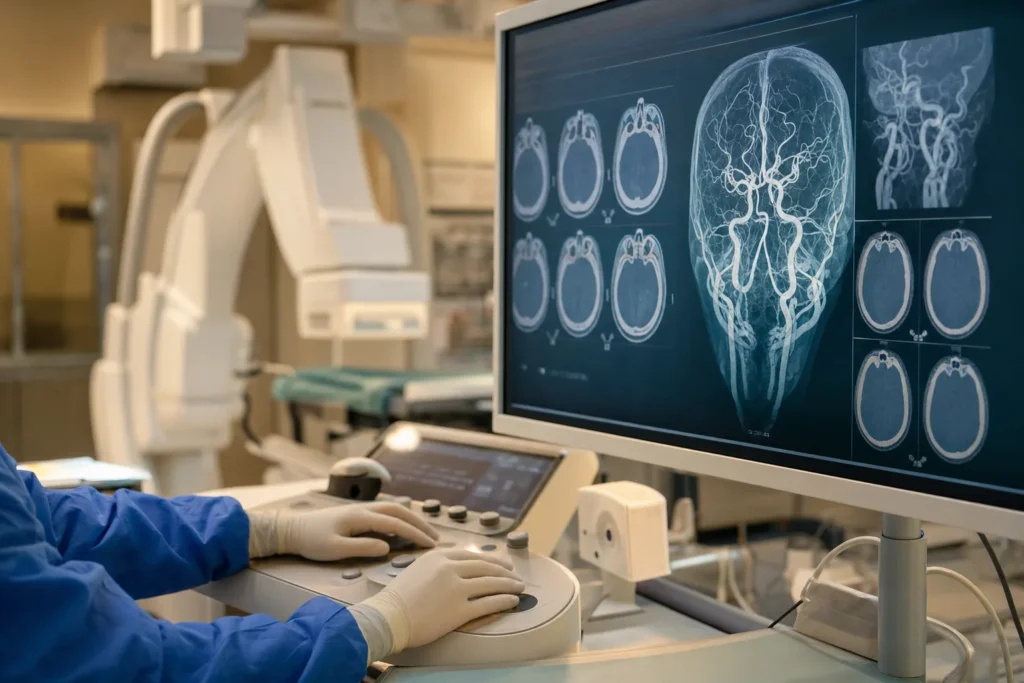
Ischaemic stroke
An ischaemic stroke happens when a blood clot blocks the supply of blood to part of the brain. It is the most common kind of stroke, and it is a medical emergency where every minute counts. This guide explains, in plain language, what an ischaemic stroke is, how it is recognised and treated, what recovery usually involves, and how to think about arranging stroke and rehabilitation care abroad.
What an ischaemic stroke is
A stroke happens when blood stops flowing to part of the brain. Your brain needs a steady supply of blood to bring it oxygen and nutrients. When that supply is cut off, brain cells in the affected area start to be damaged within minutes, which is why a stroke is always treated as an emergency.
There are two main kinds of stroke. An ischaemic stroke (sometimes spelled "ischemic") is caused by a blood clot or other blockage that stops blood reaching the brain. A haemorrhagic stroke is different: it is caused by a blood vessel bleeding into or around the brain. This article is about the ischaemic kind, which is by far the more common of the two. According to the American Stroke Association and the U.S. Centers for Disease Control and Prevention (CDC), about 87% of all strokes are ischaemic.
The word "ischaemic" simply means "caused by a reduced blood supply." Because the part of the brain that loses its blood supply controls a particular function, the symptoms depend on where in the brain the blockage happens. A stroke can affect movement, speech, vision, balance, memory and more. The good news is that fast treatment can limit the damage, and rehabilitation can help the brain and body recover, sometimes a great deal.
Types and subtypes
Doctors group ischaemic strokes by where the clot came from and which blood vessel it blocked. Understanding the type matters because it guides treatment and how to prevent another stroke.
- Thrombotic stroke. A clot (called a thrombus) forms directly inside an artery that supplies the brain. This usually happens where the artery wall has become narrowed and stiff with fatty deposits, a process called atherosclerosis ("hardening of the arteries").
- Embolic stroke. A clot or piece of debris forms somewhere else in the body, often in the heart, then travels through the bloodstream until it lodges in a brain artery. An irregular heart rhythm called atrial fibrillation is a common source of these travelling clots.
- Large-vessel stroke. A blockage in one of the brain's bigger arteries. These can cause more extensive symptoms and are the kind most likely to benefit from a procedure to physically remove the clot.
- Small-vessel (lacunar) stroke. A blockage in one of the tiny, deep arteries of the brain. These are often linked to long-standing high blood pressure or diabetes.
- Cryptogenic stroke. A stroke where, even after tests, no clear cause is found. "Cryptogenic" simply means "of unknown origin."
There is also a closely related event called a transient ischaemic attack (TIA), often called a "mini-stroke." It is covered in more detail below.
Causes and risk factors
The underlying cause of most ischaemic strokes is a blocked artery, but several things make a blockage more likely. Some risk factors cannot be changed; many can.
Things you cannot change:
- Age. Stroke becomes more common as we get older. The NHS notes that risk rises after the age of around 50, and the CDC reports that risk increases with age.
- Family history and genetics. Having close relatives who had a stroke, or certain inherited conditions such as sickle cell disease, can raise risk.
- Ethnic background. People of South Asian, African or Caribbean heritage have a higher average risk. In the United States, the CDC reports that Black adults have nearly twice the risk of stroke compared with White adults.
Things that can often be managed or treated:
- High blood pressure (hypertension) — the single biggest treatable risk factor.
- Atrial fibrillation, an irregular heartbeat that can let clots form in the heart.
- High cholesterol, which contributes to fatty deposits in the arteries.
- Diabetes.
- Smoking and vaping.
- Being overweight, drinking too much alcohol, and not being physically active.
- A previous TIA or stroke.
Less common contributors include migraines, the combined contraceptive pill, and pregnancy complications such as pre-eclampsia. Having a risk factor does not mean you will have a stroke; it simply means it is worth working with a doctor to keep that factor under control.
Signs and symptoms (and when to get help)
Stroke symptoms come on suddenly. The most widely taught way to recognise them is the FAST test:
- F — Face. One side of the face may droop, or the smile may be uneven.
- A — Arms. The person may not be able to lift both arms and keep them up, because of weakness or numbness on one side.
- S — Speech. Speech may be slurred, or the person may struggle to find words or seem confused.
- T — Time. If you see any of these signs, it is time to call emergency services straight away.
Some sources expand this to BE FAST, adding B for sudden loss of Balance and E for sudden changes in the Eyes or vision. Other symptoms can include sudden numbness or weakness down one side of the body, sudden trouble seeing in one or both eyes, sudden severe headache, dizziness, or difficulty understanding others.
Call your local emergency number immediately if you or someone near you has any of these signs, even if the symptoms seem to ease or go away. The NHS advises calling for an ambulance if there have been signs of a stroke in the last 24 hours, even if they have stopped. Do not wait, and do not drive yourself; an ambulance crew can begin assessment on the way to hospital. With stroke, doctors often say "time is brain" because faster treatment means more brain tissue can be saved.
Screening and early detection
There is no routine, single screening test for stroke itself the way there is for some cancers. Instead, prevention focuses on finding and managing the conditions that lead to stroke, and on recognising warning signs early.
The most useful "screening" in everyday life is regular health monitoring: having your blood pressure checked, knowing your cholesterol levels, checking for an irregular pulse that might signal atrial fibrillation, and managing diabetes. Many strokes are preceded by a transient ischaemic attack (TIA), so treating a TIA as an urgent warning is one of the most important forms of early detection.
In people who already have certain risk factors, a doctor may arrange tests such as an ultrasound scan of the neck arteries (a carotid Doppler) to look for narrowing, or heart monitoring to detect an irregular rhythm. These are not population-wide screening programmes but targeted checks based on individual risk. If you are worried about your stroke risk, a check-up with a doctor is a sensible first step.
How an ischaemic stroke is diagnosed
When someone arrives at hospital with possible stroke symptoms, the team works quickly to confirm what is happening and to find out whether it is ischaemic (a clot) or haemorrhagic (a bleed), because the treatments are very different.
Diagnosis usually involves:
- A brain scan. A CT (computed tomography) scan is often done first because it is fast and good at spotting bleeding. An MRI (magnetic resonance imaging) scan gives a more detailed picture and can show the area of brain affected.
- Imaging of the blood vessels. A CT or MR angiogram uses dye and scanning to show exactly where an artery is blocked. This helps the team decide whether a clot-removal procedure is possible.
- A clinical examination. The doctor checks strength, sensation, speech, vision and balance. Many teams use a standardised stroke severity scale (such as the NIHSS) to measure how much the stroke has affected the person.
- Heart and blood tests. An ECG (a recording of the heart's rhythm) can reveal atrial fibrillation, and blood tests check things such as blood sugar and clotting.
Unlike cancers, ischaemic stroke is not given a numbered "stage." Instead, doctors describe its severity, location and the underlying cause, which together shape the treatment and prevention plan.
Treatment options
Treatment has two goals: first, to restore blood flow and limit damage during the emergency; and second, to prevent another stroke and support recovery. Care is delivered by a multidisciplinary team, which may include stroke physicians (neurologists), interventional radiologists, nurses, physiotherapists, occupational therapists, speech and language therapists, dietitians and psychologists.
Emergency treatments to restore blood flow:
- Clot-dissolving medicine (thrombolysis). A drug such as alteplase or tenecteplase can break down the clot. The American Stroke Association notes that, given within 4.5 hours of symptoms starting, these medicines may improve the chance of recovery. They are only suitable for certain patients, which is one reason getting to hospital fast matters so much.
- Mechanical thrombectomy (clot removal). For a blockage in a large artery, doctors can thread a thin tube up to the brain and physically pull the clot out using a device called a stent retriever. This can be done in selected patients up to 24 hours after symptoms begin, if scans show there is still brain tissue worth saving.
Medicines to prevent another stroke:
- Antiplatelet medicines such as aspirin or clopidogrel, which make the blood less likely to clot.
- Anticoagulants (blood thinners), often used when atrial fibrillation is involved.
- Blood-pressure-lowering medicines and statins to lower cholesterol.
Procedures and surgery in selected cases: If a neck artery is badly narrowed, surgery to clear it (carotid endarterectomy) or to widen it with a stent may be advised. A procedure to relieve dangerous pressure inside the skull is occasionally needed after a large stroke. Throughout, supportive care, such as help with breathing, swallowing, fluids and preventing complications, is an essential part of treatment.
Outlook: what to expect
Recovery after an ischaemic stroke varies enormously from one person to another, and it is not possible to predict any individual's outcome in advance. The picture depends on how much of the brain was affected, which functions it controlled, how quickly treatment was given, and a person's general health.
Some people recover quickly, within days or weeks. Others need months or even years of rehabilitation and ongoing support. The Cleveland Clinic notes that most people take a few months to recover, and that ischaemic strokes generally tend to have better outcomes than haemorrhagic strokes, though individual results vary widely. The brain has a real capacity to relearn and rewire, especially with consistent rehabilitation.
At a population level, stroke remains a serious condition. The CDC describes it as a leading cause of long-term disability, reducing mobility in more than half of survivors aged 65 and older, and it is a major cause of death worldwide. These are population-level figures, not a prediction for any one person. Many survivors go on to regain independence and a good quality of life. The most useful thing anyone can do is to work closely with their stroke team and stick with rehabilitation, which is where much of the recovery happens.
Living with it and follow-up
Life after a stroke usually combines rehabilitation, prevention of another stroke, and emotional support. Rehabilitation is tailored to each person and may include:
- Physiotherapy to rebuild strength, movement and balance.
- Occupational therapy to relearn everyday tasks such as washing, dressing and cooking.
- Speech and language therapy for difficulties with speaking, understanding, or swallowing.
- Cognitive support for memory, concentration and thinking.
- Psychological support, because anxiety, low mood and fatigue are common after a stroke and can be treated.
Rehabilitation can be delivered in hospital, at home, in the community, or partly online. Progress is usually reviewed at intervals, and the NHS describes a review at around six months after leaving hospital. Recovery is rarely a straight line, and small, steady gains matter.
Follow-up also means staying on prescribed medicines, attending check-ups, and keeping risk factors under control: blood pressure, cholesterol, diabetes, weight, smoking and alcohol. Family members and carers play a huge role, and looking after their own wellbeing matters too. Stroke support organisations and survivor groups can be a valuable source of practical help and reassurance.
Planning treatment abroad: what affects cost and how to prepare your records
Emergency stroke treatment almost always happens close to where the stroke occurs, because it is so time-critical. Where international care is more often arranged is for rehabilitation, follow-up assessment, secondary-prevention work-up (such as carotid surgery or stenting), and second opinions once a person is stable. If you are considering this, it helps to understand what shapes the overall cost so you can ask the right questions.
Factors that typically influence the cost of stroke care and rehabilitation include:
- The severity of the stroke and how much rehabilitation is needed.
- The type and intensity of therapy (physiotherapy, speech therapy, occupational therapy) and how many weeks of inpatient or outpatient treatment are involved.
- Whether procedures such as carotid surgery, stenting, or advanced imaging are required.
- The length of any hospital stay and the level of nursing or intensive care.
- Medicines, follow-up scans and specialist consultations.
- Travel, accommodation and interpreter or coordination services.
To prepare, gather your medical records: brain scan images and reports (CT or MRI), hospital discharge summaries, a current medication list, details of any procedures already performed, and recent blood-pressure and blood-test results. Having these translated and organised lets a specialist give accurate advice and a realistic, personalised plan. Because every stroke is different, costs cannot be quoted from a price list; the sensible step is to request a personalised estimate through a free consultation, where your records can be reviewed.
Why Turkiye, and how to choose a good centre
Turkiye (Turkey) has become a well-known destination for medical care, including neurology and rehabilitation, with many hospitals that hold international accreditation and treat patients from abroad. When you are choosing a centre for stroke care or rehabilitation, the goal is to verify quality rather than to look for the cheapest or the most heavily advertised option.
Practical things to check:
- Accreditation. Look for hospitals accredited by Joint Commission International (JCI), an independent body that assesses patient safety and quality of care. Turkiye has a large number of JCI-accredited hospitals.
- A dedicated stroke or neurology service. Ask whether there is a stroke unit, a neurology department, and access to advanced imaging and, where relevant, thrombectomy or carotid procedures.
- The specialist team. Check the qualifications and experience of the neurologists, rehabilitation physicians and therapists who would be involved in your care.
- A structured rehabilitation programme with physiotherapy, occupational therapy and speech and language therapy.
- Clear communication. Confirm that interpreters are available and that you will receive written treatment plans and reports you can share with doctors at home.
- Continuity of care. Ask how follow-up will work once you return home, and what records and instructions you will be given.
A reputable centre or coordinator will be happy to answer these questions, share doctor credentials, and explain what is and is not possible in your situation before you travel.
Prevention and self-care
Many ischaemic strokes are linked to risk factors that can be reduced, so prevention is genuinely worthwhile, both before a first stroke and to lower the chance of another one. The main steps are consistent and well evidenced:
- Keep blood pressure under control. This is the most important single thing, since high blood pressure is the leading treatable cause of stroke. Have it checked, and take any prescribed medicine.
- Stop smoking and vaping, and avoid second-hand smoke.
- Eat a balanced diet rich in vegetables, fruit and whole grains, with less salt and saturated fat.
- Be physically active in a way that suits you, and aim for a healthy weight.
- Limit alcohol.
- Manage diabetes and cholesterol with your doctor's help.
- Treat atrial fibrillation if you have it, since the right medicine can greatly lower the risk of clots.
- Take a TIA seriously. A "mini-stroke" is a warning that a full stroke may follow, and prompt treatment can prevent it.
If you have already had a stroke, taking your prescribed medicines exactly as advised and attending follow-up appointments are among the most effective ways to protect yourself. Small, sustainable changes add up. A qualified doctor can help you build a prevention plan that fits your life and your particular risk factors.
Frequently asked questions
What is the difference between an ischaemic stroke and a haemorrhagic stroke?
What does FAST stand for?
How quickly does an ischaemic stroke need to be treated?
What is a TIA or mini-stroke?
Can you recover fully from an ischaemic stroke?
What causes an ischaemic stroke?
Who is most at risk of an ischaemic stroke?
Is there a screening test for stroke?
What does stroke rehabilitation involve?
How can I lower my risk of another stroke?
Should I travel abroad for stroke treatment?
How much does stroke care or rehabilitation abroad cost?
This article is for general information only and is not medical advice. Always consult a qualified doctor about your individual case.
Considering this procedure?
Send us your photos and questions. A BergemHealth coordinator and a department-head specialist will review your case and reply with honest, personalised guidance — no obligation.
Free consultation