Brain tumours
A brain tumor diagnosis raises urgent questions, but "brain tumor" is not a single disease. The term covers many different growths, from slow-growing, often benign meningiomas to fast-growing gliomas and cancer that has spread to the brain from elsewhere in the body. Each behaves differently and is treated differently. This guide explains, in plain language and drawing only on established cancer authorities, what these tumors are, how they are diagnosed and graded, the treatments available, and what to consider if you are weighing care abroad in Turkiye (Turkey). It is information to help you ask good questions, not a substitute for advice from a qualified neuro-oncology team.
What a brain tumor is
A brain tumor is a growth of abnormal cells in or around the brain. Doctors divide these tumors into two broad groups, and the difference matters enormously for treatment and outlook.
Primary brain tumors start in the brain itself or its surrounding tissues. They are named for the cells they come from. Some are benign (non-cancerous), meaning they grow slowly and do not spread to other parts of the body, though they can still cause problems by pressing on nearby structures. Others are malignant (cancerous) and grow more quickly into surrounding brain tissue.
Secondary brain tumors, also called brain metastases, are cancers that began somewhere else in the body, such as the lung or breast, and have spread to the brain. According to the American Cancer Society, metastatic brain tumors are more common than primary brain tumors in adults. The same source notes that about 3 in 10 brain tumors are some type of glioma, while meningiomas account for about 1 in 3 primary brain and spinal cord tumors.
Unlike most cancers, primary brain tumors very rarely spread outside the central nervous system. This is one reason the usual cancer "staging" system is not used in the same way for the brain. Instead, doctors rely heavily on the tumor's grade and its molecular features, which we explain below.
Types and subtypes
The most common brain tumors discussed here fall into three families.
Gliomas arise from the brain's supporting (glial) cells. They include several subtypes:
- Astrocytomas, which range from slow-growing low-grade tumors to highly aggressive forms. Glioblastoma (often shortened to GBM) is a grade 4 astrocytoma and an aggressive primary malignant brain tumor in adults. The American Cancer Society notes that glioblastomas make up more than half of all gliomas.
- Oligodendrogliomas, which are less common and tend to grow more slowly, though they can become more aggressive over time.
- Ependymomas, which develop in or near the fluid-filled spaces of the brain and spinal cord.
Meningiomas grow from the meninges, the membranes covering the brain and spinal cord. The American Cancer Society describes them as the most common primary tumors that affect the brain in adults. The great majority are grade 1 (benign) and slow-growing; grade 2 (atypical) and grade 3 (malignant) meningiomas are less common but recur more readily.
Brain metastases are clusters of cancer cells that have travelled to the brain through the bloodstream. Lung and breast cancers, melanoma, kidney and colorectal cancers are among the more frequent sources. A person may have one metastasis or several.
Risk factors and causes
For most people, the honest answer is that the cause of a brain tumor is unknown. The American Cancer Society and the National Cancer Institute emphasise that many of the genetic changes inside tumor cells appear to be random events, not the result of anything a person did or could have prevented.
A small number of factors are recognised:
- Ionizing radiation. The American Cancer Society describes radiation exposure, for example previous radiation therapy to the head used to treat another condition, as the clearest known environmental risk factor for brain tumors.
- Inherited genetic syndromes. In rare cases, brain and spinal cord tumors run in families and are linked to hereditary conditions such as neurofibromatosis type 1 and type 2, Li-Fraumeni syndrome, and others. The American Cancer Society notes that most people with brain tumors do not have a family history of them.
- Age, and a family history of certain tumors, may affect risk for some types.
Importantly, the American Cancer Society reports that most larger studies have not found an increased brain tumor risk from mobile phone use, and that there is no convincing evidence linking factors such as diet to brain tumors; the role of head injury remains an area of research. If you are worried about an inherited pattern of tumors in your family, genetic counselling can help clarify your situation.
Signs and symptoms, and when to see a doctor
Brain tumor symptoms depend heavily on the tumor's size, type and, above all, its location, because different parts of the brain control different functions. Symptoms may come from the tumor itself or from raised pressure inside the skull.
Common brain tumor symptoms described by the NHS and Cancer Research UK include:
- Headaches, which may be worse in the morning or worsen with coughing, sneezing or bending down (though headache alone is rarely caused by a tumor)
- Seizures (fits), which can affect the whole body or just part of it
- Persistent nausea or vomiting
- Weakness, numbness or loss of movement on one side of the body
- Problems with balance, coordination or walking
- Changes in vision, speech, memory, personality or behaviour
Most of these symptoms have causes far more common than a brain tumor. Still, the NHS advises seeing a doctor if you have a headache that is new, different from your usual headaches, or steadily worsening, or if you develop any of the other symptoms above. A first-ever seizure, sudden severe headache, or sudden weakness, vision loss or confusion should be treated as an emergency.
Screening and early detection
There is no standard screening test for brain tumors in people without symptoms. Unlike breast, cervical or bowel cancer, brain tumors are not screened for in the general population, because there is no test that reliably finds them early in healthy people and primary brain tumors are relatively uncommon.
Because of this, brain tumors are usually found after a person develops symptoms, or sometimes incidentally on a scan done for another reason. For people with a known hereditary syndrome that raises their risk, a specialist may recommend periodic monitoring, including MRI scans, but this is surveillance of a high-risk individual rather than population screening.
The practical takeaway is straightforward: be aware of persistent or unusual neurological symptoms and seek prompt medical assessment, since early evaluation, not routine screening, is what leads to timely diagnosis.
Diagnosis and staging
Diagnosis usually begins with a neurological examination, in which a doctor checks vision, hearing, balance, coordination, reflexes and strength to look for clues about which part of the brain may be affected.
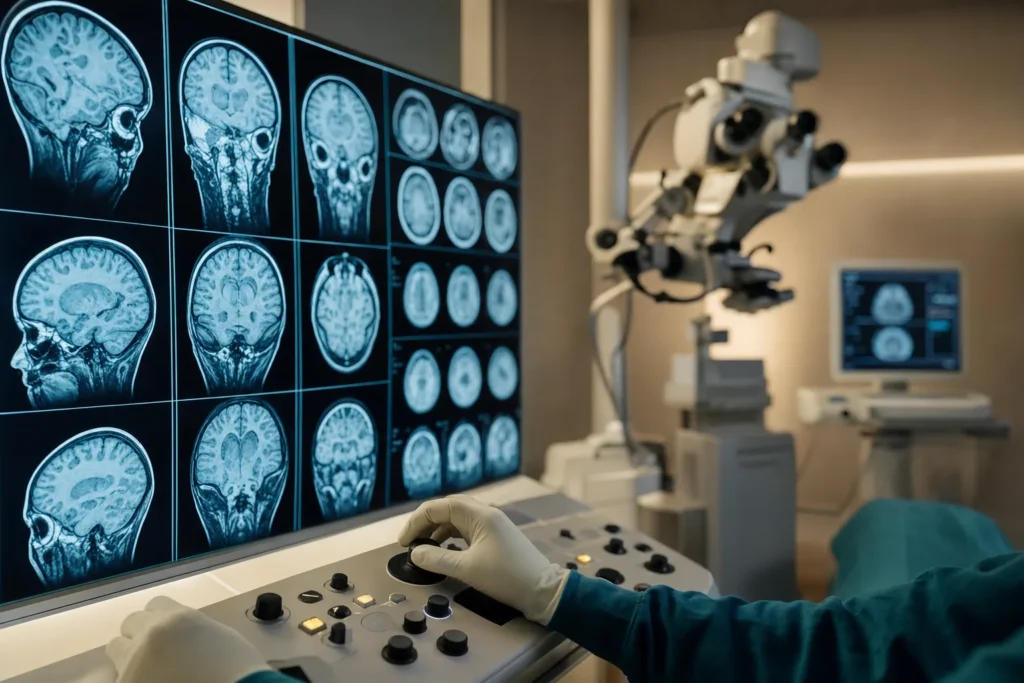
Imaging is central. MRI (magnetic resonance imaging) is the main scan used to find a brain tumor and show its size and location. Specialised MRI techniques can add detail: contrast-enhanced scans highlight areas of abnormal blood vessels, magnetic resonance spectroscopy examines the chemistry of the tumor, and perfusion MRI assesses blood flow. A CT scan may be used in some situations, for example in an emergency.
Imaging can suggest the likely type of tumor, but a definite diagnosis usually requires a biopsy, in which a small sample of tissue is removed and examined under a microscope. Sometimes the biopsy is taken during surgery to remove the tumor; for deep or hard-to-reach tumors, a needle biopsy may be guided by MRI or CT (a stereotactic biopsy).
Rather than a numbered stage, primary brain tumors are described by grade (1 to 4), reflecting how abnormal and fast-growing the cells look. Modern classification, following the 2021 World Health Organization system, also uses molecular markers. For example, glioblastoma is now defined as an IDH-wildtype astrocytoma, while tumors with an IDH mutation are classified and managed differently and often behave less aggressively. Markers such as MGMT promoter methylation can help predict how a tumor may respond to certain chemotherapy.
Treatment options
Brain tumor treatment is tailored to the tumor type, grade, molecular features, location and the person's overall health. Most patients are cared for by a multidisciplinary tumor board, a team that typically includes a neurosurgeon, radiation oncologist, medical (neuro-)oncologist, neuroradiologist, pathologist and specialist nurses, who together agree on a plan.
Surgery is often the first step. The goals are to obtain tissue for diagnosis, relieve pressure, and remove as much tumor as can be done safely. For many benign meningiomas, complete surgical removal alone may be sufficient.
Radiotherapy uses targeted radiation to destroy tumor cells. External-beam radiation is common after surgery for many malignant tumors. Stereotactic radiosurgery (for example Gamma Knife, CyberKnife or linac-based systems) delivers a high, precisely focused dose in one or a few sessions and is often used for small, well-defined tumors and many brain metastases. Proton therapy is another precisely targeted option offered in some specialised centres; our partner hospitals do not offer it, and it is not yet available in Turkiye.
Chemotherapy may be added for certain tumors. For high-grade gliomas, an alkylating drug of the temozolomide class is frequently given alongside and after radiotherapy. For newly diagnosed glioblastoma, a widely used approach combines surgery, radiotherapy and temozolomide.
Targeted therapy and immunotherapy act on specific molecular features or harness the immune system. An anti-VEGF antibody (an angiogenesis inhibitor class) is sometimes used for recurrent glioblastoma, and immune checkpoint inhibitors play a role in some brain metastases, particularly from cancers such as melanoma or lung cancer, often guided by the molecular profile of the primary tumor. Supportive medicines, such as corticosteroids to reduce swelling and anti-seizure drugs, are frequently part of care. The right combination is always decided by the treating team.
Prognosis and survival
Survival statistics for brain tumors vary widely by type, grade, molecular features, the person's age and how much of the tumor can be removed. The figures below are population-level estimates from past groups of patients; they are not a prediction for any individual, and outcomes have changed over time as treatment has improved.
Cancer Research UK reports that, across all types of primary brain tumors in adults in the UK, 25 in 100 people (25%) survive their tumor for 5 years or more, and almost 50 in 100 (almost 50%) survive for 1 year or more. Within that overall figure there is wide variation by tumor type. The same source reports that almost 55 in 100 people (almost 55%) with oligodendroglioma survive for 5 years or more, compared with more than 5 in 100 people (more than 5%) with glioblastoma.
For glioblastoma specifically, published reports describe median survival measured in months rather than years with standard combined treatment (surgery, radiotherapy and temozolomide). One review reports a median survival of around 14 to 15 months with this combined approach. Outcomes may be more favourable in tumors that carry MGMT promoter methylation. Many factors influence outlook, and statistics describe groups rather than individuals.
Because so much depends on personal details, the only reliable prognosis comes from your own oncology team after they have reviewed your scans, pathology and molecular results. Statistics can inform the conversation, but they cannot tell you what will happen in your case.
Supportive and follow-up care
Living well during and after treatment is an important part of brain tumor care, and good support can make a real difference to quality of life.
Symptom control may include corticosteroids to reduce brain swelling, anti-seizure medication, and medicines for headache, nausea or fatigue. Rehabilitation, such as physiotherapy, occupational therapy and speech and language therapy, helps people regain or adapt skills affected by the tumor or its treatment. Neuropsychological and emotional support addresses memory, concentration, mood and the understandable anxiety that a diagnosis brings; many people find counselling and patient support groups valuable.
After treatment, follow-up usually involves regular clinic visits and MRI scans to watch for any change or recurrence, on a schedule set by the tumor type and grade. Practical issues such as driving (which may be restricted after seizures), returning to work, and caregiver support are best discussed openly with the care team. Where a tumor cannot be cured, palliative and supportive care focuses on comfort, dignity and the best possible quality of life, and can be provided alongside active treatment.
Planning treatment abroad: what affects cost and how to prepare your records
If you are considering treatment in another country, careful preparation makes the process smoother and helps each consulting team give you sound, personalised advice. We do not quote prices in this guide, because the right plan, and therefore the cost, depends entirely on your individual situation.
Factors that influence the overall cost and complexity of brain tumor care include:
- The tumor type, grade and molecular profile
- Which treatments are recommended, such as surgery, stereotactic radiosurgery, a full course of radiotherapy, chemotherapy, targeted therapy or immunotherapy, and whether several are combined
- The length of any hospital stay and intensive monitoring
- Imaging, pathology and molecular testing required
- Rehabilitation and follow-up scans
- Travel, accommodation and the length of stay abroad for you and a companion
To prepare, gather your complete records: recent MRI and any CT scans on disc or in digital (DICOM) form, pathology and molecular reports if a biopsy or surgery has already been done, a summary of your medical history and current medicines, and details of any prior treatment. Having these ready allows a center to review your case and provide an informed opinion and a personalised estimate. BergemHealth can help coordinate this review; request a consultation to receive guidance tailored to your records rather than a generic figure.
Considering Turkiye, and how to choose a cancer center
Turkiye (Turkey) is an established destination for international patients seeking neurosurgery and cancer care, with hospitals in cities such as Istanbul and Ankara that offer modern imaging, stereotactic radiosurgery platforms and multidisciplinary teams. For brain tumor treatment in Turkey, as anywhere, the quality of the team and the process matters far more than the location.
When evaluating any cancer center, wherever it is, it is reasonable to verify:
- A genuine multidisciplinary tumor board that reviews each case, including neurosurgery, radiation oncology, neuro-oncology, neuroradiology and neuropathology
- Accreditation and standards, such as recognised national licensing and international quality accreditation
- Access to modern technology, including high-quality MRI, stereotactic radiosurgery and, where relevant, molecular pathology testing
- Experience with your specific tumor type and transparent discussion of the proposed plan, expected benefits and risks
- Clear communication in a language you understand, and coordinated aftercare and follow-up
A good center will welcome your questions, share a written treatment plan, and support a second opinion. BergemHealth acts as a concierge to help you reach our partner hospitals and coordinate the practical details, while the medical decisions always rest with you and your treating doctors.
Clinical trials and second opinions
Because brain tumors, and especially aggressive gliomas, are an active area of research, clinical trials can be an important option. Trials test new surgical techniques, radiotherapy approaches, targeted drugs, immunotherapies and combinations, and may offer access to treatments not yet in routine use. Eligibility depends on the tumor type, molecular features and prior treatment, and your oncology team or a cancer center can advise whether a suitable trial is open. The National Cancer Institute and other registries list trials by tumor type and location.
Seeking a second opinion is a normal and sensible part of cancer care, not a sign of distrust. For brain tumors in particular, where the diagnosis hinges on detailed pathology and molecular testing, a review by another experienced team, or re-examination of the tumor tissue by a specialist neuropathologist, can confirm the diagnosis and help ensure the plan is right for you. Reputable centers expect and support this. Whatever you decide, the most reliable course is to base it on the advice of a qualified, multidisciplinary oncology team that has reviewed your own results.
Frequently asked questions
Is a brain tumor the same as brain cancer?
What are the most common brain tumor symptoms?
How is a brain tumor diagnosed?
What is the difference between glioma, glioblastoma and meningioma?
Are brain tumors treatable?
What is stereotactic radiosurgery?
Can brain tumors be screened for or prevented?
What survival statistics apply to glioblastoma?
Should I get a second opinion?
What should I prepare before consulting a center abroad?
Why might someone consider brain tumor treatment in Turkey?
Sources
- American Cancer Society – Types of Brain and Spinal Cord Tumors in Adults
- American Cancer Society – Brain and Spinal Cord Tumor Risk Factors
- National Cancer Institute – Adult Central Nervous System Tumors Treatment (PDQ)
- NHS – Brain tumours
- NHS – Symptoms of a malignant brain tumour
- Cancer Research UK – Brain tumour symptoms
- Cancer Research UK – Tests for diagnosing brain tumours
- Cancer Research UK – Brain tumour survival
- WHO Classification of CNS Tumours 2021 – practical update (PMC)
- Epidemiology and Outcome of Glioblastoma (NCBI Bookshelf)
This article is for general information only and is not medical advice. Always consult a qualified doctor about your individual case.
Specialists in Oncology
Doctors of the department we work with directly. Which doctor takes your case is decided after the specialists have reviewed your records — your coordinator confirms it, not this page.



Considering this procedure?
Send us your photos and questions. A BergemHealth coordinator and a senior specialist will review your case and reply with honest, personalised guidance — no obligation.
Free consultation