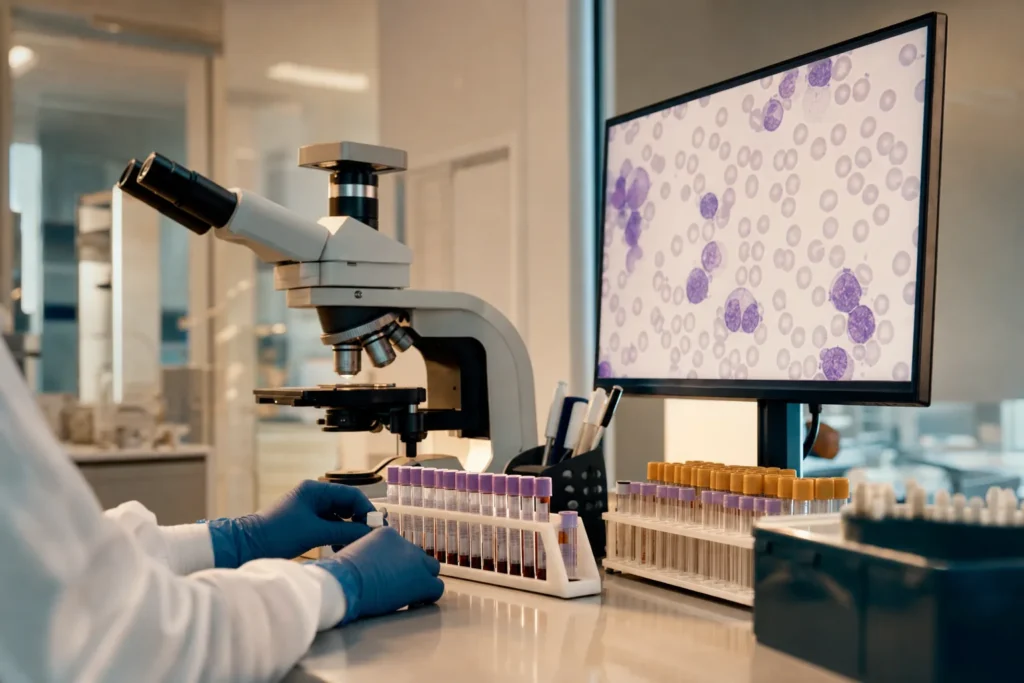
Lymphoma & leukaemia
Lymphoma and leukemia are not a single illness but two broad families of blood and lymphatic cancers, each with several distinct types that behave and respond to treatment in very different ways. A diagnosis can feel overwhelming, but many of these cancers respond well to treatment, and care has advanced considerably with targeted drugs, immunotherapy and stem-cell transplantation. This guide explains, in plain language and drawing on authoritative cancer sources, what these diseases are, how they are diagnosed and treated, and what to consider if you are exploring care abroad, including in Turkiye. It is educational information, not a substitute for advice from a qualified haematologist or oncologist.
What lymphoma and leukemia are
Lymphoma and leukemia are cancers that begin in the body's blood-forming and immune systems. They are distinct disease families, and it helps to understand the difference from the outset.
Lymphoma starts in lymphocytes, a type of white blood cell that is part of the lymphatic system, the network of nodes, vessels and organs (including the spleen and bone marrow) that helps fight infection. In lymphoma, abnormal lymphocytes grow out of control and often collect in lymph nodes, causing them to swell. The two main groups are Hodgkin lymphoma and non-Hodgkin lymphoma.
Leukemia starts in the bone marrow, the soft tissue inside bones where blood cells are made. In leukemia, the marrow produces large numbers of abnormal white blood cells that can crowd out healthy red cells, white cells and platelets. Leukemias are grouped by how quickly they develop (acute or chronic) and by the cell line affected (myeloid or lymphoid).
Because these are different diseases, the right approach for one type may be completely inappropriate for another. Accurate diagnosis of the specific subtype is the foundation of effective, modern treatment, and is best confirmed by a qualified specialist team.
Types and subtypes
Knowing the precise type matters because it shapes the whole treatment plan.
Hodgkin lymphoma divides into two categories. Classic Hodgkin lymphoma is the most common and is identified by large abnormal cells called Reed-Sternberg cells; it has four subtypes (nodular sclerosing, mixed cellularity, lymphocyte-depleted and lymphocyte-rich). Nodular lymphocyte-predominant Hodgkin lymphoma is uncommon and tends to grow more slowly.
Non-Hodgkin lymphoma (NHL) is an umbrella term for many lymphomas grouped by growth rate. Indolent (slow-growing) types include follicular lymphoma and marginal zone lymphoma. Aggressive (fast-growing) types include diffuse large B-cell lymphoma (DLBCL), the most common NHL overall, as well as mantle cell, Burkitt and various T-cell lymphomas. Most non-Hodgkin lymphomas arise from B lymphocytes; some come from T cells or natural killer cells.
Leukemia has four main types. The acute leukemias progress quickly and usually need prompt treatment: acute myeloid leukemia (AML) and acute lymphoblastic leukemia (ALL). The chronic leukemias often develop slowly over years: chronic myeloid leukemia (CML) and chronic lymphocytic leukemia (CLL). ALL is the most common cancer in children but also occurs in adults; CLL is one of the more common adult leukemias.
Risk factors and causes
For most people, no single cause can be identified, and having a risk factor does not mean a person will develop the disease. Many people with these cancers have no known risk factors at all.
For lymphoma, recognised factors include older age, being male, and a weakened immune system, whether from HIV, autoimmune disease, or medicines taken after an organ transplant. Certain infections are also linked, including the Epstein-Barr virus and hepatitis B and C. Hodgkin lymphoma shows a distinctive age pattern, with cases more common in early adulthood and again in older age.
For leukemia, recognised factors include smoking, previous chemotherapy or radiotherapy, exposure to benzene or high-dose radiation, certain genetic conditions, and a prior bone-marrow disorder such as myelodysplastic syndrome. Chronic myeloid leukemia is defined by a specific acquired genetic change (described below) rather than by inherited risk.
It is important to be clear that these cancers are not contagious and, in the great majority of cases, are not inherited from a parent.
Signs and symptoms (and when to see a doctor)
Symptoms vary widely by disease type and can overlap with many common, non-cancerous conditions.
A frequent feature of lymphoma is one or more swollen lymph nodes, often painless, in the neck, armpit or groin. A group of symptoms known as B symptoms can also occur: unexplained fever, drenching night sweats and unintentional weight loss. Fatigue and persistent itching are also reported.
The leukemia symptoms patients ask about most often reflect the marrow's reduced ability to make healthy blood cells. These can include feeling very tired or weak, paleness, repeated infections, fever, easy bruising or bleeding, and bone pain. An enlarged spleen may cause discomfort or fullness under the ribs on the left side. Acute leukemia symptoms tend to appear and worsen over a short time, whereas chronic leukemias may cause few or no symptoms for a long time and are sometimes found on a routine blood test.
None of these symptoms is specific to cancer, but you should see a doctor if a swollen lymph node persists for more than a couple of weeks, or if you have unexplained fevers, night sweats, weight loss, persistent fatigue, or unusual bruising or bleeding. Early assessment allows the cause to be identified and treated promptly, whatever it turns out to be.
Screening and early detection
There is no routine, population-wide screening test for lymphoma or leukemia in people without symptoms, in the way that some other cancers are screened. These blood and lymphatic cancers are usually detected when a person notices a symptom, such as a swollen node, or when an abnormality shows up on a blood test done for another reason.
This makes paying attention to your body, and acting on persistent or unexplained symptoms, the most practical form of early detection. A standard complete blood count (CBC) can reveal abnormal numbers of white cells, red cells or platelets and is often the first clue that prompts further investigation. People with certain inherited conditions or a strong family history may be advised on individualised monitoring by their specialist, but this is not the same as general screening.
Diagnosis and staging
Diagnosis aims to confirm whether cancer is present, identify the exact type and subtype, and assess how far it has spread. A precise diagnosis usually relies on examining cells under a microscope together with specialised laboratory tests.
For lymphoma, the key step is a biopsy of an affected lymph node or tissue, ideally removing the whole node when possible. Pathologists then use immunohistochemistry, immunophenotyping and genetic tests such as FISH to classify the subtype. Reed-Sternberg cells, for example, point to classic Hodgkin lymphoma. Blood tests (including CBC and LDH), tests for hepatitis and HIV, and a bone-marrow biopsy may be done. Imaging such as PET-CT helps show the extent of disease.
For leukemia, diagnosis centres on examining the blood and bone marrow. A peripheral blood smear, flow cytometry, a bone-marrow aspiration and biopsy, and molecular and cytogenetic tests identify the type and key genetic features, such as the BCR::ABL1 gene in CML or specific mutations in AML.
Lymphomas are described using a four-stage system (I to IV) based on how many lymph-node areas are involved and whether disease has spread to organs outside the lymphatic system. Leukemias generally are not staged in the same way; instead, doctors use the type, genetic features and, for CML, the phase (chronic, accelerated or blastic) to guide treatment.
Treatment options
Treatment is highly individualised and is best planned by a multidisciplinary tumour board, a team that may include haematologists, medical and radiation oncologists, pathologists, radiologists, transplant specialists and nurses. They tailor therapy to the exact diagnosis, genetic features, stage or phase, and the person's age and general health.
Chemotherapy remains a backbone for many of these cancers, often combining several drugs. In aggressive lymphomas and acute leukemias it may be given in intensive phases, for example remission induction followed by consolidation in AML, sometimes with chemotherapy delivered into the spinal fluid to help protect the nervous system.
Radiotherapy uses targeted high-energy beams and is used in some lymphomas, alone or with chemotherapy, and occasionally before a transplant.
Targeted therapy attacks specific molecular features of the cancer. Tyrosine kinase inhibitors (TKIs) block the abnormal BCR::ABL1 protein in CML and have greatly improved its outlook; other examples include Bruton tyrosine kinase inhibitors used in some lymphomas and CLL, a BCL-2 inhibitor, and FLT3 or IDH inhibitors in selected AML.
Immunotherapy and monoclonal antibodies harness or direct the immune system. Anti-CD20 monoclonal antibodies are widely used in B-cell lymphomas, antibody-drug conjugates are used in Hodgkin and some non-Hodgkin lymphomas, and immune checkpoint inhibitors are options in certain relapsed lymphomas.
Stem-cell (bone-marrow) transplant allows very high-dose treatment by replacing damaged marrow with healthy blood-forming stem cells, either the patient's own (autologous) or a donor's (allogeneic). CAR T-cell therapy is an option for some relapsed B-cell lymphomas and leukemias and is described in its own section below. For slow-growing diseases without symptoms, careful active monitoring (watchful waiting) is sometimes the most appropriate choice.
Prognosis and survival
Outlook varies enormously across these different diseases, and many respond well to treatment. The figures below are population-level estimates from cancer registries. They describe groups of people diagnosed in the past and are not a prediction for any individual, who may do better or worse depending on subtype, genetics, age, overall health and response to treatment. Because treatments keep improving, people treated today may have a different outlook from what older statistics suggest. Discuss your own situation with your oncologist.
For Hodgkin lymphoma, US SEER data report an overall 5-year relative survival of about 89% (all stages combined, 2016 to 2022), and roughly 93% for localized (stage I) disease.
For non-Hodgkin lymphoma, outlook depends strongly on subtype. The American Cancer Society reports 5-year relative survival for diffuse large B-cell lymphoma of about 74% for localized and 65% for all stages combined, and for follicular lymphoma about 97% for localized and 89% for all stages combined.
For leukemia, outcomes differ markedly by type and age. SEER data report an overall 5-year relative survival of about 90% for chronic lymphocytic leukemia, while acute myeloid leukemia is more challenging, with overall 5-year relative survival of around one-third (about 33%) and generally higher rates in younger patients. Chronic myeloid leukemia outcomes have improved substantially since the introduction of tyrosine kinase inhibitors.
Supportive and follow-up care
Supportive care, sometimes called palliative care, runs alongside treatment to manage symptoms and side effects and to protect quality of life. It is appropriate at any stage, not only in advanced disease.
Because both the cancers and their treatments can lower blood counts, supportive care often includes preventing and treating infections, transfusions of red cells or platelets when needed, medicines to control nausea, and attention to nutrition, fatigue and pain. Emotional and psychological support for patients and families is an important part of good care, as are fertility discussions before treatment for younger patients.
After treatment, structured follow-up monitors for any return of disease and for late effects of therapy. This typically involves regular clinical review, blood tests and, for some lymphomas, periodic imaging. Survivors of these cancers benefit from a long-term care plan that also covers general health, vaccinations and screening for other conditions, coordinated with their oncology team and primary doctor.
Planning treatment abroad: what affects cost and how to prepare
If you are considering treatment in another country, careful preparation makes the process safer and smoother. We do not quote prices here, because the right plan, and therefore the cost, depends entirely on your specific diagnosis; the only reliable figure comes from a personalised assessment.
Several factors influence the overall cost and complexity of blood-cancer care: the exact disease type and subtype; the stage or phase; the treatments needed (for example, standard chemotherapy versus a stem-cell transplant or CAR T-cell therapy, which require specialised units); the number of treatment cycles and length of hospital stay; the diagnostic and molecular tests required; supportive care and any complications; and the duration of follow-up. Travel, accommodation and translation or coordination services for international patients also play a part.
To prepare, gather your medical records in one place: pathology and biopsy reports (and, ideally, the original tissue slides or blocks, which a centre abroad may wish to re-review), bone-marrow results, blood test results over time, imaging scans on disc with their reports, a full list of treatments already received with dates and doses, and a current medication list. Having these ready allows a haematology team to give an accurate opinion and a tailored assessment. To understand what your specific situation may involve, you can request a personalised consultation through BergemHealth.
Turkiye as a destination, and how to choose a cancer centre
Turkiye (Turkey) has become an established destination for international patients seeking lymphoma and leukemia treatment and other cancer care, with a number of large hospitals that offer modern diagnostic facilities, specialised haematology and transplant units, and experience treating patients from abroad. As a medical-tourism concierge, BergemHealth helps patients organise consultations, but the clinical decisions always rest with the treating specialists.
When choosing any cancer centre, in Turkiye or elsewhere, it is worth verifying several things rather than relying on marketing claims. Look for a genuine multidisciplinary tumour board that reviews each case; recognised hospital accreditation and quality standards; dedicated facilities for the treatment you may need, such as a transplant unit or an accredited cellular-therapy programme if CAR T-cell therapy is being considered; experienced haematology-oncology specialists; access to a full range of modern diagnostics including molecular pathology; and clear arrangements for follow-up and for communication in a language you understand.
It is reasonable to ask how many cases of your specific subtype the team treats, how decisions are made, and how complications are handled. A trustworthy centre will welcome these questions and will support you in seeking a second opinion.
Clinical trials and second opinions
Clinical trials test new treatments and new ways of using existing ones, and for blood cancers in particular much of the recent progress, including targeted drugs and CAR T-cell therapy, has come through them. Taking part may give access to investigational approaches while contributing to knowledge that helps future patients. Trials have careful eligibility criteria and oversight; your oncologist can advise whether a relevant trial exists and whether it might be suitable for you.
A second opinion is a normal and sensible step, especially for a complex blood-cancer diagnosis or before starting an intensive treatment such as a transplant. Because precise subtyping is so important, having pathology reviewed by another expert centre can occasionally refine the diagnosis and change the recommended plan. Seeking a second opinion does not offend good doctors; reputable teams expect and support it. Whatever you decide, the goal is a treatment plan you understand and feel confident about, made together with a qualified specialist team.
Key takeaways
Lymphoma and leukemia are two distinct families of blood and lymphatic cancers, each with several types that are diagnosed and treated differently. A few points are worth remembering as you read further or prepare to speak with a specialist.
- Accurate subtyping matters most. The exact type and genetic features, confirmed by biopsy or bone-marrow tests, drive the entire treatment plan.
- Treatment is individualised and team-based. A multidisciplinary tumour board tailors chemotherapy, radiotherapy, targeted therapy, immunotherapy, transplant or active monitoring to your specific situation.
- Outlook varies and is population-level. Survival statistics describe groups, not individuals, and many of these cancers respond well to modern treatment.
- Persistent symptoms deserve assessment. Swollen nodes lasting more than a couple of weeks, or unexplained fevers, night sweats, weight loss or bruising, should be checked by a doctor.
- Ask questions and consider a second opinion. Reputable centres welcome questions about experience, decision-making and follow-up.
This article is educational and does not replace personalised advice from a qualified haematologist or oncologist.
Frequently asked questions
Are lymphoma and leukemia the same cancer?
What is the difference between Hodgkin and non-Hodgkin lymphoma?
What is the difference between acute and chronic leukemia?
What are common leukemia symptoms?
How are these cancers diagnosed?
Can lymphoma and leukemia be cured?
What is CAR T-cell therapy?
What is a stem-cell or bone-marrow transplant?
Do targeted therapy and immunotherapy replace chemotherapy?
Why do some people consider Turkiye for blood-cancer treatment?
How should I prepare for a consultation about treatment abroad?
This article is for general information only and is not medical advice. Always consult a qualified doctor about your individual case.
Considering this procedure?
Send us your photos and questions. A BergemHealth coordinator and a department-head specialist will review your case and reply with honest, personalised guidance — no obligation.
Free consultation